What Are Stocks and Shares in the Stock Market? Explained Simply
Stocks and shares can sound confusing when you hear people talk about prices, charts, dividends, portfolios, brokers, market crashes, and trading apps. But the basic idea is much simpler than it looks: a stock is ownership in a business, and a share is one small piece of that ownership.
Think of a company like a large pizza. If the company divides ownership of that pizza into many slices, each slice is a share. When you buy one share, you do not own the office, the laptops, or the products personally. You own a tiny financial claim on the company. If the company grows and investors become more willing to pay for its shares, your share may become more valuable. If the company struggles, your share can lose value.
This article explains stocks and shares in a plain, practical way for someone starting from zero. It also covers how the stock market works, why prices move, what beginners should know before investing, how people commonly use stocks to build wealth, and the mistakes new investors should avoid.
Quick answer: Stocks are ownership in companies. Shares are the individual units of that ownership. The stock market is where buyers and sellers trade those shares. Beginners should focus on learning, risk control, diversification, long-term thinking, and avoiding get-rich-quick promises.
1. Stock vs Share: What Is the Difference?
In everyday conversation, people often use stock and share as if they mean the same thing. That is usually fine. But there is a small difference that helps beginners understand the topic better.
Stock means ownership in a company in a broad sense. For example, someone might say, 'I own Apple stock' or 'I own bank stock.' Share means one unit of that ownership. For example, if a company has 1,000,000 shares and you own 100 shares, you own 100 units out of 1,000,000.
A simple way to remember it is this: stock is the company ownership category; shares are the countable pieces. You can own stock in a company by owning shares of that company.
| Term | Simple meaning | Example |
|---|---|---|
| Stock | Ownership in a company | I own stock in a technology company. |
| Share | One unit of stock | I bought 10 shares of that company. |
| Shareholder | A person or institution that owns shares | A shareholder may receive dividends or voting rights. |
2. What Happens When You Buy a Share?
When you buy a share, you become a shareholder. Your money usually goes to the person or institution selling the share, not directly to the company, unless it is a new share issue. After the trade is completed, your brokerage account shows that you own those shares.
As a shareholder, you may benefit in two main ways. First, the share price may rise, which is called capital appreciation. Second, some companies pay dividends, which are cash payments made from part of the company’s profits. Not all companies pay dividends. Many growing companies reinvest profits back into the business instead.
Owning shares does not guarantee profit. The price can rise or fall every day. In extreme cases, if a company fails, shareholders can lose most or all of their investment. This is why experienced investors usually avoid putting all their money into one company.
3. Why Do Companies Sell Shares?
Companies sell shares to raise money. This money can be used to build factories, hire employees, develop products, pay debt, expand into new markets, or fund research. When a private company sells shares to the public for the first time, this is called an initial public offering, or IPO.
After shares are public, they trade in the stock market. The company does not receive money every time investors trade existing shares with each other. However, a public share price can still matter because it affects the company’s reputation, ability to raise more capital, employee stock compensation, and investor confidence.
For the company, selling shares can be useful because it raises money without taking a traditional loan. For investors, buying shares gives a chance to participate in the company’s future success, while accepting the risk that the company may perform poorly.
4. How Does the Stock Market Work?
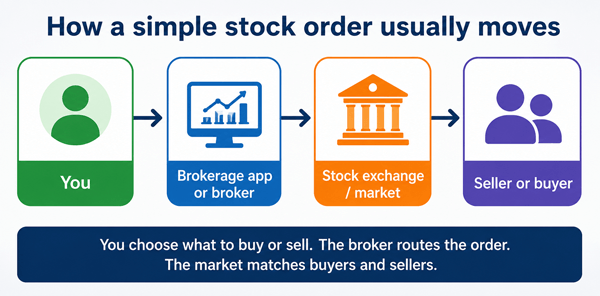
The stock market is not one single room where everyone shouts prices, although that image still appears in movies. Today, most trading happens electronically. Buyers place orders to buy shares. Sellers place orders to sell shares. The market helps match those orders.
If many people want to buy a stock and fewer people want to sell it, the price usually rises. If many people want to sell and fewer people want to buy, the price usually falls. This is basic supply and demand.
A beginner usually accesses the market through an online broker, brokerage account, investment app, retirement account, or financial advisor. The broker provides the platform, holds records, routes orders, and may offer research tools. Choosing a trustworthy broker matters because low fees are helpful, but safety, regulation, customer support, order quality, and transparency also matter.
5. Why Do Stock Prices Go Up and Down?
Stock prices move because investors are constantly updating what they believe a company is worth. A share price is not only based on what the company is doing today. It also reflects expectations about the future.
For example, if a company reports strong sales, launches a popular product, reduces debt, or grows profits, investors may become more optimistic. If the company loses customers, faces lawsuits, has weak earnings, or operates in a struggling industry, investors may become more cautious. Larger market forces also matter, such as interest rates, inflation, currency movements, wars, political decisions, and general economic confidence.
The important beginner lesson is that price movement does not always mean the business changed that day. Sometimes prices move because of emotion, news, rumors, short-term trading, or the overall market mood. This is why long-term investors try to separate business value from daily noise.
6. Practical Example: Buying Shares in Simple Numbers
Imagine a company called FreshBread Ltd. It has 1,000,000 shares. You buy 100 shares at $10 each. Your cost is $1,000, excluding any fees or taxes.
A year later, the company performs well and the share price rises to $13. Your 100 shares are now worth $1,300. If you sell, your capital gain before costs and taxes is $300. If the price falls to $7, your shares are worth $700, and selling would create a $300 loss.
Now suppose FreshBread also pays a dividend of $0.20 per share. With 100 shares, you receive $20 in dividends before any tax. Your total result depends on both price change and dividends. This is called total return.
| Situation | Share price | Value of 100 shares | Result before costs/tax |
|---|---|---|---|
| You buy | $10 | $1,000 | Starting point |
| Price rises | $13 | $1,300 | $300 gain if sold |
| Price falls | $7 | $700 | $300 loss if sold |
| Dividend paid | $0.20/share | $20 cash | Income, if company pays it |
7. Common Types of Stocks Beginners Hear About
- Common stock: The most familiar type. It usually gives ownership, possible voting rights, and exposure to price gains or losses.
- Preferred stock: Often behaves more like a mix of stock and income investment. It may pay fixed dividends but usually has less voting power.
- Dividend stocks: Companies that regularly pay part of their earnings to shareholders. Beginners should check whether dividends are sustainable, not just high.
- Growth stocks: Companies expected to grow faster than average. They can offer strong upside but may be expensive and volatile.
- Value stocks: Companies that appear cheap compared with earnings, assets, or cash flow. They can be attractive, but sometimes they are cheap for a reason.
- Blue-chip stocks: Large, established companies with long operating histories. They may still lose value, but they are often considered more stable than small speculative companies.
- Penny stocks: Very low-priced shares, often risky, thinly traded, and vulnerable to manipulation. Beginners should be extremely careful.
8. Stocks vs Shares vs Bonds vs ETFs: A Helpful Comparison
| Investment | What you own | Main benefit | Main risk | Beginner note |
|---|---|---|---|---|
| Individual stock | Part of one company | High upside if company succeeds | Company-specific loss | Needs research and risk control |
| Bond | Debt issued by company/government | Interest payments | Default, inflation, rate risk | Usually different risk profile from stocks |
| ETF | Basket of investments traded like a stock | Diversification and convenience | Market risk and fees | Often beginner-friendly for broad exposure |
| Mutual fund | Professionally managed basket | Diversification and management | Fees, performance risk | Check expense ratio and strategy |
9. What Should a Beginner Know Before Buying Any Stock?
The biggest mistake beginners make is thinking investing is only about finding the next winning stock. In real life, successful investing is more about behavior, patience, risk control, and consistency than secret tips.
Before buying a stock, a beginner should know five things: why they are investing, how long they can leave the money invested, how much loss they can emotionally and financially handle, how the company makes money, and what could go wrong.
A practical rule is to never invest money in stocks that you may need for rent, school fees, emergency medical costs, loan payments, or short-term living expenses. Stock prices can fall at the exact time you need cash. Many experienced investors keep an emergency fund before investing aggressively.
- Do I understand what the company sells and how it earns profit?
- Is this money for long-term goals, not next month’s bills?
- Am I buying because of research, or because of hype on social media?
- Could I handle a 20%, 30%, or 50% decline without panic selling?
- Have I compared this stock with a diversified ETF or index fund?
- Do I understand fees, taxes, currency risk, and local rules?
- Have I checked whether the broker or advisor is properly registered?
10. How Beginners Can Use Stocks in Real Life
People use stocks for different goals. Some invest for retirement, some for long-term wealth building, some for dividend income, and some for learning about business. The right approach depends on the person’s income, age, goals, risk tolerance, time horizon, and financial responsibilities.
A beginner with no experience often starts with education first, then a small amount of money, then a diversified approach. Many people use broad-market ETFs or index funds before buying individual stocks. This reduces the risk of one bad company damaging the whole portfolio.
Someone who enjoys researching companies may later add individual stocks, but this should be done with a clear plan. For example, they might decide that no single stock should be more than 5% or 10% of their portfolio. That way, one mistake does not destroy years of savings.
11. Investing vs Trading: Do Not Confuse Them
Investing and trading are not the same. Investing usually means buying assets for long-term growth based on business value, diversification, and time in the market. Trading usually means buying and selling more frequently based on price movements, charts, momentum, or short-term news.
Both can involve risk, but trading is often harder than beginners expect. It can create more fees, taxes, emotional pressure, and losses from overconfidence. Many people enter trading after seeing screenshots of profits online, but they rarely see the losing trades, stress, or full account history behind those posts.
For a true beginner, long-term investing education is usually a safer starting point than active stock trading. Learning how businesses work, how compounding works, and how risk works is more useful than chasing every price movement.
| Feature | Long-term investing | Short-term trading |
|---|---|---|
| Time horizon | Years or decades | Minutes to months |
| Main focus | Business value, goals, diversification | Price movement and timing |
| Typical beginner risk | Impatience and poor diversification | Overtrading, leverage, emotional decisions |
| Useful tools | Brokerage account, index funds, ETFs, retirement account | Trading platform, charts, strict risk management |
12. The Risks of Stocks Explained Honestly
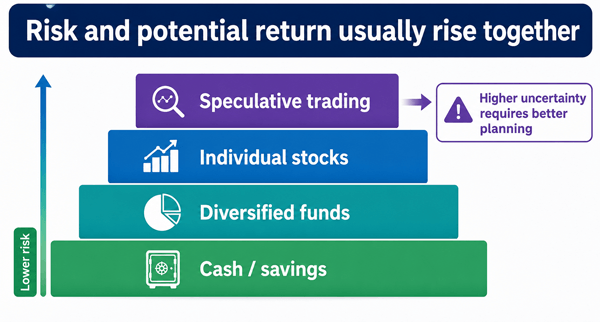
Stocks can help build wealth, but they are not safe in the same way as cash in a bank account. The value can fall sharply. A company can disappoint investors. A whole market can decline during a recession or crisis. Even good companies can become overpriced, and even smart investors can be wrong.
There are several risks beginners should know: market risk, company risk, liquidity risk, currency risk, inflation risk, emotional risk, fraud risk, and concentration risk. Concentration risk means putting too much money into one stock, one sector, or one idea.
The honest way to approach stocks is not to ask, 'How much can I make?' first. A better first question is, 'How much can I afford to lose, and what is my plan if the market falls?'
Market risk: The entire market falls, even if your company is decent.
Company risk: A specific company performs badly or faces legal, financial, or management problems.
Liquidity risk: You may not be able to sell quickly at a fair price, especially in small stocks.
Emotional risk: Fear and greed push you to buy high, sell low, or follow hype.
Fraud risk: Scams, fake gurus, pump-and-dump schemes, and unregistered platforms can target beginners.
13. Beginner Mistakes People Commonly Regret
Many investors learn the same lessons the hard way. They buy because a friend said a stock will double. They sell after a market drop because fear takes over. They check prices every few minutes and confuse movement with meaning. They put too much money into one company because they like the product. They ignore fees and taxes. They trust influencers who show confidence but not evidence.
A useful habit is to write down why you are buying before you buy. Include what the company does, what would make you sell, how much you are willing to lose, and how this investment fits your larger plan. This simple note can protect you from emotional decisions later.
- Buying only because the price looks cheap
- Thinking a popular product always means a good stock
- Ignoring debt, profits, cash flow, and valuation
- Believing guaranteed-profit claims
- Using borrowed money or leverage without deep experience
- Selling good investments only because of normal volatility
- Copying strangers without understanding their goals or risk
14. How to Research a Stock in a Simple Way
Stock research can become complicated, but beginners can start with simple questions. What does the company sell? Who are its customers? Is revenue growing? Is the company profitable? Does it have too much debt? Who are the competitors? What could hurt the business? Is the share price already too expensive compared with the company’s results?
Public companies usually publish financial reports. In the United States, public company filings are available through the SEC’s EDGAR system. In other countries, exchanges and regulators have similar disclosure systems. These reports are not entertainment, but they are much more reliable than rumors and social media tips.
A beginner does not need to become a professional analyst on day one. But they should learn enough to avoid blind decisions. If an investment sounds exciting but you cannot explain how it makes money in two sentences, pause before buying.
- Read the company’s latest annual report or investor presentation.
- Check revenue, profit, debt, and cash flow trends.
- Compare the company with competitors.
- Look for major risks in the company’s own filings.
- Check whether the current price already assumes perfect growth.
- Decide position size before buying.
- Keep notes so you can review your thinking later.
15. Are Stocks Good for Beginners?
Stocks can be suitable for beginners when they are used carefully, with education, diversification, and a long-term plan. They can be unsuitable when a person needs short-term safety, cannot tolerate losses, is using borrowed money, or is chasing fast profits.
For many beginners, the first step is not picking a single stock. It is understanding budgeting, emergency savings, debt, investment goals, risk tolerance, and basic portfolio construction. A diversified ETF, index fund, retirement account, or robo-advisor may be easier than building a portfolio from individual stocks immediately.
The best beginner strategy is often boring: invest gradually, diversify, keep costs low, avoid scams, and give time for compounding to work. Boring does not mean weak. In investing, boring habits often beat exciting mistakes.
16. Useful Beginner Terms in Plain English
| Term | Plain-English meaning |
|---|---|
| Bull market | A period when prices are generally rising and investors feel optimistic. |
| Bear market | A period when prices are generally falling and investors feel pessimistic. |
| Dividend | Cash a company may pay to shareholders from profits. |
| Capital gain | Profit made when you sell an investment for more than you paid. |
| Portfolio | All your investments together. |
| Diversification | Spreading money across different investments to reduce single-investment risk. |
| Market order | An order to buy or sell quickly at the best available current price. |
| Limit order | An order to buy or sell only at a chosen price or better. |
| Volatility | How much and how quickly prices move up and down. |
| Brokerage account | An account used to buy, sell, and hold investments. |
17. How to Start Learning Without Getting Overwhelmed
Start with the basics, not predictions. Learn what a share is, how a broker works, what risk means, how diversification works, and why time horizon matters. Then learn how to read simple company information. Only after that should you compare specific investments.
A practical beginner path looks like this: build an emergency fund, pay attention to high-interest debt, define your goals, choose a regulated brokerage platform or investment account, start small, diversify, and review your plan regularly. You do not need to know everything before investing, but you should know enough to avoid obvious mistakes.
Good investing is not about acting smarter than everyone else every day. It is about making fewer bad decisions, controlling risk, and staying consistent.
18. What About Taxes, Fees, and Accounts?
Taxes and fees can reduce investment returns. Depending on your country, you may pay tax on dividends, capital gains, or both. Some accounts may offer tax advantages for retirement or long-term saving. Rules vary widely, so beginners should check local tax laws or speak with a qualified tax professional.
Fees also matter. A stock trading platform may advertise zero commission, but there can still be costs through spreads, currency conversion, account fees, fund expense ratios, margin interest, withdrawal fees, or poor execution. Always read the fee schedule before opening an account.
19. Red Flags and Honest Practices
Any article about stocks should avoid promising guaranteed returns. No one can honestly guarantee stock market profits. Responsible investing content should explain both opportunity and risk, encourage readers to verify information, and avoid pushing people into urgent decisions.
Be especially careful with anyone who says a stock is a sure thing, pressures you to act now, asks you to send money outside a regulated platform, hides fees, refuses to explain risks, or uses fake screenshots of profits. Beginners are often targeted because they may not know what normal market behavior looks like.
A trustworthy approach is simple: use regulated brokers, read official sources, diversify, avoid borrowed money until you fully understand it, and never invest based only on hype.
- Guaranteed profit or “no risk” claims
- Pressure to buy immediately
- Secret insider tips from strangers
- Unregistered brokers or unclear custody of money
- Promises of daily income from trading signals
- Complex products you cannot explain
- Advice that ignores your personal goals and risk tolerance
20. Final Simple Explanation
Stocks are pieces of ownership in companies. Shares are the individual units of those pieces. The stock market is where people buy and sell shares. Prices move because buyers and sellers constantly react to company results, expectations, news, risk, interest rates, and emotion.
For beginners, the goal is not to become rich overnight. The goal is to understand what you are buying, why you are buying it, what risks you are taking, and how it fits your life. Stocks can be powerful tools for long-term wealth building, but only when used with patience, diversification, and honest expectations.
If you remember only one thing, remember this: a stock is not just a moving price on a screen. Behind every stock is a real business, real risk, real people, real money, and real consequences. Treat it that way, and you will already be ahead of many beginners.
21. Frequently Asked Questions
21.1 Are stocks and shares the same thing?
In daily language, yes, people often use them the same way. More precisely, stock means ownership in a company, while shares are the individual units of that ownership.
21.2 Can beginners make money from stocks?
Yes, beginners can make money, but there is no guarantee. Many beginners lose money when they chase hype, ignore risk, trade too often, or fail to diversify.
21.3 How much money do I need to start investing in stocks?
This depends on your country, broker, and whether fractional shares are available. The better question is whether you have emergency savings, a clear goal, and money you can leave invested long term.
21.4 Is stock trading the same as investing?
No. Investing usually focuses on long-term ownership and business value. Trading focuses more on short-term price movement and timing.
21.5 What is the safest way to start?
There is no completely safe stock investment. Many beginners start by learning first, using small amounts, avoiding leverage, and considering diversified funds or ETFs rather than only individual stocks.
21.6 Should I buy a stock because it is cheap?
Not necessarily. A low price per share does not automatically mean good value. A $5 stock can be expensive if the business is weak, and a $500 stock can be reasonable if the company is strong and fairly valued.
21.7 What is a dividend stock?
A dividend stock is a stock of a company that pays cash dividends to shareholders. Dividends can be useful, but they are not guaranteed and can be reduced or stopped.
21.8 What should I check before choosing a broker?
Check regulation, fees, account protection, customer support, trading tools, available investments, deposit and withdrawal methods, and whether the broker’s incentives are transparent.
Sources Consulted and Checked
The following authoritative sources were consulted and checked while preparing this article to support its accuracy and educational value.
- SEC Investor.gov - Stocks FAQ
- SEC Investor.gov - Stock glossary definition
- SEC - Ten Things to Consider Before You Make Investing Decisions
- FINRA - Risk
- Washington State Department of Financial Institutions - Basics of Investing in Stocks
Reader Advice
This article is provided solely for educational and general informational purposes. It does not constitute personalized financial, investment, legal, tax, or accounting advice, and it should not be treated as a recommendation to buy, sell, or hold any security or use any particular broker, platform, or investment strategy. Investments can rise or fall in value, and you may lose some or all of the money invested. Before making any financial decision, consider your objectives, financial circumstances, time horizon, and tolerance for risk, and seek advice from an appropriately qualified and regulated professional when necessary.
Market conditions, laws, tax rules, fees, account protections, product features, and regulatory requirements vary by country and may change over time. Examples and figures in this article are simplified for explanation and may not reflect current prices, costs, or rules. Readers should verify important facts, figures, registration details, and legal or tax requirements directly through current official regulator, exchange, tax-authority, company, and broker sources before acting.