How to Make Money in the Stock Market for Beginners
1. What the stock market is in plain English
The stock market is a place where people buy and sell small ownership pieces of public companies. Those pieces are called shares or stocks. When you buy one share of a company, you do not own the whole company. You own a tiny part of it, and the value of that tiny part can rise or fall every trading day.
Imagine a business as a large pizza. The company cuts that pizza into millions or billions of slices. Each slice is a share. Investors buy slices because they believe the business may become more valuable, may pay dividends, or both. Other investors sell because they need cash, think the price is too high, or found a better opportunity.
Prices move because buyers and sellers disagree. A stock price is not a fixed truth. It is the current market opinion about the company’s future profits, risks, growth, interest rates, industry conditions, and investor emotions. This is why a good company can have a falling stock price and a weak company can temporarily rise because of hype.
For beginners, the key idea is simple: the stock market can help you build wealth, but it does not pay you just because you opened an account. You make money only when your investments perform well over time, when dividends are paid, or when you sell for more than you paid. You can also lose money if prices fall, if you sell at a bad time, or if you take risks you do not understand.
2. How people actually make money in stocks
There are three main ways investors try to make money in the stock market: capital gains, dividends, and compounding. Capital gains happen when you buy an investment at one price and later sell it at a higher price. For example, if you buy a stock at $50 and sell it at $70, you made a $20 gain per share before fees and taxes.
Dividends are payments some companies make to shareholders. A dividend is not free money. It usually comes from company profits or available cash, and it can be reduced or stopped. Beginners often like dividend stocks because cash payments feel real, but a dividend does not automatically make a stock safe. A company with a very high dividend yield may be risky if the business is struggling.
Compounding is the quiet engine behind long-term investing. It means your earnings can start earning their own earnings. If you reinvest dividends and leave gains invested, your money has more time to grow. Compounding works best when you give it years, not weeks.
Here is the honest part: nobody can promise a specific return. The market does not move in a straight line. Some years are excellent, some are flat, and some are painful. Many beginners lose money not because investing is impossible, but because they treat the market like a casino, follow social media tips, trade too often, or sell in panic after a normal decline.
3. The beginner mindset: slow money beats exciting money
The beginner who asks “How can I double my money fast?” is usually in danger. The better question is “How can I build a repeatable, low-cost, risk-aware investing habit that can last for years?” That question sounds less exciting, but it is closer to how real wealth is usually built.
Experienced investors often learn the same lesson the hard way: the boring plan is often the plan that survives. Buying diversified investments regularly, keeping fees low, avoiding debt-fueled trading, and staying patient may not make dramatic social media content, but it protects beginners from the most common emotional mistakes.
You should also separate investing from trading. Investing usually means buying assets because you expect their value to grow over years. Trading means trying to profit from short-term price changes. Trading can be educational, but for beginners it is often expensive, stressful, and risky. The SEC warns that day trading involves high risk and can lead to large losses in a short time.
4. The safest way to start learning with small amounts
A beginner does not need to start by picking individual stocks. In fact, many beginners are better served by learning the basics with small, diversified investments. A diversified fund can hold hundreds or thousands of companies, which reduces the damage if one company performs badly.
A practical starting path is: build an emergency fund first, pay attention to high-interest debt, choose a reputable brokerage or retirement account, start with a small monthly amount, use a diversified fund, and track what you are learning. This is not the only path, but it is a safer learning path than buying one trending stock with all your savings.
Paper trading, which means practicing with fake money, can help you understand order types and platform mechanics. But do not confuse paper trading confidence with real investing skill. Real money brings emotions. The first time your account falls 10%, you learn something that a simulator cannot fully teach.
5. Stock, ETF, mutual fund, index fund, dividend stock - what is the difference?
| Investment type | Plain meaning | How beginners use it | Main benefit | Main risk or drawback |
|---|---|---|---|---|
| Individual stock | One ownership piece of one company | Buy a company you understand after research | Can outperform if the company does very well | High company-specific risk |
| ETF | A basket of investments traded like a stock | Buy broad market exposure through one ticker | Diversified, often low cost, easy to trade | Can still fall with the market |
| Mutual fund | A pooled fund priced after market close | Common in retirement accounts | Professional management or index tracking | Fees and minimums can vary |
| Index fund | A fund that tracks a market index | Simple long-term core holding | Low effort, diversified, usually low cost | Will not beat the index it tracks |
| Dividend stock | A stock that may pay cash dividends | Income-focused investors may use it | Can provide cash flow | Dividend can be cut; price can fall |
| Robo-advisor | Automated portfolio service | Beginners who want help choosing allocation | Convenient portfolio management | Advisory fee; less control |
Beginner takeaway: if you do not know how to analyze a company, a broad low-cost index fund or ETF is often a more sensible first tool than trying to find the “next big stock.”
5.1 A simple compounding example
The chart below is hypothetical. It assumes a $500 starting investment and $100 added each month for 20 years. It does not predict future returns. It simply shows why time and regular contributions matter.
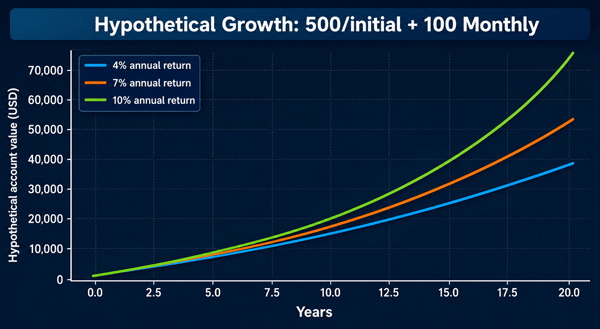
Figure 1. Hypothetical growth with monthly contributions at different annual return assumptions. Actual returns vary and can be negative.
6. A practical beginner plan in 7 steps
6.1 Step 1: Fix your financial base
Before investing, create a small emergency fund and deal with very high-interest debt. The stock market can fall at the exact moment you need cash. If all your money is invested and you need to sell during a downturn, a temporary decline becomes a real loss.
6.2 Step 2: Choose your investing goal
A goal changes the right strategy. Money needed in one year should not be treated like retirement money needed in 30 years. Short-term money usually belongs in safer cash-like places. Long-term money can usually handle more market movement.
6.3 Step 3: Open the right account
A taxable brokerage account is flexible, but taxes may apply when you sell for a gain or receive dividends. Retirement accounts may offer tax advantages, but rules vary by country and account type. For U.S. readers, examples include IRA, Roth IRA, 401(k), and taxable brokerage accounts. Readers outside the U.S. should check local account types and tax rules.
6.4 Step 4: Pick a simple first investment
A broad market ETF or index fund is often easier than choosing individual stocks. It lets you invest in many companies at once. This does not remove risk, but it removes some single-company risk.
6.5 Step 5: Automate a small amount
A beginner can start with a realistic monthly amount, even if it is small. The habit matters. Regular investing also reduces the pressure to guess the perfect day to buy.
6.6 Step 6: Review, do not obsess
Checking prices every hour can turn a long-term plan into an emotional game. A monthly or quarterly review is enough for many beginners. Review your contribution rate, asset allocation, fees, and whether your plan still fits your goal.
6.7 Step 7: Keep a decision journal
Write down why you bought an investment, what could go wrong, when you would sell, and what you are trying to learn. This simple habit prevents emotional rewriting of history and helps you learn from experience.
7. Example portfolios for different beginners
7.1 Very cautious beginner
Mostly cash or high-quality short-term instruments for short-term needs, with a small diversified stock fund position for learning. This person values stability more than high growth.
7.2 Long-term beginner with steady income
A diversified portfolio such as 70% broad stock index funds and 30% bonds or cash-like assets may be a starting idea, adjusted for risk tolerance. Younger investors sometimes hold more stocks because they have more time, but age alone is not enough; emotional comfort matters too.
7.3 Beginner who wants to learn individual stocks
Keep the core portfolio diversified, then use a small “learning bucket” for individual stocks. For example, 90% diversified funds and 10% individual stock experiments. If the learning bucket performs badly, your whole financial life is not damaged.
7.4 Dividend-focused beginner
Use dividend ETFs or a diversified mix rather than chasing the highest yield. A sustainable 3% yield from strong businesses may be healthier than a 12% yield that disappears next quarter. Dividend investing still needs business research.
8. How much money do you need to start?
8.1 The practical answer
You can start learning with a small amount if your brokerage supports fractional shares or low minimum investments. But “can start” does not mean “should invest every dollar.” Keep money for rent, food, bills, emergencies, and planned expenses outside the stock market.
8.2 A simple example
Suppose a beginner invests $100 per month. In the first year, the biggest result may not be profit. The biggest result may be education: learning how orders work, how market drops feel, how dividends appear, how statements look, and how fees affect returns. That knowledge is valuable before larger sums are involved.
8.3 The honest target
Instead of asking for the minimum, ask what amount you can invest consistently without panic. Consistency is more useful than one large emotional deposit followed by a panic sale.
9. How to choose a brokerage account or investing app
9.1 What matters most
Look for regulation, account security, low fees, easy statements, good customer support, available investment choices, educational tools, and clear tax documents. The best online brokerage for beginners is not always the app with the flashiest interface. It is the platform that helps you invest responsibly and understand what you are doing.
9.2 Questions to ask before opening an account
Is the broker registered in your country? What commissions, spreads, account fees, inactivity fees, advisory fees, and fund expense ratios apply? Can you buy low-cost ETFs or index funds? Does it support fractional shares? Are cash balances protected under applicable rules? How easy is it to withdraw money?
9.3 Avoid this trap
Some investing apps make trading feel like a game. Confetti, leaderboards, push alerts, and “hot stock” lists can encourage overtrading. A platform is a tool. If the tool pushes you toward impulsive decisions, it may be bad for you even if it is popular.
10. Risk management rules beginners should follow
10.1 Rule 1: Never invest money you need soon
Stock prices can fall quickly and stay down longer than you expect. Money needed for rent, school fees, medical needs, or near-term purchases should not depend on stock market performance.
10.2 Rule 2: Diversify
Do not put all your money into one stock, one sector, one country, or one idea. Diversification cannot guarantee profit, but it can reduce the damage from being wrong about one investment.
10.3 Rule 3: Understand before using leverage
Margin, options, short selling, and leveraged ETFs can magnify losses. Beginners should usually avoid them until they understand the mechanics, worst-case outcomes, and account rules.
10.4 Rule 4: Avoid “guaranteed profit” claims
No honest person can guarantee stock market profits. Be careful with paid signal groups, social media gurus, pump-and-dump schemes, and anyone showing luxury lifestyle photos instead of risk disclosures.
10.5 Rule 5: Decide your sell rules before emotions arrive
A selling rule could be based on rebalancing, goal changes, business fundamentals, valuation, or tax planning. It should not be based only on fear after a red day.
11. Common beginner mistakes and what experienced investors learn
11.1 Mistake: buying because everyone is talking about it
By the time a stock is viral, the easy money may already be gone. Beginners often buy near excitement peaks and sell after the crowd loses interest.
11.2 Mistake: confusing a cheap price with a good investment
A $3 stock is not automatically cheaper than a $300 stock. What matters is the value of the business compared with the price, the number of shares, the company’s profits, debt, growth, and risks.
11.3 Mistake: checking the account too often
Frequent checking increases emotional stress. If you are investing for 10 years, a bad Tuesday should not control your plan.
11.4 Mistake: ignoring fees
A 1% annual fee may sound small, but it can take a meaningful bite from long-term returns. Compare expense ratios, advisory fees, and trading costs.
11.5 Mistake: no written plan
Without a written plan, every headline becomes a strategy. With a plan, headlines become information you can evaluate calmly.
12. Taxes, fees, and inflation: the hidden details
12.1 Taxes
Taxes can reduce investment returns. In the U.S., long-term capital gains often receive different tax treatment than short-term gains, but rules depend on income, account type, holding period, and tax year. Outside the U.S., rules can be very different. A tax professional can help when the amounts become meaningful.
12.2 Fees
Brokerage commissions have fallen in many markets, but investing is not always free. Funds can charge expense ratios, advisors can charge management fees, and trading can involve spreads or currency conversion costs. Always read the fee schedule.
12.3 Inflation
Cash feels safe because the number does not move much, but inflation can reduce purchasing power. Investing is partly a way to try to beat inflation over time, but taking too much risk can also destroy capital. The balance depends on your time horizon.
13. Practical examples: good vs. risky beginner behavior
| Situation | Better beginner choice | Risky beginner choice |
|---|---|---|
| You receive a bonus | Put part into emergency savings, part into a diversified fund, and keep records | Put the whole bonus into one stock mentioned online |
| Market falls 15% | Review plan, rebalance if needed, continue if goal is long term | Sell everything in panic without checking your plan |
| A friend gives a hot tip | Research the company and position size very small if you proceed | Buy immediately because you fear missing out |
| You want passive income | Study dividend quality, payout ratio, diversification, and taxes | Chase the highest dividend yield only |
| You want to learn trading | Use paper trading or a tiny learning bucket | Trade with rent money, margin, or borrowed money |
14. FAQ: How to make money in the stock market for beginners
14.1 Can beginners really make money in the stock market?
Yes, beginners can make money, but not reliably by guessing short-term moves. The more realistic path is long-term investing, diversification, regular contributions, patience, and risk control.
14.2 What is the best stock for beginners?
There is no universal best stock. For many beginners, the better first question is whether they should buy a diversified ETF or index fund before choosing individual stocks.
14.3 Is stock market investing gambling?
It can become gambling if you trade blindly, use borrowed money, chase hype, or seek quick wins. It is more like business ownership when you research, diversify, control risk, and think long term.
14.4 How long does it take to make money?
Sometimes an investment rises quickly, but beginners should not depend on quick gains. A serious investing plan usually needs years because compounding and business growth take time.
14.5 Should I use a financial advisor?
A qualified financial advisor can help if your situation involves large sums, taxes, retirement planning, inheritance, business income, or emotional decision-making. Make sure the advisor is properly registered and transparent about fees.
14.6 Are ETFs safer than stocks?
A broad ETF is usually more diversified than a single stock, but it can still fall in value. Safer does not mean risk-free.
14.7 Can I lose all my money?
With a single stock, yes, it is possible if the company fails. With a broad diversified fund, losing everything is much less likely, but large declines are still possible.
15. Final beginner checklist
- I have emergency savings before investing serious money.
- I understand that returns are not guaranteed.
- I know my goal and time horizon.
- I can explain what I am buying in plain English.
- I know the fees, taxes, and risks.
- I am diversified and not dependent on one stock.
- I have written rules for adding money, rebalancing, and selling.
- I avoid hype, leverage, and guaranteed-profit claims.
- I review my plan regularly but do not obsess over daily moves.
16. Conclusion: the real way beginners make money
The stock market is not a magic income machine. It is a place where patient people can buy ownership in businesses, funds, and portfolios that may grow over time. Beginners make the best progress when they stop trying to predict every short-term move and start building a clear, repeatable process.
The practical formula is simple: earn money, save part of it, protect your emergency cash, invest regularly in diversified low-cost assets, avoid unnecessary fees and hype, learn from your decisions, and give compounding enough time to work. That may sound ordinary, but ordinary habits repeated for years can produce extraordinary results.
Sources Consulted and Checked
These sources were consulted and checked while preparing this article to support factual accuracy, responsible presentation, and reader trust.
- SEC Investor.gov - Introduction to Investing - official guidance used for factual accuracy and compliance-friendly framing.
- SEC Investor.gov - Asset Allocation and Diversification - official guidance used for factual accuracy and compliance-friendly framing.
- SEC Investor.gov - Thinking of Day Trading? Know the Risks - official guidance used for factual accuracy and compliance-friendly framing.
- FINRA - Risk - official guidance used for factual accuracy and compliance-friendly framing.
- FINRA - Asset Allocation and Diversification - official guidance used for factual accuracy and compliance-friendly framing.
- IRS - Topic No. 409, Capital Gains and Losses - official guidance used for factual accuracy and compliance-friendly framing.
Reader Advice
This article is provided solely for educational and general informational purposes. It does not constitute personal financial, investment, tax, legal, or professional advice, and it does not recommend any particular security, account, broker, strategy, or course of action. Stock-market investments can rise or fall in value, and investors may lose some or all of the money invested. Before making any decision, readers should assess their own goals, financial position, emergency savings, time horizon, risk tolerance, fees, and tax circumstances, and should consider consulting appropriately qualified and regulated professionals.
Laws, tax rules, account protections, product features, market conditions, fees, and regulatory requirements may change and may differ by country, region, provider, and individual circumstances. Readers should therefore verify important facts, figures, eligibility rules, and current requirements through official government, regulatory, tax-authority, and service-provider sources. No return, income, or investment outcome is guaranteed.