Value Investing in the Stock Market: A Beginner's Guide
1. Quick Answer
Value investing is a long-term investing strategy where you try to buy a good business for less than it is reasonably worth. Instead of chasing popular stocks, hot tips, or short-term price moves, a value investor studies the company, estimates a fair value, and waits for a price that offers a cushion called a margin of safety. The method sounds simple, but it requires patience, research, emotional control, and honest risk management.
The simplest way to understand it: imagine buying a quality product during a sale. The product is the same, but the price is lower. Value investors look for similar “sales” in the stock market, while remembering that stocks are not guaranteed bargains just because they look cheap.
2. What Is Value Investing?
Value investing means buying stocks that appear undervalued compared with the real economic value of the business behind them. You are not buying a ticker symbol on a screen. You are buying a small ownership piece of a company that sells products, earns revenue, pays expenses, takes debt, competes with rivals, and either grows stronger or weaker over time.
A beginner often sees the stock market as a place where prices jump randomly. A value investor sees it differently: the market is a voting machine in the short term and a weighing machine over the long term. In simple words, daily stock prices can be pushed around by fear, excitement, news, interest rates, social media, and trader behavior. But over many years, a company’s value usually depends more on earnings, cash flow, debt, competitive strength, and management decisions.
Value investing does not mean buying the cheapest stock. A $3 stock can be expensive if the company is losing money and drowning in debt. A $300 stock can be cheap if the company has strong profits, durable growth, and the market is temporarily underestimating it. Price alone tells you almost nothing. Value comes from the relationship between price and business quality.
3. How Value Investing Works in Plain English
The basic process is easy to describe: find a business you can understand, check whether it is financially healthy, estimate what it may be worth, and buy only if the market price is meaningfully below that estimate. In real life, every step involves judgment. That is why value investing is part math, part business analysis, and part emotional discipline.
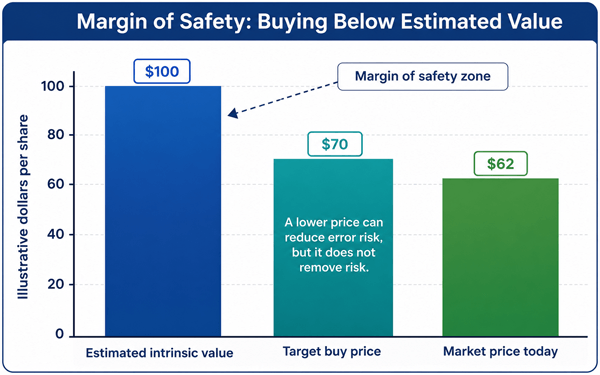
Practical example: suppose you study a company and estimate that a reasonable fair value is about $100 per share. Because your estimate may be wrong, you do not want to pay $100. You set a target buy price of $70 to give yourself a 30% margin of safety. If the market price is $62, the stock may be worth researching further. If the market price is $95, the company may still be good, but the bargain may not be attractive enough for you.
Notice the word “estimate.” No investor knows exact intrinsic value. The goal is not false precision. The goal is to be roughly right, avoid obvious overpayment, and protect yourself from mistakes.
4. The Core Ideas Every Beginner Should Know
4.1 Intrinsic value
Intrinsic value is the estimated real worth of a business based on its future cash flows, current assets, earnings power, brand strength, competitive position, and risks. Beginners should not treat intrinsic value as a magic number. It is a sensible range. For example, after research you may decide a stock is worth somewhere between $80 and $100, not exactly $91.37.
4.2 Margin of safety
Margin of safety is the discount between your estimated value and the price you are willing to pay. It protects you from overconfidence. If you think a stock is worth $100, paying $95 leaves little room for error. Paying $65 may give you room if your assumptions are too optimistic, the economy slows, or the company has a bad year.
4.3 Mr. Market behavior
Benjamin Graham used the idea of “Mr. Market” to explain how emotional the market can be. Some days the market is excited and offers high prices. Other days it is fearful and offers lower prices. You do not have to agree with every price. You can simply wait for a price that makes sense.
4.4 Business quality matters
A cheap stock is not automatically a value stock. Many cheap stocks are cheap because the business is shrinking, debt is too high, products are outdated, or management is destroying shareholder value. Beginner value investing should focus first on understandable, financially stable companies rather than complicated turnaround stories.
4.5 Patience is part of the return
Value investing often feels boring. You may research many companies and buy none. You may hold a good stock for years before the market recognizes its value. This is normal. If you need excitement every week, value investing may frustrate you.
5. Value Investing vs. Growth Investing vs. Trading
| Approach | Main question | Typical time frame | Beginner risk |
|---|---|---|---|
| Value investing | Am I paying less than the business is reasonably worth? | Usually years | Buying a value trap or being too early |
| Growth investing | Can this company grow revenue and earnings faster than expected? | Usually years | Overpaying for exciting future growth |
| Dividend investing | Can this company pay stable or rising dividends? | Years to decades | Chasing high dividend yield from weak companies |
| Index investing | Can I own a broad market basket at low cost? | Years to decades | Expecting it to avoid market downturns |
| Short-term trading | Can I profit from near-term price movement? | Minutes to months | Emotional decisions, leverage, high turnover, losses |
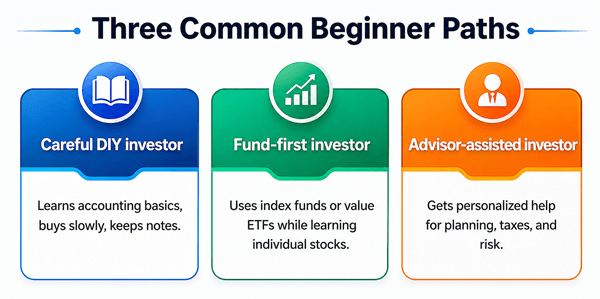
Many investors combine these approaches. For example, a beginner may keep most money in low-cost diversified funds and use a smaller “learning portfolio” for individual value stocks. This can reduce the chance that one mistake damages the entire investment portfolio.
6. What Makes a Stock Look Undervalued?
Value investors commonly look at numbers, but numbers need context. A low price-to-earnings ratio can be attractive, or it can signal that the market expects earnings to fall. A high dividend yield can be useful, or it can warn that the dividend may be cut. Good analysis asks why the stock is cheap.
| Metric | What it tells you | Beginner caution |
|---|---|---|
| P/E ratio | How much investors pay for each dollar of earnings. | Low P/E can mean cheap, cyclical, declining, or risky. |
| Price-to-book ratio | Price compared with accounting book value. | More useful for banks and asset-heavy firms than software companies. |
| Free cash flow | Cash left after operating costs and capital spending. | Cash flow can be temporarily high or low in cyclical businesses. |
| Debt-to-equity | How much debt supports the business. | High debt can become dangerous when rates rise or sales fall. |
| Return on equity | How efficiently the company uses shareholder capital. | Very high ROE can be distorted by debt or one-time gains. |
| Dividend yield | Cash dividend compared with stock price. | A very high yield may signal market concern about a cut. |
7. A Practical Beginner Example
Imagine a fictional company called Everyday Foods Ltd. It sells basic packaged food, has been profitable for many years, and people buy its products in good and bad economies. The stock price has fallen from $50 to $34 because investors are worried about a temporary rise in raw material costs.
A beginner value investor might ask:
- Is the business understandable? Yes, it sells everyday food products.
- Are sales stable? Revenue has grown slowly but consistently.
- Is debt manageable? Debt is not excessive compared with cash flow.
- Is the problem temporary or permanent? Ingredient costs may normalize, but brand weakness would be more serious.
- What is a reasonable value range? Based on normalized earnings, perhaps $42 to $48 per share.
- Is there a margin of safety? At $34, the price is below the estimated value range, but the investor still needs to check risks.
Now compare it with a second fictional stock, TrendMax Tech. It is down 70%, has no profits, burns cash every quarter, and depends on raising new money to survive. It looks “cheap” because the price collapsed, but it may not be a value investment. It may be a speculative turnaround. Beginners often lose money by confusing a falling price with a bargain.
8. Step-by-Step: How a Beginner Can Use Value Investing
- Build an emergency fund first. Money needed for rent, fees, debt payments, or emergencies should not be placed in individual stocks.
- Learn the basics of financial statements. Start with revenue, net income, free cash flow, total debt, cash, and shareholder equity.
- Choose a small research universe. Instead of scanning every stock, begin with companies whose products you understand.
- Write a simple investment checklist. Do not buy unless the company passes your basic quality, debt, valuation, and risk questions.
- Estimate a value range. Use conservative assumptions and compare several valuation methods rather than relying on one ratio.
- Demand a margin of safety. Beginners are usually better served by patience than by forcing a purchase.
- Start small. A first position can be small enough that a mistake becomes a lesson, not a disaster.
- Keep an investment journal. Record why you bought, what could go wrong, and when you would sell.
- Review periodically, not emotionally. Review business facts quarterly or annually; avoid reacting to every price move.
- Diversify. Even careful analysis can be wrong, so avoid putting too much money into one stock or sector.
9. A Beginner-Friendly Stock Research Checklist
| Question | Good sign | Warning sign |
|---|---|---|
| Do I understand how the company makes money? | You can explain it in one sentence. | The business model sounds vague or overly complex. |
| Is the company profitable? | Profits and cash flow are steady over time. | Losses continue with no clear path to improvement. |
| Is debt manageable? | Interest payments are easily covered. | Debt is high and refinancing looks difficult. |
| Does it have an advantage? | Brand, scale, patents, switching costs, network effects, or cost leadership. | Competitors can easily copy the product or undercut prices. |
| Why is the stock cheap? | Temporary fear, cyclical downturn, misunderstood segment, one-time issue. | Permanent decline, fraud concerns, broken balance sheet, obsolete product. |
| Is management shareholder-friendly? | Clear reporting, sensible capital allocation, reasonable dilution. | Constant hype, excessive stock issuance, poor transparency. |
| What could make me wrong? | Risks are visible and manageable. | You cannot clearly name the major risks. |
10. Common Beginner Mistakes in Value Investing
10.1 Mistake 1: Buying only because the P/E ratio is low
A low P/E ratio can be a starting point, not a final decision. Earnings may be temporarily inflated, the business may be cyclical, or the market may expect profits to collapse. Always ask whether the current earnings are sustainable.
10.2 Mistake 2: Ignoring debt
Debt can turn a small business problem into a serious shareholder problem. If a company must repay or refinance debt during a weak period, shareholders may suffer through dilution, dividend cuts, or bankruptcy risk.
10.3 Mistake 3: Falling in love with a stock
A stock does not know you own it. If the facts change, your opinion should change. Emotional attachment is dangerous because it makes investors defend mistakes instead of correcting them.
10.4 Mistake 4: Averaging down without new analysis
Buying more after a price drop can be sensible only if the business value remains strong and the original thesis is intact. Averaging down just to lower your cost basis can turn one mistake into a larger mistake.
10.5 Mistake 5: Not comparing alternatives
A value stock should compete with other available choices: cash, bonds, index funds, dividend stocks, or better companies at fair prices. Opportunity cost matters.
11. How Much Money Does a Beginner Need?
You do not need a large amount of money to learn value investing. Many online brokerage account platforms now allow fractional shares, which means you can practice with small amounts. The more important question is not “How much can I start with?” but “Can I afford to keep this money invested for years and accept possible losses?”
A practical structure for many beginners is: keep emergency savings separate, use diversified funds for core long-term investing, and set aside a small learning amount for individual stock analysis. This approach lets you build skill without making your entire financial future depend on your first few stock picks.
12. When Should a Value Investor Sell?
Buying gets most of the attention, but selling is just as important. A value investor may sell when the stock reaches or exceeds fair value, when the business quality deteriorates, when debt risk becomes unacceptable, when a better opportunity appears, or when the original reason for buying is proven wrong.
Selling just because the price dropped is not always right. Selling just because the price rose is not always right either. The key question is: compared with today’s facts, does the stock still offer an attractive risk-adjusted return?
13. Value Investing and Risk: Honest Expectations
Value investing can reduce some risks, especially the risk of overpaying, but it does not remove market risk. Stocks can lose value, entire sectors can suffer, interest rates can change, companies can misreport results, and good businesses can stay undervalued for a long time. A beginner should never treat value investing as a guaranteed way to make money.
Important risk controls include diversification, position sizing, avoiding leverage, checking debt, understanding taxes and fees, and not investing money needed soon. In personal finance, survival matters more than looking smart.
14. Where Value Investing Fits in Financial Planning
Value investing is one investment strategy, not a complete financial plan. A proper plan includes emergency savings, debt management, insurance, retirement investing, tax planning, estate planning when needed, and a realistic budget. Some readers may benefit from a qualified financial advisor, especially if they have complex income, business ownership, inheritance, retirement decisions, or tax questions.
For many people, the best online broker or investment app is not the one with the flashiest features. It is the one with reasonable fees, reliable execution, strong security, clear reporting, educational tools, and access to diversified investment products. Beginners should compare costs, account minimums, available funds, research tools, customer support, and regulatory protections in their country.
15. Frequently Asked Questions
15.1 Is value investing good for beginners?
It can be good for beginners who are patient and willing to learn business basics. It is not ideal for people who want fast profits, constant trading, or guaranteed returns.
15.2 Is value investing the same as buying cheap stocks?
No. Value investing is about buying below reasonable business value. A cheap-looking stock can be a value trap if the business is weak.
15.3 Can I do value investing with ETFs?
Yes. Some investors use value ETFs or mutual funds to get diversified exposure to value-style stocks instead of picking individual companies.
15.4 How long does value investing take to work?
Often years. A stock can remain undervalued longer than expected, so patience and position sizing matter.
15.5 What is the safest way to start?
Many beginners start by learning with small amounts, keeping most long-term money diversified, avoiding leverage, and writing down every investment reason before buying.
15.6 Do value investors ignore growth?
No. Growth can be part of value. The issue is whether the price already reflects too much optimism.
15.7 What is a value trap?
A value trap is a stock that looks cheap but keeps declining because the business is permanently damaged or the original valuation assumptions were wrong.
15.8 Should I hire a financial advisor?
Consider professional advice if you need personalized help with taxes, retirement, risk, debt, or portfolio management. Always check credentials and conflicts of interest.
16. Conclusion: The Real Lesson of Value Investing
Value investing teaches a beginner one powerful habit: do not confuse price with value. The stock market offers prices every second, but it does not always offer wisdom. A thoughtful investor slows down, studies the business, compares price with value, demands a margin of safety, and accepts that mistakes are part of the journey.
The best value investors are not just good with numbers. They are honest about what they do not know. They avoid hype. They manage risk. They wait. For a beginner, that mindset may be more valuable than any single stock idea.
Reader Advice
This article is provided solely for educational and informational purposes and does not constitute individualized investment, legal, tax, accounting, or financial advice. Investing involves risk, including the possible loss of principal, and past performance does not guarantee future results. Rules, regulations, taxes, fees, market conditions, and product features may change and may differ by country, account type, and personal circumstances.
Before making any financial decision, readers should conduct independent research, verify current facts and figures through official and authoritative sources, review applicable disclosures, and consider seeking advice from a suitably qualified professional.
Sources Consulted and Checked
The following sources were consulted and checked while preparing this article to support clarity and accuracy.
- Investor.gov, Introduction to Investing: risk tolerance, time horizon, asset allocation, and diversification.
- Investor.gov, Diversification glossary entry.
- FINRA, Risk: explanation of investment risk, market risk, business risk, liquidity risk, and concentration risk.
- FINRA, Financial Tips for New Investors: due diligence and checking investment professionals.
- FINRA, Asset Allocation and Diversification: rebalancing and portfolio risk management.
- Investopedia, Value Investing: definition, intrinsic value, margin of safety, and common valuation metrics.