Swing Trading for Beginners: A Stock Market Trading Guide
1. What Is Swing Trading?
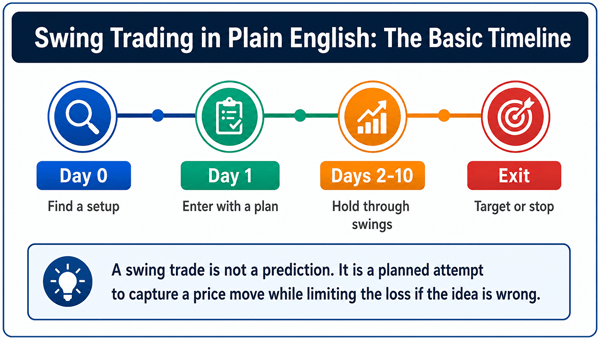
Swing trading is a short-term to medium-term stock trading style where a trader tries to capture a price move, or “swing,” that may last from a few days to a few weeks. A beginner can think of it as the middle ground between day trading and long-term investing. A day trader may enter and exit in the same session. A long-term investor may hold for years. A swing trader usually holds long enough for a stock to move, but not so long that the trade becomes a forgotten investment.
The goal is not to buy the perfect bottom or sell the perfect top. The practical goal is to find a reasonable setup, plan the entry, place a clear risk limit, and exit when the trade either works or proves the idea wrong. This is why experienced traders often say that swing trading is less about being right all the time and more about managing risk when you are wrong.
For a beginner, the simplest definition is this: swing trading is buying or selling a stock based on a planned short-term price idea, then managing the trade with a target, a stop, and a written reason for taking the trade.
Quick example
Suppose a stock has been moving between $48 and $54 for several weeks. It pulls back near $49, starts showing strength again, and the overall market is not falling sharply. A swing trader may buy near $50, place a stop near $48, and aim to sell near $54. The trade idea is simple: risk about $2 per share to try to make about $4 per share. The trader can still lose money, but the plan is clear before the buy button is clicked.
2. How Swing Trading Works Step by Step
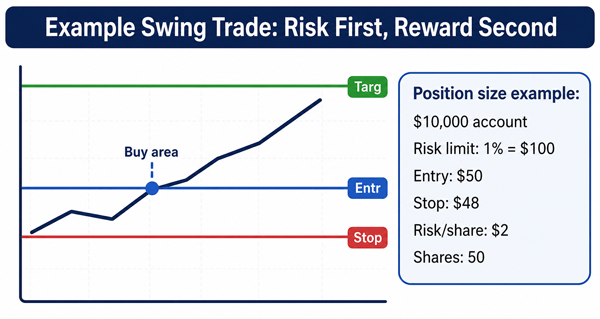
- Choose a market and watchlist. Most beginners start with liquid stocks or ETFs because they are easier to buy and sell than thinly traded names. Liquidity matters because wide bid-ask spreads can turn a good-looking setup into a poor real trade.
- Look for a setup. A setup is a repeatable situation: a pullback in an uptrend, a breakout above resistance, a bounce from support, or a reversal after heavy selling. Beginners should avoid taking trades only because a stock is trending on social media.
- Define the entry. The entry is the price area where the trade makes sense. It can be a breakout price, a pullback price, or a close above a key level. The entry should be written down before the trade.
- Define the stop. The stop is the price where the trade idea is considered wrong. It is not a punishment; it is a safety rule. Stop orders can help manage market risk, but they can be triggered by short-term volatility and may not guarantee the exact exit price in fast markets.
- Define the target. A target is a realistic area where the trader plans to take profit. It may be based on a prior high, a chart pattern, average true range, or a simple risk-reward ratio.
- Size the position. Position sizing decides how many shares to buy. Good beginners usually calculate position size from the stop distance, not from excitement or available buying power.
- Manage and review. After entry, the trader follows the plan, records the outcome, and reviews the lesson. The review is where improvement happens.
3. Swing Trading vs Day Trading vs Long-Term Investing
| Feature | Swing Trading | Day Trading | Long-Term Investing |
|---|---|---|---|
| Typical holding period | Days to weeks | Minutes to hours | Years or decades |
| Main focus | Short-term price swings with planned entries and exits | Intraday price movement | Business quality, valuation, income, compounding |
| Time needed | Moderate; can be checked around market close | High; active screen time | Low to moderate |
| Common tools | Trendlines, support/resistance, moving averages, volume, catalysts | Level II, intraday charts, order flow, news | Financial statements, valuation ratios, diversification |
| Main risk | Overtrading, poor stops, gap risk, emotional exits | Speed, leverage, commissions/spreads, stress | Market cycles, business risk, opportunity cost |
| Beginner fit | Often easier than day trading, but still risky | Usually hardest for beginners | Usually most suitable for wealth building |
This comparison is important because many beginners confuse swing trading with “easy day trading.” It is not. Swing trading may require less screen time, but it still exposes you to overnight gaps, earnings surprises, market news, and emotional decision-making. In the U.S., new FINRA intraday margin standards took effect on June 4, 2026, replacing the former pattern-day-trader framework and its $25,000 minimum-equity requirement. Brokers may still impose their own risk controls and stricter account requirements. Swing traders should still read their brokerage account rules carefully before using margin or frequent trading.
4. What Beginners Should Know Before Their First Swing Trade
4.1 Risk comes before profit
A beginner usually asks, “How much can I make?” A disciplined trader asks, “How much can I lose if I am wrong?” This small change in thinking is the foundation of responsible swing trading. A trade that can make $300 but lose $1,000 is not attractive for most beginners. A trade that risks $100 to aim for $200 or $300 may be easier to manage, provided the setup is realistic.
4.2 A stock can be good and still be a bad trade
A strong company can be overpriced in the short term. A weak company can bounce sharply for a few days. Swing trading focuses on price behavior over a shorter window, so the trade must be judged by its setup, risk, liquidity, and timing. This is why beginners should avoid confusing a company they like with a trade that has a good risk-reward plan.
4.3 News and earnings can break a chart
Charts show past and current behavior, not guaranteed future movement. Earnings reports, regulatory news, analyst downgrades, lawsuits, geopolitical events, and broad market selloffs can all cause gaps. A gap can jump over a stop price, resulting in a worse exit than expected. Beginners should know when a company reports earnings and decide whether they are willing to hold through that event.
4.4 Margin can magnify mistakes
Margin means borrowing from a broker to trade. It can increase buying power, but it also increases losses and can lead to margin calls or forced liquidation. For beginners, cash trading or very small position sizes are usually safer learning environments than borrowing money to trade.
4.5 Taxes matter
Frequent trading can create more taxable events than long-term investing. In the U.S., wash-sale rules can prevent a trader from claiming a loss if they sell at a loss and buy substantially identical securities within the rule window. Tax rules vary by country and can change, so traders should keep clean records and consult a tax professional when needed.
5. The Core Tools of Swing Trading
5.1 Support and resistance
Support is an area where buyers have previously stepped in. Resistance is an area where sellers have previously appeared. Beginners should treat these as zones, not exact magic lines. A stock bouncing near support may create a possible entry. A stock approaching resistance may be near a profit-taking area.
5.2 Trend
A trend is the general direction of price. In an uptrend, price often makes higher highs and higher lows. In a downtrend, it often makes lower highs and lower lows. Many beginner-friendly swing strategies work better when they trade in the direction of the larger trend instead of fighting it.
5.3 Moving averages
Moving averages smooth price action. Common examples are the 20-day, 50-day, and 200-day moving averages. A beginner might use the 20-day average to observe short-term trend, the 50-day for medium trend, and the 200-day for broad market direction. Moving averages are not signals by themselves; they are context tools.
5.4 Volume
Volume shows how many shares traded. A breakout on higher-than-usual volume can suggest stronger participation. A weak breakout on low volume may be more suspicious. Volume is especially useful when comparing today’s activity with the stock’s normal trading volume.
5.5 Relative strength
Relative strength means a stock is acting stronger than the market or its sector. If the market is flat but a stock keeps making higher lows, it may be attracting buyers. Beginners can use this concept to avoid weak names and focus on stocks that institutions may be supporting.
6. Beginner-Friendly Swing Trading Strategies
6.1 Strategy 1: Pullback in an uptrend
This is often the cleanest beginner strategy. The trader finds a stock in an uptrend, waits for a pullback toward support or a moving average, and buys only if price starts to stabilize. The stop can be placed below the recent swing low. The target can be the prior high or the next resistance zone.
Example: A stock rises from $40 to $50, pulls back to $46 near the 20-day moving average, and then forms a strong candle. A trader buys at $47, places a stop at $44.80, and targets $52. The trade risks $2.20 per share for a possible $5 gain. The plan is easy to understand, even though the outcome is never guaranteed.
6.2 Strategy 2: Breakout from consolidation
A consolidation happens when a stock trades in a tight range after a prior move. A breakout occurs when price moves above the range. Beginners should look for breakouts with volume and avoid chasing a stock that is already far above the breakout point. A common stop is below the breakout level or below the consolidation base.
6.3 Strategy 3: Failed breakdown reversal
Sometimes a stock briefly breaks below support, attracts sellers, and then quickly recovers above the support level. This can trap late sellers and create a fast upside move. This strategy can be powerful but is harder for beginners because it requires quick decision-making and strict stops.
6.4 Strategy 4: ETF swing trading
Beginners who find individual stocks overwhelming can study liquid ETFs. ETFs can reduce single-company surprise risk, although they still carry market risk. Examples include broad market, sector, or industry ETFs. The same rules apply: entry, stop, target, position size, and journal.
7. Risk Management: The Part Beginners Should Never Skip
Risk management is the difference between learning and blowing up an account. A beginner does not need a complex system. They need consistent rules.
Risk a small fixed percentage per trade. Many traders keep risk around 0.5% to 1% of account value per trade while learning.
Know the dollar loss before entry. If your account is $5,000 and you risk 1%, the maximum planned loss is $50. If entry is $25 and stop is $24, risk is $1 per share, so the position is 50 shares.
Avoid putting all trades in the same theme. Five trades in semiconductor stocks may behave like one large trade if the sector falls.
Do not average down without a written rule. Adding to a losing position can turn a small planned loss into a large emotional loss.
Respect gap risk. Overnight news can create exits worse than planned. This is one reason position size matters.
Keep emergency cash separate. Money needed for rent, bills, tuition, healthcare, or debt repayment should not be used for trading practice.
8. A Simple Swing Trading Plan Template
A trading plan removes guesswork. It does not guarantee profit, but it reduces impulsive decisions. Beginners can copy this structure into a notebook, spreadsheet, or trading journal.
| Plan item | Beginner question to answer before trading |
|---|---|
| Market condition | Is the overall market trending up, sideways, or down? |
| Ticker | What stock or ETF am I trading? |
| Setup | Is this a pullback, breakout, reversal, or another defined setup? |
| Entry | At what price or condition will I enter? |
| Stop | Where is the trade idea wrong? |
| Target | Where will I take profit or reduce the position? |
| Position size | How many shares match my risk limit? |
| Reason to avoid | Is earnings, low volume, bad spread, or emotional pressure present? |
| Review rule | What will I record after the trade closes? |
9. Common Beginner Mistakes and Honest Fixes
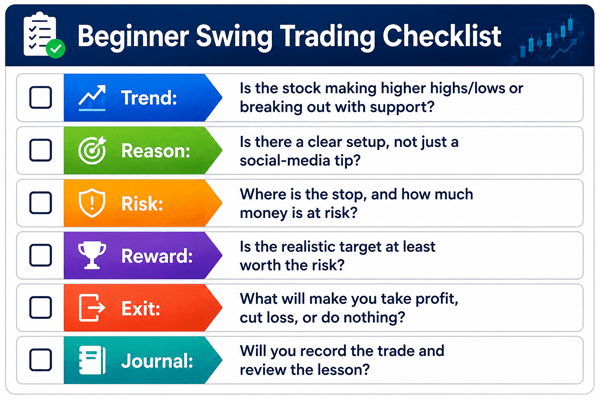
9.1 Mistake: Trading without a stop
A stop is not perfect, but having no exit plan is usually worse. The honest fix is to decide the invalidation point before entry. If you cannot define where the trade idea is wrong, skip the trade.
9.2 Mistake: Chasing a stock after it already moved
Beginners often see a stock up 10% and buy because they fear missing out. The honest fix is to ask whether the stop is now too far away. If the risk is too large, wait for a pullback or another setup.
9.3 Mistake: Taking random tips
A tip is not a trading plan. If a friend, influencer, or forum post gives a ticker, the beginner still needs to check liquidity, trend, support, resistance, earnings date, risk per share, and position size.
9.4 Mistake: Confusing confidence with evidence
A trader can feel very confident and still be wrong. Evidence means the chart, volume, market condition, and risk-reward all support the trade. Confidence without evidence is usually just emotion.
9.5 Mistake: Overtrading
Overtrading happens when a beginner tries to force income from the market every day. The market does not owe anyone a setup. A good rule is to trade fewer, cleaner setups and review them carefully.
10. Practical Walkthrough: A Full Beginner Swing Trade
Imagine a beginner named Sara has a $10,000 account. She decides to risk only 1% per trade, or $100. She finds a liquid stock trading near $50. The stock has been in an uptrend, pulled back for four days, and is now bouncing near the 50-day moving average. The prior swing high is near $56. Earnings are not due for three weeks.
- Setup: Pullback in an uptrend.
- Entry: Buy at $50.20 only if the stock closes strong above $50.
- Stop: $48.20, below the recent swing low.
- Risk per share: $50.20 - $48.20 = $2.00.
- Position size: $100 planned risk / $2 risk per share = 50 shares.
- Target: $55.80 near prior resistance. Potential reward is about $5.60 per share, or $280 on 50 shares.
- Plan: If price reaches $53.50, Sara may move the stop to reduce risk or take partial profit. If the stock closes below $48.20, she exits. If market news turns sharply negative, she reassesses instead of hoping.
This example shows the mindset. Sara is not saying, “This stock must go up.” She is saying, “If this setup works, I may make more than I risk. If it fails, I have a planned loss I can survive.” That is the kind of practical thinking beginners should learn first.
11. Best Indicators for Swing Trading Beginners
Indicators can help, but too many indicators can confuse beginners. Start with a small toolkit and understand what each tool is supposed to show.
| Tool | What it helps with | Beginner warning |
|---|---|---|
| 20-day moving average | Short-term trend and pullbacks | Not a buy signal by itself |
| 50-day moving average | Medium-term trend and support area | Price can cut through it in weak markets |
| Volume | Breakout strength or weak participation | One high-volume day can be misleading |
| RSI | Overbought/oversold momentum context | A strong stock can stay overbought; a weak stock can stay oversold |
| ATR | Average price movement and stop distance | A wide ATR means smaller position size may be needed |
12. How Much Money Do You Need to Start Swing Trading?
There is no universal amount that makes someone ready. The better question is: how much can you afford to risk while learning without damaging your life? A beginner can paper trade first, then use very small real positions. Small accounts should focus on process, not income. Trying to turn a tiny account into a full-time salary quickly is one of the fastest paths to reckless risk.
Brokerage account minimums, margin rules, and available order types vary by country and broker. In the U.S., margin accounts generally involve regulatory and broker requirements, and brokers may enforce stricter rules than the minimum. Beginners should read the online brokerage account agreement carefully and understand fees, spreads, margin interest, order routing, and tax reporting before trading actively.
13. Choosing a Broker or Trading Platform
A beginner does not need the fanciest trading platform. They need reliability, clear order entry, good charts, transparent fees, and strong risk controls. When comparing a stock trading app or online brokerage account, look beyond marketing claims like “best trading platform” or “commission-free trading.” Free trading can still involve spreads, payment-for-order-flow practices, margin interest, option contract fees, data fees, or poor execution quality.
- Check whether the platform supports market, limit, stop, and stop-limit orders.
- Check charting tools, watchlists, alerts, and trading journal exports.
- Check margin rates before using borrowed money.
- Check educational resources, customer support, and account protection details.
- Check whether the platform makes trading feel like a game. App design should support responsible decisions, not encourage impulsive trades.
14. Daily and Weekly Routine for Beginners
14.1 Weekend preparation
Review the overall market trend and major sector performance.
Build a watchlist of 10 to 30 liquid stocks or ETFs.
Mark support, resistance, earnings dates, and possible entry zones.
Remove stocks with poor liquidity, huge spreads, or unclear setups.
14.2 Before market open
Check major news, futures, and any company-specific announcements.
Decide which setups are still valid and which should be deleted.
Set alerts instead of staring at every tick.
14.3 During the trade
Follow the stop and target plan.
Avoid changing the plan because of fear or excitement.
Do not add new trades just because the market feels active.
14.4 After the trade
Record entry, exit, chart screenshot, reason, mistake, and lesson.
Review at least 20 to 30 trades before judging whether a setup works for you.
15. Pros and Cons of Swing Trading
| Potential advantages | Real risks and disadvantages |
|---|---|
| Less screen time than day trading | Still risky and not guaranteed to make money |
| Can be learned with simple tools | Overnight gaps can hurt stops |
| Works with planned entries and exits | Frequent trading can increase taxes and mistakes |
| Can be applied to stocks and ETFs | Requires emotional discipline |
| Encourages risk-reward thinking | Margin and options can magnify losses |
16. Frequently Asked Questions
16.1 Is swing trading good for beginners?
It can be easier to understand than day trading, but it is still risky. Beginners should start with education, paper trading, small position sizes, and a written plan.
16.2 Can you make a living from swing trading?
Some traders do, but beginners should not treat swing trading as reliable income. Results vary widely, losses are common, and income pressure often leads to bad decisions.
16.3 What is the best time frame for swing trading?
Many swing traders use daily charts for decisions and weekly charts for context. Shorter charts can help refine entries, but beginners should avoid overcomplicating the process.
16.4 Do I need technical analysis?
Basic technical analysis can help identify trend, support, resistance, and risk levels. You do not need dozens of indicators. A simple, repeatable method is better than a crowded chart.
16.5 Should beginners use margin?
Usually not at first. Margin can increase both gains and losses, and it can lead to margin calls. Beginners should learn risk management before considering borrowed money.
16.6 What is the safest swing trading strategy?
No swing trading strategy is safe in the sense of being guaranteed. A conservative beginner approach is to trade liquid ETFs or large-cap stocks, risk a small amount per trade, avoid earnings gaps, and use clear stops.
16.7 How many trades should a beginner take?
Fewer than they think. Quality matters more than activity. A beginner may learn more from 10 well-planned trades than from 50 random trades.
16.8 What should I put in a trading journal?
Record ticker, date, setup, entry, stop, target, position size, reason for entry, reason for exit, result, screenshot, and lesson learned.
17. Final Takeaway
Swing trading is not a shortcut to easy money. It is a structured way to trade short-term price movement with a plan. The beginner who survives long enough to improve is usually the one who keeps position sizes small, avoids hype, respects stops, studies completed trades, and treats the market as a risk-management environment rather than a casino.
The best first goal is not to double an account. The best first goal is to become consistent in process: find a clear setup, define risk, take the correct position size, follow the exit plan, and learn from the result. Profits may or may not come in any individual trade, but disciplined habits give a beginner a much better chance of lasting in the stock market.
Sources Consulted and Checked
The following official and authoritative sources were consulted and checked while preparing this article and reviewing its accuracy. Rules, guidance, and web pages may be updated after publication, so readers should confirm current information directly with the relevant authority.
- FINRA - Understanding the New Intraday Margin Requirements (April 20, 2026): https://www.finra.org/investors/insights/intraday-margin-requirements
- FINRA Regulatory Notice 26-10 on intraday margin requirements: https://www.finra.org/rules-guidance/notices/26-10
- Investor.gov/SEC - Understanding Order Types: https://www.investor.gov/introduction-investing/general-resources/news-alerts/alerts-bulletins/investor-bulletins-14
- FINRA - Order Types: https://www.finra.org/investors/investing/investment-products/stocks/order-types
- Investor.gov/SEC - Stop, Stop-Limit, and Trailing Stop Orders: https://www.investor.gov/introduction-investing/general-resources/news-alerts/alerts-bulletins/investor-bulletins-15
- SEC - Understanding Margin Accounts: https://www.sec.gov/investor/alerts/ib_marginaccounts.pdf
- FINRA - Know What Triggers a Margin Call: https://www.finra.org/investors/insights/margin-calls
- Investor.gov - Wash Sales: https://www.investor.gov/introduction-investing/investing-basics/glossary/wash-sales
- IRS Publication 550 - Investment Income and Expenses: https://www.irs.gov/publications/p550
- FINRA - Risk: https://www.finra.org/investors/investing/investing-basics/risk
Reader Advice
This article is provided solely for educational and informational purposes. It does not constitute financial, investment, trading, tax, accounting, or legal advice, and it is not a recommendation to buy, sell, or hold any security or use any particular strategy, broker, platform, account type, or order. Trading and investing involve risk, including the possible loss of some or all capital; leverage and margin can magnify losses, and stop orders may not execute at the expected price in fast or gapping markets.
Before making a decision, readers should assess their objectives, financial circumstances, experience, risk tolerance, and local legal and tax requirements, and seek advice from appropriately qualified professionals where necessary. Laws, regulations, brokerage rules, fees, tax treatment, market conditions, and product features differ by jurisdiction and may change over time. Readers should therefore verify all material facts, figures, dates, requirements, and account terms through current official sources and their chosen regulated service provider. Past performance, examples, and hypothetical calculations do not guarantee future results.