How to Build Wealth Through Long-Term Stock Market Investing
1. Introduction: Wealth Building Is Usually Boring Before It Looks Impressive
Most people imagine wealth building as something dramatic: finding the next hot stock, buying at the perfect bottom, or discovering a secret trading strategy. In real life, the most reliable form of stock market wealth is usually much simpler and much less exciting. It comes from buying productive assets, adding money regularly, keeping costs low, reinvesting growth, and giving the plan enough years to work.
Long-term stock market investing means owning pieces of businesses for many years instead of trying to guess tomorrow’s price. A stock is not just a number on a screen. It represents ownership in a company. When companies earn profits, grow sales, improve productivity, and return money to shareholders through dividends or buybacks, long-term investors may benefit. The road is not smooth, but the basic idea is easy: own a diversified basket of good assets, avoid emotional mistakes, and let time do the heavy lifting.
This guide explains the topic as if the reader has no background at all. It covers what stock investing is, how long-term compounding works, what beginners should know before investing, how to start, what mistakes to avoid, and how to turn investing into a calm long-term habit rather than a stressful guessing game.
2. What Is Long-Term Stock Market Investing?
Long-term stock market investing is the practice of buying stocks, stock funds, or exchange-traded funds and holding them for many years, often 10, 20, 30, or more. The goal is not to get rich next week. The goal is to participate in the long-term growth of businesses and the economy.
A beginner can think of it like planting a tree. In the first few months, nothing exciting may happen. Some days the weather is bad. Some seasons feel slow. But if the tree is healthy, protected, and given time, the growth becomes more visible later. Investing works in a similar way. The early years may feel small because the account balance is still small. Later, the growth can become larger because the money you invested may start earning returns on previous returns.
This is different from short-term trading. Trading focuses on price movement over days, hours, or minutes. Long-term investing focuses on ownership, patience, risk management, and consistent saving. A trader often asks, “What will this price do soon?” A long-term investor asks, “Does this asset fit my goals for the next decade or longer?”
2.1 Simple Example
Imagine Sara invests $300 every month into a diversified stock index fund. She does not try to predict the market. She keeps investing during good years and bad years. If her investment earned an average annual return of 7% before inflation and taxes, her account could grow to roughly $368,000 after 30 years, even though she personally contributed only $108,000. The exact return is never guaranteed, but the example shows why time and consistency matter.
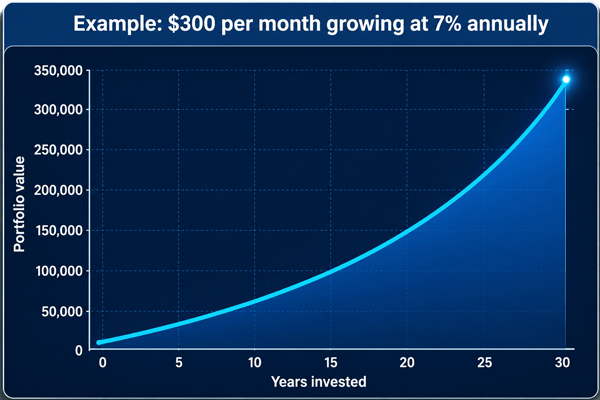
Figure 1. Hypothetical growth from investing $300 per month for 30 years at a 7% average annual return. This illustration is not a forecast or guarantee.
3. How the Stock Market Builds Wealth
3.1 Capital Growth
Capital growth happens when the value of your investment increases. For example, if you buy shares of a company or a fund at $100 and years later it is worth $180, the increase is capital growth. Long-term investors do not need every company to win. A broad fund can hold hundreds or thousands of companies, so the growth of successful companies can help offset weaker ones.
3.2 Dividends
Some companies share part of their profits with shareholders through dividends. Beginners often love dividends because they feel like passive income. Dividends can be useful, but they are not magic. A company that pays a dividend has less cash inside the business afterward. What matters is total return: price growth plus dividends, minus costs and taxes.
3.3 Reinvestment
Reinvesting means using dividends or distributions to buy more shares instead of spending the cash. This can increase the number of shares you own, which may increase future dividends and growth potential. Reinvestment is one reason patient investors can see accelerating results over long periods.
3.4 Compounding
Compounding is growth on growth. If a $10,000 investment grows 10%, it becomes $11,000. If it then grows another 10%, it earns $1,100, not just $1,000, because the return applies to the larger balance. In the early years, compounding feels slow. Later, the same percentage return can create much larger dollar growth.
4. What Beginners Should Know Before Investing
4.1 The Stock Market Goes Up and Down
The first emotional truth is simple: your account will not move in a straight line. Even strong long-term investments can fall sharply. A diversified portfolio can have negative months, negative years, and painful crashes. This does not mean the plan is broken. It means stocks are risky assets. Investors expect higher long-term returns because they accept uncertainty along the way.
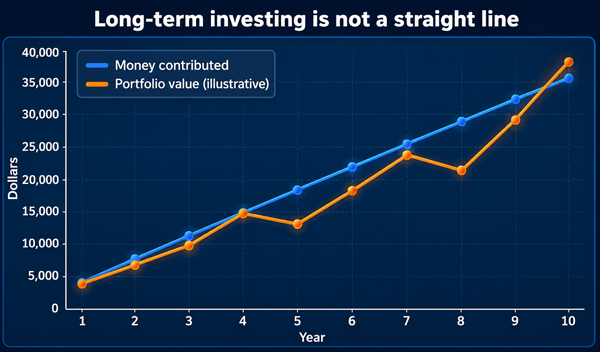
Figure 2. Illustrative comparison of steady contributions and an uneven portfolio-value path. Actual market results will vary.
4.2 Risk Tolerance Matters
Risk tolerance is your ability and willingness to handle losses in exchange for possible higher long-term returns. A person who panics and sells after a 20% decline may need a less aggressive portfolio. Risk is not just math; it is behavior. The best portfolio is not the one that looks perfect in a spreadsheet. It is the one you can actually stick with through bad markets.
4.3 Emergency Savings Come First
Long-term investing works best when you do not need to sell at the wrong time. Before investing aggressively, many beginners should build an emergency fund for surprise expenses such as medical bills, job loss, repairs, or family needs. Money needed in the next few years usually belongs in safer places, not in stocks.
4.4 Debt Can Change the Decision
If someone has high-interest debt, such as expensive credit card debt or payday loans, paying it down may be more urgent than investing. A guaranteed high interest cost can be harder to beat safely in the stock market. Long-term investing should be part of a complete financial plan, not a way to ignore unstable personal finances.
4.5 No Strategy Removes All Risk
Index funds, diversification, dollar-cost averaging, and long holding periods can help manage risk, but they do not eliminate it. Honest investing content should never promise guaranteed profits, fixed returns, or “risk-free” stock market income. A reader should understand that losses are possible and patience is required.
5. The Simple Beginner Strategy: Own the Market, Not a Guess
Many beginners start by trying to pick individual winning stocks. Some succeed, but many underestimate how difficult it is. A simpler method is to invest through broad, low-cost index funds or ETFs. An index fund is designed to track a market index, such as a broad U.S. stock market index, an international stock index, or a bond index. Instead of betting on one company, the investor owns a small piece of many companies.
Research from S&P Dow Jones Indices SPIVA has repeatedly shown that a large share of active fund managers fail to beat their benchmarks over long periods. This does not prove that every index fund is always best for every person, but it does explain why passive investing has become popular among everyday investors.
5.1 Index Funds vs. Individual Stocks
| Feature | Broad Index Fund/ETF | Individual Stocks |
|---|---|---|
| Diversification | Often hundreds or thousands of holdings | Usually concentrated unless you buy many companies |
| Beginner difficulty | Lower | Higher |
| Research required | Moderate | High |
| Risk of one company hurting you | Lower | Higher |
| Potential excitement | Lower | Higher |
| Good use case | Core long-term portfolio | Small satellite position after learning |
5.2 ETF vs. Mutual Fund
Both ETFs and mutual funds can be used for long-term investing. An ETF trades during the day like a stock. A mutual fund typically trades once per day after the market closes. For most long-term beginners, the bigger issues are not the label but the fund’s diversification, expense ratio, tax efficiency, minimum investment, and whether it fits the investor’s plan.
6. Dollar-Cost Averaging: A Practical Way to Start
Dollar-cost averaging means investing the same amount at regular intervals, such as every week or every month, regardless of market conditions. For example, an investor might put $200 into a diversified ETF on the first Monday of every month. When prices are high, the $200 buys fewer shares. When prices are low, it buys more shares.
This approach is useful for beginners because it turns investing into a routine. It reduces the pressure to wait for the “perfect” time. It also helps people continue investing during downturns, when fear often stops them from buying. Dollar-cost averaging does not guarantee profit and does not always beat investing a lump sum immediately, but it can make behavior easier and more consistent.
7. A Practical Step-by-Step Plan for Beginners
7.1 Step 1: Define the Goal
Do not start with the question, “Which stock should I buy?” Start with, “What is this money for?” A retirement goal 30 years away can usually handle more stock exposure than a house down payment needed in two years. A clear goal helps decide how much risk is reasonable.
7.2 Step 2: Choose an Account
The right investment account depends on the country and the purpose. In the U.S., examples include employer retirement plans, IRAs, taxable brokerage accounts, and education accounts. In other countries, investors may have different tax-advantaged accounts and broker options. A beginner should compare fees, available funds, account protections, customer support, tax reporting, and ease of use. This is where keywords like “best brokerage account for beginners” and “retirement planning account” naturally matter, but the best choice depends on the reader’s location and needs.
7.3 Step 3: Pick a Simple Asset Allocation
Asset allocation means dividing money among stocks, bonds, and cash. Stocks usually provide more growth potential but more volatility. Bonds can reduce volatility and provide income, though they also have risks. Cash is stable but may lose buying power to inflation. A young investor with a stable income and a long timeline may choose a stock-heavy portfolio. Someone near retirement may want more balance.
7.4 Step 4: Choose Low-Cost, Diversified Funds
Cost matters because every fee is money not compounding for you. A fund with a 1.00% annual expense ratio costs much more over decades than a similar fund charging 0.05% or 0.10%. This does not mean the cheapest fund is always best, but beginners should understand what they are paying and why.
7.5 Step 5: Automate Contributions
Automation is one of the most practical habits in wealth building. Set a recurring transfer after each paycheck, even if the amount is small. Many investors fail not because they choose the wrong fund, but because they never build the habit of investing regularly.
7.6 Step 6: Rebalance Occasionally
Over time, one part of a portfolio may grow faster than another. Rebalancing means returning the portfolio to the intended mix. For example, if the target is 80% stocks and 20% bonds, and stocks grow until the mix becomes 90/10, the investor may shift money back toward bonds. Rebalancing is not about predicting the market; it is about controlling risk.
7.7 Step 7: Review, But Do Not Obsess
A long-term investor should review the plan periodically, perhaps quarterly or annually, but checking prices every hour can create anxiety and bad decisions. The more often people look, the more often they see losses, and the more tempted they may be to interfere with a good plan.
8. How Much Money Do You Need to Start?
You do not need to be rich to start investing. Many brokers now allow fractional shares, low minimums, and automatic investments. The more important question is not “Do I have enough?” but “Can I invest consistently without risking money I need for bills or emergencies?”
A beginner can start with a small amount, such as $25, $50, or $100 per month, and increase it over time. The habit matters. As income grows, raises and bonuses can be used to increase contributions before lifestyle spending absorbs them.
8.1 Contribution Example
| Monthly investment | Years | Total contributed | Hypothetical value at 7% annual return |
|---|---|---|---|
| $100 | 30 | $36,000 | About $122,700 |
| $300 | 30 | $108,000 | About $368,000 |
| $500 | 30 | $180,000 | About $613,500 |
| $1,000 | 30 | $360,000 | About $1.23 million |
These are simplified examples, not promises. Real returns vary, taxes and fees matter, and inflation reduces purchasing power. The point is that time plus consistency can turn ordinary monthly contributions into meaningful wealth.
9. Common Beginner Mistakes and How to Avoid Them
9.1 Mistake 1: Waiting for the Perfect Time
Many people say they will invest after the market crashes, after the news improves, or after they understand everything. The problem is that clarity often arrives after prices have already moved. A practical solution is to start small, learn while investing, and use regular contributions instead of trying to predict the perfect entry point.
9.2 Mistake 2: Chasing Hot Stocks
By the time a stock is popular on social media, much of the good news may already be reflected in the price. Beginners often buy after a big rise and sell after a drop. A diversified core portfolio helps reduce the damage from emotional stock picking.
9.3 Mistake 3: Selling During Market Crashes
Selling during a crash can turn a temporary decline into a permanent loss. This is why emergency savings and risk tolerance matter. A good long-term plan should be built before panic arrives.
9.4 Mistake 4: Ignoring Fees
A 1% annual fee may sound small, but over 30 years it can consume a large portion of returns. Beginners should look at expense ratios, trading commissions, advisory fees, account fees, bid-ask spreads, and tax costs.
9.5 Mistake 5: Confusing Investing With Gambling
Investing is not about excitement. It is about using money to own assets that may grow over time. Gambling depends mainly on chance and often has negative expected value. Sensible investing uses diversification, patience, research, and risk control.
10. People’s Real-World Experiences: What Usually Works
Many long-term investors share similar lessons after years in the market. First, their biggest wins often came from simply staying invested. Second, they usually regret panic selling more than they regret boring index funds. Third, they discover that savings rate matters more than finding the perfect investment in the early years. A person investing $600 per month into a sensible diversified portfolio may build more wealth than someone investing $50 per month into an exciting stock idea.
Another common experience is that confidence grows with education. At first, market drops feel personal. Later, experienced investors often see downturns as normal. Some even welcome lower prices because their regular contributions buy more shares. This mindset does not remove risk, but it makes the process calmer.
A practical investor’s routine may look like this: maintain an emergency fund, invest automatically every payday, hold a broad stock index fund and a bond fund, increase contributions yearly, rebalance once or twice a year, avoid financial news noise, and review goals annually. This may sound too simple, but simplicity is often a strength.
11. Tax-Efficient Investing: Keep More of What You Earn
Taxes can reduce investment returns, so long-term investors should understand the basics. Tax rules vary by country, and readers should confirm local rules or speak with a qualified tax professional. In the U.S., investments held for more than one year may qualify for long-term capital gains treatment, while short-term gains are generally taxed differently. Qualified dividends and capital gains can have different rates depending on income and filing status.
Tax-efficient investing may include using retirement accounts where appropriate, holding tax-efficient index funds in taxable brokerage accounts, avoiding unnecessary trading, harvesting losses carefully where allowed, and placing less tax-efficient assets in tax-advantaged accounts when suitable. The goal is not to avoid legal tax responsibilities. The goal is to plan honestly and keep records properly.
12. How to Build a Simple Portfolio
12.1 Option A: One-Fund Portfolio
Some beginners use a single target-date fund or global allocation fund. This can be useful for retirement investors who want a simple all-in-one solution. The fund automatically holds a mix of stocks and bonds and may become more conservative over time. The investor should still understand the fund’s cost, glide path, and holdings.
12.2 Option B: Two-Fund Portfolio
A simple two-fund portfolio might include one broad stock index fund and one broad bond index fund. The investor controls risk by changing the stock/bond mix. For example, a more aggressive investor might choose 90% stocks and 10% bonds, while a moderate investor might choose 70% stocks and 30% bonds.
12.3 Option C: Three-Fund Portfolio
A common long-term structure is a U.S. stock fund, an international stock fund, and a bond fund. This gives exposure to domestic companies, global companies, and stabilizing fixed income. It is simple enough for beginners but diversified enough for many long-term investors.
12.4 Sample Portfolio Comparison
| Investor type | Sample mix | Possible benefit | Main risk |
|---|---|---|---|
| Aggressive long-term beginner | 90% stocks / 10% bonds | Higher growth potential | Large declines may be hard to tolerate |
| Moderate investor | 70% stocks / 30% bonds | Balance of growth and stability | May still fall during bear markets |
| Conservative investor | 50% stocks / 50% bonds | Lower volatility | Lower long-term growth potential |
13. When Should You Sell?
Long-term investing does not mean never selling. It means selling for planned reasons, not emotional reasons. Good reasons to sell may include rebalancing, reaching a goal, needing retirement income, changing risk level, replacing a high-cost fund with a better option, or tax planning. Bad reasons often include fear after a market drop, hype after a market rise, or a prediction from someone who cannot actually know the future.
A useful rule is to write an investment policy statement before investing. This can be a one-page note that says your goal, target allocation, contribution amount, rebalancing rule, and reasons you are allowed to sell. When markets become emotional, the written plan helps you avoid impulsive decisions.
14. Frequently Asked Questions
14.1 Is the stock market safe for beginners?
Stocks are not “safe” in the short term because prices can fall. They may be suitable for beginners only when the money is long-term, the portfolio is diversified, and the investor understands risk. Beginners should avoid using rent money, emergency savings, or borrowed money for stock investing.
14.2 Can I get rich from stocks?
Stocks can help build wealth over time, but getting rich usually requires consistent saving, patience, income growth, risk control, and avoiding major mistakes. The stock market is not a guaranteed shortcut.
14.3 Should I invest during a recession?
For long-term investors with stable finances, continuing regular contributions during downturns can be reasonable because prices may be lower. But this depends on job security, emergency savings, and risk tolerance. Someone facing immediate financial stress may need cash more than market exposure.
14.4 What is better: real estate or stocks?
Both can build wealth. Real estate can provide leverage, income, and control, but it requires maintenance, local knowledge, transaction costs, and tenant or property risk. Stocks are easier to diversify and more liquid, but prices move daily and can be emotionally difficult. Many households use both over a lifetime.
14.5 How often should I check my portfolio?
Monthly or quarterly is enough for many long-term investors. An annual deep review is often more useful than daily price checking. The goal is to monitor the plan, not react to every headline.
15. Honest Wealth-Building Principles to Remember
- Invest only money that fits your time horizon and risk tolerance.
- Build emergency savings before taking major market risk.
- Use diversification so one bad company does not ruin your plan.
- Keep costs low because fees compound too.
- Automate contributions so investing does not depend on mood.
- Expect market declines before they happen.
- Rebalance occasionally to control risk.
- Avoid promises of guaranteed returns, secret systems, or quick wealth.
- Keep tax records and follow local laws honestly.
- Increase your savings rate as your income grows.
16. Conclusion: The Best Long-Term Investing Plan Is the One You Can Keep
Building wealth through long-term stock market investing is not about being a genius. It is about owning productive assets, starting early enough, adding money consistently, staying diversified, keeping costs low, and refusing to let fear or hype control your decisions. The market will always have scary news. There will always be someone predicting a crash and someone promising a boom. A sensible investor listens less to noise and more to the plan.
For a beginner, the best first step is small and practical: understand your goal, build financial stability, choose a simple diversified fund, automate a contribution, and keep learning. Over time, these ordinary actions can become extraordinary because compounding rewards patience. Wealth is rarely built in one dramatic move. More often, it is built quietly, month after month, by people who keep going.
Sources Consulted and Checked
The following authoritative sources were consulted when preparing this article and checking its accuracy. Readers should verify current rules, rates, dates, and requirements directly with the relevant official source.
- SEC Investor.gov, Compound Interest Calculator: https://www.investor.gov/financial-tools-calculators/calculators/compound-interest-calculator
- FINRA, The Benefits and Limitations of Dollar-Cost Averaging, May 19, 2026: https://www.finra.org/investors/insights/dollar-cost-averaging
- SEC Investor.gov, Diversification: https://www.investor.gov/introduction-investing/investing-basics/glossary/diversification
- SEC Investor.gov, Asset Allocation and Diversification: https://www.investor.gov/introduction-investing/getting-started/asset-allocation
- SEC Investor.gov, Rebalancing: https://www.investor.gov/introduction-investing/investing-basics/glossary/rebalancing
- S&P Dow Jones Indices, SPIVA: https://www.spglobal.com/spdji/en/research-insights/spiva/
- Vanguard, Principles for Investing Success: https://corporate.vanguard.com/content/dam/corp/research/pdf/vanguards_principles_for_investing_success.pdf
- IRS, Topic No. 409 Capital Gains and Losses: https://www.irs.gov/taxtopics/tc409
- Federal Reserve, Survey of Consumer Finances: https://www.federalreserve.gov/econres/scfindex.htm
Reader Advice
This article is provided solely for educational and informational purposes. It does not constitute personal investment, financial, tax, accounting, or legal advice, and it does not recommend any particular security, fund, broker, account, or strategy. Stock market investing involves risk, including market volatility and the possible loss of some or all invested capital. Hypothetical examples are illustrations only and do not predict or guarantee future results. Before making a financial decision, readers should consider their own goals, time horizon, financial circumstances, liquidity needs, and risk tolerance, and should seek advice from appropriately qualified professionals when necessary. Laws, tax rules, account protections, product terms, fees, market conditions, and regulatory requirements can change and may differ by country or jurisdiction. Readers should therefore confirm all material facts, figures, dates, and requirements with current official sources before acting.