What Is a Stop Loss in Stock Trading and Why Should Investors Use It?
1. Quick Answer: What Is a Stop Loss?
A stop loss in stock trading is an instruction you place with your broker to sell a stock if it falls to a price you choose. That chosen price is called the stop price or trigger price. When the stock reaches that level, the stop order is activated and usually becomes a market order, meaning your broker tries to sell it at the best available price at that moment.
In simple words, a stop-loss order is like saying: “If this stock drops to this level, get me out automatically so the loss does not become bigger than I planned.”
Investors use stop losses because stock prices can move quickly, emotions can lead to poor decisions, and most people cannot watch the market every second. A stop loss can help create discipline before fear, hope, or panic takes over.
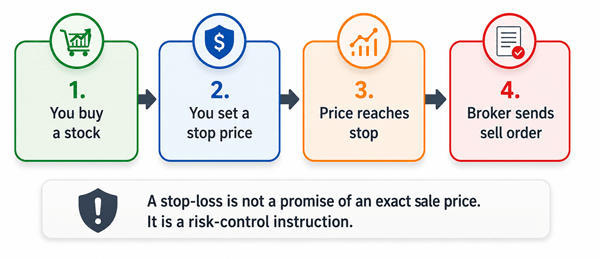
Figure 1: Basic stop-loss order flow.
2. How a Stop-Loss Order Works Step by Step
- You buy or already own a stock. For example, you buy 20 shares at $50 per share.
- You decide the maximum loss you are willing to accept. Maybe you do not want to lose more than about 5% on this trade.
- You place a sell stop order below the current market price. If the stock trades at $47.50, the stop is triggered.
- After the trigger, the order is sent for execution. A regular stop-loss order normally becomes a market order.
- The stock is sold at the best available price, which may be $47.50, but it may also be slightly higher or lower depending on market conditions.
3. Practical Example for Beginners
Imagine you buy a stock at $50 because you believe the company has long-term growth potential. You like the business, but you also know that not every idea works. You decide in advance that if the stock falls 5%, you would rather exit and review your decision than keep hoping.
| Item | Example |
|---|---|
| Buy price | $50.00 |
| Shares purchased | 20 |
| Investment amount | $1,000 |
| Stop-loss level | 5% below buy price |
| Stop price | $47.50 |
| Planned maximum loss before slippage | About $50 |
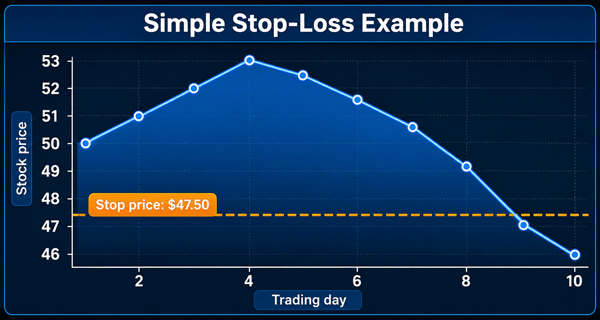
Figure 2: Example of a stock moving toward a stop price.
If the price touches $47.50 during regular trading hours, the stop is triggered. If the market is liquid and moving normally, your sale might happen close to $47.50. But if the stock gaps down after bad news, your actual sale could happen at $46, $44, or another available price. That difference is called slippage.
4. Why Investors Use Stop Losses
4.1 To limit downside risk
The main reason is simple: investors want to decide their risk before the trade, not during a stressful price drop. A stop loss helps turn a vague hope into a written exit rule.
4.2 To reduce emotional trading
Many beginners hold a falling stock because they do not want to “take the loss.” A stop-loss order can reduce hesitation because the decision was made earlier, when the investor was calmer.
4.3 To protect some profit
A stop is not only for losing trades. If a stock rises from $50 to $70, an investor may move the stop to $63 or $65 to protect part of the gain while still giving the stock room to move.
4.4 To avoid constant screen-watching
A stop order can be useful for people who work full-time, run a business, or cannot monitor every price movement. It is not a substitute for reviewing your portfolio, but it can help automate one part of your risk management strategy.
4.5 To create a repeatable investing process
Professional traders and experienced investors often think in terms of process: entry, position size, exit plan, and risk per trade. A stop loss can become part of that process.
5. Stop Loss vs Stop Limit vs Trailing Stop
| Order type | How it works | Main advantage | Main risk |
|---|---|---|---|
| Stop-loss / stop market | Triggers at stop price, then becomes a market order. | Higher chance of getting out after trigger. | Final sale price is not guaranteed. |
| Stop-limit | Triggers at stop price, then becomes a limit order at your chosen limit price or better. | More control over minimum acceptable price. | May not execute at all if the market moves past your limit. |
| Trailing stop | Stop level moves with the stock by a fixed dollar amount or percentage. | Can protect gains while allowing upside. | Can still trigger during normal volatility. |
| Mental stop | You do not place an order; you only promise yourself you will sell. | Flexible and avoids accidental short-term trigger. | Requires discipline; beginners often ignore it. |
For beginners, the key difference is this: a regular stop loss focuses on getting out; a stop-limit focuses on getting a specific price or better. Neither is perfect. One can sell at a worse price than expected; the other may not sell at all.
6. What Beginners Should Know Before Using a Stop Loss
- A stop price is not a guaranteed sale price. Once triggered, a regular stop-loss order becomes a market order. In a fast-moving market, the execution price can be different from the stop price.
- Market gaps can jump over your stop. If a stock closes at $50 and opens next morning at $42 after bad news, a $47.50 stop may execute near the opening price, not at $47.50.
- Very tight stops can backfire. A 1% or 2% stop on a volatile stock may be triggered by normal daily movement, even if the long-term idea is still valid.
- Stop losses do not replace position sizing. If you put too much money into one stock, even a stop loss may not protect your overall portfolio from serious damage.
- Different brokers and trading platforms may handle order rules differently. Before using stop orders in a brokerage account, read the order ticket carefully, including duration, regular-hours settings, and whether the order can trigger outside normal market hours.
- Taxes and wash sale rules may matter. Selling a stock can create tax consequences. Beginners should avoid making tax decisions based only on a stop-loss strategy.
7. How to Choose a Stop-Loss Level
There is no single perfect stop-loss percentage. A beginner often hears rules like “use an 8% stop” or “use a 10% stop,” but the right level depends on the stock, your time horizon, volatility, and the reason you bought it. A stop should usually be placed where your original idea would be wrong, not just at a random number.
| Method | How it works | Best for | Watch out for |
|---|---|---|---|
| Percentage stop | Sell if the stock falls a set percentage, such as 5%, 8%, or 10%. | Simple beginner planning. | May ignore volatility and chart structure. |
| Dollar stop | Risk a fixed dollar amount, such as $100 per trade. | People managing account-level risk. | Needs correct share sizing. |
| Support-based stop | Place the stop below a price area where buyers previously appeared. | Technical traders. | Support can fail quickly in bad markets. |
| Volatility-based stop | Use wider stops for volatile stocks and tighter stops for stable stocks. | More advanced risk management. | Requires understanding price swings. |
| Time-based exit | Exit if the stock does not behave as expected after a set period. | Swing trades or planned reviews. | Does not protect against sudden price drops. |
Beginner rule of thumb: Start with the amount you can afford to lose on the trade, then calculate the stop and share size from that. Do not start with the dream profit.
8. The Simple Risk Formula
A practical way to use a stop loss is to decide how much of your total trading account you are willing to risk on one idea. Many cautious beginners think in small amounts, such as 1% or less of their trading capital per trade. This is not a universal rule, but it shows the mindset: protect the account first.
| Step | Formula | Example |
|---|---|---|
| Account size | Your trading capital | $5,000 |
| Risk per trade | Account size x chosen risk percentage | $5,000 x 1% = $50 |
| Entry price | Price where you buy | $25 |
| Stop price | Your planned exit if wrong | $23 |
| Risk per share | Entry price - stop price | $2 |
| Position size | Risk per trade / risk per share | $50 / $2 = 25 shares |
This approach prevents a common beginner mistake: buying too many shares and then choosing a stop based on fear. With position sizing, your stop and your share count work together.
9. Common Stop-Loss Mistakes Beginners Make
- Placing the stop at a round number where many other traders may place orders, such as exactly $50.00 or $100.00, without checking volatility.
- Moving the stop lower after the stock falls because they do not want to accept the loss.
- Using the same percentage stop for every stock, even though some stocks naturally move more than others.
- Forgetting earnings dates, news events, and low-liquidity periods when price gaps are more likely.
- Treating a stop loss as a profit strategy instead of a risk management tool.
- Using stop orders on very thinly traded stocks where spreads and slippage can be large.
10. Real-World Experience: What Many Beginners Learn the Hard Way
Many beginner investors discover stop losses after one painful experience: they buy a stock, it drops 10%, then 20%, then 40%, and they keep telling themselves it will come back. Sometimes it does. Often it does not. The deeper the loss becomes, the harder it feels to sell.
A stop loss can help because it forces a smaller decision earlier. Instead of asking, “Should I sell after a big loss?” the investor asks before buying, “At what price would I admit this idea is not working?”
At the same time, experienced traders also learn the opposite lesson: stops that are too tight can create repeated small losses. A stock may dip, trigger the stop, and then recover. This is frustrating, but it does not mean stop losses are useless. It means the stop level, position size, and trade idea need to fit together.
11. When a Stop Loss May Be Helpful
- Short-term trades where you have a clear entry and exit plan.
- Stocks with company-specific risk, such as earnings, lawsuits, regulatory decisions, or high debt.
- A concentrated position where one stock could damage your investment portfolio.
- A situation where you know you may not be able to monitor the market closely.
- Protecting part of a gain after a strong upward move.
12. When a Stop Loss May Not Be the Best Tool
- Very long-term investing where you are comfortable with normal market declines and have diversified properly.
- Low-liquidity stocks where the bid-ask spread is wide.
- Highly volatile stocks where normal price swings can easily trigger the stop.
- When you have not calculated position size and are using the stop only as emotional comfort.
- During major news events when the stock can gap far beyond the stop price.
13. How to Place a Stop Loss on an Online Trading Platform
The exact steps depend on your broker, but most online brokerage platforms follow a similar order ticket process:
- Log in to your brokerage account and choose the stock position.
- Select “sell” if you own the stock and want downside protection.
- Choose the order type, such as stop, stop market, stop-loss, stop limit, or trailing stop.
- Enter the stop price. For a sell stop, this is usually below the current market price.
- Choose the number of shares.
- Choose order duration, such as day order or good-till-canceled. Read how long the broker keeps the order active.
- Review the estimated order carefully before submitting.
- After placing it, monitor the order and adjust only for a clear reason, not because of fear.
Brokerage platform tip: Before using real money, many beginners benefit from testing stop orders in a paper trading or demo environment. This helps them understand order tickets, stop prices, limit prices, and execution behavior without risking capital.
14. Stop-Loss Strategy for Long-Term Investors
Long-term investors do not always use stop losses the same way active traders do. A person investing in a diversified portfolio for retirement may accept normal market declines instead of selling automatically. For long-term investors, risk management may come more from diversification, asset allocation, emergency savings, and avoiding oversized positions.
Still, stop losses can have a place in long-term stock market investing when a single stock becomes too large, when an investment thesis breaks, or when the investor wants a written exit plan. The key is to avoid using a stop so tight that it turns a long-term investment into an accidental short-term trade.
15. Stop Loss and Risk Management: The Bigger Picture
A stop loss is one tool inside a larger risk management strategy. It should work together with:
- Position sizing: how much money you put into one trade.
- Diversification: avoiding too much exposure to one stock, sector, or theme.
- Cash management: not investing money needed for near-term bills.
- Research: understanding why you own the stock.
- Review schedule: checking whether your original reason for buying still makes sense.
- Emotional discipline: accepting that small losses are part of investing.
16. Pros and Cons of Stop-Loss Orders
| Pros | Cons |
|---|---|
| Helps limit losses before they grow larger. | Does not guarantee the exact stop price. |
| Can reduce emotional decision-making. | Can be triggered by short-term volatility. |
| Useful when you cannot monitor the market constantly. | May create unwanted sales in choppy markets. |
| Can protect part of a profit. | Stop-limit orders may not execute. |
| Encourages planning before buying. | May lead to overtrading if used without a strategy. |
17. Mini Case Studies
17.1 Case: The disciplined beginner
Sara buys a stock at $40 and places a stop at $36 because she only wants to risk $4 per share. The stock falls after weak earnings and sells near $35.80. She is disappointed, but her loss is controlled. Two months later, the stock is at $28. Her stop did not make the trade profitable, but it protected her from a much larger loss.
17.2 Case: The too-tight stop
Ali buys a volatile growth stock at $30 and places a stop at $29.40, only 2% below his entry. The stock regularly moves 4% to 6% in a day. His stop triggers the next morning, and later the stock recovers. The lesson is not that stops are bad. The lesson is that the stop did not match the stock’s normal movement.
17.3 Case: The stop-limit problem
Nadia owns a stock at $60 and places a stop-limit order with a stop at $55 and a limit at $54.50. Bad news comes out, and the stock drops quickly to $52. Her order triggers, but it does not execute because the market is below her limit. She still owns the stock. The stop-limit gave price control, but not execution certainty.
18. Beginner Checklist Before Placing a Stop Loss
- Do I understand whether this is a stop market, stop limit, or trailing stop?
- What is my stop price, and why did I choose it?
- How much money could I lose if the order executes near my stop?
- What could happen if the stock gaps below my stop?
- Is the stock liquid enough for this order type?
- Am I placing the stop because of a plan or because of panic?
- Does this order fit my investing time horizon?
- Have I read my broker’s order disclosure and platform rules?
19. Frequently Asked Questions
19.1 Is a stop loss good for beginners?
It can be helpful for beginners because it encourages planning and risk control. But beginners must understand that it does not guarantee the exact sale price and can trigger during normal volatility.
19.2 What is the best stop-loss percentage?
There is no universal best percentage. A 5% stop may be too tight for one stock and too wide for another. The stop should fit the stock’s volatility, your time horizon, and your maximum acceptable risk.
19.3 Can I lose money with a stop loss?
Yes. A stop loss is designed to limit or manage loss, not prevent it completely. You can still lose money, especially if the stock gaps down or trades quickly through your stop price.
19.4 What happens after a stop loss is triggered?
A regular stop-loss order usually becomes a market order. Your broker then attempts to sell at the best available price.
19.5 Is stop loss better than stop limit?
Neither is always better. A stop loss gives a higher chance of execution after the trigger, but the price can be worse than expected. A stop-limit gives price control, but the order may not execute.
19.6 Should long-term investors use stop losses?
Some do, especially for individual stocks or concentrated positions. Others rely more on diversification and long-term planning. The right choice depends on the investor’s goals, risk tolerance, and strategy.
19.7 Can market makers see my stop loss?
Retail investors often worry about this. The more practical concern for beginners is not “being hunted,” but placing stops at obvious levels or too close to the current price. Focus on liquidity, volatility, and a clear plan.
19.8 Can I change my stop loss later?
Usually yes, as long as it has not triggered or executed. But changing it should be based on a rational plan, not simply moving it lower to avoid taking a loss.
20. Final Takeaway
A stop loss is one of the simplest risk management tools in stock trading, but simple does not mean risk-free. It helps investors plan an exit, limit emotional decisions, and protect capital when a trade moves against them. The best use of a stop loss is not to predict the market perfectly. It is to create a clear plan before money is at risk.
For beginners, the goal is not to place stops randomly. The goal is to think like a risk manager: know why you bought, know where your idea is wrong, know how much you can afford to lose, and know exactly what your order type does before clicking submit.
Sources Consulted and Checked
The following sources were consulted and checked while preparing this article to support accuracy, reliability, and alignment with current investor-education guidance.
- SEC Investor.gov - Types of Orders
- SEC Investor.gov - Stop, Stop-Limit, and Trailing Stop Orders
- FINRA - Order Types
- FINRA - Stop Orders: Factors to Consider During Volatile Markets
Reader Advice
This article is provided solely for educational and informational purposes. It is not personalized financial, investment, tax, legal, or brokerage advice, and it should not be treated as a recommendation to buy, sell, or hold any security or to use any particular order type.
Before making an investment or trading decision, consider your objectives, financial circumstances, risk tolerance, time horizon, and ability to absorb losses. Where appropriate, consult a qualified financial, tax, or legal professional.
Market conditions, securities regulations, tax rules, brokerage policies, order-handling practices, platform features, and available order types may change and may differ by country, broker, account type, security, and trading session. Verify important facts, figures, fees, disclosures, and current rules directly with official regulators, your brokerage firm, and other authoritative sources before acting.
Stop-loss and related orders can help manage risk, but they cannot eliminate risk or guarantee a particular execution price. Price gaps, rapid market movements, low liquidity, trading halts, and slippage may cause an order to execute at a materially different price or, in the case of certain limit orders, not execute at all.