The Power of Compound Interest in Stock Market Investing
1. Quick answer: what is compound interest?
Compound interest means your money earns a return, and then that return also starts earning returns. In plain words, your investment growth begins to grow on top of itself. At first, the change can look small. After enough years, the growth can become surprisingly powerful because time, reinvested gains, and regular contributions work together.
In stock market investing, compound interest is not usually a fixed interest payment like a bank account. Stocks rise and fall, dividends may change, and returns are never guaranteed. But the same compounding idea applies when you keep your money invested, reinvest dividends, and allow long-term gains to remain in your portfolio.
Beginner takeaway
Compounding is not magic. It is the result of three ordinary habits repeated for years: invest consistently, reinvest earnings, and avoid interrupting the process without a good reason.
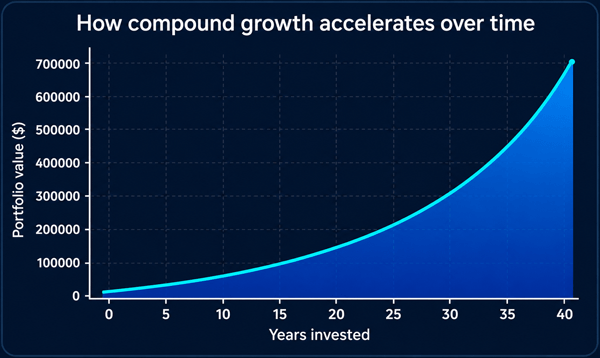
Figure. How compound growth accelerates over time
2. Why compound interest feels slow in the beginning
Many beginners feel disappointed in the first few months because they expect compounding to look dramatic right away. In real life, it often starts quietly. A small portfolio cannot produce huge gains because there is not much money working yet. But every contribution, every reinvested dividend, and every year in the market adds more “snow” to the snowball.
This is why experienced long-term investors often talk less about predicting next week’s market and more about staying invested through many market cycles. The early years are mostly about building the base. The later years are where compounding can become more visible.
3. How compound interest works in stock market investing
There are four main engines behind compounding in a stock market portfolio: capital growth, dividend reinvestment, regular contributions, and time.
3.1 Capital growth
If you buy shares of a company, mutual fund, or exchange-traded fund (ETF), the price may rise over time as the underlying businesses grow. If your $1,000 investment grows by 8%, it becomes $1,080. If that $1,080 grows by 8% the next year, the gain is $86.40 instead of $80. Your return is now being earned on a larger base.
3.2 Dividend reinvestment
Some stocks and funds pay dividends. If you spend those dividends, they no longer compound. If you reinvest them, they can buy more shares. Those extra shares may later produce their own dividends and gains. This is one reason dividend reinvestment plans are popular among long-term investors.
3.3 Regular contributions
Compounding works best when you keep feeding it. A person who invests $100, $200, or $500 every month is not relying only on one lump sum. They are adding new money during good markets and bad markets. Over time, steady contributions can become more important than trying to find the perfect day to invest.
3.4 Time
Time is the hardest part because it requires patience. Compounding needs years, not weeks. A beginner who starts small at 25 may have an advantage over someone who waits until 40, even if the later investor earns more money, because the early investor gave compounding more time to work.
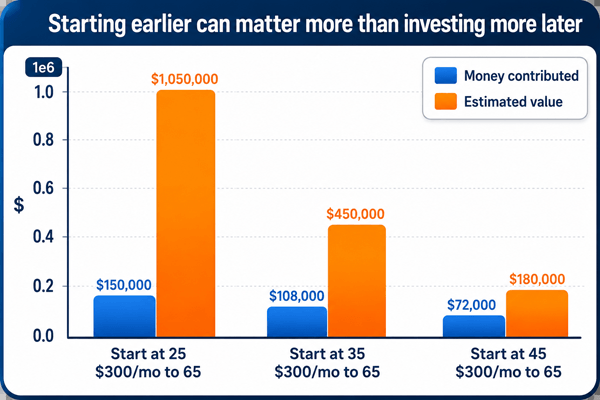
Figure. Starting earlier can matter more than investing more later
4. A practical example anyone can understand
Imagine Sara starts investing $200 per month in a diversified stock market ETF. She does not try to pick hot stocks. She invests regularly, reinvests dividends, and avoids selling during normal market drops. If her portfolio earns an average annual return of 8% over 30 years, her total contributions would be $72,000. Her estimated portfolio value could be about $298,000 before taxes and fees.
Now imagine she waits 10 years and starts at the same $200 per month for only 20 years. At the same assumed 8% annual return, her contributions would be $48,000 and her estimated value could be about $118,000. The difference is not just the missing $24,000 of contributions. The bigger difference is the missing 10 years of compounding.
5. Compound interest vs simple interest
| Feature | Simple interest | Compound growth in investing |
|---|---|---|
| How growth is calculated | Only on the original amount | On the original amount plus past gains |
| What it feels like | Linear and predictable | Slow at first, then faster over time |
| Example | A fixed bond-like payment | Stocks, ETFs, mutual funds with reinvested returns |
| Risk level | Can be low if fixed and guaranteed | Market-based; returns can be negative in some periods |
| Best use | Short-term certainty | Long-term wealth building when risk is suitable |
6. What beginners should know before using compounding in the stock market
6.1 Compounding needs money you can leave invested
Do not invest rent money, emergency money, or money needed in the next few months just because compounding sounds attractive. Stock market investing is best suited for long-term goals because markets can fall sharply in the short term. Many investors build an emergency fund first, then invest money they can leave alone for years.
6.2 Diversification protects you from one bad decision
A beginner may be tempted to buy one exciting stock and hope it compounds forever. Sometimes that works, but often it does not. A diversified index fund or ETF spreads your money across many companies, sectors, or even countries. This does not remove risk, but it can reduce the damage from one company failing or one sector struggling.
6.3 Fees quietly reduce compounding
A 1% annual fee may sound small, but over decades it can take a meaningful bite out of returns. Beginners should compare expense ratios, trading costs, account fees, advisory fees, and tax costs. Low-cost index funds and ETFs are often discussed by long-term investors because lower costs leave more money inside the compounding machine.
6.4 Taxes matter
Taxes can slow compounding when gains or dividends are paid out and taxed. Tax-advantaged retirement accounts, where available, can help investors keep more money invested for longer. The right account depends on the country, income level, and goal, so it is wise to understand local tax rules or speak with a qualified tax professional.
6.5 Your behavior matters more than the formula
The compound interest formula is simple. The hard part is staying consistent when markets are scary, boring, or exciting. People often hurt their own returns by buying after big hype, selling after big drops, chasing trends, or changing strategy too often. Long-term compounding rewards discipline more than constant action.
7. How beginners can practically use the power of compounding
7.1 Choose a clear goal
A goal gives your investing plan a purpose. Are you investing for retirement, a house in 10 years, children’s education, or general wealth building? The longer the goal, the more room you may have for stock market exposure. The shorter the goal, the more careful you need to be with risk.
7.2 Open the right type of investment account
Depending on your country, this may be a standard brokerage account, retirement account, employer-sponsored plan, robo-advisor account, or tax-advantaged investment account. Beginners should compare regulation, fees, fund choices, account minimums, customer support, withdrawal rules, and tax treatment.
7.3 Start with diversified funds before individual stocks
Many beginners do better by starting with broad index funds, mutual funds, or ETFs instead of trying to pick individual winners. A broad stock market ETF can provide instant diversification, while a bond fund or cash allocation can reduce volatility depending on risk tolerance.
7.4 Automate contributions
Automatic investing removes the pressure of deciding every month. It also helps avoid emotional timing. When money is invested on a schedule, you are more likely to stay consistent, even when headlines are noisy.
7.5 Reinvest dividends
Turning on dividend reinvestment can make compounding more automatic. Instead of dividends sitting as idle cash, they buy more shares. Over decades, this small setting can make a large difference.
7.6 Review, but do not overreact
Checking your portfolio every hour can make investing feel like gambling. A better habit is to review periodically: maybe monthly for contributions and annually for asset allocation. Rebalancing once or twice a year can help keep risk aligned with your plan.
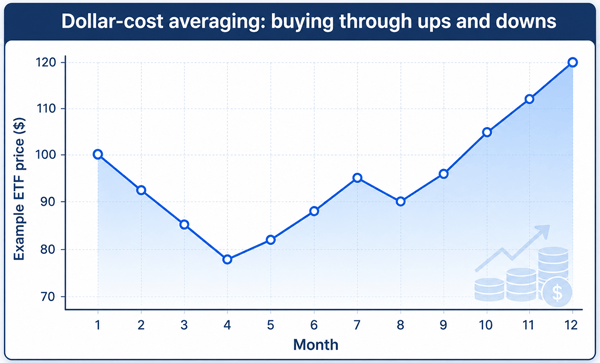
Figure. Dollar-cost averaging: buying through ups and downs
8. Dollar-cost averaging and compounding
Dollar-cost averaging means investing a fixed amount on a regular schedule, such as every week or month. When prices are high, your fixed amount buys fewer shares. When prices are low, it buys more shares. This does not guarantee profit and does not protect against losses, but it can help beginners avoid the stress of trying to time the market.
For many ordinary investors, dollar-cost averaging is not about beating everyone else. It is about building the habit that allows compounding to continue. A person who invests steadily for 20 years may do better than someone who keeps waiting for the “perfect entry” and never starts.
9. The role of dividends in compound growth
Dividends can be useful because they provide cash flow from investments. But for long-term compounding, the key question is what you do with those dividends. Reinvested dividends can buy more shares, and those additional shares can create more future dividends.
However, dividend investing should not be treated as a shortcut. A very high dividend yield can sometimes be a warning sign that the market expects the payout to be cut. Beginners should look at the quality of the business, fund diversification, payout sustainability, fees, and total return, not yield alone.
10. The biggest mistakes that stop compounding
| Mistake | Better beginner habit |
|---|---|
| Starting late because the amount feels small | Small amounts can become meaningful when repeated for years. |
| Selling during every market drop | Normal volatility is part of stock investing; panic selling can lock in losses. |
| Chasing hot stocks and viral tips | A lucky win can create overconfidence; a bad pick can damage years of savings. |
| Ignoring fees and taxes | Costs that look tiny each year can reduce long-term compounding. |
| Not reinvesting dividends | Uninvested cash may miss future growth. |
| Changing strategy too often | Compounding needs consistency; constant switching resets the process. |
11. What experienced investors often learn the hard way
People who have invested through real market cycles often share a similar lesson: the math is easy, but the emotions are hard. During a bull market, everyone feels like a genius. During a crash, even good investments can feel unsafe. The investors who benefit most from compounding are usually not the ones who predict every turn. They are the ones who create a reasonable plan and keep following it.
Another common experience is regret about waiting too long. Many people wish they had started with small amounts earlier instead of waiting until they felt “rich enough” to invest. Compounding does not require perfection at the beginning. It requires time and a repeatable process.
A third lesson is that boring can be powerful. A low-cost diversified ETF, automatic monthly investing, and dividend reinvestment may not sound exciting. But boring systems are often easier to maintain than complicated strategies that depend on constant prediction.
12. Helpful facts and realistic expectations
Historically, broad stock market indexes such as the S&P 500 have produced strong long-term returns, but the path has never been smooth. Investors have experienced recessions, inflation shocks, wars, crashes, banking stress, technology bubbles, and long flat periods. This is why a long-term average should never be confused with a guaranteed yearly result.
A simple way to think about expectations is this: compounding is powerful, but it is not instant, guaranteed, or risk-free. A good investment plan should survive bad years, not only look good in a spreadsheet.
Rule of 72
The Rule of 72 is a quick estimate: divide 72 by the annual return to estimate how many years it may take money to double. At 8%, 72 ÷ 8 = about 9 years. This is only a rough educational shortcut, not a promise.
13. Sample beginner plan: simple, honest, and practical
Here is a beginner-friendly framework. It is not personal financial advice, but it shows how someone might structure a compounding plan responsibly.
- Build an emergency fund before investing aggressively.
- Pay attention to high-interest debt because debt interest can compound against you.
- Choose a regulated brokerage or retirement account provider.
- Use low-cost diversified index funds or ETFs as the core portfolio.
- Automate monthly contributions based on income and budget.
- Reinvest dividends when the goal is long-term growth.
- Review asset allocation once or twice a year.
- Increase contributions when income rises, instead of upgrading lifestyle immediately.
- Avoid investing money needed soon.
- Speak with a qualified financial advisor or tax professional when decisions are complex.
14. Example portfolio thinking for beginners
A beginner does not need a complicated portfolio to benefit from compounding. The exact allocation depends on age, goals, risk tolerance, income stability, local market access, and tax rules. But the thinking can be simple: own productive assets, diversify, keep costs low, and stay consistent.
| Investor type | Possible focus | Main caution |
|---|---|---|
| Young long-term investor | Higher stock allocation through diversified ETFs or index funds | Must tolerate volatility without panic selling |
| Family saver with 10-15 year goal | Balanced mix of stocks, bonds, and cash reserves | Avoid taking stock risk with money needed soon |
| Near-retirement investor | Capital preservation, income planning, and lower volatility | Sequence-of-returns risk becomes more important |
| Hands-off beginner | Robo-advisor or target-date style fund where available | Still compare fees, risk level, and tax impact |
15. Frequently Asked Questions
15.1 Is compound interest guaranteed in the stock market?
No. Stock market compounding depends on market returns, dividends, reinvestment, time, and investor behavior. Unlike a guaranteed savings product, stocks can lose value, especially in the short term.
15.2 How much money do I need to start investing?
You can often start with a small amount, depending on your brokerage account or fund minimums. The habit matters more than the starting amount.
15.3 Is it better to invest monthly or wait for a market crash?
For beginners, investing monthly is usually easier and more realistic than waiting for a perfect crash. Waiting can turn into years of missed compounding.
15.4 Do dividends help compound interest?
Yes, when dividends are reinvested. Reinvested dividends can buy more shares, which may create more future income and growth.
15.5 Can compound interest make me rich?
It can help build wealth over time, but it is not a guarantee. Results depend on contributions, returns, fees, taxes, inflation, risk, and discipline.
15.6 What is the best investment for compounding?
There is no single best investment for everyone. Many beginners start with diversified index funds or ETFs because they are simple, low-cost, and broad. The right choice depends on personal goals and risk tolerance.
16. Final thoughts
The power of compound interest in stock market investing is not about getting rich overnight. It is about giving good investments enough time to work. For beginners, the most practical path is usually simple: start with money you can leave invested, use diversified funds, keep fees low, reinvest dividends, contribute regularly, and avoid emotional decisions.
The earlier you start and the longer you stay consistent, the more compounding can do. But the most honest lesson is this: compounding rewards patience, not hype. A steady, realistic plan is far more useful than a perfect-sounding strategy that you cannot follow when markets become uncomfortable.
Sources Consulted and Checked
These sources were consulted and checked while preparing this article to support accuracy, clarity, and responsible presentation of the information.
- Investor.gov Compound Interest Calculator: Used for the general educational idea that compounding shows how money may grow over time.
- FINRA Investor Education: Investing Basics and Tips for New Investors: Used for beginner principles such as goals, time frame, diversification, patience, and risk awareness.
- Fidelity Learning Center: S&P 500 average return article, March 2026: Used as a general source for long-term S&P 500 return context; exact future returns are not guaranteed.
Reader Advice
This article is provided for educational and informational purposes only. It does not constitute personal financial, investment, tax, legal, or accounting advice, and it should not be treated as a recommendation to buy, sell, or hold any security or financial product. Investing in the stock market involves risk, including market volatility and the possible loss of principal. Examples, assumed rates of return, and projected values are illustrative only; actual results may differ because of market performance, fees, taxes, inflation, timing, and investor behavior. Rules, account features, tax treatment, investment products, and regulatory requirements may vary by country and may change over time.
Before making any financial decision, verify current facts, figures, eligibility requirements, fees, and rules through official or regulated sources, assess your goals and risk tolerance, and consider consulting a qualified financial adviser, tax professional, or legal professional where appropriate.