What Is Day Trading in the Stock Market and Is It Profitable?
1. What is day trading in simple words?
Day trading means buying and selling a financial instrument within the same trading day. A day trader may buy shares of a stock in the morning and sell them a few minutes or hours later. The goal is not to own a business for years. The goal is to benefit from a small short-term price move.
For example, imagine a stock is trading at $50.00. A trader believes strong news and high trading volume may push it to $50.80 during the day. The trader buys 100 shares at $50.00 and sells at $50.80. The gross profit is $80 before fees, taxes, spreads, slippage, and possible borrowing or margin costs. The same trade can also go wrong quickly. If the stock falls to $49.20 and the trader exits, the loss is $80 before costs.
That is the heart of day trading: fast decisions, small price movements, strict risk control, and no promise of profit.
2. How day trading works step by step
A professional-looking day trade usually starts before the market opens. The trader checks news, earnings, economic events, pre-market movement, volume, support and resistance levels, and overall market direction. Then the trader creates a plan: where to enter, where to exit if right, where to exit if wrong, and how much money to risk.
A beginner often thinks the most important question is, 'Which stock will go up today?' Experienced traders usually ask a different question: 'Where is my risk, and is the possible reward worth that risk?' This mindset protects them from turning one bad trade into a large account-damaging loss.
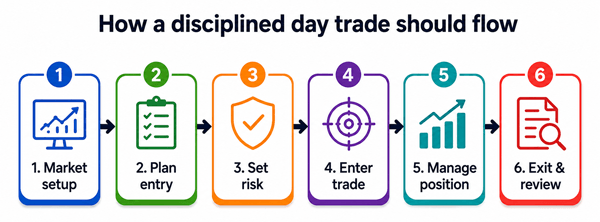
Figure 1. A simple day-trading workflow
3. The basic mechanics beginners should understand
Day trading happens through an online brokerage account or trading platform. The platform shows real-time or delayed prices, order buttons, charts, account balance, positions, and risk controls. Many beginners start with a stock trading app because it feels simple, but a clean app does not make trading easy. The hard part is judgment under pressure.
Common order types include market orders, limit orders, stop orders, and stop-limit orders. A market order tries to fill immediately but may fill at a worse price in fast markets. A limit order gives price control but may not fill. A stop-loss order can help define risk, but it is not a guarantee because gaps and volatility can create slippage.
Day traders often look for liquidity, volatility, volume, news catalysts, and clean price levels. Liquidity means there are enough buyers and sellers to enter and exit without a large price difference. Volatility means the price moves enough to create opportunity, but too much volatility can also make losses faster.
4. Day trading vs investing vs swing trading
Many people confuse day trading with normal investing. They are very different. Investing focuses on business quality, valuation, dividends, long-term growth, and time in the market. Day trading focuses on short-term price behavior, volume, technical analysis, news, and execution speed.
Swing trading sits between the two. A swing trader may hold for several days or weeks. A day trader tries to close positions before the market closes to avoid overnight news risk. This can reduce one type of risk but increase another: pressure to make quick decisions.
| Approach | Typical holding time | Main focus | Skill needed | Common risk |
|---|---|---|---|---|
| Long-term investing | Years | Business quality, valuation, diversification | Research and patience | Market downturns, poor company selection |
| Swing trading | Days to weeks | Trend, momentum, chart patterns, catalysts | Timing and risk control | Overnight gaps and news |
| Day trading | Seconds to one day | Intraday price movement, volume, execution | Fast decisions and emotional discipline | Large losses from leverage, overtrading, slippage |
5. Is day trading profitable?
Yes, day trading can be profitable for a small number of skilled, disciplined, well-capitalized traders. But for most beginners, it is not profitable. This is the honest answer readers need before risking real money.
Several reasons make day trading difficult. Short-term price movement is noisy. Professional firms use faster technology, better data, advanced trading software, and sometimes algorithmic execution. Retail traders face spreads, slippage, emotional mistakes, taxes, and the temptation to use margin trading or options trading before they understand the risk.
A well-known study of Brazilian day traders found that 97% of individuals who persisted for more than 300 days lost money, and only a very small fraction earned more than a basic wage. FINRA and the SEC also warn that frequent intraday trading, especially on margin, can lead to losing some or all of the money invested, and leveraged trading can sometimes create losses larger than the original investment.
This does not mean every profitable trader is fake. It means profitability is rare, unstable, and usually built on years of practice, record keeping, emotional control, and strict position sizing. A beginner should treat day trading as a high-risk skill to study, not as a quick income plan.
6. Why so many beginners lose money
The most common beginner problem is not lack of intelligence. It is the combination of speed, emotion, uncertainty, and easy access. A beginner sees a green candle, buys late, panics on a pullback, sells at a loss, then immediately tries to win it back. This cycle is called revenge trading, and it is one of the fastest ways to damage a small account.
Beginners also underestimate costs. Even if a broker advertises commission-free stock trading, the trader may still face bid-ask spreads, poor fills, options contract fees, margin interest, platform fees, market data fees, taxes, and opportunity cost. A strategy that looks profitable on a chart may not survive real-world costs.
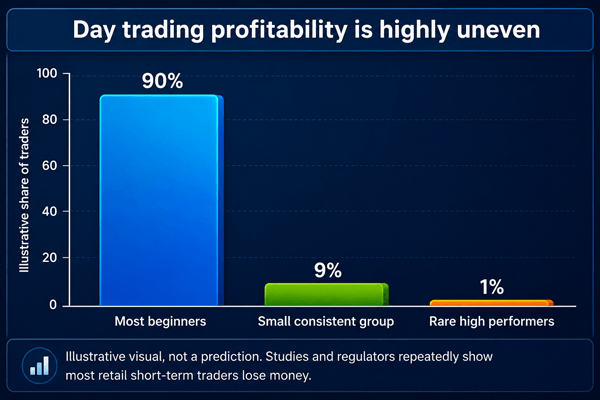
Figure 2. Why day trading profits are not evenly distributed
7. A practical day-trading example
Suppose a trader has a $5,000 cash account and decides to risk only 1% on one trade. That means the maximum planned loss is $50. A stock is trading near $25.00 after strong news. The trader plans to buy only if the price breaks above $25.20 with strong volume. The stop is $24.95, so the risk is $0.25 per share. If the trader risks $50, the position size is 200 shares ($50 divided by $0.25).
The target is $25.70, which offers a possible gain of $0.50 per share. That is a 2-to-1 reward-to-risk setup: possible $100 gain versus planned $50 loss. If the price reaches the target, the trade works. If it hits the stop, the trader exits and accepts the small loss.
Now compare this with a beginner who buys 1,000 shares because the stock 'looks strong' and has no stop. A small $0.50 drop creates a $500 loss, or 10% of the account. One emotional trade can undo many good decisions. This is why position sizing matters more than exciting predictions.
| Item | Disciplined example | Undisciplined example |
|---|---|---|
| Account size | $5,000 | $5,000 |
| Risk plan | 1% or $50 maximum planned loss | No clear limit |
| Shares | 200 shares | 1,000 shares |
| Stop distance | $0.25 | No stop or moving stop lower |
| Loss if trade fails | About $50 before slippage | Could be $500 or more |
| Lesson | Risk is defined before entry | Position is too large for the account |
8. What beginners should know before trying day trading
Before a beginner places a real trade, they should understand that day trading is not a salary, not a guaranteed side hustle, and not a shortcut to wealth. It is closer to running a small high-risk trading business where every decision has a cost.
The first goal should not be to make money. The first goal should be to avoid large losses while learning how markets move.
- Use a demo account or paper trading journal before risking real money.
- Learn order types, bid-ask spread, volume, volatility, and stop-loss behavior.
- Trade small enough that one loss does not affect rent, bills, family money, or mental health.
- Avoid borrowed money, credit cards, personal loans, and emergency savings.
- Keep a written trading journal with entry, exit, reason, emotion, mistake, and screenshot.
- Never trust anyone promising guaranteed returns, secret signals, or risk-free income.
9. Useful tools for day trading
A trader does not need the most expensive trading software on day one, but they do need reliable tools. A good online brokerage account should provide clear order execution, transparent fees, strong security, educational resources, risk controls, and responsive support. Some active traders also pay for real-time data, advanced charting, scanners, and backtesting tools.
- Broker reliability and regulation
- Commission, spread, contract, data, and margin costs
- Order types and risk controls
- Charting and scanner quality
- Execution speed and platform stability
- Mobile app safety, especially avoiding emotional trading from a phone
10. Common day-trading strategies beginners hear about
Beginners will hear names such as scalping, momentum trading, breakout trading, reversal trading, news trading, gap trading, and opening range breakout. These are not magic systems. They are frameworks for reading short-term price behavior.
A strategy only matters if it has clear rules: market condition, entry trigger, invalidation point, target, position size, maximum daily loss, and review process. Without rules, a strategy becomes guessing with a chart.
- Scalping: very short trades aiming for tiny moves; requires speed and discipline.
- Momentum trading: following strong price movement with high volume; risky if entry is late.
- Breakout trading: buying above resistance or selling below support; false breakouts are common.
- Reversal trading: betting that an extended move will reverse; dangerous without confirmation.
- News trading: reacting to earnings, economic data, or headlines; slippage can be severe.
11. Margin, leverage, and the changing U.S. day-trading rules
Margin means borrowing from the broker to increase buying power. Leverage can magnify profit, but it also magnifies losses. In fast markets, leverage can turn a small move into a serious loss before the trader has time to react.
For many years, U.S. traders heard about the Pattern Day Trader rule and the $25,000 minimum equity requirement for frequent day trading in margin accounts. Effective June 4, 2026, FINRA's new intraday margin standards replaced that framework. The updated rules no longer use the old pattern-day-trader trade-count designation or its $25,000 minimum, and instead calculate intraday margin based on account equity and intraday exposure. A $2,000 minimum generally still applies to margin accounts, while broker implementation, account eligibility, house requirements, and local rules can vary. Readers should check their own broker and jurisdiction before trading.
The practical lesson is unchanged: lower barriers do not mean lower risk. A smaller account can still lose money quickly if the trader uses too much buying power.
12. Day trading stocks, options, futures, crypto, and CFDs
Stock day trading is the simplest conceptually because the trader buys or sells shares. Options trading is more complex because price depends on the underlying stock, time decay, volatility, strike price, expiration, and liquidity. Futures can offer high leverage. Crypto trades nearly 24/7, which can increase emotional overtrading. CFDs and spread bets, where available, are highly risky leveraged products; UK regulators have stated that around 80% of customers lose money on CFDs.
Beginners should not jump from basic stock trading to leveraged products just because online ads make them look exciting. Complexity does not create an edge. Usually it adds more ways to lose money.
13. Taxes, records, and real business-like discipline
Profitable trading can create tax obligations, and frequent trading creates record-keeping complexity. Rules differ by country and by product. In the U.S., short-term gains are generally taxed differently from long-term capital gains, and active traders may need to understand wash sale rules. Readers should consult a qualified tax professional for their location.
A serious trader keeps records like a business owner. They track win rate, average win, average loss, maximum drawdown, fees, slippage, time of day, strategy type, and emotional notes. Without data, the trader cannot know whether they have a real edge or are simply remembering the exciting wins.
| Beginner question | Good sign | Warning sign |
|---|---|---|
| Do I understand the trade? | Can explain entry, exit, stop, and risk in one minute | Buying because of a social media post or fear of missing out |
| Can I afford the loss? | Loss is small and planned | Loss would affect bills, family, or sleep |
| Am I using leverage? | No leverage or very controlled margin | Borrowed money, oversized position, or options without understanding Greeks |
| Do I keep records? | Every trade logged and reviewed | Only remembers big wins and ignores small repeated losses |
| Is the strategy tested? | Paper trading and small real tests show consistency | A guru says it works but shows no audited evidence |
14. A realistic beginner learning path
A beginner who still wants to explore day trading should move slowly. The aim is to learn market behavior without exposing the account to unnecessary damage.
- Month 1: Learn market basics, order types, risk, charts, and common scams.
- Month 2: Paper trade one simple setup and record every trade.
- Month 3: Review at least 50 to 100 paper trades. Look for repeated mistakes.
- Month 4: If results and discipline are stable, trade very small with money you can afford to lose.
- Ongoing: Keep maximum daily loss limits, avoid increasing size after wins, and take breaks after emotional trades.
15. Red flags: when day trading content is misleading
Responsible financial content should be honest, balanced, and helpful. It should not manipulate readers with unrealistic promises. Readers should be warned about common marketing traps.
- Guaranteed profit claims
- Screenshots of gains without full account history and losses
- Pressure to join a paid signal group quickly
- Claims that a strategy works in every market
- Promoters who make more from courses, affiliate commissions, or broker referrals than from verified trading
- Advice to use debt, margin, or oversized options positions
16. Safer alternatives for many beginners
Some readers search for day trading because they want financial progress. It is helpful to show alternatives that may fit them better.
- Long-term diversified investing through low-cost funds
- Dollar-cost averaging for investors with regular income
- Learning fundamental analysis before active trading
- Swing trading with smaller position sizes and wider time frames
- Building income skills or a business instead of relying on daily market profits
- Using paper trading as education rather than treating trading as income
17. Frequently asked questions
17.1 Is day trading gambling?
Day trading is not automatically gambling, but it can become gambling-like when a person trades without a plan, chases losses, uses money they cannot afford to lose, or relies on excitement instead of evidence. A planned trade has defined risk, clear rules, and a review process.
17.2 How much money do you need to start day trading?
The amount depends on country, broker, product, account type, and margin rules. A beginner should start with education and paper trading first. When using real money, the amount should be money they can afford to lose, not emergency savings or borrowed money.
17.3 Can you make a living from day trading?
A small number of traders can, but research and regulator warnings suggest most retail traders lose money. Treat day trading as a difficult high-risk profession, not an easy work-from-home income plan.
17.4 What is the best trading platform for beginners?
The best trading platform for beginners is not necessarily the one with the most features. Beginners should compare regulation, fees, security, order controls, educational tools, usability, and customer support. The platform should help control risk, not encourage impulsive trading.
17.5 Should beginners use options for day trading?
Most beginners should avoid day trading options until they understand stocks, volatility, time decay, liquidity, spreads, and position sizing. Options can move fast and lose value quickly.
17.6 What is the biggest mistake new day traders make?
The biggest mistake is usually risking too much before they have a proven process. Other common mistakes include revenge trading, overtrading, ignoring stop losses, following social media alerts, and increasing size after a lucky win.
18. Final verdict: should beginners day trade?
Day trading is the act of opening and closing trades within the same trading day. It can look simple because modern stock trading apps and online brokerage platforms make buying and selling easy. But easy access is not the same as easy profit.
The honest answer is that day trading is profitable for a small minority and unprofitable for many beginners. The people who survive usually treat it as a serious skill: they manage risk, keep records, avoid hype, understand costs, and accept small losses quickly. The people who lose often treat it as entertainment, prediction, or a shortcut.
For a beginner, the safest first step is education, paper trading, and learning risk management before placing real trades. If they eventually trade, they should use small size, avoid leverage until they truly understand it, and never risk money needed for normal life. In trading, protecting capital is not boring. It is the foundation.
Sources Consulted and Checked
The following sources were consulted when preparing this article and checking its accuracy. Rules, regulator guidance, broker policies, tax treatment, and market practices may change, so readers should verify current information directly with the relevant official source before acting.
- FINRA, Frequent Intraday Trading: Understanding the Basics (June 4, 2026)
- FINRA, Understanding the New Intraday Margin Requirements (April 20, 2026)
- FINRA Regulatory Notice 26-10, New Intraday Margin Standards (April 20, 2026)
- Investor.gov / SEC, Thinking of Day Trading? Know the Risks
- Investor.gov / SEC, Day Trading glossary
- Chague, De-Losso and Giovannetti, Day Trading for a Living?
- Barber et al., The Cross-Section of Speculator Skill: Evidence from Day Trading
- UK Financial Conduct Authority, Concerns About Problem Firms in the CFD Sector (December 1, 2022)
Reader Advice
This article is provided solely for educational and informational purposes and does not constitute financial, investment, legal, tax, accounting, or other professional advice. It does not recommend or endorse buying, selling, or holding any stock, option, ETF, cryptocurrency, CFD, futures contract, or other financial product, nor does it recommend any broker, platform, strategy, or service. Day trading and leveraged products involve substantial risk, and readers may lose some or all of the money committed, or more than the amount initially invested in certain leveraged arrangements.
Before making any financial decision, readers should consider their objectives, financial circumstances, risk tolerance, experience, local laws, tax obligations, and the terms and risks of the relevant account or product. They should independently verify facts, figures, fees, eligibility requirements, and regulatory rules through current official sources and, where appropriate, seek advice from a suitably qualified and licensed professional. Regulations, broker policies, market conditions, product features, and tax rules can change and may differ by country, jurisdiction, account type, and provider. Past performance, examples, and hypothetical calculations do not guarantee future results.