Bull Market vs Bear Market: Understanding Stock Market Cycles
1. Introduction: why these two words matter
You will hear investors say, “We are in a bull market,” or “A bear market is coming.” For a beginner, that can sound like secret Wall Street language. It is not. A bull market simply means prices are generally rising and confidence is strong. A bear market means prices are generally falling and fear is spreading. These two ideas help explain the mood, direction, and rhythm of the stock market.
The important point is this: bull and bear markets are not just lines on a chart. They affect how people feel, how companies raise money, how news is interpreted, and how beginners make decisions. In a bull market, many people feel smart because prices keep going up. In a bear market, many people feel foolish because even good investments can fall. Both feelings can lead to mistakes if you do not understand the cycle.
This guide explains bull market vs bear market in a simple, practical way. It is written for someone who has no background in investing. You will learn what each market means, how stock market cycles work, why prices rise and fall, what beginners should do, what mistakes to avoid, and how to use this knowledge without pretending to predict the future.
2. Simple definition: what is a bull market?
A bull market is a period when stock prices are rising over time, usually with positive investor sentiment. People are more willing to buy stocks because they believe companies will earn more money, the economy will improve, or future returns will be attractive. In plain language, a bull market is a season of confidence.
A common rule of thumb is that a bull market begins after a broad market index rises 20% or more from a recent low. This is not a perfect law of nature, but it is widely used by investors and financial media. The key idea is sustained upward movement, not just one good day or one good week.
During a bull market, you may notice headlines about record highs, strong earnings, IPO activity, popular growth stocks, rising retirement account balances, and people talking more openly about investing. Beginners often enter the market during this phase because everyone around them seems excited. That excitement can be useful if it gets someone started, but dangerous if it makes them ignore risk.
3. Simple definition: what is a bear market?
A bear market is a period when stock prices are falling over time and investor sentiment is negative. People become more cautious, sell risky assets, and worry about recession, high interest rates, weak profits, inflation, debt, or global events. In plain language, a bear market is a season of fear.
A common definition is a decline of 20% or more in a broad market index over at least a meaningful period, often discussed as roughly two months or longer. A bear market is more serious than normal daily volatility or a small correction. It is a broad decline that changes investor behavior.
During a bear market, even strong companies can fall in price. This confuses beginners because they assume a good company should always have a rising stock. In reality, stock prices reflect expectations, emotions, interest rates, liquidity, and risk appetite. A business can remain strong while its stock price temporarily drops because investors are demanding a cheaper price for taking risk.
4. Bull market vs bear market: quick comparison
| Feature | Bull market | Bear market |
|---|---|---|
| Main direction | Prices generally rise | Prices generally fall |
| Investor mood | Optimism, confidence, sometimes greed | Fear, caution, sometimes panic |
| Common headlines | Record highs, strong earnings, new opportunities | Recession worries, layoffs, inflation, weak earnings |
| Beginner risk | Buying too late because everyone is excited | Selling too low because everyone is scared |
| Useful behavior | Stay disciplined, avoid overconfidence | Stay calm, protect cash needs, avoid panic selling |
| Opportunity | Long-term wealth can grow as companies expand | Quality assets may become cheaper, but risk remains |
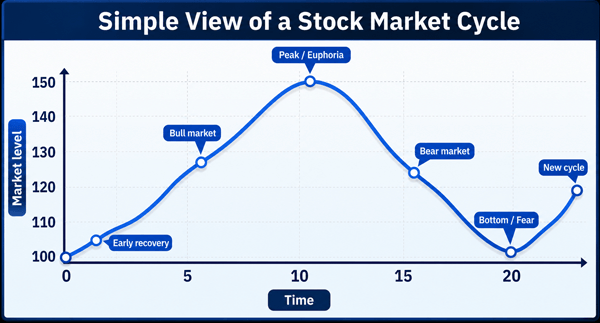
Figure 1. A simplified stock market cycle showing recovery, expansion, peak, decline, and the beginning of a new cycle.
5. How stock market cycles work
A stock market cycle is the repeating pattern of rising prices, peak excitement, falling prices, bottoming fear, and recovery. The exact timing is never predictable. One cycle may last months, another may last years. But the human behavior behind the cycle is surprisingly familiar.
A simple cycle has four stages. First comes recovery, when prices begin improving but many people still do not believe it. Second comes expansion, when earnings, confidence, and stock prices rise. Third comes the peak, when optimism becomes extreme and people start assuming good times will continue forever. Fourth comes decline, when expectations reset and prices fall until pessimism becomes too heavy. Then, eventually, a new recovery begins.
The market cycle does not move in a clean circle. It is messy. There can be corrections inside bull markets and sharp rallies inside bear markets. A beginner should not expect a perfect pattern. Instead, use the cycle as a mental map: when everyone is excited, ask whether expectations are too high; when everyone is fearful, ask whether prices may already reflect a lot of bad news.
6. Why bull markets happen
Bull markets usually happen when investors expect the future to be better than the recent past. Company profits may be growing. Interest rates may be falling. Inflation may be improving. Consumers may be spending. New technology may be creating excitement. The economy may be recovering from a downturn. When these forces combine, buyers become more willing to pay higher prices for stocks.
Another reason bull markets happen is liquidity. If money is available and investors feel there are few attractive alternatives, more capital can flow into stocks. This can push valuations higher. That is why a bull market is not only about company quality; it is also about what investors are willing to pay for future growth.
The danger is that a bull market can make risk look smaller than it is. People may use too much margin, buy speculative stocks, chase hot sectors, or believe every dip is a buying opportunity. A healthy bull market rewards patience and participation. An overheated bull market punishes people who confuse rising prices with guaranteed returns.
7. Why bear markets happen
Bear markets usually happen when expectations fall. Investors may worry that companies will earn less, interest rates will stay high, inflation will hurt consumers, credit will tighten, unemployment will rise, or a financial shock will spread. When investors become uncertain, they demand lower prices before they are willing to own stocks.
Bear markets also happen because previous optimism went too far. If stocks became expensive during a bull market, even a small disappointment can cause a large decline. This is why valuation matters. A great company bought at an unrealistic price can still become a painful investment for years.
The painful part of a bear market is that it tests behavior. Many beginners discover their real risk tolerance only after their portfolio falls. They thought they were long-term investors, but a 25% drop makes them want to sell everything. This does not mean they are weak; it means they did not build a plan before emotions arrived.
8. Correction, crash, recession, and bear market: what is the difference?
A market correction is usually a decline of about 10% from a recent high. Corrections are common and can happen even in strong bull markets. They often feel scary in the moment but do not always become bear markets.
A stock market crash is a sudden, sharp drop in prices, often driven by panic, forced selling, or a major shock. A crash can happen inside a bear market, or it can be a short event that later stabilizes.
A recession is an economic downturn, not the same thing as a bear market. A bear market is about stock prices. A recession is about the broader economy: production, income, employment, spending, and business activity. They often overlap, but not always. The stock market may start falling before a recession is officially recognized, and it may start recovering before the economy feels better.
9. How beginners can actually use this knowledge
The goal is not to predict every bull and bear market. Most people cannot do that consistently. The practical use is to make better decisions when the market mood changes. When you understand cycles, you stop treating every rise as proof that you are a genius and every fall as proof that investing is broken.
In a bull market, use the good times to strengthen your plan. Rebalance if your stock allocation has grown too large. Avoid borrowing money to chase returns. Keep your emergency fund separate. Review whether your investments still match your goals. Do not buy something only because it is trending on social media.
In a bear market, use the bad times to protect your behavior. Do not sell long-term investments just because prices are down. Check whether you need cash soon. If you have a long time horizon and a diversified plan, continuing regular investments can help you buy at lower prices. But do not invest money you may need for rent, bills, debt payments, medical needs, or short-term goals.
10. A practical example: two beginners in the same market
Imagine Sara and Ali both start investing with $5,000. They both buy a diversified stock market ETF. During the first year, the market rises 25%. Sara feels happy but keeps investing the same monthly amount. Ali feels excited and adds money he was saving for a house deposit because he thinks the market will keep rising.
Then the market falls 30%. Sara is uncomfortable, but she still has her emergency fund and does not need to sell. She reviews her plan, continues small monthly contributions, and accepts that downturns are part of long-term investing. Ali panics because he needs some of the money soon. He sells near the bottom to protect what is left.
They owned the same investment, but their results became different because their behavior and time horizon were different. The lesson is simple: the best investment can still be wrong if it is bought with money you cannot afford to keep invested. Market cycles reward planning more than excitement.
11. What experienced investors often learn the hard way
Many experienced investors have a similar story: their first serious mistake was not buying a bad company, but reacting emotionally. Some bought aggressively after a long rally because they feared missing out. Some sold during a bear market and waited too long to re-enter. Some held a concentrated stock position because it had worked before, then watched one company damage the whole portfolio.
The experience-based lesson is that investing is not only about intelligence. It is about process. A simple process may include automatic monthly investing, a diversified portfolio, a written target allocation, a rule for rebalancing, and a decision not to check prices every hour. These habits sound boring, but boring can be powerful.
People also learn that news feels most convincing at the worst times. Near market peaks, positive stories sound unstoppable. Near market bottoms, negative stories sound permanent. A beginner should respect the news but not let headlines become a complete investment strategy.
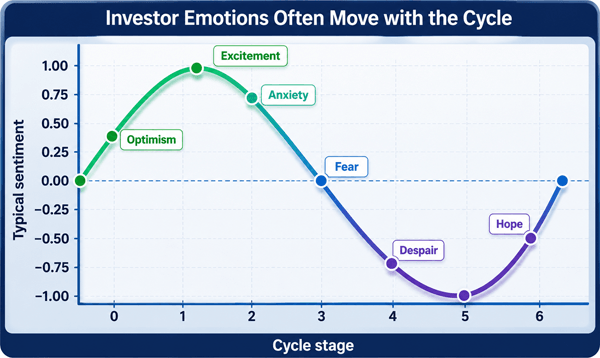
Figure 2. Typical investor emotions across a market cycle, from optimism and excitement to fear, despair, and hope.
12. What to do in a bull market
A bull market is not a signal to become careless. It is a time to participate with discipline. If you are investing for retirement or another long-term goal, keep your regular contributions going. But also check whether your portfolio has become too risky. A rising stock market can quietly turn a balanced portfolio into an aggressive one.
For example, suppose your original plan was 70% stocks and 30% bonds or cash-like assets. After a strong bull market, your portfolio may become 85% stocks. That can feel great while prices rise, but it can hurt more in a downturn. Rebalancing means selling a little of what grew too much and adding to what fell behind. It is a disciplined way to reduce risk without guessing the market top.
Beginners should also be careful with hot tips. In bull markets, stories spread fast: artificial intelligence stocks, crypto-related stocks, electric vehicles, biotech, small caps, meme stocks, or any sector that is popular at the time. Some may become real winners, but many will not. If you want to take a small speculative position, keep it small enough that a loss will not damage your financial life.
13. What to do in a bear market
A bear market is not a signal to quit forever. It is a time to protect your financial stability and avoid panic. First, separate money by time horizon. Money needed in the next one to three years should generally not be exposed heavily to stocks. Long-term money can usually tolerate more volatility because it has time to recover.
Second, review your diversification. A portfolio concentrated in one stock, one sector, or one country may fall harder than expected. Diversification does not remove risk, but it can reduce the damage from one bad investment. Broad index funds and ETFs are common tools beginners use for diversification, although every product still has fees, risks, and tax considerations.
Third, avoid all-or-nothing decisions. Many beginners think they must either sell everything or buy aggressively. A better approach is often gradual. If you already have a plan, continue it. If you want to invest more during a downturn, consider spreading purchases over time. This reduces the pressure of trying to pick the exact bottom, which is nearly impossible in real life.
14. Dollar-cost averaging: useful but not magic
Dollar-cost averaging means investing a fixed amount at regular intervals, such as every month. When prices are high, your fixed amount buys fewer shares. When prices are low, it buys more shares. This can be helpful for beginners because it removes the need to decide whether today is the perfect day to invest.
However, dollar-cost averaging is not magic. It does not guarantee profit or prevent losses. It works best when combined with a long time horizon, a diversified investment, and the emotional ability to keep going during downturns. Its biggest benefit may be behavioral: it turns investing into a habit instead of a series of emotional decisions.
A simple example: if you invest $200 every month into a diversified fund, a bear market may feel less like a disaster and more like a period when your future purchases are cheaper. This mindset is easier to maintain when your emergency fund is already built and you are not investing borrowed money.
15. Asset allocation: the beginner tool that matters more than predictions
Asset allocation means deciding how much of your money goes into stocks, bonds, cash, and other assets. This decision often matters more than trying to pick the best stock or predict the next market cycle. A young investor with a stable income and a 30-year time horizon may hold more stocks. Someone close to retirement or saving for a near-term goal may need more stability.
There is no perfect allocation for everyone. The right mix depends on your goals, time horizon, risk tolerance, income stability, debt, family responsibilities, and local tax rules. A beginner should avoid copying someone else’s portfolio without understanding their situation. The same aggressive portfolio that works for one person may be completely unsuitable for another.
A practical test is this: imagine your stock investments fall 30%. Would you stay invested, reduce spending, continue contributions, and sleep reasonably well? Or would you panic and sell? Your honest answer tells you more about your risk tolerance than any online quiz.
16. How bull and bear markets affect different types of investors
Long-term retirement investors usually benefit from focusing on consistency. Their biggest risk is often not one bear market, but stopping contributions, selling during panic, or investing too conservatively for decades. For them, market cycles are uncomfortable but expected.
Short-term traders experience bull and bear markets differently. They may try to profit from trends, volatility, short selling, options, or sector rotation. This requires skill, risk controls, and time. Beginners should be cautious because trading can look easy during a bull market and become expensive during sudden reversals.
Income-focused investors may care about dividends, bonds, and cash flow. Bear markets can create higher yields in some assets, but dividend cuts and credit risk are real. Growth investors may do very well in bull markets but suffer larger drawdowns when expectations change. Value investors may look for strong businesses that become cheaper during fear, but cheap stocks can remain cheap for a long time.
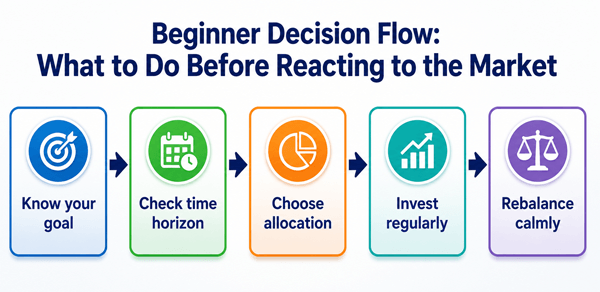
Figure 3. A beginner decision flow: define the goal, check the time horizon, choose an allocation, invest regularly, and rebalance calmly.
17. Beginner action checklist for bull and bear markets
| Situation | Useful action | Avoid this mistake |
|---|---|---|
| Market is rising fast | Review allocation, rebalance if needed, keep investing according to plan | Chasing every hot stock or using borrowed money |
| Market is falling fast | Check time horizon, keep emergency cash, avoid panic decisions | Selling long-term investments because of fear alone |
| You have cash to invest | Use a gradual plan, compare fees, focus on diversification | Trying to pick the exact bottom |
| You need money soon | Keep short-term money safer and more liquid | Putting rent, tuition, or emergency money into stocks |
| You feel emotional | Write down the reason before buying or selling | Making decisions after scary headlines or social media hype |
18. Common myths beginners should ignore
Myth 1: A bull market means every stock is safe. Reality: weak companies can rise in a bull market and still collapse later. Rising prices can hide poor business quality.
Myth 2: A bear market means investing is a scam. Reality: bear markets are part of stock market history. They are painful, but they also reset expectations and create future opportunities for disciplined investors.
Myth 3: You must predict the next market cycle to succeed. Reality: many successful long-term investors focus on saving regularly, diversifying, controlling costs, managing taxes, and avoiding emotional mistakes.
Myth 4: Cash is always bad in a bull market. Reality: cash has a purpose. It protects short-term needs and prevents forced selling. The problem is not holding cash; the problem is holding too much cash for long-term goals because of permanent fear.
Myth 5: More information always means better decisions. Reality: too much news can create anxiety. A simple plan followed consistently may beat a complicated plan abandoned under stress.
19. FAQ: bull market vs bear market
19.1 What is the main difference between a bull market and a bear market?
A bull market is a period of generally rising prices and confidence. A bear market is a period of generally falling prices and pessimism.
19.2 Is a bear market always bad?
It is painful for existing investors, but it can also create lower prices for long-term buyers. It is most dangerous for people who need money soon or who panic sell without a plan.
19.3 Should beginners invest during a bull market?
Beginners can invest during a bull market if they have a plan, a long-term goal, and proper diversification. They should avoid chasing hype or investing short-term cash.
19.4 Should beginners invest during a bear market?
Beginners with a long time horizon and stable finances may continue regular investing during a bear market. But they should first protect emergency savings and avoid investing money needed soon.
19.5 Can anyone predict when a bull or bear market will start?
Some people make forecasts, but no one can predict market turns consistently with certainty. A practical plan is more reliable than trying to guess every top and bottom.
19.6 What is the safest strategy for a beginner?
There is no risk-free stock strategy. Many beginners start with diversified funds, regular contributions, emergency savings, and an asset allocation that matches their goals and risk tolerance.
20. Conclusion: the simple lesson
Bull markets and bear markets are two sides of the same investing journey. A bull market teaches you not to become overconfident. A bear market teaches you not to become hopeless. Both can help you become a better investor if you respond with discipline instead of emotion.
For beginners, the best use of market cycle knowledge is not prediction. It is preparation. Build an emergency fund, understand your time horizon, diversify, control fees, invest regularly, rebalance when needed, and avoid decisions driven by fear or greed. The market will keep moving through cycles. Your advantage is having a plan before the next cycle tests you.
Sources Consulted and Checked
The following sources were consulted and checked while preparing this article to support accuracy, clarity, and responsible presentation. Readers should verify current facts, definitions, rules, and figures directly with official sources before acting on them.
- Investor.gov: Bear Market glossary; Introduction to Investing; Beginners’ Guide to Asset Allocation, Diversification, and Rebalancing; Diversification glossary.
- CIRO Office of the Investor: Understanding Bull and Bear Markets.
- Charles Schwab investor education: How to Invest During a Bear Market.
Reader Advice
This article is provided solely for educational and informational purposes. It is not personal financial, investment, legal, tax, or accounting advice, and it does not recommend any particular security, fund, strategy, brokerage, or course of action. Investing involves risk, including the possible loss of principal, and past market performance does not guarantee future results. Definitions, market conventions, regulations, tax rules, product terms, fees, and economic conditions may change over time and may differ by country, institution, and individual circumstances. Before making any financial decision, consider your goals, time horizon, financial position, risk tolerance, and need for liquidity; verify material facts and figures through current official or primary sources; review relevant product documents; and seek advice from an appropriately qualified professional where necessary.