How to Buy Stocks for Beginners: Step-by-Step Stock Market Guide
Buying your first stock can feel more complicated than it really is. Most beginners do not struggle because the stock market is impossible to understand. They struggle because every article, app, and video seems to use different words: brokerage account, portfolio, ETF, market order, limit order, dividend, margin, volatility, capital gains, and many more.
This guide explains stock investing as if you are starting from zero. You will learn what stocks are, how the stock market works, how to open the right kind of account, how to research an investment, how to place an order, and how to avoid the mistakes that usually hurt beginners. The goal is not to make you feel clever for one day. The goal is to help you make calmer, safer, more informed decisions for years.
The honest truth is simple: stocks can help build wealth over time, but they can also lose money. No website, influencer, trading app, or financial advisor can honestly promise guaranteed profits. Good investing is less about finding a “secret stock” and more about using a repeatable process: save first, understand risk, diversify, keep costs low, avoid panic, and give your investments enough time to work.
1. What is a stock?
A stock is a small ownership share in a company. When you buy a share of a company, you become a shareholder. You do not own the company’s buildings or products directly, and you do not get to walk into the office and take decisions. But you do own a small financial claim on the business.
If the company grows, earns more profit, and investors become more confident about its future, the stock price may rise. If the company performs poorly, faces competition, takes on too much debt, or the market loses confidence, the stock price may fall. Some companies also pay dividends, which are cash payments to shareholders. Dividends are not guaranteed and can be reduced or stopped.
Think of a stock like owning one tiny slice of a large business. If you buy one share of a company for $50 and later sell it for $70, you made a $20 gain before fees and taxes. If you sell it for $35, you lost $15. The price changes because buyers and sellers constantly disagree about what that company is worth today and what it may be worth in the future.
2. How does the stock market work in simple words?
The stock market is a regulated marketplace where shares are bought and sold. You usually do not buy directly from the company. You buy through a brokerage account, and your order is matched with someone who wants to sell. Stock exchanges and market systems help organize this process so buyers and sellers can trade efficiently.
Prices move because of supply and demand. When more people want to buy a stock than sell it, the price often rises. When more people want to sell than buy, the price often falls. The reasons can include company earnings, interest rates, inflation, news, investor mood, competition, new technology, legal problems, and general economic conditions.
A beginner should remember one important point: the stock price is not the same thing as the company’s quality. A great company can be a bad investment if you pay too much for it. A cheap-looking stock can still be dangerous if the business is weak. Your job is not to guess every move. Your job is to buy with a plan and understand what you own.
3. Before buying stocks: the beginner checklist
Many people ask, “Which stock should I buy first?” A better first question is, “Am I financially ready to invest?” Stocks can rise and fall sharply, so money needed for rent, school fees, medical bills, loan payments, or emergency expenses should not be placed in risky investments.
- Build an emergency fund before investing serious money. Even a small emergency fund can stop you from selling stocks at the wrong time.
- Pay attention to high-interest debt. If a credit card or personal loan charges a very high rate, paying it down may be more valuable than taking stock market risk.
- Decide your goal. Are you investing for retirement, a house down payment, education, wealth building, or learning with a small amount?
- Know your time horizon. Money needed in the next one to three years usually does not belong in individual stocks.
- Accept that losses are possible. If a 20% drop would make you panic-sell, start smaller and more diversified.
4. Decide whether you are investing or trading
Investing and trading are not the same. Investing usually means buying quality assets and holding them for years. Trading means trying to profit from short-term price moves. Beginners often enter the market thinking they are investing, but they behave like traders: checking prices every hour, chasing hot tips, and selling after a small drop.
| Feature | Long-term investing | Short-term trading |
|---|---|---|
| Main goal | Build wealth over years | Profit from short-term price changes |
| Time needed | Low to moderate | High; often daily attention |
| Common tools | Diversified funds, stocks, retirement accounts | Charts, technical indicators, fast execution |
| Biggest risk | Market declines and poor selection | Overtrading, fees, emotion, leverage, large losses |
| Better for most beginners? | Usually yes | Usually no, unless learning with very small risk capital |
For most beginners, long-term investing is the safer starting point. You can still learn about trading later, but your first goal should be to understand ownership, risk, diversification, fees, and patience.
5. Choose the right brokerage account
A brokerage account is the account you use to buy and sell investments such as stocks, ETFs, mutual funds, and sometimes bonds. In many countries, you can open an account online with a regulated broker or investment platform. The exact account names differ by country, but the basic idea is the same: the broker holds the account, processes your trades, provides statements, and may offer research tools.
Beginners should compare brokers carefully. A clean app is useful, but regulation, costs, account security, and order quality matter more than a beautiful dashboard. FINRA and Investor.gov encourage investors to check the background and registration of investment professionals and firms before trusting them with money.
| What to compare | Why it matters | Beginner-friendly tip |
|---|---|---|
| Regulation and registration | Helps reduce fraud risk and gives you a place to complain if something goes wrong. | Use official regulator tools where available, such as BrokerCheck in the U.S. or your local securities regulator. |
| Fees and commissions | Trading fees, spreads, account fees, transfer fees, and fund expense ratios reduce returns. | A “free” platform can still make money through spreads, margin interest, or paid features. |
| Minimum deposit | Some platforms allow small deposits; others require larger balances. | Start with an amount you can afford to leave invested. |
| Investment choices | Some brokers offer U.S. stocks, local stocks, ETFs, fractional shares, mutual funds, or retirement accounts. | Do not choose a broker only because it offers risky products like options or margin. |
| Security | Two-factor authentication, trusted contact options, and strong account controls protect your money. | Use a unique password and avoid public Wi-Fi for account access. |
| Education and support | Beginners need clear explanations and responsive help. | Test support before depositing a large amount. |
6. Understand cash accounts vs margin accounts
A cash account means you buy investments using the cash you deposit. A margin account allows borrowing from the broker to buy more than your cash balance. Margin can magnify gains, but it also magnifies losses and can lead to forced selling if your account falls too much.
For a beginner, a cash account is usually the better starting point. Margin sounds attractive because it gives you more buying power, but it can turn a normal market decline into a stressful emergency. Learn the market first. Borrowing to invest should not be your first lesson.
7. Fund your account safely
After your account is approved, you fund it from a bank account or another approved method. Keep clear records of deposits and withdrawals. Do not send money to personal accounts, strangers, social media traders, or anyone promising to invest for you outside the official platform.
A practical beginner approach is to start small. For example, instead of investing $5,000 on day one, you might invest $250 or $500 first, learn the platform, read the confirmation, understand how orders settle, and then gradually build your plan. There is no shame in starting small. Many successful investors began with modest amounts and good habits.
8. Learn the main ways to invest in stocks
When people say “buy stocks,” they may mean different things. You can buy shares of one company, a basket of stocks through an exchange-traded fund (ETF), a mutual fund, or a managed portfolio. For beginners, diversified funds are often easier than choosing individual companies one by one.
| Investment type | What it is | Pros | Risks / limits |
|---|---|---|---|
| Individual stock | Shares of one company. | High upside if the company performs well; you learn business analysis. | High company-specific risk; one bad stock can hurt your portfolio. |
| ETF | A fund that trades like a stock and holds many investments. | Diversification, easy buying/selling, often low cost. | Still can fall; some niche ETFs are risky or expensive. |
| Index fund | A fund designed to track a market index. | Simple, diversified, low-maintenance. | You will not beat the index because you are trying to match it before fees. |
| Dividend stocks | Companies that pay regular dividends. | Potential income plus growth. | Dividends are not guaranteed; high yield can signal risk. |
| Robo-advisor / managed portfolio | Automated or professional portfolio management. | Helpful for people who want guidance and rebalancing. | Advisory fees; less control; still market risk. |
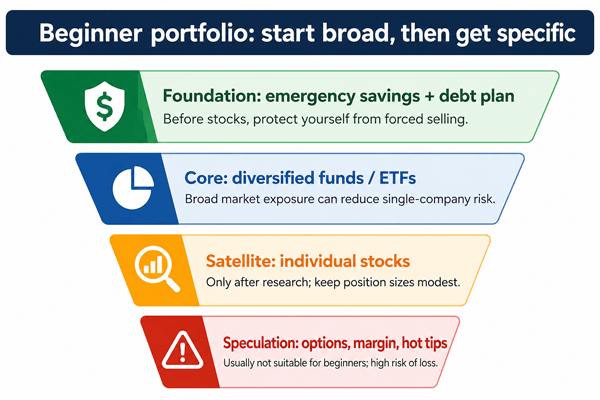
A sensible beginner path is to build a diversified core first, then add a few individual stocks only after you understand the business, valuation, and risks. This reduces the chance that one mistake damages your entire plan.
9. Research before you buy
Good research does not mean watching ten random videos and copying the loudest person. It means understanding what the company does, how it makes money, whether it is profitable, how much debt it has, whether it has competitors, and whether the stock price already reflects high expectations.
For an individual stock, ask these questions:
- What does the company sell, and do I understand the business in one sentence?
- Is revenue growing, shrinking, or unstable?
- Is the company profitable? If not, when might it become profitable and what could go wrong?
- Does the company carry heavy debt?
- Who are the competitors?
- Why do I believe this stock is worth buying now?
- What would make me sell: bad earnings, broken business story, better opportunity, or needing the money?
For ETFs or index funds, research the index, expense ratio, holdings, geographic exposure, sector concentration, tracking history, and whether it fits your goal. A broad low-cost index ETF is very different from a narrow leveraged sector ETF, even though both may appear under “ETFs” in a stock investing app.
10. Decide how much to invest
Position sizing is one of the most practical beginner skills. It answers the question: “How much of my money should go into this one investment?” A common beginner mistake is putting too much money into one exciting stock. If the stock drops 40%, the beginner learns risk management in the most painful way.
Example: Suppose you have $2,000 ready for long-term investing. Instead of putting all $2,000 into one technology stock, you might place $1,500 in a diversified ETF and use $500 for two or three individual stocks you have researched. This is not a perfect formula, but it shows the idea: keep the core stable and let individual stocks be smaller learning positions.
Another method is dollar-cost averaging, where you invest a fixed amount on a regular schedule, such as $100 every month. This does not guarantee profit or prevent losses, but it can reduce the pressure of guessing the perfect day to buy.
11. Know market orders and limit orders
When you are ready to buy, you must choose an order type. The two most common beginner order types are market orders and limit orders.
| Order type | What it means | When beginners use it | Main caution |
|---|---|---|---|
| Market order | Buy or sell immediately at the best available price. | Large, highly traded stocks or ETFs during normal market hours. | Final price can be different from what you expected, especially in fast or thin markets. |
| Limit order | Buy only at or below your chosen price, or sell only at or above your chosen price. | When you want price control. | The order may not execute if the market does not reach your price. |
Example: A stock is quoted around $50. If you place a market order, you might buy close to $50, but the exact price is not guaranteed. If you place a limit order at $49.50, your order will only buy if shares are available at $49.50 or lower. Limit orders are useful because they force you to choose the maximum price you are willing to pay.
Illustrative order-ticket checklist
| Example Order Ticket | Illustrative entry |
|---|---|
| Ticker / fund | XYZ or selected ETF ticker |
| Action | Buy |
| Quantity | $100 or selected number of shares |
| Order type | Limit order |
| Limit price | Maximum price you are willing to pay |
12. Place your first stock order
The exact screen differs by broker, but the basic process is usually similar:
1. Search the ticker symbol, such as AAPL for Apple or an ETF ticker for a fund.
2. Open the order ticket and choose Buy.
3. Enter the number of shares or the dollar amount if fractional shares are available.
4. Choose order type: market or limit.
5. Review estimated cost, fees, and buying power.
6. Read the confirmation screen carefully.
7. Submit the order only when the details match your plan.
8. Save or review the trade confirmation for your records.
Do not rush this step. Many beginner mistakes happen because the investor chooses the wrong ticker, adds an extra zero, buys instead of sells, or uses a market order during a volatile period. Slow is smooth; smooth is safe.
13. What happens after you buy?
After buying, the investment appears in your portfolio. The price will move, sometimes immediately. This is normal. A beginner often expects a stock to rise right after purchase, but the market does not know or care where you bought. Your purchase price is important to you, not to the market.
You should track your thesis, not every tick. If you bought a broad index ETF for a 10-year goal, a bad week should not automatically change your plan. If you bought an individual stock because you expected earnings growth, then quarterly earnings, debt, margins, and competitive position matter more than daily noise.
14. A practical first-stock example
Imagine Sara, a beginner, has saved an emergency fund and wants to invest $100 per month for long-term wealth building. She opens a regulated brokerage account, turns on two-factor authentication, and chooses a cash account. She decides not to use margin or options.
For her first month, Sara compares two choices: buying one popular company she likes or buying a broad market ETF. She realizes that the company may do well, but one company carries more risk. She decides to invest $80 in a diversified ETF and $20 in one company she understands and wants to follow as a learning position. She uses a limit order, reads the confirmation, and records why she bought each investment.
Six months later, one of her individual stocks is down 25%, but the ETF is more stable. Because her individual stock position is small, she does not panic. She reviews the company’s results and decides whether the original reason for buying is still valid. This is a realistic beginner experience: not perfect, not dramatic, but controlled.
15. Common beginner mistakes to avoid
- Buying because of hype. A stock can be popular and still be overpriced or risky.
- Putting all money into one company. Diversification cannot remove all risk, but it can reduce the damage from one bad decision.
- Using margin too early. Borrowed money can turn a normal loss into a major problem.
- Ignoring fees and expense ratios. Small costs can compound over time.
- Selling in panic. If you cannot handle normal volatility, your position may be too large.
- Confusing a low share price with a cheap stock. A $5 stock is not automatically cheaper than a $500 stock; valuation depends on the whole company.
- Following anonymous tips. If someone pressures you to act fast, promises high returns with little risk, or uses fake testimonials, treat it as a red flag.
- Not understanding taxes. Selling for a gain may create a taxable event, and rules vary by country.
16. Risk management: how beginners protect themselves
Investment risk cannot be eliminated. FINRA explains that asset allocation and diversification can help manage risk, but they do not make investing risk-free. Investor.gov describes risk tolerance as your ability and willingness to lose some or all of your original investment in exchange for the possibility of higher returns.
A practical beginner risk plan can be very simple:
- Use money you do not need soon.
- Keep a diversified core, such as broad funds, before buying many individual stocks.
- Limit any single stock to a percentage you can emotionally and financially handle.
- Avoid margin until you fully understand it.
- Write down why you bought before you buy.
- Review your portfolio on a schedule, not every minute.
17. Fees, taxes, and records
Fees are easier to control than market returns. A beginner should understand trading commissions, bid-ask spreads, account fees, transfer fees, margin interest, fund expense ratios, and advisory fees. Even when an app advertises commission-free trading, it may still have costs in other forms.
Taxes depend on your country and account type. In the United States, the IRS generally classifies capital gains as long-term when the asset is held for more than one year, and short-term when held for one year or less. Wash sale rules may also limit the ability to claim a loss if you sell a security at a loss and buy a substantially identical security within the rule’s window. Other countries have different rules, so readers should check local tax guidance or speak with a qualified tax professional.
Keep records of deposits, purchases, sales, dividends, fees, tax forms, and your reason for buying. Good records help you measure performance honestly and make tax season less painful.
18. How much money do you need to start buying stocks?
You do not need to be rich to start learning. Many brokers now offer fractional shares, which allow investors to buy a dollar amount instead of a full share. For example, if a stock trades at $300, a fractional-share platform may let you buy $10 worth. Availability depends on the broker and country.
That said, starting small does not mean treating investing like a game. A $25 investment should still be researched and recorded. The habit matters. A beginner who learns discipline with $100 is more likely to handle $10,000 wisely later.
19. Individual stocks vs ETFs: which is better for beginners?
There is no single answer for everyone, but many beginners benefit from starting with diversified funds or ETFs. Individual stocks can be rewarding and educational, but they require more research and emotional control. ETFs can provide exposure to many companies in one purchase, reducing the risk that one company ruins your plan.
| Beginner question | Individual stock | ETF / index fund |
|---|---|---|
| Do I need to analyze one business deeply? | Yes | Usually no; analyze the fund and index instead |
| Can one company problem hurt me badly? | Yes, if position is large | Less likely in broad diversified funds |
| Can it beat the market? | Possible, but difficult | Usually designed to track a market or sector |
| Is it exciting? | Often more exciting | Often less exciting |
| Is boring good? | Not always | For long-term beginners, boring can be powerful |
20. How to build a simple beginner portfolio
A beginner portfolio does not need 30 positions. Complexity can make you feel productive while hiding the fact that you do not understand what you own. Start with a simple structure:
- Core holding: a diversified index fund or ETF that matches your long-term goal.
- Learning positions: a few individual stocks you can explain clearly.
- Cash reserve: money for upcoming needs or future opportunities.
- Review rule: rebalance or adjust only on a planned schedule unless your financial situation changes.
Example beginner allocation for educational purposes only: 80% diversified ETF, 10% cash for future investing, 10% individual stocks. A younger investor with stable income may choose more stock exposure; a conservative investor may choose less. The correct allocation depends on goals, risk tolerance, time horizon, income stability, and local options.
21. Red flags and scams beginners must know
Investor.gov lists common fraud red flags such as promises of high returns with little or no risk, pressure to act now, fear of missing out, fake testimonials, promises of great wealth, and suspicious payment methods. These red flags are especially common around hot stocks, crypto-style promotions, private groups, and social media “mentors.”
- Do not send money to someone who says they will trade for you through their personal wallet or bank account.
- Do not believe screenshots of profits without verified statements.
- Do not join paid groups that guarantee returns.
- Do not trust urgency. Real investing opportunities do not usually require sending money in the next five minutes.
- Check registration and complaints through official regulator tools where available.
22. Beginner stock market glossary
| Term | Simple meaning |
|---|---|
| Share | One unit of ownership in a company. |
| Ticker | Short symbol used to identify a stock or fund. |
| Portfolio | All your investments together. |
| Dividend | Cash payment some companies make to shareholders. |
| Volatility | How much prices move up and down. |
| Market cap | Total value of a company’s shares. |
| P/E ratio | A valuation measure comparing price with earnings. |
| ETF | A fund that trades like a stock and holds a basket of investments. |
| Expense ratio | Annual fund cost expressed as a percentage. |
| Capital gain | Profit from selling an investment for more than you paid. |
23. Frequently asked questions
23.1 Is buying stocks safe for beginners?
Stocks are not “safe” in the way a bank deposit may be considered safer. They can lose value. Beginners can make stock investing more sensible by using money they do not need soon, diversifying, avoiding margin, and learning before buying.
23.2 What is the best stock to buy for beginners?
There is no universal best stock. A beginner should first decide on goals and risk tolerance. Many beginners start with diversified ETFs or index funds before buying individual stocks.
23.3 Can I buy stocks online?
Yes, in many countries you can buy stocks online through a regulated brokerage account or stock investing app. Always verify the platform’s registration, fees, security, and available investments.
23.4 Should I use a financial advisor?
A qualified financial advisor can help with goals, taxes, retirement planning, and risk management. However, check credentials, compensation, conflicts of interest, and regulatory history before working with anyone.
23.5 How often should beginners check their portfolio?
Checking too often can create emotional decisions. For long-term investing, a monthly or quarterly review is often more useful than watching daily price changes.
23.6 What if my stock goes down after I buy?
First, breathe. Then review why you bought it. If the business story is still strong and your position size is reasonable, a drop may not require action. If your original reason was weak or the company has changed, reassess honestly.
23.7 Can I lose all my money in stocks?
With an individual stock, yes, a company can fail or decline severely. With a diversified fund, losing everything is less likely, but losses are still possible. Diversification reduces some risks but does not eliminate market risk.
24. Final beginner action plan
1. Build an emergency fund and clear urgent high-interest debt.
2. Write your investing goal and time horizon.
3. Choose a regulated broker and start with a cash account.
4. Learn ETFs/index funds before concentrating in individual stocks.
5. Research every investment before buying.
6. Use position sizing so one mistake cannot ruin you.
7. Use limit orders when price control matters.
8. Keep records for fees, taxes, and performance review.
9. Avoid hype, margin, and guaranteed-profit claims.
10. Review calmly and improve your process over time.
The best first stock purchase is not necessarily the one that makes money fastest. It is the one made with a clear plan, a sensible amount, honest research, and respect for risk. Beginners who learn slowly, diversify, and avoid emotional decisions give themselves a better chance of staying in the market long enough to benefit from it.
Sources Consulted and Checked
These sources were consulted and checked while preparing this article to support factual accuracy, reliability, and alignment with people-first content principles.
- Investor.gov / SEC: Investor education topics including getting started, risk, stock markets, investment accounts, red flags of fraud, diversification, and wash sales. https://www.investor.gov/
- FINRA Investing Basics: Investor education on investing basics, risk, brokerage accounts, and BrokerCheck. https://www.finra.org/investors/investing/investing-basics
- FINRA BrokerCheck: Background-check tool for investment professionals and brokerage firms. https://brokercheck.finra.org/
- IRS Topic No. 409: Capital gains and losses; short-term vs long-term holding period guidance. https://www.irs.gov/taxtopics/tc409
Reader Advice
This article is provided solely for educational and general informational purposes. It is not personal financial, investment, tax, accounting, or legal advice, and it should not be treated as a recommendation to buy, sell, or hold any security. Investing involves risk, including the possible loss of principal. Before making a decision, readers should consider their goals, time horizon, risk tolerance, financial circumstances, and local laws, and should seek advice from appropriately qualified professionals when necessary.
Rules, tax treatment, brokerage features, fees, market practices, and regulatory requirements may change and can differ by country, account type, platform, and individual circumstances. Readers should therefore verify important facts, figures, eligibility rules, costs, and current requirements through official regulators, tax authorities, brokerage documentation, and other primary sources.