What Is the Stock Market and How Does It Work?
1. What is the stock market?
The stock market is a marketplace where people buy and sell small pieces of companies. Those small pieces are called shares or stocks. When you buy a share, you do not own the company building, the employees, or the products in the store. You own a tiny legal claim on the business, and your investment can rise or fall as people change what they think that business is worth.
A simple way to understand it is this: imagine a business is a large pizza. The company cuts the pizza into millions or billions of slices. Each slice is a share. Investors buy slices because they hope the business will grow, earn profits, and become more valuable over time. The stock market is where those slices are first sold and then traded among investors.
Beginner-friendly definition The stock market is not a magic money machine. It is a system that connects companies that need money, investors who want ownership, and buyers and sellers who agree on prices.
2. Stocks, shares, and ownership explained
A stock represents ownership in a company. A share is one unit of that ownership. People often use “stock” and “share” in everyday conversation as if they mean the same thing. For example, “I bought Apple stock” usually means “I bought shares of Apple.”
Owning shares can benefit an investor in two main ways. First, the share price may rise, which creates a capital gain if the investor sells at a higher price than they paid. Second, some companies pay dividends, which are cash payments to shareholders. Not every company pays dividends, and dividends are never guaranteed forever.
3. Why companies sell shares
Companies sell shares to raise money. That money may be used to open new locations, hire employees, build technology, reduce debt, buy equipment, or fund research. Selling shares can be an alternative to borrowing money from a bank. The trade-off is that the company gives investors partial ownership.
When a private company sells shares to the public for the first time, it is called an initial public offering, or IPO. After the IPO, shares usually trade in the secondary market, where regular investors buy and sell shares from each other through brokers and exchanges.
4. How does the stock market work?
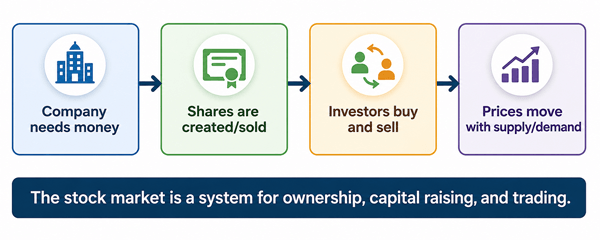
Figure 1. Simple flow of how the stock market connects companies and investors.
Most beginners imagine a stock exchange as a noisy room where people shout buy and sell orders. That image is partly historical. Today, a large part of trading happens electronically. The basic idea is still simple: buyers say what they are willing to pay, sellers say what they are willing to accept, and a trade happens when the two sides match.
A stock exchange, such as the New York Stock Exchange or Nasdaq in the United States, provides rules, technology, listings, and systems for trading. A broker is the company or platform that connects everyday investors to those markets. When a beginner uses an investing app or online brokerage account, the order does not magically go straight from their phone to another person. It passes through brokerage and market systems that match or route the trade.
4.1 The primary market vs the secondary market
| Market | What happens | Beginner example |
|---|---|---|
| Primary market | A company sells new shares to raise capital. | A company launches an IPO and sells shares to early public investors. |
| Secondary market | Investors trade existing shares with each other. | You buy 5 shares of a listed company through your brokerage app from another investor who is selling. |
5. How stock prices move
A stock price moves because buyers and sellers keep updating what they believe a share is worth. If more people urgently want to buy than sell, the price often rises. If more people urgently want to sell than buy, the price often falls. This is supply and demand, but in real life it is influenced by many things: company earnings, interest rates, inflation, news, product launches, competition, investor emotions, and expectations about the future.
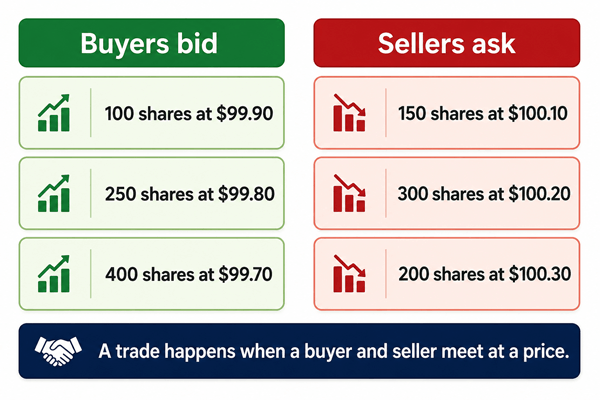
Figure 2. A simplified bid-ask example. Actual markets are faster and more complex.
Helpful fact The last price you see on a finance website is not always the exact price you will get. Market orders can fill at a different price, especially in fast-moving or low-liquidity stocks.
6. A practical example: buying one share
Suppose a beginner named Sara opens a brokerage account and wants to buy one share of a company trading around $100. She searches for the ticker symbol, checks the company information, and decides whether to place a market order or a limit order.
- Sara deposits $100 plus a little extra for price movement or fees if applicable.
- She searches for the company ticker inside her brokerage account.
- She chooses “buy” and enters 1 share.
- If she uses a market order, the trade should execute quickly but the exact price is not guaranteed.
- If she uses a limit order at $100, the order only buys at $100 or lower, but it may not fill if sellers want more.
- After buying, she owns one share. If the price moves to $110, her position is worth more before taxes and fees. If it moves to $90, it is worth less.
- 1 Market order, limit order, and stop order
| Order type | Plain meaning | Main benefit | Main risk |
|---|---|---|---|
| Market order | Buy or sell as soon as possible. | Fast execution. | Final price is not guaranteed. |
| Limit order | Buy or sell only at your chosen price or better. | Price control. | Order may not execute. |
| Stop order | Turns into a market order after a stop price is reached. | Can help manage risk or protect gains. | Execution price can surprise you in fast markets. |
7. Common investment options beginners see
A beginner does not have to buy single stocks. In fact, many experienced investors prefer broad, low-cost funds because they are easier to diversify. The main choices a beginner may see are individual stocks, exchange-traded funds, mutual funds, bonds, cash savings, and sometimes more advanced products such as options. This guide focuses on stocks, ETFs, and funds because those are common starting points.
| Option | What it is | Ease for beginners | Diversification | Common use |
|---|---|---|---|---|
| Individual stock | One company | Medium to hard | Low by itself | Owning a company you understand |
| ETF | A basket that trades like a stock | Often easier | Can be high | Building a simple portfolio |
| Mutual fund | A pooled fund often priced once daily | Often easier | Can be high | Retirement accounts and automatic investing |
| Index fund | A fund that tracks an index | Often easier | Usually high | Long-term diversified investing |
| Bond | A loan to a company or government | Medium | Varies | Income and lower volatility than stocks in many cases |
8. How beginners can use the stock market
The healthiest way for most beginners to think about the stock market is not “How can I get rich quickly?” but “How can I use ownership and compounding to build wealth carefully over time?” The stock market can help people save for retirement, education, a home down payment, or long-term financial independence. But it can also hurt people who treat it like gambling, chase hype, borrow money to trade, or invest money they need next month.
- Use it to invest for long-term goals, not emergency money.
- Start with education before risk. Learn basic terms, fees, taxes, and account rules.
- Consider diversified funds before trying to pick winning individual stocks.
- Use reputable, regulated brokers and avoid anyone promising guaranteed returns.
- Track your behavior as much as your returns. Panic selling, overconfidence, and copying strangers are common beginner problems.
8.1 A simple beginner roadmap
- Build an emergency fund before investing money you may need soon.
- Pay attention to high-interest debt. A guaranteed debt cost can be more urgent than uncertain investment returns.
- Define the goal: retirement, education, wealth building, or learning with a small amount.
- Choose an account type: taxable brokerage, retirement account, or another account available in your country.
- Choose a regulated broker with clear fees, strong security, useful education, and no pressure tactics.
- Start with a small amount you can afford to leave invested.
- Prefer simple, diversified investments until you know why you are doing something more complex.
- Review regularly, but do not stare at prices every hour.
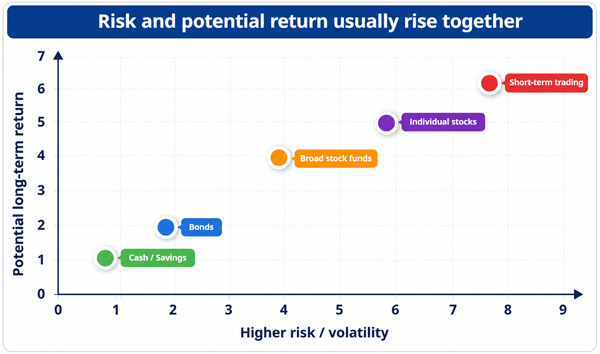
Figure 3. Risk and potential return are connected. Higher return hopes usually come with higher uncertainty.
9. Practical example: two beginner paths
Two beginners may both use the stock market, but their experience can be completely different.
| Beginner | Approach | Likely lesson |
|---|---|---|
| Ali | Buys a broad index ETF every month, ignores daily noise, and keeps learning. | Progress feels slow, but the habit is sustainable and diversified. |
| Ben | Buys a hot stock after seeing social media hype, checks the price every hour, and sells in panic after a drop. | Excitement turns into stress. The lesson is that emotion can be more dangerous than the market itself. |
9.1 Dollar-cost averaging: a practical habit
Dollar-cost averaging means investing a fixed amount on a regular schedule, such as every month. It does not guarantee profit and it does not protect against loss, but it can reduce the pressure of trying to guess the perfect buying day. When prices are lower, the fixed amount buys more shares. When prices are higher, it buys fewer shares.
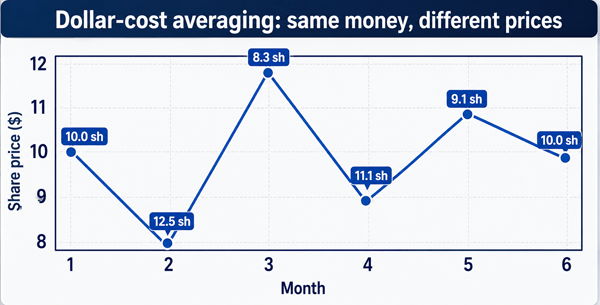
Figure 4. A simplified dollar-cost averaging example with $100 invested each month.
10. Important risks every beginner should understand
Every investment has risk. Even investments that feel “safe” have some kind of risk, such as inflation risk or opportunity cost. Stocks can rise, fall, remain flat for years, or lose most of their value. The goal is not to eliminate risk. The goal is to understand it, size it properly, and avoid risks you are not paid or prepared to take.
- Market risk: the whole market can fall during recessions, crises, or fear-driven selloffs.
- Company risk: an individual company can disappoint, lose customers, face lawsuits, or fail.
- Liquidity risk: some investments may be hard to sell quickly at a fair price.
- Behavior risk: investors often buy after excitement and sell after fear.
- Concentration risk: putting too much money in one stock, one sector, or one country can magnify losses.
- Leverage risk: borrowing money to invest can multiply losses and create forced selling.
- Scam risk: fake brokers, signal groups, guaranteed-return schemes, and pump-and-dump promotions target beginners.
Honest investing rule If someone says an investment has high returns, no risk, and guaranteed profit, treat that as a warning sign. Real investing always includes uncertainty.
11. Stock investing vs stock trading
People use the words investing and trading loosely, but they are not the same. Investing usually means buying assets because you believe they can grow or produce value over a long period. Trading usually means trying to profit from shorter-term price movement. Both can involve the same stocks, but the mindset, risk, time commitment, and skill requirements are different.
| Feature | Long-term investing | Short-term trading | Beginner-friendly view |
|---|---|---|---|
| Time horizon | Years or decades | Minutes to months | Longer horizons usually give beginners more room to learn. |
| Main focus | Business value, diversification, goals | Price patterns, timing, volatility | Trading requires stricter risk control. |
| Emotional pressure | Lower if well planned | Often high | Fast decisions can lead to mistakes. |
| Taxes and costs | Can be lower with less activity | Can increase with activity | Frequent buying and selling may reduce returns. |
| Common beginner mistake | Ignoring risk or overconcentrating | Overtrading and chasing losses | Simple beats exciting for many beginners. |
12. What to check before buying a stock
Buying a stock because the price went up is not research. Before buying an individual company, a beginner should be able to explain the business in simple words. If you cannot explain how the company makes money, who its customers are, what could go wrong, and why the price makes sense, you may be guessing rather than investing.
- Business model: How does the company make money?
- Financial health: Is revenue growing? Is debt manageable? Is the company profitable or on a path to profitability?
- Competition: What makes the company different, and can competitors copy it?
- Valuation: Are you paying a reasonable price compared with profits, growth, and risk?
- Management: Does leadership communicate clearly and act responsibly?
- Risk factors: What could make the investment fail?
- Portfolio fit: Will this single stock make your portfolio too concentrated?
13. Choosing an online brokerage account
A brokerage account is the account you use to buy and sell investments. Beginners often search for terms such as “best online brokerage account,” “stock trading app,” “low-cost broker,” or “commission-free trading.” These are useful search terms, but the cheapest or most popular app is not automatically the best choice. A good broker should be regulated, transparent, secure, easy to use, and suitable for your country and account needs.
- Regulation and reputation: Confirm the broker is properly licensed where you live.
- Fees: Look beyond $0 commissions. Check spreads, currency conversion, inactivity fees, fund expense ratios, and withdrawal fees.
- Investment choices: Make sure it offers the stocks, ETFs, mutual funds, or retirement accounts you need.
- Education: Beginner-friendly explanations are valuable.
- Security: Use strong passwords, two-factor authentication, and withdrawal protections.
- Customer support: Test whether help is available before something goes wrong.
14. Fees, taxes, and hidden costs
Fees may look small, but they matter because investing compounds over time. A fund charging 0.05% per year is very different from a fund charging 1.00% per year over decades. Trading fees, bid-ask spreads, currency conversion charges, advisory fees, tax drag, and account maintenance fees can quietly reduce returns.
Taxes depend on your country and personal situation. Capital gains, dividends, retirement account rules, and tax-loss harvesting can be complex. A beginner article should not pretend to give tax advice. The honest approach is to tell readers to learn their local rules or speak with a qualified tax professional when money is significant.
15. Beginner mistakes to avoid
- Investing without an emergency fund.
- Using rent, tuition, or short-term savings for risky investments.
- Copying influencers without understanding the investment.
- Thinking a low share price means a stock is cheap.
- Ignoring diversification.
- Selling in panic during normal market declines.
- Buying only because a stock has already gone up.
- Using margin or options before understanding basic stocks.
- Checking the portfolio so often that emotions control decisions.
- Believing “guaranteed profit” messages or paid signal groups.
16. A beginner-friendly portfolio example
As an educational illustration, Suppose a beginner has a long-term goal and wants simplicity. Instead of buying ten random stocks, they might study a broad stock market ETF, a bond fund, and cash savings. The exact mix depends on age, goals, income stability, risk tolerance, and time horizon.
| Bucket | Purpose | Example thinking |
|---|---|---|
| Cash emergency fund | Money for surprises | Kept outside the stock market so a job loss or medical bill does not force selling stocks. |
| Broad stock fund | Growth engine | Owns many companies, reducing dependence on one winner. |
| Bond or conservative fund | Stability and income | May reduce portfolio swings, though it still has risks. |
| Small learning account | Education | A tiny amount for studying individual stocks without risking core savings. |
17. How to read stock market news without getting confused
Stock market news can sound dramatic because media companies compete for attention. “Market loses billions” does not mean every investor lost the same amount. “Stock jumps 20%” does not mean it is still a good buy. “Analyst upgrades” and “price targets” are opinions, not guarantees. A beginner should read news as context, not as instructions.
- Ask: Is this news about one company, one sector, or the whole economy?
- Ask: Does this change the long-term business, or is it short-term noise?
- Ask: Is the article explaining facts, or creating urgency?
- Ask: Who benefits if I trade after reading this?
- Ask: What would I do if the price dropped 20% after I buy?
18. Glossary of stock market terms
| Term | Plain-English meaning |
|---|---|
| Stock | Ownership in a company. |
| Share | One unit of stock ownership. |
| Ticker symbol | The short code used to identify a listed security. |
| Broker | A company that helps investors buy and sell securities. |
| Exchange | A regulated marketplace for securities trading. |
| Dividend | A payment some companies make to shareholders. |
| Capital gain | Profit from selling an investment for more than you paid. |
| Market capitalization | The total market value of a company’s shares. |
| Volatility | How much and how quickly prices move. |
| ETF | A fund that trades on an exchange like a stock. |
| Index fund | A fund designed to track a market index. |
| Bull market | A period when markets are generally rising. |
| Bear market | A period when markets are generally falling. |
| Diversification | Spreading investments so one failure does not dominate the whole portfolio. |
19. FAQ: What beginners usually ask
19.1 Is the stock market safe for beginners?
It can be useful for beginners who learn first, diversify, avoid scams, and invest only money they can leave alone. It is not safe if treated like a guaranteed-profit game.
19.2 How much money do I need to start?
Many brokers allow small deposits and fractional shares, but the better question is whether you have emergency savings and understand the risks.
19.3 Can I lose all my money?
With an individual stock, yes, a company can fail. With a broad diversified fund, losing everything is less likely but losses are still possible.
19.4 Should I buy stocks or ETFs first?
Many beginners find diversified ETFs or index funds easier than picking individual stocks, but suitability depends on goals and local options.
19.5 What is the best stock to buy now?
A responsible beginner guide should not claim one best stock. A better question is what investment fits your goal, risk tolerance, time horizon, and knowledge.
19.6 How often should I check my portfolio?
Checking too often can increase emotional decisions. Many long-term investors review on a schedule, such as monthly or quarterly, rather than reacting daily.
19.7 Is trading the same as investing?
No. Investing focuses more on long-term ownership and goals. Trading focuses more on shorter-term price moves and usually requires more skill, time, and emotional control.
19.8 What is the biggest beginner secret?
The boring basics matter: save consistently, diversify, control costs, avoid hype, and stay patient.
20. Final takeaway
The stock market is easier to understand when you remove the noise. It is a marketplace for ownership. Companies use it to raise money. Investors use it to buy pieces of businesses. Prices move because people constantly update what they are willing to pay or accept. Beginners can use the market wisely by learning the basics, avoiding hype, diversifying, controlling costs, and investing for clear long-term goals.
The best beginner investor is not the person who knows every chart pattern. It is the person who knows their goal, respects risk, avoids dishonest promises, and makes steady decisions even when markets are emotional.
Sources Consulted and Checked
These sources were consulted and checked while preparing this article to support accuracy and clarity.
- SEC Investor.gov - Introduction to Investing - https://www.investor.gov/introduction-investing
- SEC Investor.gov - How Stock Markets Work - https://www.investor.gov/introduction-investing/investing-basics/how-stock-markets-work
- SEC Investor.gov - Types of Orders - https://www.investor.gov/introduction-investing/investing-basics/how-stock-markets-work/types-orders
- SEC Investor.gov - Stocks FAQ - https://www.investor.gov/introduction-investing/investing-basics/investment-products/stocks
- SEC Investor.gov - Mutual Funds - https://www.investor.gov/introduction-investing/investing-basics/investment-products/mutual-funds-and-exchange-traded-funds-etfs/mutual-funds
- SEC Investor.gov - ETFs - https://www.investor.gov/introduction-investing/investing-basics/investment-products/mutual-funds-and-exchange-traded-2
- FINRA - Investing Basics - https://www.finra.org/investors/investing/investing-basics
- FINRA - Risk - https://www.finra.org/investors/investing/investing-basics/risk
- NYSE - Equities Trading - https://www.nyse.com/trade/equities
Reader Advice
This article is provided solely for educational and informational purposes and does not constitute personal financial, investment, legal, or tax advice. Investing involves risk, including the possible loss of principal, and no return is guaranteed. Before making any financial decision, consider your goals, financial circumstances, time horizon, and ability to bear loss, and seek advice from an appropriately qualified professional where necessary. Market conditions, laws, taxes, brokerage rules, product features, fees, and regulatory requirements may differ by country and may change over time. Readers should verify important facts, figures, eligibility requirements, and current rules through official regulators, licensed service providers, and other authoritative sources.
Examples in this article are simplified illustrations rather than recommendations to buy, sell, or hold any particular security or follow any specific strategy. Never invest money needed for essential or near-term expenses, and remain alert to scams, pressure tactics, and promises of guaranteed profit.