Stock Market for Beginners: Everything You Need to Know
1. What Is the Stock Market?
The stock market is a place - now mostly digital - where people buy and sell small ownership pieces of companies. Those pieces are called shares or stocks. If you buy one share of a company, you own a tiny part of that company. You do not run the company, but you may benefit if the business becomes more valuable, and you may receive dividends if the company pays them.
A beginner-friendly way to think about it is this: a company needs money to grow, so it sells ownership pieces to the public. Investors buy those pieces because they believe the business may grow, pay income, or become more valuable over time. After the first sale, investors usually trade shares with each other on stock exchanges. That everyday buying and selling is what most people mean when they say "the stock market."
The market is not a magic machine that makes everyone rich. It is a pricing system. Prices move because millions of investors constantly react to earnings, interest rates, inflation, news, business quality, emotions, and expectations about the future. Some days prices rise sharply; other days they fall sharply. A smart beginner learns the system before risking serious money.
2. Why Does the Stock Market Exist?
The stock market connects two groups: businesses that need capital and investors who want their money to work. A business may use stock market capital to build factories, hire employees, create products, pay debt, or expand into new markets. Investors participate because stocks have historically offered higher long-term growth potential than cash, although they also bring higher risk and no guarantee of profit.
For ordinary people, the stock market can be used for long-term goals such as retirement, education funding, wealth building, or protecting money from losing purchasing power over many years. It can also be misused for gambling, emotional trading, and chasing internet hype. The same market can be a helpful wealth-building tool or a stressful casino, depending on how a person uses it.
3. How the Stock Market Works in Simple Words
When you place a buy order in a brokerage account or stock trading app, the order does not go directly to the company. It goes through your broker and reaches a market where it can match with someone willing to sell. The trade happens at an agreed price. If there are more eager buyers than sellers, the price often moves up. If there are more eager sellers than buyers, the price often moves down.
There are two broad stages. The primary market is where a company first sells shares to raise money, often through an initial public offering, or IPO. The secondary market is where investors trade shares with each other after the IPO. Most beginner investors operate in the secondary market through a brokerage account.
Market prices are not only about today’s company results. They often reflect what investors expect tomorrow, next quarter, or several years from now. This is why a company can report good news and still see its stock fall if the news was not as good as investors expected. It is also why a risky, fast-growing company may trade at a high price even before it earns much profit.
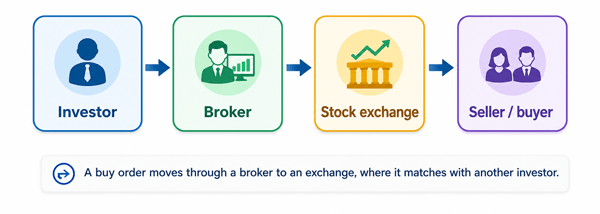
Figure 1: A simplified view of how a stock trade moves from investor to market.
Helpful fact: Investor.gov explains diversification as spreading money among investments so losses in one area may be offset by gains or stability in another. That simple idea is one of the most important habits for beginners.
4. Important Stock Market Terms Beginners Should Know
| Term | Meaning in plain English |
|---|---|
| Stock / share | A small ownership unit in a company. |
| Share price | The current market price for one share. A low price does not automatically mean cheap; a high price does not automatically mean expensive. |
| Market capitalization | The total market value of a company: share price multiplied by number of shares. |
| Dividend | A cash payment some companies make to shareholders. Dividends are not guaranteed. |
| Brokerage account | An account used to buy and sell investments such as stocks, ETFs, mutual funds, and bonds. |
| ETF | An exchange-traded fund. It trades like a stock but can hold many investments inside it. |
| Index fund | A fund designed to track a market index, such as a broad stock market benchmark. |
| Bull market | A period when markets generally rise. |
| Bear market | A period when markets fall significantly and investor confidence is weak. |
| Volatility | How much prices move up and down. Volatility feels uncomfortable, but it is normal in stocks. |
| Liquidity | How easily an investment can be bought or sold without a big price impact. |
| Expense ratio | The annual fund cost, usually shown as a percentage. Lower costs leave more return for investors, all else equal. |
5. Stocks vs ETFs vs Mutual Funds vs Bonds
Individual stocks give you direct ownership in one company. They can be exciting, but they also expose you to company-specific risk. If the company disappoints, your investment can fall even if the overall market is doing fine.
ETFs and mutual funds can hold many stocks or bonds in one product. For many beginners, broad low-cost index funds or ETFs are easier to manage than picking individual stocks. They provide instant diversification and reduce the risk of one bad company damaging the whole portfolio.
Bonds are loans to governments or companies. They usually offer lower long-term growth potential than stocks but can provide income and stability. A beginner does not need to choose only one category. A balanced portfolio may include stocks for growth, bonds for stability, and cash for emergencies.
6. Comparison Table: Which Investment Type Fits a Beginner?
| Investment | Best use | Risk | Effort | Beginner note |
|---|---|---|---|---|
| Individual stocks | Learning, long-term ownership, small satellite positions | High | High | Can outperform, but one company can also fail or disappoint. |
| Broad-market ETF / index fund | Core beginner portfolio | Medium | Low to medium | Owns many companies; often lower cost and easier to maintain. |
| Actively managed mutual fund | Investors who want a manager choosing investments | Medium to high | Medium | May cost more and many active funds fail to beat benchmarks over long periods. |
| Bonds / bond funds | Stability, income, shorter goals | Low to medium | Low to medium | Still has interest-rate and credit risk. |
| Options, margin, leveraged ETFs | Advanced traders only | Very high | Very high | Not a beginner tool; losses can be fast and severe. |
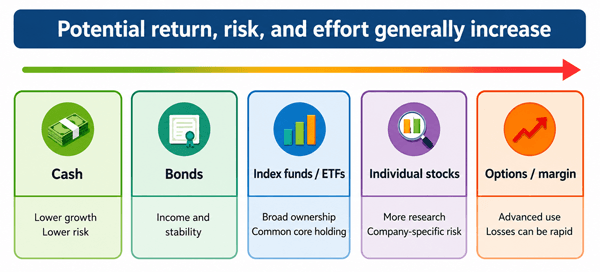
Figure 2: Risk and effort usually rise as products become more complex.
7. How Beginners Can Start Investing Step by Step
The safest beginner path is not to ask, "Which stock will explode next?" A better question is, "What goal am I investing for, how long can I leave the money alone, and what simple portfolio can I stick with?" Use this practical sequence before buying anything.
- Build an emergency fund first: Money needed for rent, food, school fees, medical needs, or short-term bills should not be exposed to stock market swings. Many people start with at least a small emergency fund before investing.
- Clear high-interest debt: If a credit card or personal loan charges very high interest, paying it down can be a better guaranteed improvement than taking market risk.
- Define the goal: Retirement in 25 years is different from buying a car next year. Stocks are generally more suitable for long time horizons, not money needed soon.
- Choose an account: A brokerage account is flexible. A retirement account may offer tax advantages depending on your country. Choose based on your rules, taxes, fees, and withdrawal needs.
- Start broad and simple: Many beginners begin with a diversified ETF or index fund rather than trying to pick winning stocks immediately.
- Automate contributions: A fixed monthly investment can reduce decision stress and help you avoid waiting forever for the "perfect" entry price.
- Review, but not daily: Check whether your plan still fits your goals. Do not let daily price movement control your emotions.
8. How to Choose a Brokerage Account or Stock Trading App
A brokerage account is the bridge between you and the market. The best stock trading app for a beginner is not the one with the flashiest charts. It is the one that is regulated, transparent, low-cost, easy to use, and does not push you into risky trading.
- Check regulation and licensing in your country. Investor.gov recommends checking the background of investment professionals as a protection step.
- Compare trading commissions, fund expense ratios, account fees, withdrawal fees, currency conversion costs, and inactivity fees.
- Look for access to low-cost ETFs or index funds if your goal is long-term investing.
- Avoid apps that make trading feel like a game with confetti, constant alerts, leverage prompts, or social hype.
- Make sure you understand tax documents, dividend treatment, and how cash is protected or insured under local rules.
- Use strong security: two-factor authentication, unique password, withdrawal alerts, and updated contact details.
9. How to Read Basic Stock Information
A stock quote page can look confusing, but beginners only need a few basics at first. The share price tells you what one share trades for now. The day range shows the lowest and highest trading price that day. Market capitalization tells you the total value investors place on the company. Volume shows how many shares traded. Dividend yield estimates income relative to price. The P/E ratio compares price with earnings, but it should never be used alone.
Example: A $20 stock is not automatically cheaper than a $200 stock. If Company A earns $1 per share and trades at $20, it sells for 20 times earnings. If Company B earns $20 per share and trades at $200, it sells for 10 times earnings. Company B has the higher share price but may be cheaper relative to earnings. Beginners should compare business quality, debt, growth, profits, valuation, and risk - not just the share price.
10. The Power of Compounding
Compounding means earning returns on your earlier returns. Investor.gov defines compound interest as interest paid on principal and accumulated interest. In investing, the same idea appears when returns are reinvested and the portfolio grows on itself. Compounding is powerful, but it needs time, patience, and realistic expectations.
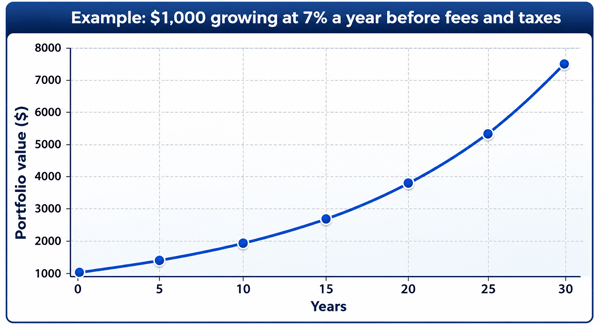
Figure 3: A simple compounding example. Real market returns are not smooth and are never guaranteed.
11. Risk: The Part Beginners Must Respect
Every investment has risk. Stock prices can fall because of recessions, weak earnings, high interest rates, fraud, competition, regulation, war, poor management, or simple investor panic. The goal is not to remove all risk. The goal is to take risk intentionally, in a size you can survive, for a goal that justifies it.
- Market risk: the whole market falls.
- Company risk: one company performs badly.
- Liquidity risk: you cannot sell quickly at a fair price.
- Currency risk: foreign investments move because of exchange rates.
- Inflation risk: cash loses purchasing power over time.
- Behavior risk: you panic, chase hype, trade too much, or abandon your plan.
12. Diversification and Asset Allocation
Diversification means spreading money across different investments. Asset allocation means deciding how much goes into broad categories such as stocks, bonds, and cash. Investor.gov describes asset allocation as dividing an investment portfolio among categories like stocks, bonds, and cash, based largely on time horizon and ability to tolerate risk.
Practical example: A 25-year-old investing for retirement may accept more stocks because the goal is decades away. A 60-year-old who needs money soon may prefer more bonds and cash. There is no perfect allocation for everyone. The best allocation is one you understand, can afford, and can hold through bad markets.
| Example profile | Sample allocation | Best suited for |
|---|---|---|
| Very cautious beginner | 30% stock funds / 50% bonds / 20% cash | Shorter timeline or low risk tolerance |
| Balanced beginner | 60% stock funds / 30% bonds / 10% cash | Medium to long timeline, moderate risk tolerance |
| Growth-focused beginner | 80% stock funds / 15% bonds / 5% cash | Long timeline and ability to tolerate large drops |
13. Practical Beginner Portfolio Examples
The examples below illustrate how different goals and time horizons can lead to different simple portfolio choices.
13.1 Example 1: A student investing $25 a week
A student with no debt emergency may start with a broad-market ETF and invest a small automatic amount each week. The goal is not to become rich next month. The goal is to build the habit, learn account mechanics, and let time do the heavy lifting.
13.2 Example 2: A working professional saving for retirement
A worker may use a retirement account, contribute monthly, and choose a low-cost target-date fund or a mix of stock and bond index funds. The main decisions are contribution rate, asset allocation, fees, and staying consistent.
13.3 Example 3: Someone tempted by a hot stock
Instead of putting all money into one trending company, the investor could keep the core portfolio in diversified funds and limit individual stocks to a small percentage. This allows learning without risking the entire plan.
13.4 Example 4: A person needing money in two years
This person may avoid heavy stock exposure for that specific goal because a market drop could happen right before the money is needed. Cash, savings products, or short-term bonds may be more appropriate, depending on local options and risk.
14. Index Funds vs Stock Picking: What Beginners Should Know
Many beginners think successful investing means finding the next superstar stock. Some people do succeed at stock picking, but it takes research, discipline, emotional control, and a willingness to be wrong. Broad index funds take a different approach: instead of trying to pick the winner, they own a basket of companies and accept the market return minus low costs.
S&P Dow Jones Indices publishes SPIVA scorecards comparing active funds with benchmarks. Its SPIVA overview has shown that a high percentage of U.S. large-cap funds underperformed the S&P 500 over long periods. This does not mean every active manager is bad, and it does not mean index funds always win every year. It means beginners should be careful before assuming that frequent trading or expensive active management will automatically beat a simple low-cost portfolio.
15. How Much Money Do You Need to Start?
You do not need to be rich to learn investing. Some platforms allow fractional shares or small ETF purchases. The more important question is whether your financial foundation is ready. Starting with a small amount can be wise because it lets you learn without putting your life savings at risk. A beginner who invests $20 or $50 consistently and avoids big mistakes may build better habits than someone who starts with a large amount and trades emotionally.
16. Dollar-Cost Averaging vs Lump Sum
Dollar-cost averaging means investing a fixed amount regularly, such as every month. It can reduce emotional pressure because you do not need to guess the perfect market day. A lump sum means investing available money all at once. Historically, lump-sum investing can do well when markets rise, but it can feel painful if the market falls soon after. Beginners often prefer dollar-cost averaging because it supports discipline and reduces regret.
17. Dividends: Income Is Useful, But Not Magic
Dividend stocks pay cash to shareholders, usually from company profits. Dividends can be attractive for income-focused investors, but beginners should not buy a stock only because its dividend yield is high. A very high yield can be a warning sign that investors expect the dividend to be cut or the business to struggle. Total return matters: price growth plus dividends, minus fees and taxes.
18. Taxes, Fees, and Inflation
Three silent forces can reduce investor results. Taxes can apply to dividends, interest, capital gains, or withdrawals depending on your country and account type. Fees include brokerage charges, expense ratios, spreads, advisory fees, and currency conversion costs. Inflation reduces purchasing power, which is one reason people invest rather than keeping all money in cash. Beginners should learn the local tax rules before selling frequently or buying complex products.
19. Common Beginner Mistakes
- Investing before building any emergency cushion.
- Buying a stock because social media says it will moon.
- Confusing a low share price with a cheap valuation.
- Putting all money into one company or one sector.
- Selling in panic during normal market declines.
- Trading too often and letting fees, spreads, and taxes eat returns.
- Using margin, options, or leverage before understanding basic investing.
- Ignoring account security.
- Copying someone else’s portfolio without knowing their income, age, risk tolerance, or goals.
- Expecting the stock market to solve poor saving habits.
20. A Simple Research Checklist Before Buying a Stock
- What does the company actually sell, and how does it make money?
- Is revenue growing, stable, or shrinking?
- Does the company earn profit and generate cash?
- How much debt does it carry?
- Who are the competitors?
- Is the stock price reasonable compared with earnings, sales, growth, and risk?
- What could go wrong?
- Would I still own this if the price fell 30%?
- How much of my total portfolio am I risking?
- Am I investing based on research or emotion?
21. Beginner-Friendly Stock Market Strategy
A practical beginner strategy often looks boring, and that is a strength. Build an emergency fund. Choose a regulated broker. Invest regularly in diversified low-cost funds. Keep individual stocks small until you have experience. Rebalance occasionally. Keep learning. Avoid leverage and hype. Focus on time in the market rather than trying to perfectly time the market.
A good plan should be written down in plain language: why you invest, how much you contribute, what you buy, when you review, what you will do during a market crash, and what you will never do. The written plan protects you from your future emotions.
22. Frequently Asked Questions
22.1 Is the stock market safe for beginners?
It can be used safely if beginners start small, diversify, avoid leverage, understand risk, and invest for suitable time horizons. It is not safe when treated like gambling.
22.2 Can I lose all my money?
In one individual stock, yes, a company can fail. In a diversified broad-market fund, losing everything is far less likely but large temporary losses can still happen.
22.3 Should I buy stocks when the market is down?
A downturn can create opportunity, but only if your finances are stable and your plan allows it. Do not invest emergency money just because prices fell.
22.4 What is the best stock for beginners?
There is no universal best stock. Many beginners are better served by broad diversified funds before choosing individual stocks.
22.5 How often should I check my portfolio?
For long-term investing, monthly or quarterly reviews may be enough. Daily checking often increases stress and bad decisions.
22.6 Do I need a financial advisor?
Some people can use simple low-cost tools themselves. Others benefit from a qualified financial advisor, especially for taxes, retirement planning, inheritance, business ownership, or complex family situations.
22.7 Is a robo-advisor useful?
A robo-advisor can help beginners who want automated portfolio management. Compare fees, investment method, tax features, account minimums, and whether the advice fits your goals.
22.8 Are stock trading apps good?
They can be useful access tools, but some encourage overtrading. Choose regulated platforms with clear fees, good security, and educational support.
23. Final Takeaway
The stock market is one of the most useful wealth-building tools available to ordinary people, but only when used with patience, honesty, and risk awareness. Beginners do not need secret tips, complicated charts, or constant trading. They need a clear goal, a safe account, diversified investments, low costs, steady contributions, and the discipline to avoid panic and hype. Learn first, start small, stay consistent, and let investing support your life instead of controlling it.
Sources Consulted and Checked
The following sources were consulted and checked while preparing this article to support accuracy, clarity, and responsible presentation of the subject.
- Investor.gov - Introduction to Investing: https://www.investor.gov/introduction-investing
- Investor.gov - Beginners Guide to Asset Allocation, Diversification, and Rebalancing: https://www.investor.gov/additional-resources/general-resources/publications-research/info-sheets/beginners-guide-asset
- Investor.gov - Diversification glossary: https://www.investor.gov/introduction-investing/investing-basics/glossary/diversification
- Investor.gov - Compound Interest glossary: https://www.investor.gov/introduction-investing/investing-basics/glossary
- FINRA - Investing Basics: https://www.finra.org/investors/investing/investing-basics
- S&P Dow Jones Indices - SPIVA research overview: https://www.spglobal.com/spdji/en/research-insights/spiva/
Reader Advice
This article is provided solely for educational and general informational purposes. It does not constitute personalized financial, investment, tax, accounting, or legal advice, and it does not recommend any particular security, broker, platform, account, or strategy. Investing involves risk, including the possible loss of principal, and past performance does not guarantee future results. Rules, taxes, fees, product features, market conditions, and regulatory protections may vary by country, provider, account type, and individual circumstances, and they may change over time. Before making a financial decision, readers should assess their goals, time horizon, financial position, and risk tolerance; verify current facts, figures, terms, and requirements through official or primary sources; and seek advice from appropriately qualified and licensed professionals when necessary.