How to Evaluate a Company Before Buying Its Stock in the Stock Market
1. Introduction: Do Not Buy a Stock Until You Understand the Company
Many beginners enter the stock market by asking, “Which stock should I buy?” A better first question is, “What kind of company would I be comfortable owning?” A stock is not just a ticker symbol moving up and down on a screen. It represents part ownership in a real business. When you buy shares, your results depend on what that business earns over time, how well it uses money, how much risk it carries, and how much you paid for those future results.
This guide explains how to evaluate a company before buying its stock in a simple, practical way. You do not need to be an accountant, finance professor, or professional analyst. You need a clear process, honest expectations, and the discipline to say “I do not know enough yet” when the facts are unclear.
Experienced investors often say they made their biggest mistakes when they bought a story instead of studying the business. A popular brand, a viral chart, or a confident social media post can make a stock feel safe, but feelings are not research. Good company evaluation slows you down. It helps you separate a strong business from a weak business, a fair price from an overexcited price, and long-term investing from short-term gambling.
2. What Does It Mean to Evaluate a Company?
To evaluate a company means to study the business behind the stock before deciding whether it deserves your money. You are trying to answer five practical questions:
- What does this company actually do, and how does it make money?
- Is the business getting stronger, weaker, or simply riding a temporary trend?
- Are the financial statements healthy enough to support future growth?
- Is management using shareholder money wisely?
- Is the current stock price reasonable compared with the company’s real prospects?
A beginner-friendly way to think about it is this: evaluating a company is like inspecting a house before buying it. You would not buy a house only because the paint looks fresh. You would check the foundation, neighborhood, roof, legal documents, repair costs, and price. With stocks, the “fresh paint” is often the exciting story. The foundation is the business model, financial strength, cash flow, competitive advantage, management quality, and valuation.
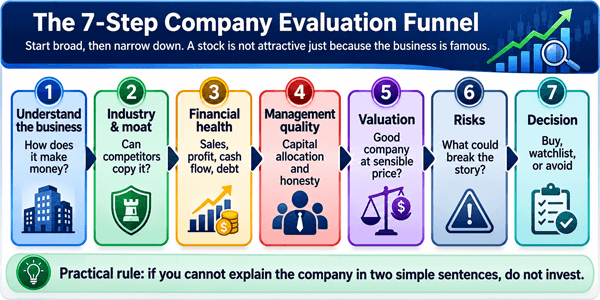
3. The Simple 7-Step Framework
- Understand the business model: know what the company sells, who buys it, and why customers keep coming back.
- Check the industry and competitive advantage: understand whether the company has protection against competition.
- Read the financial statements: focus on revenue, profit, margins, cash flow, debt, and share count.
- Judge management quality: look at capital allocation, communication, incentives, and long-term decisions.
- Estimate valuation: decide whether the price is fair for the company’s quality and growth.
- Identify risks: list what can go wrong before listing what can go right.
- Make a decision: buy, avoid, or place it on a watchlist until the price or facts improve.
Step 1: Understand the Business Model
The first test is simple: can you explain the company in two plain sentences? For example: “This company sells cloud software to businesses. Customers pay monthly or yearly subscriptions, and the company grows by adding new customers and selling more features to existing customers.” If you cannot explain the company that simply, the stock is probably not beginner-friendly yet.
A business model explains how a company turns products, services, attention, data, or assets into revenue and profit. Some businesses sell physical products. Some sell subscriptions. Some collect transaction fees. Some earn interest. Some make money from advertising. Each model has different risks and different signs of quality.
| Business type | How it makes money | Beginner question to ask |
|---|---|---|
| Retailer | Buys or makes products and sells them to customers | Are sales growing without sacrificing margins? |
| Software company | Sells licenses or subscriptions | Are customers staying, renewing, and spending more? |
| Bank | Earns interest and fees | Is loan quality strong and capital adequate? |
| Manufacturer | Produces goods and sells to distributors or customers | Can it pass higher costs to customers? |
| Platform business | Connects buyers and sellers or users and advertisers | Does the network become more valuable as it grows? |
| Utility or infrastructure | Provides essential services under regulation or contracts | Are cash flows stable and debt manageable? |
Practical experience tip Many beginners lose money in companies they cannot describe. Before looking at valuation ratios, write a one-paragraph explanation of the business. If the paragraph is vague, keep researching.
Step 2: Study the Industry and Competitive Advantage
A company does not operate in a vacuum. It competes with other companies, changing technology, suppliers, regulators, and customer habits. A company may look strong today because its whole industry is booming. The real question is whether it can remain strong when competition increases or the economy slows.
A competitive advantage, often called a moat, is something that helps a company protect profits. A moat does not mean the company is unbeatable. It means competitors have a hard time taking its customers, matching its cost structure, or replacing its position in the market.
| Type of moat | What it means | Example signal |
|---|---|---|
| Brand | Customers trust the name and may pay more | Pricing power and loyal repeat buyers |
| Switching costs | Customers find it painful to leave | High renewal rates and long contracts |
| Network effects | The product improves as more people use it | Marketplaces, payment networks, social platforms |
| Cost advantage | Company can produce or deliver cheaper | Higher margins than competitors |
| Regulatory advantage | Licenses, approvals, or rules limit competition | Stable market share in regulated sectors |
| Scale advantage | Large size improves buying power or distribution | Lower unit costs as volume grows |
Beginners should be careful with the word “moat.” A company does not have a moat just because people like its product. Ask: can a well-funded competitor copy this, undercut prices, or offer a better version? If yes, the moat may be weaker than the story suggests.
Step 3: Check the Financial Statements Without Getting Lost
Financial statements show whether the company’s story is becoming real. Public companies usually provide annual reports and quarterly reports. In the United States, Form 10-K and Form 10-Q filings give investors a detailed view of the business, risks, management discussion, and financial results. The SEC’s investor education material explains that these reports help investors understand what a company does, the risks it faces, and its operating and financial results.
| Statement | What it tells you | Beginner focus |
|---|---|---|
| Income statement | Sales, expenses, profit, and margins | Is revenue growing, and is profit quality improving? |
| Balance sheet | Assets, liabilities, and shareholder equity | Can the company survive bad years? |
| Cash flow statement | Cash generated and used by operations, investing, and financing | Does accounting profit turn into real cash? |
Key financial numbers beginners should check
- Revenue growth: Is the company selling more over time? Compare at least three to five years if possible.
- Gross margin: How much money remains after direct product or service costs? Stable or rising margins can signal pricing power.
- Operating margin: How profitable is the core business after regular operating expenses?
- Net income: Is the company profitable after all expenses, taxes, and interest?
- Operating cash flow: Is the business generating cash from normal operations?
- Free cash flow: After necessary capital spending, how much cash is left for debt reduction, dividends, buybacks, or reinvestment?
- Debt and interest expense: Can the company handle its obligations if business slows?
- Share count: Is the company quietly diluting shareholders by issuing more shares?
Beginner shortcutProfit is important, but cash flow is often harder to fake. If net income looks strong while operating cash flow is weak for several years, slow down and investigate.
Important Ratios for Company Analysis
Ratios help compare companies of different sizes. They are useful, but they should never be used alone. A low price-to-earnings ratio can mean a bargain, or it can mean the market expects earnings to decline. A high margin can mean a great business, or it can mean a temporary cycle peak.
| Ratio | Formula | What it helps you understand | Common beginner mistake |
|---|---|---|---|
| Revenue growth | Current revenue / prior revenue - 1 | Whether the business is expanding | Assuming growth will continue forever |
| Gross margin | Gross profit / revenue | Pricing power and production efficiency | Comparing different industries unfairly |
| Operating margin | Operating income / revenue | Core business profitability | Ignoring one-time cost cuts |
| Return on equity | Net income / equity | How well equity capital produces profit | Ignoring high debt that boosts ROE |
| Debt-to-equity | Total debt / equity | Financial leverage | Assuming all debt is bad |
| Current ratio | Current assets / current liabilities | Short-term liquidity | Using it without reading cash flow |
| P/E ratio | Price per share / earnings per share | How much investors pay for earnings | Buying only because P/E is low |
| P/S ratio | Market cap / revenue | Valuation for low-profit growth firms | Ignoring future profit potential |
| Free cash flow yield | Free cash flow / market cap | Cash return compared with price | Using one unusual year |
Step 4: Evaluate Management Quality
Management quality matters because executives decide how the company uses cash, handles debt, rewards shareholders, treats customers, and responds to problems. A strong business can be damaged by poor management. A decent business can become better when management allocates capital wisely.
(a) What good management usually looks like
- Clear communication: management explains results honestly, including problems.
- Consistent strategy: the company does not change its story every quarter.
- Good capital allocation: cash is invested where returns are likely to be attractive.
- Reasonable executive compensation: leaders are rewarded for long-term performance, not just short-term stock price movement.
- Shareholder awareness: management avoids unnecessary dilution and explains buybacks, dividends, and acquisitions clearly.
- Operational discipline: promises are matched by actual numbers over time.
(b) Management warning signs
- Frequent “adjusted” numbers that remove normal business costs.
- Big acquisitions with weak explanations or poor follow-up results.
- Promotional language that sounds more like advertising than reporting.
- Insider ownership that is too low, or compensation that rises while shareholders suffer.
- Repeated missed targets with excuses instead of accountability.
Step 5: Decide Whether the Stock Price Makes Sense
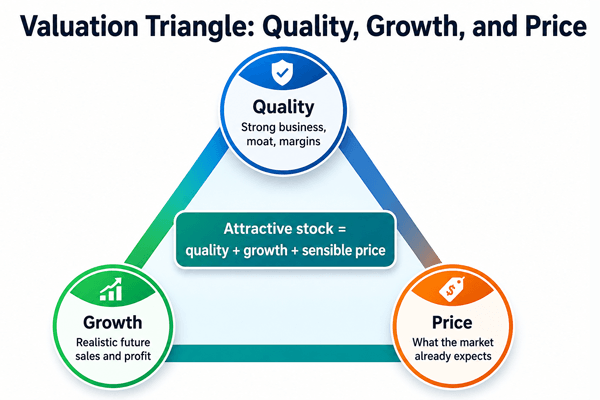
Valuation is the part beginners often skip because it feels difficult. But valuation does not need to be perfect. You are not trying to calculate the exact value of the company down to the last cent. You are trying to avoid paying a price that already assumes everything will go perfectly.
A good company is not automatically a good investment. If the price is too high, future returns can be poor even if the company keeps growing. On the other hand, a cheap stock is not automatically a bargain. Sometimes a stock is cheap because the business is shrinking, debt is heavy, or the industry is being disrupted.
| Valuation method | Best used for | Beginner-friendly use |
|---|---|---|
| P/E ratio | Profitable companies with steady earnings | Compare with history, peers, and growth quality |
| P/S ratio | Companies with low or temporary profits | Ask whether sales can eventually become real profit |
| EV/EBITDA | Capital-intensive or debt-heavy comparisons | Useful for comparing operating value across firms |
| Free cash flow yield | Companies with meaningful cash generation | Higher yield can signal better value, if cash flow is durable |
| Dividend yield | Mature dividend-paying companies | Check payout safety, not just yield size |
| Discounted cash flow | Long-term estimate of future cash flows | Use conservative assumptions and a margin of safety |
Honest valuation habit
Instead of asking, “Can this stock go up?” ask, “What must happen for this price to be justified?” If the answer requires perfect growth, perfect margins, and no competition, the investment may have little margin of safety.
4. Practical Example: Evaluating a Fictional Company
To make the process practical, imagine a fictional company called FreshBite Foods. It sells packaged healthy snacks through supermarkets and online channels. The stock is popular because revenue has grown quickly and many customers recognize the brand.
| Metric | Year 1 | Year 2 | Year 3 | What it suggests |
|---|---|---|---|---|
| Revenue | $500 million | $650 million | $780 million | Strong growth, but growth rate is slowing |
| Gross margin | 38% | 39% | 40% | Slight pricing power or better efficiency |
| Operating margin | 8% | 10% | 11% | Profitability improving |
| Net income | $25 million | $45 million | $60 million | Profits rising faster than sales |
| Operating cash flow | $20 million | $30 million | $35 million | Cash flow positive, but weaker than net income |
| Debt | $180 million | $230 million | $310 million | Debt rising quickly |
| Shares outstanding | 100 million | 106 million | 114 million | Shareholder dilution |
5.1 How a beginner should read this
FreshBite looks attractive at first. Revenue, margins, and profit are improving. But the deeper review shows three concerns: cash flow is not keeping up with reported profit, debt is rising, and the share count is increasing. That does not automatically make the stock bad, but it changes the questions an investor should ask.
- Why is cash flow lower than net income? Is inventory building up? Are customers paying slowly?
- Why is debt rising? Is the company funding growth wisely, or covering weak cash generation?
- Why is the company issuing more shares? Is dilution creating long-term value or simply funding operations?
- What valuation is the market giving FreshBite? Is the stock priced like a steady food company or like a high-growth technology company?
This example shows why good stock analysis is not about finding one impressive number. It is about connecting the numbers into a full business picture.
6. Red Flags Beginners Should Watch Before Buying a Stock
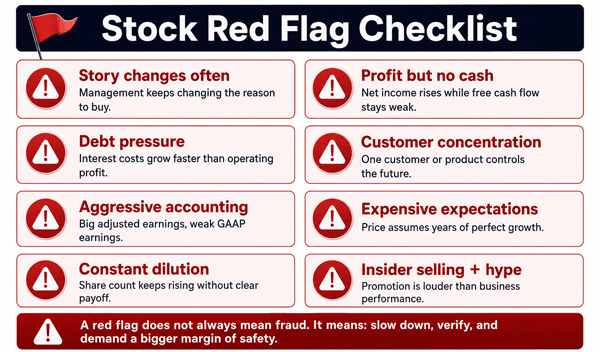
Many poor investments have warning signs before the stock collapses. Beginners often ignore them because the story sounds exciting or because the stock has already gone up. Red flags should not always make you run away immediately, but they should make you slow down and demand stronger evidence.
- Revenue grows but receivables grow much faster, which may mean customers are not paying on time.
- Inventory rises faster than sales, which may indicate weak demand or future markdowns.
- Free cash flow stays negative while management keeps highlighting adjusted profit.
- Debt increases while interest coverage weakens.
- Management regularly issues shares, causing your ownership percentage to shrink.
- The company depends on one customer, supplier, product, commodity price, or regulation.
- The stock trades at a valuation that requires unrealistic growth for many years.
- The investment case depends mostly on rumors, social media excitement, or a “next big thing” promise.
7. Do Not Ignore Qualitative Factors
Financial numbers are essential, but they are not the whole story. Some of the most important information is qualitative: product quality, customer satisfaction, brand trust, regulation, culture, technology changes, and competitive behavior. These factors can later appear in the numbers, but by then the stock price may have already reacted.
| Qualitative factor | Why it matters | How beginners can research it |
|---|---|---|
| Customer behavior | Shows whether demand is real and repeatable | Read reviews, renewal rates, churn data, and customer case studies |
| Competition | Determines future pricing power | Compare products, prices, market share, and customer switching costs |
| Regulation | Can help or hurt profits | Read risk factors in filings and industry news |
| Technology change | Can disrupt old business models | Track whether the company is adapting or defending the past |
| Culture and hiring | Affects execution quality | Look for turnover, employee reviews, and management commentary |
| Supply chain | Affects costs and reliability | Check supplier concentration and geographic risks |
8. Where to Find Reliable Information
Beginners should avoid depending only on social media, message boards, or short videos. Those can be useful for discovering ideas, but they are not enough for making investment decisions. Use primary sources first, then independent analysis.
| Source | What to use it for | Caution |
|---|---|---|
| Annual report / Form 10-K | Business model, risks, financial statements, management discussion | It is written by the company, so read critically |
| Quarterly report / Form 10-Q | Recent operating and financial updates | Quarterly changes can be noisy |
| Earnings call transcript | Management tone, questions from analysts, guidance | Management may emphasize positives |
| Investor presentation | Strategy and key metrics | Often more promotional than filings |
| Company investor relations page | Reports, presentations, press releases | Verify claims in official filings |
| SEC EDGAR or local regulator database | Original filing documents | Can feel technical but is reliable |
| Brokerage research tools or stock analysis software | Screening, charts, ratios, estimates | Do not outsource judgment to a tool |
| Independent financial advisor | Personal suitability and risk planning | Check credentials and incentives |
Safe investing practiceUse an online brokerage account and investment research tools responsibly. Tools can make research faster, but they cannot remove risk or replace a personal investment plan.
9. Beginner Checklist Before Buying Any Stock
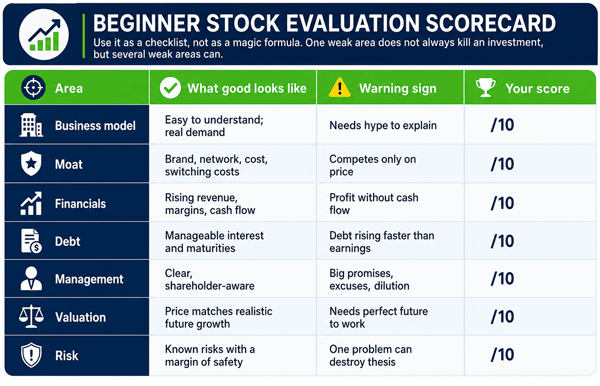
- I can explain the company in two simple sentences.
- I know how the company makes money and who its main customers are.
- I understand the industry and the main competitors.
- I can name the company’s strongest advantage and why it may last.
- I checked revenue, margins, profit, cash flow, debt, and share count.
- I read the main risk factors, not just the growth story.
- I compared valuation with growth, quality, and similar companies.
- I know what would prove my investment thesis wrong.
- I decided how much of my portfolio I am willing to risk.
- I am not buying because of panic, hype, fear of missing out, or a promise of guaranteed returns.
10. Common Beginner Mistakes and How to Avoid Them
| Mistake | Why it hurts | Better habit |
|---|---|---|
| Buying a familiar brand without research | A good product is not always a good stock | Study profit, cash flow, debt, and valuation |
| Chasing stocks after a big rise | The price may already reflect optimism | Ask what future results must happen from today’s price |
| Using one ratio only | Single ratios miss context | Use several metrics and compare with business quality |
| Ignoring debt | Debt can magnify problems in downturns | Check interest costs, maturities, and cash flow coverage |
| Trusting adjusted earnings blindly | Adjustments can hide recurring costs | Compare adjusted numbers with GAAP and cash flow |
| Buying too much of one stock | Even good analysis can be wrong | Use position sizing and portfolio diversification |
| Confusing trading with investing | Short-term price moves can distract from business value | Write a thesis and review it with new facts |
| No sell discipline | Beginners hold losers for emotional reasons | Know what would make you sell or reduce |
11. Comparing Two Companies: A Practical Approach
Beginners often ask which company is “better.” Better for customers, better as a business, and better as a stock can be three different answers. A fast-growing company may be lower quality if it burns cash. A slower company may be a better investment if it has durable profits and a fair valuation.
| Question | Company A | Company B | How to think about it |
|---|---|---|---|
| Revenue growth | Higher | Lower | Higher growth is useful only if it can become profitable cash flow |
| Margins | Lower | Higher | Higher margins may show pricing power or efficiency |
| Debt | High | Low | High debt increases risk when business slows |
| Cash flow | Negative | Positive | Positive free cash flow gives flexibility |
| Valuation | Expensive | Fair | A great company can disappoint if expectations are too high |
| Moat | Unclear | Strong | Moat affects how durable future profits may be |
The better stock is not always the company with the fastest growth. The better stock is the one where business quality, future growth, risk, and price work together in your favor.
12. How Company Evaluation Fits Into Portfolio Management
Evaluating a company is only one part of investing. You also need portfolio management. A stock can pass your research process and still perform badly because the future is uncertain. That is why beginners should think about diversification, position size, time horizon, and personal financial goals.
- Diversification: Do not depend on one company, one sector, or one theme.
- Position sizing: Invest smaller amounts in riskier or less proven companies.
- Time horizon: Money needed soon should generally not depend on stock market outcomes.
- Rebalancing: If one stock becomes too large, consider whether risk has changed.
- Retirement planning: Long-term goals may require a broader plan than individual stock picking.
- Wealth management: As your assets grow, taxes, estate planning, and risk control can become more important.
Real-world lessonProfessional investors are wrong often. Their advantage is not being perfect; it is having a process, managing risk, and avoiding decisions that can permanently damage the portfolio.
13. Frequently Asked Questions
13.1 How long should I research a company before buying its stock?
There is no fixed number of hours. Research until you can explain the business, financial health, valuation, main risks, and why the stock may be mispriced. If you cannot do that, keep it on a watchlist.
13.2 Is fundamental analysis enough to make money?
No method guarantees profit. Fundamental analysis helps you make more informed decisions, but stock prices are affected by interest rates, economic conditions, investor behavior, competition, and unexpected events.
13.3 Should beginners buy individual stocks or index funds?
Many beginners start with diversified funds while learning about individual companies. Individual stocks require more research, emotional discipline, and risk control.
13.4 What is the most important financial statement?
All three matter. The income statement shows profitability, the balance sheet shows financial strength, and the cash flow statement shows whether profits turn into cash.
13.5 Is a low P/E ratio always good?
No. A low P/E ratio can signal value, but it can also signal declining earnings, high debt, weak growth, or industry disruption.
13.6 How do I know if management is trustworthy?
Look for consistency between promises and results, clear communication, sensible capital allocation, reasonable compensation, and honest discussion of risks.
13.7 What is a margin of safety?
A margin of safety means leaving room for mistakes. You do not pay a price that requires everything to go perfectly.
13.8 Can stock analysis software choose stocks for me?
Software can organize data, screen companies, and speed up research. It should support your judgment, not replace it.
13.9 When should I avoid a stock?
Avoid it when you do not understand the business, cannot verify the numbers, see multiple red flags, or feel pressured to buy quickly.
13.10 Should I speak with a financial advisor?
A qualified financial advisor can help with suitability, risk tolerance, retirement planning, taxes, and portfolio construction, especially if your situation is complex.
14. Conclusion: Evaluate First, Buy Second
The stock market rewards patience, preparation, and honest thinking more than excitement. Before buying a stock, study the company like a business owner. Understand how it makes money, whether it has a real advantage, whether the financial statements support the story, whether management allocates capital wisely, and whether the valuation leaves room for normal business mistakes.
For beginners, the goal is not to become perfect. The goal is to avoid careless decisions. A simple checklist, a few reliable sources, and the willingness to walk away can protect you from many common investing mistakes. If a company is truly worth owning, it should still look understandable after the excitement fades.
Final honest practiceNever buy a stock only because someone online says it is the next big opportunity. Read the filings, compare the numbers, understand the risk, and make decisions that fit your own financial situation.
Sources Consulted and Checked
The following sources were consulted and checked while preparing this article to support accuracy, clarity, and responsible presentation.
- U.S. Securities and Exchange Commission: Beginners’ Guide to Financial Statements.
- Investor.gov / SEC: How to Read a 10-K and 10-Q.
- FINRA investor education resources on investor protection and market integrity.
- General financial statement analysis concepts: profitability, liquidity, leverage, cash flow, valuation, and risk analysis.
This article is provided solely for educational and informational purposes and does not constitute financial, investment, legal, tax, or other professional advice. It does not recommend any particular stock, security, brokerage account, investing platform, financial adviser, or investment strategy. Investing involves risk, including the possible loss of principal. Company information, market conditions, laws, regulations, tax rules, fees, financial figures, and investment products may change over time and may differ by country or individual circumstances.
Before making any decision, readers should verify current facts and figures through official company filings, securities regulators, and other reliable primary sources, consider their objectives and risk tolerance, and seek advice from appropriately qualified professionals where necessary. No result, return, or outcome is guaranteed.