How to Create a Winning Stock Market Investment Strategy
A winning stock market investment strategy is not a magic formula for picking the next famous stock. It is a simple written plan that tells you what you will invest in, why you are investing, how much risk you can handle, when you will buy, when you will sell, and how you will behave when the market becomes exciting or scary. For a beginner, this plan is more important than finding a hot tip, because most investing mistakes happen when people act without rules.
Think of it like planning a long road trip. You do not need to know every turn before you leave, but you do need a destination, a budget, a map, a fuel plan, and rules for what to do if traffic gets bad. In investing, your destination is your financial goal. Your map is your investment strategy. Your fuel is your regular savings. Your safety rules are diversification, risk management, and patience.
Plain-English definition
A stock market investment strategy is a personal plan for choosing, buying, holding, reviewing, and selling investments in a way that matches your goals, time frame, risk tolerance, and financial situation.
1. What Beginners Should Understand Before Investing
Before building a strategy, it helps to understand the stock market in the simplest possible way. A stock is a small ownership share in a company. When you buy a stock, you are not buying a lottery ticket; you are buying a claim on part of a real business. If the business grows, earns more, and investors become more confident about its future, the stock price may rise. If the business struggles or investors become worried, the price may fall.
The market is the place where buyers and sellers agree on prices every trading day. Prices move because people constantly update their expectations about company earnings, interest rates, inflation, competition, government policy, technology, and investor emotion. That is why prices can move sharply even when the company itself has not changed much in one day.
- Stocks can build wealth over long periods, but they can fall sharply in the short term.
- No beginner can reliably predict tomorrow’s market move.
- Good investing is usually more about repeatable behavior than perfect predictions.
- The right strategy for one person may be wrong for another because goals, income, age, savings, and risk tolerance differ.
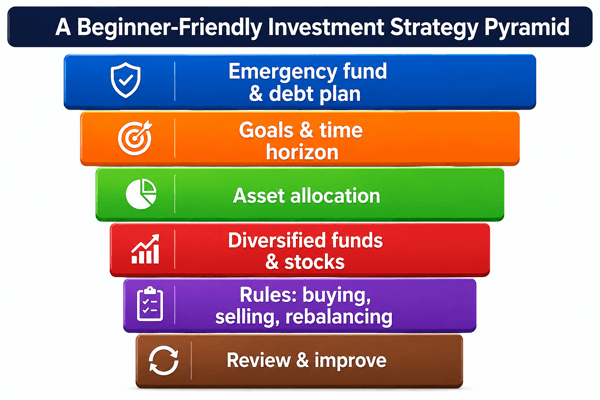
Figure 1: A beginner strategy works best when it is built from the bottom up, starting with financial stability and clear goals.
2. Build Your Investment Strategy Step by Step
2.1 Start With Your Real Goal
The first question is not “Which stock should I buy?” The first question is “What job should this money do for me?” Money for a home deposit next year should not be invested the same way as money for retirement 25 years from now. A clear goal helps you choose the right level of risk.
| Goal | Typical time horizon | What it usually means for strategy |
|---|---|---|
| Emergency savings | 0-12 months | Usually keep in cash or safe savings, not stocks. |
| Home deposit | 1-5 years | Avoid taking too much stock market risk because you may need the money soon. |
| Child education | 5-15 years | Use a balanced approach that becomes safer as the goal gets closer. |
| Retirement planning | 10+ years | Can usually hold more stocks because there is time to recover from downturns. |
| Long-term wealth building | 10+ years | Focus on diversified growth, low costs, and consistent contributions. |
2.2 Know Your Risk Tolerance Before the Market Tests It
Risk tolerance means how much uncertainty and temporary loss you can handle without making emotional decisions. Many people think they are aggressive investors when markets are rising, but discover they are conservative investors when their portfolio falls 20% or 30%. A useful strategy is honest before it is exciting.
A simple test: if a $10,000 portfolio fell to $7,500 during a bad market, would you buy more, hold calmly, reduce risk, or panic sell? Your answer matters. A strategy that looks perfect on paper but causes you to abandon it during a downturn is not the right strategy for you.
Beginner rule
Never choose a risky portfolio just because it has the highest expected return. Choose a portfolio you can realistically stay with during bad markets.
2.3 Choose an Asset Allocation
Asset allocation means dividing your money among broad categories such as stocks, bonds, and cash. This is one of the biggest decisions in a portfolio because it controls much of your risk and return pattern. Official investor education sources such as Investor.gov and FINRA describe asset allocation as a personal decision based on time horizon and risk tolerance.
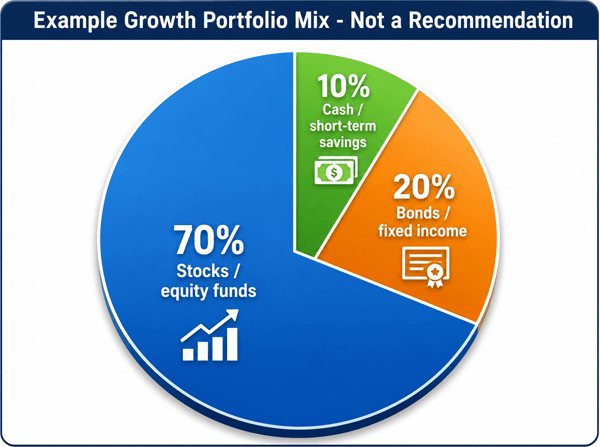
Figure 2: Example only. A younger long-term investor may choose more stocks, while a short-term or conservative investor may choose more bonds and cash.
| Investor profile | Example allocation | Why someone might choose it |
|---|---|---|
| Conservative beginner | 40% stocks / 40% bonds / 20% cash | Prioritizes stability and lower volatility. |
| Balanced investor | 60% stocks / 30% bonds / 10% cash | Wants growth but also wants some cushion. |
| Growth-focused long-term investor | 80% stocks / 15% bonds / 5% cash | Can accept larger ups and downs for long-term growth potential. |
2.4 Diversify So One Mistake Does Not Ruin the Plan
Diversification means spreading money across many investments instead of relying on one company, one sector, or one country. For many beginners, broad stock market index funds or exchange-traded funds can provide instant diversification because they own many companies inside one fund. Diversification does not guarantee profit, but it can reduce the damage from being wrong about a single investment.
A practical beginner mistake is buying only three famous technology stocks and calling it a portfolio. That may feel diversified because the companies are different, but it is still concentrated in a small number of businesses and often one sector. A more diversified approach may include U.S. stocks, international stocks, bonds, and cash, depending on the investor’s situation.
2.5 Decide Whether You Are an Investor or a Trader
A long-term investor buys assets because they believe the underlying businesses or markets can grow over years. A trader tries to profit from shorter-term price movements. Both require skill, but beginners often confuse them. They say they are long-term investors, then check prices every hour and sell after a bad week. A winning strategy must define the time frame clearly.
| Approach | Main focus | Beginner difficulty | Common risk |
|---|---|---|---|
| Long-term index investing | Broad market growth over years | Lower | Getting impatient during downturns. |
| Dividend investing | Companies or funds that pay income | Medium | Chasing high yields without checking quality. |
| Growth investing | Companies expected to grow faster | Medium to high | Overpaying for exciting stories. |
| Value investing | Buying undervalued companies | High | Buying cheap-looking companies with weak futures. |
| Active trading | Short-term price moves | Very high | Fees, emotions, leverage, and overconfidence. |
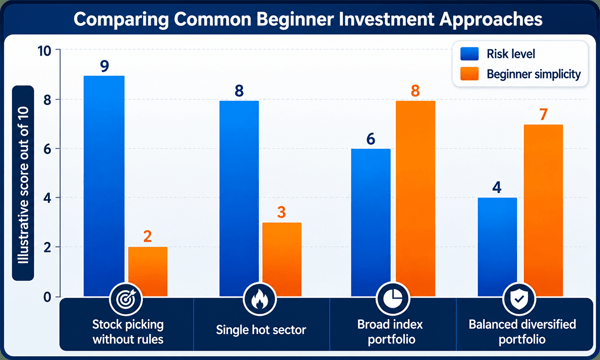
Figure 3: The simplest approach is often easier for beginners to follow consistently.
2.6 Pick Investment Vehicles That Fit the Strategy
A beginner does not need dozens of products. Common investment vehicles include individual stocks, mutual funds, index funds, ETFs, bonds, and cash savings. The right mix depends on your goal and knowledge level. Many beginners start with diversified funds because they reduce the need to analyze every company from scratch.
| Investment vehicle | What it is | Best use | Main caution |
|---|---|---|---|
| Individual stock | Ownership in one company | For investors willing to research businesses | Single-company risk can be high. |
| Index fund | Fund that tracks a market index | Simple diversified long-term investing | Still falls when the market falls. |
| ETF | Fund traded like a stock | Low-cost diversified exposure | Trading too often can hurt discipline. |
| Bond fund | Fund holding many bonds | Stability and income potential | Can lose value when rates change. |
| Cash / money market | Very low-risk liquid money | Emergency fund and short-term needs | May not beat inflation over long periods. |
2.7 Control Costs, Taxes, and Account Choices
Two portfolios can own similar investments but produce different results because of fees, taxes, and account structure. Expense ratios, brokerage commissions, advisory fees, fund turnover, tax rules, and currency costs can quietly reduce returns. Beginners should compare online brokerage accounts, fund fees, account minimums, research tools, customer support, and available retirement accounts before investing.
Services and account choices such as wealth management, portfolio management, retirement planning, financial advice, robo-advisors, online brokerage accounts, and tax-efficient investing may be relevant to some investors. The appropriate choice depends on the investor’s needs, the services provided, the costs involved, and any potential conflicts of interest. The aim should be to understand how a service may help and what fees or limitations it may add—not to choose a product merely because it is heavily promoted.
Cost example
If two funds track a similar market but one costs 0.05% per year and another costs 1.00% per year, the expensive fund must overcome a larger fee drag every year. Low cost is not the only factor, but it is one of the few factors investors can control.
2.8 Create Buying Rules
Buying rules remove guesswork. A beginner might use monthly investing, also called dollar-cost averaging, where the same amount is invested on a regular schedule. This does not guarantee profit, but it can reduce the pressure of trying to pick the perfect day. It also builds a habit, which is often more valuable than a clever forecast.
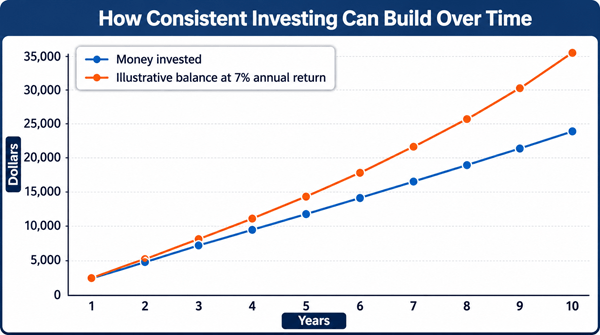
Figure 4: Illustration only. Regular investing plus time can become powerful, but actual returns will vary and can be negative.
- Invest a fixed amount every month after emergency savings are in place.
- Use limit orders or planned purchase dates if buying individual stocks.
- Do not buy only because a stock is trending on social media.
- Write down the reason for every individual stock purchase before buying.
- Keep position sizes small enough that one mistake cannot destroy the portfolio.
2.9 Create Selling Rules Before You Need Them
Many beginners spend hours deciding what to buy but no time deciding when to sell. Selling rules are important because emotions are strongest when a stock rises quickly or falls sharply. Your rules should separate normal volatility from a broken investment case.
| Reason to sell | Healthy example | Unhealthy example |
|---|---|---|
| Goal changed | You need the money for a planned home deposit soon. | You sell because a friend said the market will crash tomorrow. |
| Rebalancing | Stocks grew too large, so you trim back to target allocation. | You sell winners only because you are scared of losing gains. |
| Investment thesis broke | Company debt, earnings, or competitive position changed badly. | You sell after one normal bad quarter without reviewing facts. |
| Better risk control | One stock became 25% of your portfolio, so you reduce concentration. | You sell diversified funds after a temporary market decline. |
2.10 Rebalance the Portfolio
Rebalancing means bringing your portfolio back to its target mix. If your target is 70% stocks and 30% bonds, a strong stock market may push it to 80% stocks and 20% bonds. Rebalancing forces you to manage risk instead of letting the market choose your risk level for you.
A simple rule is to review once or twice per year, or when an asset class moves more than 5 percentage points away from target. Avoid checking too often, because too much attention can create unnecessary trading.
3. A Practical Beginner Strategy Example
Meet Sara, a 30-year-old beginner investor. She has paid off high-interest credit card debt, has a three-month emergency fund, and wants to invest for long-term wealth and retirement. She does not want to study individual companies every week, and she knows she may feel nervous during market crashes.
| Strategy area | Sara’s rule |
|---|---|
| Goal | Long-term wealth building and retirement planning over 25+ years. |
| Account | Tax-advantaged retirement account first, then taxable brokerage if extra money is available. |
| Allocation | 75% diversified stock index funds, 20% bond fund, 5% cash buffer. |
| Contribution rule | Invest 15% of income monthly. Increase by 1% when salary rises. |
| Buying rule | Automatic monthly investing. No market timing. |
| Selling rule | Sell only for rebalancing, goal changes, or if a fund no longer fits the plan. |
| Review rule | Review every January and July. Ignore daily market noise. |
| Risk rule | No single individual stock above 5% of portfolio. Optional individual stocks limited to 10% total. |
This strategy is not perfect and is not a personal recommendation. But it is clear, realistic, and easier to follow than a strategy based on predictions. The best part is that Sara knows what to do before the market becomes emotional.
4. Lessons Investors Often Learn the Hard Way
4.1 Patience feels boring, but it is powerful.
Many real investors say their biggest gains came not from constant activity but from staying invested through uncomfortable periods. Boring does not mean weak; it often means repeatable.
4.2 A good company is not always a good stock at any price.
Beginners often buy excellent companies after huge price increases. The business may be strong, but the expected return can be lower if the price already reflects too much optimism.
4.3 Cash has a job.
Cash may not create high long-term returns, but it can prevent forced selling. Emergency savings give investors the emotional and financial ability to leave long-term investments alone.
4.4 Simple beats complicated for many beginners.
A portfolio with two or three diversified funds can be easier to manage than a portfolio with 40 random stocks. Complexity often creates false confidence.
4.5 Your behavior is part of the strategy.
The best portfolio is not the one with the highest theoretical return. It is the one you can fund consistently, understand clearly, and hold responsibly.
5. Beginner Checklist: Build Your Strategy in One Sitting
- Write your main investing goal in one sentence.
- Write your time horizon: short term, medium term, or long term.
- Decide your target asset allocation.
- Choose whether you will use index funds, ETFs, individual stocks, or a combination.
- Set a monthly contribution amount that does not harm your emergency fund.
- Choose an online brokerage account or retirement account after comparing fees, tools, and account types.
- Write buying rules and selling rules before placing the first trade.
- Set a review schedule, such as twice per year.
- Keep a simple investing journal for decisions and lessons.
- Avoid promises of guaranteed profit, secret systems, or pressure to act immediately.
6. Frequently Asked Questions
6.1 How much money do I need to start investing?
Many modern brokerage platforms allow beginners to start with small amounts, sometimes through fractional shares or low-minimum funds. The more important question is whether you have emergency savings and whether the money can stay invested long enough.
6.2 Is stock picking better than index funds?
Stock picking can work for skilled investors, but it requires research, patience, emotional control, and risk management. Broad index funds are often simpler for beginners because they provide instant diversification and reduce the need to pick winners.
6.3 Can I lose all my money in the stock market?
A diversified stock fund is unlikely to go to zero unless the entire market collapses, but it can lose significant value during downturns. Individual stocks can fall dramatically or even become worthless if a company fails.
6.4 Should I invest when the market is high?
Nobody knows the perfect entry point. For long-term investors, consistent investing and appropriate asset allocation often matter more than waiting for the perfect price. Short-term money should usually not be exposed to major stock market risk.
6.5 How often should I check my portfolio?
For many beginners, monthly contribution checks and semiannual strategy reviews are enough. Checking every day can encourage emotional decisions.
6.6 Do I need a financial advisor?
Some people can manage a simple portfolio themselves. Others may benefit from a qualified financial advisor or fiduciary wealth management service, especially when taxes, retirement planning, estate planning, business income, or large sums are involved. Always understand the advisor’s fees and incentives.
7. Final Thoughts
A winning stock market investment strategy is not about being the smartest person in the room. It is about having a clear plan, controlling risk, avoiding unnecessary costs, staying diversified, and behaving consistently when emotions are high. Beginners should start with simple rules they understand. Over time, experience can improve the plan, but the foundation should remain the same: goals first, risk second, investments third, behavior always.
The stock market rewards no one every day. But a thoughtful strategy gives you a better chance of using the market as a long-term wealth-building tool instead of treating it like a guessing game.
Sources Consulted and Checked
The following sources were consulted and checked while preparing this article to support clarity and accuracy:
- Investor.gov / SEC - Asset Allocation and Diversification: https://www.investor.gov/introduction-investing/getting-started/asset-allocation
- Investor.gov - Introduction to Investing: https://www.investor.gov/introduction-investing
- FINRA - Asset Allocation and Diversification: https://www.finra.org/investors/investing/investing-basics/asset-allocation-diversification
- FINRA - Risk: https://www.finra.org/investors/investing/investing-basics/risk
- Vanguard - Model Portfolio Allocation: https://investor.vanguard.com/investor-resources-education/education/model-portfolio-allocation
- Vanguard - Index Funds: How to Invest: https://investor.vanguard.com/investment-products/index-funds
- SEC - Ten Things to Consider Before You Make Investing Decisions: https://www.sec.gov/investor/pubs/tenthingstoconsider.htm
Reader Advice
This article is provided solely for general educational and informational purposes. It does not constitute personalized financial, investment, tax, accounting, or legal advice, and it does not recommend or endorse any particular stock, fund, broker, adviser, platform, or strategy. Investing involves risk, including market volatility and the possible loss of some or all invested capital. Before making any decision, readers should consider their own goals, time horizon, financial circumstances, risk tolerance, liquidity needs, taxes, and fees, and should obtain advice from an appropriately qualified professional when necessary.
Laws, tax rules, account features, product terms, fees, market conditions, and regulatory requirements may change and may also vary by country, jurisdiction, provider, and individual circumstances. Readers should therefore verify all material facts, figures, eligibility requirements, and current rules directly from official regulators, government agencies, financial institutions, and other authoritative sources before acting. Historical performance, examples, charts, and hypothetical returns do not guarantee future results.