Dividend Investing in the Stock Market: A Beginner's Guide
1. What Is Dividend Investing?
Dividend investing is a stock market strategy where you buy shares of companies or dividend-focused funds that pay part of their profits to shareholders. In simple words, you own a tiny piece of a business, and when that business shares cash with owners, you may receive a dividend.
The U.S. Securities and Exchange Commission’s Investor.gov defines a dividend as a portion of a company’s profit paid to shareholders, usually on a fixed schedule, though special dividends can also be paid at any time. This is the cleanest beginner definition: a dividend is not a bonus from a broker; it is a company distribution to owners.
Many people like dividend investing because it feels easier to understand than fast trading. You are not trying to guess tomorrow’s price. You are trying to own durable businesses or diversified dividend ETFs that may pay income over time. That income can be taken as cash or reinvested to buy more shares.
Imagine buying a small apple tree. The tree may grow in value over many years, but it may also produce apples each season. In dividend investing, the stock price is like the tree value, and dividends are like the apples. A strong investor cares about both: the health of the tree and the apples it can keep producing.
2. How Dividend Investing Works in the Stock Market
A company earns revenue, pays expenses, invests in growth, manages debt, and may have profit left over. Management and the board decide whether to reinvest all of that money, pay down debt, buy back shares, acquire another company, or pay a dividend. A dividend-paying company is usually more mature, but not always safer.
- You buy a dividend stock or dividend ETF through a brokerage account, retirement account, or investing app.
- The company or fund announces a dividend amount and key dates.
- If you own the shares by the required date, you receive the dividend.
- The cash appears in your account, or a dividend reinvestment plan, often called DRIP, uses it to buy more shares.
- Over time, reinvested dividends can create a compounding effect because more shares can produce more future dividends.
This is why many long-term investors call dividend investing a “dividend snowball.” At first, the income may look small. But if you add money consistently, reinvest dividends, and avoid chasing unsafe yields, the income can grow gradually.
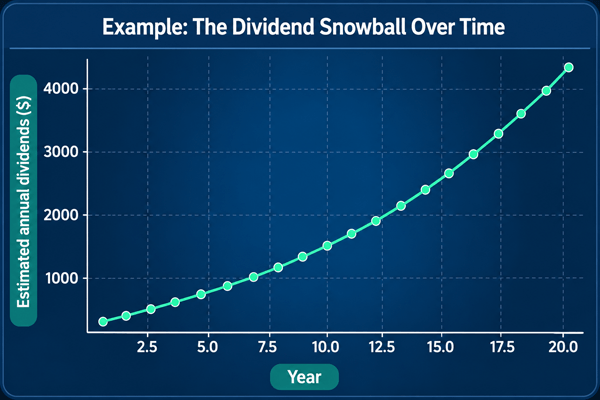
Illustrative chart. Assumptions: $5,000 starting balance, $200 monthly contributions, 7% annual total return, and 3.5% portfolio yield. Real returns and dividends will vary.
3. Dividend Dates Explained: When Do You Actually Get Paid?
Dividend investing becomes much less confusing once you understand four dates. Beginners often think they can buy a stock one day before payment and instantly collect free money. That is not how it works. The stock market adjusts around dividend dates, and the share price often drops by roughly the dividend amount on the ex-dividend date, although normal market movement can hide this.
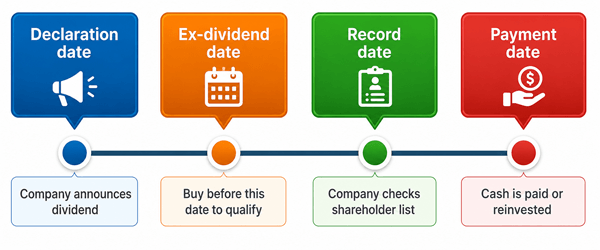
Figure. Simplified dividend timeline for beginners.
| Dividend date | Meaning for beginners |
|---|---|
| Declaration date | The company announces the dividend amount and schedule. |
| Ex-dividend date | The key eligibility date. If you buy on or after this date, you usually do not receive the next dividend. |
| Record date | The company checks its shareholder records. Because trades take time to settle, the ex-dividend date is usually the practical date investors watch. |
| Payment date | The dividend is paid as cash or reinvested, depending on your account settings. |
4. How Do Dividend Investors Make Money?
Dividend investors can make money in two main ways: cash income from dividends and capital appreciation when the stock price rises. A good dividend investment does not have to be the highest-yielding stock. In many real investor experiences, steady dividend growth from a strong business can be more valuable than a huge dividend from a weak business.
| Source of return | Simple meaning | What beginners should watch |
|---|---|---|
| Dividend income | Cash paid by the company or fund. | Is the dividend covered by earnings or cash flow? Has it been stable? |
| Dividend growth | The company raises the dividend over time. | Are profits, cash flow, and the balance sheet strong enough to support increases? |
| Capital appreciation | The share price rises over time. | Does the company still have room to grow? Is the valuation reasonable? |
| Compounding | Dividends buy more shares, which may pay more dividends. | Reinvestment works best with patience, diversification, and time. |
5. Key Dividend Terms Beginners Must Know
| Term | Easy explanation | Beginner example |
|---|---|---|
| Dividend yield | Annual dividend divided by share price. | A $2 annual dividend on a $50 stock equals a 4% yield. |
| Payout ratio | Percentage of earnings paid as dividends. | If a company earns $4 per share and pays $2, payout ratio is 50%. |
| Dividend growth rate | How fast the dividend has increased. | A dividend rising from $1.00 to $1.05 grew 5%. |
| Dividend reinvestment / DRIP | Using dividends to buy more shares automatically. | Your $25 dividend buys partial shares instead of sitting as cash. |
| Qualified dividend | A dividend that may receive lower U.S. federal tax treatment if rules are met. | IRS rules decide whether a dividend is qualified, not the investor’s preference. |
| Yield trap | A very high yield that looks attractive but may signal danger. | A stock yields 12% because the price collapsed and the dividend may be cut. |
6. Dividend Yield: Helpful Number, Dangerous Shortcut
Dividend yield is one of the most searched dividend investing terms, but it is also one of the most misunderstood. A 7% yield is not automatically better than a 3% yield. A high yield can mean the stock price has fallen because investors are worried about the business. It can also mean the market expects a dividend cut.
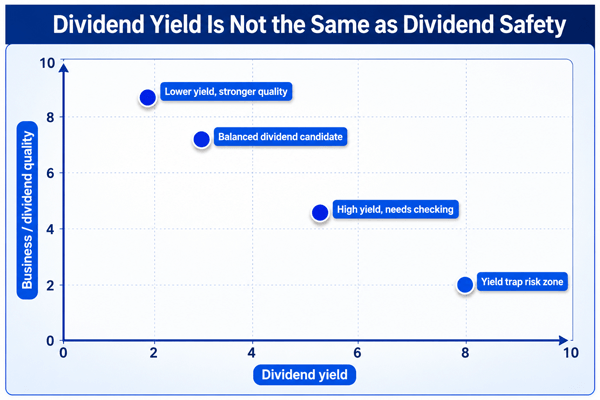
Figure. The point: beginners should compare yield with business quality, not look at yield alone.
A beginner should never buy only because the dividend yield is high. First ask: Why is the yield high? Is the business stable? Can cash flow cover the dividend? Is debt manageable? Has management protected shareholders in difficult years?
7. Dividend Stocks vs Dividend ETFs vs Growth Stocks
Dividend investing is not one single product. You can buy individual dividend stocks, dividend ETFs, dividend mutual funds, real estate investment trusts, and other income-producing assets. Each choice has trade-offs.
| Choice | Best for | Pros | Cons |
|---|---|---|---|
| Individual dividend stocks | Investors willing to research companies. | More control; can choose specific businesses; may build a custom dividend income portfolio. | Company-specific risk; dividend cuts hurt; requires ongoing monitoring. |
| Dividend ETFs | Beginners who want diversification. | Instant basket of stocks; easier than picking companies; lower single-company risk. | Fund fees; dividend income changes; may own companies you would not pick yourself. |
| Growth stocks | Investors focused on price growth more than income. | Can reinvest profits internally; may grow faster. | Little or no dividend income; often more sensitive to valuation changes. |
| Bonds or bond funds | Investors seeking fixed-income exposure. | Can reduce all-stock risk; regular interest income. | Interest-rate risk; credit risk; returns may lag stocks over long periods. |
For many beginners, a diversified dividend ETF may be easier and less stressful than choosing ten individual stocks. That does not make ETFs perfect, but it reduces the risk of one bad company damaging the whole plan.
8. A Practical Beginner Example
Let’s say Sara is 28, new to investing, and wants to learn dividend investing without gambling. She has an emergency fund, no high-interest credit card debt, and can invest $150 per month. She decides not to chase “best dividend stocks” lists blindly. Instead, she starts with a diversified dividend ETF inside a tax-advantaged retirement account, then studies individual dividend stocks slowly.
| Month | Action | Why it helps |
|---|---|---|
| 1 | Opens a low-cost brokerage or retirement account and learns how dividends appear in the account. | She understands the process before adding complexity. |
| 2 | Buys a small amount of a diversified dividend ETF. | She gets diversification instead of betting on one company. |
| 3 | Turns on dividend reinvestment. | Dividends buy more shares automatically. |
| 4-6 | Studies payout ratio, dividend history, debt, cash flow, and valuation. | She learns how dividend safety works. |
| 7-12 | Adds money monthly and reviews the portfolio quarterly, not daily. | Consistency matters more than constant checking. |
This example is not a recommendation to buy a specific ETF or stock. It shows a sensible process: build foundations, start diversified, learn the terms, avoid hype, and invest with patience.
9. How to Analyze a Dividend Stock Before Buying
A beginner does not need to become a Wall Street analyst, but you should know what to check before buying a dividend stock. The goal is not perfection. The goal is avoiding obvious mistakes.
9.1 Understand the business
Can you explain how the company makes money in one sentence? If not, pause. A dividend is only as reliable as the business behind it.
9.2 Check dividend safety
Look at the payout ratio and free cash flow. A payout ratio that is too high can mean the company has little room for mistakes. Some industries naturally pay more than others, so compare companies within the same sector.
9.3 Look at debt
Debt is not always bad, but too much debt can pressure dividends when sales slow down or interest rates rise. A company with heavy debt may need to choose between lenders and shareholders.
9.4 Review dividend history
A long dividend history can be a useful sign, but it is not a guarantee. Companies can and do cut dividends when conditions change. Focus on the future ability to pay, not only the past record.
9.5 Compare valuation
Even a wonderful dividend company can be a poor investment if you overpay. Beginners can compare price-to-earnings ratio, dividend yield history, and analyst expectations, but they should avoid pretending any single number tells the whole story.
| Question | Good sign | Warning sign |
|---|---|---|
| Is the dividend covered? | Earnings and cash flow comfortably cover the dividend. | Dividend is larger than sustainable profits or cash flow. |
| Is the balance sheet healthy? | Debt is manageable and refinancing risk is low. | Debt is rising quickly or interest costs are eating cash flow. |
| Is the business durable? | Stable demand, clear moat, sensible management. | Sales falling, weak industry, frequent restructuring. |
| Is the yield reasonable? | Yield is attractive compared with history and peers. | Yield is extremely high because the stock price collapsed. |
| Is the price fair? | Valuation is reasonable for quality and growth. | Great company, but stock price assumes perfection. |
10. Common Beginner Mistakes in Dividend Investing
- Chasing the highest dividend yield without checking whether the dividend is safe.
- Buying a stock right before the ex-dividend date and thinking the dividend is free money.
- Ignoring taxes on dividend income, especially in taxable brokerage accounts.
- Owning too many companies without understanding any of them.
- Selling quality holdings during normal market drops because the price moved down for a few weeks.
- Believing dividend stocks cannot lose money. They can.
- Forgetting that dividend ETFs can also fall in price and change payouts.
- Confusing passive income with effort-free investing. Research, discipline, and patience still matter.
11. Taxes, Accounts, and Dividend Reinvestment
In the United States, dividends are generally taxable. The IRS explains that ordinary dividends are included in ordinary income, while qualified dividends may be taxed at lower long-term capital gains rates if requirements are met. This matters because two investors can receive the same dividend but have different tax outcomes depending on account type, income level, holding period, and tax rules.
Tax-advantaged accounts, such as certain retirement accounts, can make dividend reinvestment simpler because taxes may be deferred or treated differently. In a regular taxable brokerage account, reinvested dividends can still be taxable even if you did not take the cash out. Beginners should keep records and consider tax software or a tax professional if dividend income becomes meaningful.
Do not choose investments only for tax reasons. A bad investment with good tax treatment is still a bad investment. Tax efficiency should support a strong plan, not replace one.
12. How Beginners Can Start Using Dividend Investing
- Build an emergency fund first so you do not have to sell stocks during a bad month.
- Pay attention to high-interest debt. A guaranteed credit card interest cost can be more damaging than a possible dividend return.
- Choose an account type: taxable brokerage, retirement account, or other local equivalent.
- Start diversified if you are not ready to analyze individual companies.
- Decide whether dividends will be reinvested or taken as cash.
- Create a simple watchlist and learn one company at a time.
- Review quarterly or twice per year. Avoid checking dividend income every day.
- Keep costs low: compare fund expense ratios, trading fees, platform features, and customer support.
- Write down your rules before buying: target diversification, maximum position size, and reasons to sell.
13. Dividend Investing Strategy Examples
| Strategy | How it works | Who may like it | Main risk |
|---|---|---|---|
| Dividend growth investing | Focuses on companies that raise dividends over time. | Long-term investors seeking rising income. | Lower starting yield; growth may slow. |
| High-yield investing | Focuses on higher current income. | Investors needing income now. | Higher risk of dividend cuts and price declines. |
| Dividend ETF investing | Uses funds that hold many dividend stocks. | Beginners who want simplicity and diversification. | Less control over holdings and payout pattern. |
| Core-and-satellite | Core ETF plus a few researched dividend stocks. | Learners who want both simplicity and customization. | Requires discipline to keep stock picks small. |
| Retirement income dividend plan | Uses dividends as part of retirement cash flow. | Retirees and near-retirees. | Inflation, concentration, and dividend cuts. |
14. Real-World Experience Lessons Investors Often Learn
Dividend investing feels calm when markets are rising, but the real test comes when prices fall. Experienced investors often say the first lesson is emotional: a dividend portfolio can show red numbers for months, and that does not automatically mean the plan is broken. The second lesson is quality: weak companies often look most attractive right before they disappoint investors. The third lesson is patience: the first year of dividends may look tiny, but the habit matters.
Another practical lesson is that dividend income is not the same as total return. A stock can pay a 5% dividend and fall 25%. A growth stock can pay no dividend and outperform for years. A balanced investor looks at income, growth, risk, valuation, taxes, and personal goals together.
15. Beginner Checklist Before Buying Any Dividend Stock
- I understand how the company makes money.
- The dividend yield is not unusually high without explanation.
- The payout ratio and cash flow look sustainable.
- Debt does not appear excessive compared with peers.
- The company has a realistic path to maintain or grow earnings.
- I know the ex-dividend date, but I am not buying only for the next dividend.
- This stock will not make my portfolio too concentrated.
- I understand the tax treatment in my account.
- I have a written reason to buy and a written reason that would make me sell.
- I know this is educational research, not a guaranteed income plan.
16. Frequently Asked Questions
16.1 Is dividend investing good for beginners?
It can be, if beginners focus on diversification, quality, cost, tax awareness, and long-term thinking. It is not good when beginners chase high yield, ignore risk, or treat dividends as guaranteed income.
16.2 How much money do I need to start dividend investing?
Many brokerages allow fractional shares, so the starting amount can be small. The more important question is whether you have an emergency fund, a clear budget, and a plan to invest consistently.
16.3 Can you live off dividends?
Some investors eventually use dividends as part of retirement income, but living entirely off dividends usually requires a large portfolio. Beginners should treat dividends as one tool, not a magic salary replacement.
16.4 Are dividend stocks safer than growth stocks?
Not automatically. Some dividend companies are stable, while others are distressed. Safety depends on business quality, balance sheet strength, valuation, diversification, and investor behavior.
16.5 What is a good dividend yield?
There is no universal good yield. A moderate, sustainable yield from a strong business can be better than a very high yield from a weak company. Compare yield with payout ratio, cash flow, debt, and industry norms.
16.6 Should I reinvest dividends?
Many long-term beginners reinvest dividends because it supports compounding. Investors who need current income may take cash. The right choice depends on goals, taxes, and cash-flow needs.
17. Final Thoughts
Dividend investing is simple to understand but not always easy to practice. The simple part is receiving cash from companies or funds you own. The hard part is choosing quality investments, avoiding yield traps, staying diversified, managing taxes, and being patient when the market is uncomfortable.
A strong beginner dividend plan does not start with “What is the highest dividend stock I can buy?” It starts with “What is a sensible, diversified, affordable, tax-aware plan I can follow for years?” That mindset is safer, more honest, and more likely to help a reader make good decisions.
Sources Consulted and Checked
The following sources were consulted and checked while preparing this article to support accuracy, clarity, and responsible presentation:
- SEC Investor.gov: dividend definition and beginner investing risk education (investor.gov).
- IRS Topic No. 404: ordinary dividends and qualified dividends (irs.gov/taxtopics/tc404).
Reader Advice
This article is provided solely for educational and informational purposes. It does not constitute investment, financial, tax, legal, or accounting advice, and it should not be treated as a recommendation to buy, sell, or hold any security, fund, or other asset. Investing involves risk, including possible loss of principal; share prices can decline, dividends may be reduced or discontinued, and past performance does not guarantee future results. Rules, tax treatment, market conditions, product features, fees, and eligibility requirements can vary by country, account type, provider, and personal circumstances, and they may change over time.
Before making any decision, readers should independently verify current facts, figures, dates, terms, and regulatory or tax information through official sources and relevant service providers. Consider consulting a suitably qualified and licensed financial, tax, or legal professional who can assess your individual goals, circumstances, risk tolerance, and jurisdiction.