Crypto On-Ramps and Off-Ramps: Complete Guide, Examples, Risks and Best Practices
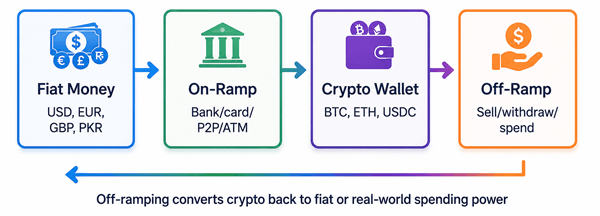
Figure: The basic movement between fiat money, crypto, and real-world spending power.
Crypto on-ramps and off-ramps are the bridges between traditional money and cryptocurrency. An on-ramp helps you turn fiat money, such as dollars or euros, into crypto. An off-ramp helps you turn crypto back into fiat money or spend it in the real world.
For beginners, these bridges matter more than they first appear. Buying bitcoin with a debit card, receiving USDC from a client and withdrawing it to a bank account, cashing out trading profits, or using a crypto card to pay for groceries are all on-ramp or off-ramp activities.
The most important thing to understand is this: crypto transactions are not just about clicking buy or sell. They involve payment rails, identity checks, fees, blockchain networks, wallet addresses, taxes, consumer protection, fraud risk, and sometimes bank or regulatory reviews.
1. Quick Answer: What Are Crypto On-Ramps and Off-Ramps?
| Term | Simple meaning | Common examples |
|---|---|---|
| Crypto on-ramp | A service or method that converts fiat money into cryptocurrency. | Buying BTC with a bank transfer, buying USDC with a debit card, using a crypto ATM, receiving crypto through a payment processor. |
| Crypto off-ramp | A service or method that converts cryptocurrency into fiat money or spendable value. | Selling ETH to withdraw USD to a bank, converting USDT to local currency through a regulated exchange, using a crypto debit card, merchant settlement into fiat. |
| Fiat money | Government-issued money that is not crypto. | USD, EUR, GBP, JPY, PKR, CAD, AUD. |
| VASP/CASP | A regulated crypto service provider in many jurisdictions. | Centralized exchanges, custodial wallet providers, brokerages, crypto payment processors. |
2. Why On-Ramps and Off-Ramps Matter
Blockchains are useful because they let people move digital assets without relying on the same infrastructure as banks. But most people still earn, save, pay bills, and calculate prices in fiat money. That creates a practical problem: people need a safe way to move in and out of crypto.
- New users need on-ramps to buy their first crypto.
- Freelancers and businesses need off-ramps to convert crypto payments into local currency.
- Traders and investors need reliable fiat withdrawals to realize gains or manage risk.
- Apps and games need embedded on-ramps so users can buy tokens without leaving the product.
- Regulators and banks pay close attention to these points because they connect anonymous or pseudonymous blockchain activity with the traditional financial system.
3. How a Crypto On-Ramp Works
A typical on-ramp has six steps. The exact flow depends on the provider, country, payment method, and asset.
- You choose a platform. This could be a centralized exchange, broker, wallet app, payment processor, ATM, or peer-to-peer marketplace.
- You verify your identity. Regulated platforms usually require KYC checks such as name, date of birth, address, government ID, selfie verification, or source-of-funds information.
- You select the asset and network. For example, you may choose BTC on Bitcoin, ETH on Ethereum, or USDC on Base, Ethereum, Solana, Polygon, or another network.
- You pay with fiat. Common methods include bank transfer, ACH, wire, debit card, credit card, mobile wallet, local instant payment rails, or cash at an ATM.
- The provider executes the purchase. The platform quotes a price, adds any fees or spread, and sends the crypto to your exchange account or wallet.
- You store or transfer the crypto. You may keep it with the exchange, move it to a self-custody wallet, use it in an app, or trade it for another asset.
4. How a Crypto Off-Ramp Works
An off-ramp reverses the process. Instead of putting fiat money into crypto, you convert crypto back into fiat or spendable value.
- You send or select the crypto to sell. On an exchange, the crypto may already be in your account. With a wallet-based off-ramp, you may send funds from your wallet to the provider.
- The provider screens the transaction. Regulated providers may run blockchain analytics, sanctions screening, fraud checks, and account risk reviews.
- You sell the crypto for fiat. The platform converts the asset at a quoted price, usually with a fee, spread, or both.
- You choose a payout method. Bank transfer, ACH, wire, instant card payout, local payment rails, mobile wallet, or merchant settlement are common options.
- Funds arrive in your bank or payment account. Timing can range from minutes to several business days.
- You keep records. Sales, swaps, rewards, and payments can have tax consequences in many countries.
5. Common Types of Crypto On-Ramps and Off-Ramps
| Type | Best for | Advantages | Limitations / risks |
|---|---|---|---|
| Centralized exchange | Beginners, investors, traders, bank-linked users | Usually liquid, regulated in many markets, supports bank transfers, clear account history | Requires KYC; withdrawals may be delayed; custody risk if you leave funds on the exchange |
| Broker or instant buy service | Simple one-time purchases | Easy user experience; quick card purchases | Often higher spreads or card fees than advanced exchange trading |
| Wallet-integrated on-ramp | Users of DeFi, games, NFTs, and Web3 apps | Convenient; sends crypto directly to wallet or app | Network selection mistakes can be costly; provider coverage varies by country |
| Peer-to-peer marketplace | Local payment methods or areas with limited exchange access | Flexible payment methods; may support local currencies | Higher fraud, chargeback, and counterparty risk; requires careful escrow use |
| Crypto ATM | Cash users or urgent small transactions | Physical cash access; simple for some users | High fees; scam risk; limited assets; strict local rules |
| Crypto debit card / spending card | Spending crypto in daily life | Converts crypto at point of sale or before spending | Fees, tax complexity, exchange-rate spread, issuer restrictions |
| Merchant payment processor | Businesses accepting crypto | Can settle in fiat, reducing volatility risk | Processor fees; compliance requirements; chargeback and refund policies differ |
| Stablecoin payment rail | Cross-border payments and treasury operations | Fast settlement, 24/7 transfer, useful where supported | Issuer, depeg, regulatory, wallet, and network risks |
6. Real-World Examples
6.1 Example 1: A beginner buys bitcoin with a bank transfer
A user creates an account at a regulated exchange, completes identity verification, links a bank account, deposits $500, and buys bitcoin. The exchange may hold the bitcoin until the bank transfer clears. If the user later sends bitcoin to a personal wallet, they must copy the address correctly and use the correct blockchain network.
6.2 Example 2: A freelancer receives USDC and cashes out
A designer completes work for an overseas client and receives 1,000 USDC in a self-custody wallet. The designer sends the USDC to an exchange that supports the same network, sells USDC for local currency, and withdraws to a bank account. The practical questions are: Which network was used? What are the withdrawal fees? Is the exchange available in the designer’s country? Does the bank accept crypto-related transfers?
6.3 Example 3: A Web3 app embeds an on-ramp
A blockchain game wants new users to buy a small amount of crypto without leaving the app. It integrates an on-ramp provider so users can pay by card or bank transfer. The provider handles identity checks, payment authorization, asset delivery, fraud screening, and compliance. The app improves onboarding, but users still need clear warnings about fees, network choice, refunds, and wallet security.
6.4 Example 4: A business accepts crypto but settles in fiat
An online store accepts USDC payments. Instead of keeping crypto on its balance sheet, it uses a payment processor that converts incoming crypto to fiat and deposits the money into the company bank account. This reduces volatility risk but does not eliminate tax, compliance, or settlement risk.
7. On-Ramp vs Off-Ramp: Key Differences
| Question | On-ramp | Off-ramp |
|---|---|---|
| Direction | Fiat to crypto | Crypto to fiat or spendable value |
| Main user goal | Buy, fund a wallet, enter a crypto app | Cash out, pay bills, settle revenue, reduce exposure |
| Common payment rails | Card, ACH, bank transfer, wire, mobile wallet, cash ATM | Bank withdrawal, card payout, wire, local rails, merchant settlement |
| Main risk | Overpaying fees, buying wrong asset, storing crypto badly | Withdrawal delay, compliance review, tax reporting, sending from risky wallet |
| Common compliance checks | KYC, payment fraud screening, sanctions screening | KYC, source of funds, blockchain risk scoring, transaction monitoring |
8. Fees: What Beginners Should Check Before Using an On-Ramp or Off-Ramp
The advertised fee is not always the full cost. Crypto conversion costs can include direct platform fees, card processing fees, bank fees, network fees, spreads, and exchange-rate markups.
| Cost type | What it means | How to reduce it |
|---|---|---|
| Trading fee | A fee to buy or sell crypto on the platform. | Compare beginner buy screens with advanced trading screens; use limit orders where appropriate. |
| Spread | The difference between the market price and the price quoted to you. | Compare the final quote with a reliable market price before confirming. |
| Payment fee | Card, bank, wire, or mobile wallet processing cost. | Bank transfers are often cheaper than card payments but may be slower. |
| Network fee | Fee paid to move crypto on a blockchain. | Use the right network; avoid congested networks for small transfers. |
| Withdrawal fee | Fee to send fiat to your bank or crypto to your wallet. | Check the platform fee page before depositing funds. |
| FX fee | Currency conversion fee if your bank currency differs from the platform currency. | Use platforms and payment methods that support your local currency where possible. |
Practical tip: Before confirming any transaction, write down the amount paid, the amount received, the asset, the network, all visible fees, and the final exchange rate. This makes it easier to compare providers and prepare tax records later.
9. Benefits of Good On-Ramps and Off-Ramps
- They make crypto easier to access for beginners.
- They connect crypto apps to familiar payment methods such as cards and bank transfers.
- They help businesses accept crypto while settling in fiat.
- They can reduce operational friction for cross-border payments.
- They create audit trails that may help users with reporting, bookkeeping, and compliance.
- They give regulated platforms a way to screen suspicious activity and protect users from some forms of fraud.
10. Risks and Limitations You Should Understand
10.1 Crypto prices can move quickly
If you buy a volatile asset such as bitcoin or ether, the value can change before, during, and after your transaction. Stablecoins are designed to track a fiat currency, but they still have issuer, reserve, redemption, network, and regulatory risks.
10.2 Transactions may be irreversible
If you send crypto to the wrong address or wrong network, there may be no bank-style reversal. Some exchanges can recover certain mistakes, but recovery is not guaranteed and may be expensive or impossible.
10.3 KYC and compliance reviews can delay withdrawals
Regulated providers may ask for additional documents, source-of-funds evidence, or explanation of wallet activity. This is especially common for large transfers, unusual patterns, sanctioned exposure, high-risk jurisdictions, or transactions involving mixers, darknet markets, scams, or stolen funds.
10.4 Banks may reject or review crypto-related transfers
Some banks support transfers to and from crypto platforms; others restrict them. Even when a platform is regulated, your bank may still flag the transaction. Check both sides before moving large amounts.
10.5 Scams often use on-ramps as the entry point
Many scams begin by telling victims to buy crypto through a legitimate exchange, ATM, or payment app and then send it to a scammer-controlled wallet. Official consumer warnings from agencies such as the FBI, FTC, SEC, and CFTC repeatedly highlight impersonation, investment fraud, fake trading platforms, and urgent requests to buy or send crypto as major red flags.
11. Common Mistakes Beginners Make
| Mistake | Why it is dangerous | Better practice |
|---|---|---|
| Using the wrong network | USDC on Ethereum, Base, Solana, and Polygon are not automatically the same deposit route. | Match the asset and network exactly before sending. |
| Ignoring the spread | A low advertised fee can hide a poor exchange rate. | Compare the final amount received, not just the headline fee. |
| Sending money because someone pressures you | Scammers create urgency and impersonate support, banks, government agencies, or romantic partners. | Stop, verify independently, and never send crypto to “protect” money. |
| Leaving large balances on an exchange | If the platform freezes withdrawals, is hacked, or fails, access may be limited. | Use reputable platforms and consider self-custody for funds you understand how to secure. |
| Skipping tax records | Selling, swapping, spending, or receiving crypto may create reportable events. | Export transaction history and keep wallet records. |
| Testing with a large transfer first | A typo or network mistake can cause a major loss. | Send a small test transaction when practical. |
12. How to Choose a Safe Crypto On-Ramp or Off-Ramp
No provider is risk-free, but you can reduce avoidable problems by checking the basics before depositing money or sending crypto.
- Check whether the provider serves your country legally and clearly lists supported jurisdictions.
- Look for transparent fees, spreads, deposit rules, withdrawal limits, and settlement times.
- Confirm supported assets and networks before sending funds.
- Review security features such as two-factor authentication, withdrawal allowlists, account alerts, and device management.
- Check custody model: Are funds held by the platform, a qualified custodian, or your own wallet?
- Read recent user complaints carefully, especially about frozen withdrawals, account closures, and support delays.
- For businesses, ask about licensing, sanctions screening, transaction monitoring, Travel Rule support, chargeback handling, refunds, and reconciliation exports.
- Start with a small transaction before using the provider for meaningful amounts.
13. Best Practices for Individuals
- Use regulated, reputable platforms where possible.
- Enable strong two-factor authentication using an authenticator app or hardware key, not SMS where avoidable.
- Never share seed phrases, private keys, one-time codes, or remote access to your device.
- Use a small test transaction before sending a large amount to a new wallet or exchange.
- Double-check asset, network, address, memo, and destination tag requirements.
- Keep screenshots or exports of confirmations, transaction hashes, fees, and exchange rates.
- Do not trust anyone who promises guaranteed returns or tells you to move crypto urgently.
- Separate long-term storage from active trading or spending accounts.
- Understand your local tax obligations before selling, swapping, or spending crypto.
14. Best Practices for Businesses and Product Teams
Businesses need a more structured approach because on-ramp and off-ramp failures can become compliance, customer-support, accounting, and reputational problems.
- Map the full flow: customer identity, payment method, asset, blockchain network, custody, settlement, refunds, disputes, and tax records.
- Use providers with clear licensing, AML/KYC controls, sanctions screening, and transaction monitoring appropriate for your markets.
- Display the final quote clearly, including fees, spread, network fee, asset, network, and expected settlement time.
- Give beginners strong warnings before wallet transfers and irreversible transactions.
- Implement fraud controls for stolen cards, account takeover, mule accounts, chargebacks, and rapid in-out flows.
- Create a support playbook for failed deposits, wrong network transfers, delayed withdrawals, frozen accounts, refunds, and suspected scams.
- Keep auditable records for finance, compliance, customer support, and tax reporting.
- Do not treat stablecoins as risk-free cash. Review issuer, reserve, redemption, custody, and jurisdiction risks.
15. Compliance Basics: KYC, AML, Sanctions, and the Travel Rule
A beginner does not need to become a compliance expert, but it helps to understand why platforms ask so many questions.
| Concept | What it means in plain English | Why it affects users |
|---|---|---|
| KYC | Know Your Customer checks verify who you are. | You may need to provide ID, address, selfie, or business documents. |
| AML/CFT | Anti-money-laundering and counter-terrorist-financing controls. | Platforms may block suspicious activity or request source-of-funds evidence. |
| Sanctions screening | Checking users, wallets, and counterparties against restricted lists. | Transactions connected to sanctioned entities can be blocked or reported. |
| Travel Rule | Rules requiring certain information to travel with crypto transfers between regulated providers. | Transfers between exchanges may require sender and recipient details. |
| Blockchain analytics | Tools that assess wallet and transaction risk using public blockchain data. | Funds linked to hacks, scams, mixers, or darknet activity may trigger review. |
The Financial Action Task Force, known as FATF, has repeatedly warned that virtual assets are borderless and that uneven regulation creates global risks. FATF guidance and red-flag reports are widely used by regulators and compliance teams when designing controls for crypto service providers.
16. Tax and Record-Keeping Basics
Tax rules vary by country, but many tax authorities treat crypto sales, exchanges, rewards, and payments as reportable. In the United States, the IRS states that income from digital assets is taxable and that virtual currency is generally treated as property for federal income tax purposes.
- Buying crypto with fiat may not itself create a taxable gain in many systems, but it creates a cost basis record.
- Selling crypto for fiat commonly creates a gain or loss.
- Swapping one crypto asset for another may be taxable in some countries.
- Spending crypto can be treated like selling crypto, because you dispose of the asset.
- Receiving crypto as payment, rewards, mining income, staking rewards, or airdrops may create income-reporting obligations.
- Keep records even if the platform does not send you a tax form.
17. On-Ramps, Off-Ramps, and Stablecoins
Stablecoins such as USDC and USDT are often used in on-ramp and off-ramp flows because they aim to track the value of a fiat currency. They can make transfers easier to price and reduce volatility compared with assets such as bitcoin or ether. However, stablecoins are not the same as insured bank deposits.
| Stablecoin benefit | Practical limitation |
|---|---|
| Easier pricing because many stablecoins aim to stay near $1. | A stablecoin can lose its peg or face redemption issues. |
| Fast blockchain settlement, often 24/7. | Settlement depends on the chosen blockchain and network congestion. |
| Useful for cross-border payments and app balances. | Regulatory treatment differs by country and can change. |
| Can reduce exposure to volatile crypto during transfers. | Issuer, custody, reserve, sanctions, smart-contract, and network risks remain. |
18. When Should You Use an On-Ramp or Off-Ramp?
| Scenario | Likely useful option | What to check first |
|---|---|---|
| You are buying your first small amount of crypto | Regulated exchange or simple broker | Fees, supported country, KYC, withdrawal rules, security settings |
| You need crypto inside a wallet app | Wallet-integrated on-ramp | Asset, network, quote, provider reputation, refund policy |
| You received stablecoins from a client | Exchange off-ramp or stablecoin payment processor | Network support, source-of-funds documents, bank withdrawal options |
| Your business wants to accept crypto payments | Merchant processor with fiat settlement | Compliance, refunds, accounting exports, settlement currency, tax reporting |
| You need cash from crypto urgently | Exchange instant payout or card payout if available | Higher fees, limits, fraud checks, bank/card support |
| Someone told you to buy crypto and send it to them | Do not proceed | This is a common scam pattern; verify independently and seek help. |
19. Red Flags: When Not to Use a Crypto On-Ramp or Off-Ramp
- Someone promises guaranteed profits or unusually high returns.
- A stranger, romantic contact, “mentor,” or social-media group tells you which platform to use.
- You are told to buy crypto to fix bank fraud, pay taxes, unlock winnings, or protect your money.
- A platform lets you deposit easily but invents fees, taxes, or verification charges when you try to withdraw.
- The provider hides its company name, legal address, fees, or terms.
- Customer support asks for your seed phrase, private key, password, or one-time code.
- You are rushed, threatened, or told not to talk to your bank, family, or law enforcement.
- The website address is slightly misspelled or reached through a sponsored ad rather than a verified source.
20. Beginner Checklist Before Any On-Ramp or Off-Ramp Transaction
- Am I using the official website or app?
- Is this provider available and regulated or registered where required in my country?
- Do I understand the total cost, including spread and network fees?
- Have I chosen the correct asset and blockchain network?
- Have I checked deposit and withdrawal limits?
- Do I know how long settlement should take?
- Have I enabled two-factor authentication?
- Have I saved records for taxes and troubleshooting?
- Am I acting because I want to, not because someone pressured me?
- For large transfers, have I tested with a small amount first?
21. Pros and Cons Summary
| Pros | Cons |
|---|---|
| Makes crypto accessible to beginners. | Can involve high fees or hidden spreads. |
| Connects bank accounts, cards, and wallets. | KYC and compliance reviews can delay transactions. |
| Lets businesses accept crypto while settling in fiat. | Scams often use legitimate on-ramps to move victim funds. |
| Creates records that can support reporting. | Wrong-network transfers and wallet mistakes can be irreversible. |
| Can support faster cross-border settlement in some use cases. | Regulatory, banking, tax, and platform rules vary widely. |
22. Frequently Asked Questions
22.1 What is the easiest crypto on-ramp for beginners?
For many beginners, a reputable centralized exchange or well-known wallet-integrated on-ramp is the easiest option because it provides a familiar buy screen, identity verification, and customer support. The best choice depends on your country, payment method, fees, and the asset you want.
22.2 Is a crypto exchange an on-ramp or an off-ramp?
It can be both. When you deposit fiat and buy crypto, the exchange acts as an on-ramp. When you sell crypto and withdraw fiat, it acts as an off-ramp.
22.3 Are crypto on-ramps safe?
Some are safer than others, but no on-ramp is risk-free. Use reputable providers, enable security features, verify URLs, check fees, and avoid transactions driven by pressure or promises of guaranteed returns.
22.4 Why do on-ramps ask for ID?
Regulated providers usually collect identity information to meet KYC, AML, sanctions, fraud-prevention, and licensing obligations.
22.5 Can I buy crypto without KYC?
Some peer-to-peer, decentralized, or cash-based methods may require less identity information, but they often carry higher fraud, legal, liquidity, and counterparty risks. Rules vary by country.
22.6 What is the cheapest way to on-ramp?
Bank transfers are often cheaper than card purchases, but they may be slower. The true cost depends on trading fees, spread, network fees, and withdrawal fees.
22.7 What is the fastest way to off-ramp?
Instant card payouts or certain local real-time payment rails can be fast where available, but they may cost more and can still be delayed by compliance checks.
22.8 Can I off-ramp from a self-custody wallet?
Yes, if the provider supports wallet-based off-ramping. You usually connect or send from your wallet, pass verification, sell the crypto, and receive fiat through a supported payout method.
22.9 What happens if I send crypto on the wrong network?
The funds may be delayed, require manual recovery, or be permanently lost. Always match both the asset and network with the receiving platform instructions.
22.10 Do I owe tax when I off-ramp crypto?
In many countries, selling crypto for fiat can create a taxable gain or loss. Tax rules vary, so keep detailed records and consult a qualified tax professional for your situation.
22.11 Are stablecoin off-ramps safer than bitcoin off-ramps?
Stablecoins reduce price volatility during transfer, but they still carry issuer, custody, network, smart-contract, redemption, and regulatory risks.
22.12 Why was my withdrawal delayed or frozen?
Common reasons include new-account holds, large transfers, source-of-funds review, suspected fraud, sanctions screening, unusual wallet history, bank processing delays, or missing identity information.
23. Final Takeaway
Crypto on-ramps and off-ramps are essential because they connect the crypto economy with everyday money. The best experience is not simply the fastest or cheapest one. It is the one that is clear, legal in your location, transparent about costs, secure, tax-record friendly, and appropriate for the amount you are moving.
For beginners, the safest mindset is simple: move slowly, verify everything, start small, keep records, and never send crypto because someone pressures you. For businesses, the best approach is to treat on-ramp and off-ramp design as a combined product, compliance, fraud, accounting, and customer-support workflow.
Sources Consulted and Checked
These sources were consulted and checked while preparing this document to support accuracy and reliability.
- Financial Action Task Force (FATF), Virtual Assets Red Flag Indicators and 2025 virtual assets updates.
- FATF, Targeted Report on Stablecoins and Unhosted Wallets, 2026.
- Internal Revenue Service (IRS), Digital assets and virtual currency FAQ pages.
- European Securities and Markets Authority (ESMA), Markets in Crypto-Assets Regulation (MiCA) overview.
- Federal Bureau of Investigation (FBI), cryptocurrency investment fraud and 2025 Internet Crime Report materials.
- Federal Trade Commission (FTC), What To Know About Cryptocurrency and Scams.
- SEC Investor.gov and CFTC investor alerts on digital asset and cryptocurrency scams.
- Stripe, Crypto on-ramps resources, 2026.
- Coinbase Developer Platform, Onramp and Offramp product documentation.
- Reuters reporting on FATF crypto risk updates and EU MiCA licensing developments.
Reader Advice
This article is provided for educational and informational purposes only. It is not personalized financial, legal, tax, investment, compliance, or security advice, and it does not recommend any particular cryptocurrency, platform, provider, or transaction. Crypto assets, stablecoins, wallets, and on-ramp or off-ramp services can involve price volatility, fraud, irreversible transfers, custody failures, account restrictions, tax consequences, and loss of some or all funds. Laws, regulations, platform policies, fees, eligibility rules, and statistics can change over time and vary by country or region. Before acting, verify current information through official government, regulator, bank, tax-authority, and provider sources, assess whether the service is lawful and suitable in your location, and consider advice from an appropriately qualified professional for your circumstances.