Best Crypto Exchanges for Beginners: Complete Guide, Examples, Risks and Best Practices
Quick Answer
The best crypto exchange for a beginner is usually the one that is available in your country, easy to use, transparent about fees, strong on security, and suitable for the coins you actually plan to buy. For many beginners, Coinbase, Kraken, Gemini, Crypto.com, Binance.US, eToro, and Robinhood Crypto are common starting points, but the right choice depends on your location, cost sensitivity, desired coins, and whether you want to withdraw crypto to your own wallet.
1. What Is a Crypto Exchange?
A crypto exchange is an online platform where you can buy, sell, trade, and sometimes store cryptocurrencies such as Bitcoin, Ethereum, Solana, or stablecoins. Think of it as a marketplace that connects buyers and sellers and gives beginners a simple way to convert regular money, such as dollars or euros, into digital assets.
Most beginner exchanges work through a website or mobile app. You create an account, verify your identity, add a payment method, choose a cryptocurrency, review the price and fees, and confirm the purchase. The exchange then credits the crypto to your exchange account. From there, you can keep it on the platform, sell it later, or withdraw it to a private wallet if withdrawals are supported.
1.1 Centralized vs. decentralized exchanges
Most beginners start with a centralized exchange because it feels similar to a banking or brokerage app. A company operates the platform, handles identity checks, provides customer support, and stores assets for many users. A decentralized exchange, or DEX, works differently: you connect your own wallet and trade directly through blockchain smart contracts. DEXs can offer more control, but they are less forgiving. A wrong network, wrong address, malicious token, or fake website can lead to permanent loss.
| Type | Best for | Beginner difficulty | Main trade-off |
|---|---|---|---|
| Centralized exchange | First-time buyers, simple fiat deposits, customer support, mobile apps | Low to medium | You trust the platform with custody unless you withdraw. |
| Decentralized exchange | Users who already understand wallets, networks, gas fees, and smart contracts | High | More control, but mistakes and scams are easier. |
2. How Crypto Exchanges Work
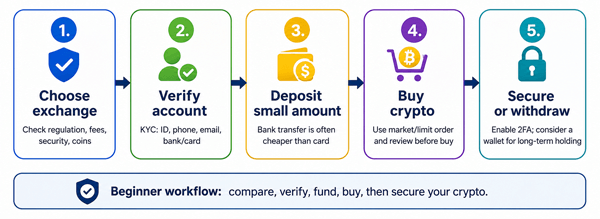
Figure 1: A simple beginner workflow for using a crypto exchange.
Behind the simple app screen, an exchange performs several jobs. It verifies customers, matches orders, displays market prices, processes deposits and withdrawals, and holds customer balances. Some platforms also offer staking, debit cards, advanced trading, derivatives, loans, or stock trading. Beginners should avoid complex features until they understand the basic buy, sell, deposit, withdrawal, and tax implications.
- Account creation: You sign up with an email, phone number, and password.
- Identity verification: Most regulated platforms require Know Your Customer checks, such as government ID and address information.
- Funding: You deposit funds by bank transfer, debit card, credit card, or crypto transfer. Bank transfers are often cheaper than cards, but processing times vary.
- Trading: You choose a coin and order type. A simple buy is easy but may include a wider spread. A limit order can give more price control.
- Custody: The exchange holds the crypto for you unless you withdraw to a self-custody wallet.
- Exit: You can sell back to fiat and cash out, transfer to another platform, or withdraw to a wallet, depending on local rules and exchange features.
3. Best Crypto Exchanges for Beginners Compared
There is no single “best” exchange for every beginner. Availability, rules, fees, and supported coins vary by country and can change.
| Exchange | Good fit for beginners who want... | Strengths | Watch-outs |
|---|---|---|---|
| Coinbase | A simple interface, strong brand recognition, easy recurring buys, and a route to more advanced tools later. | Beginner-friendly app; publicly listed U.S. company; supports simple buy/sell and Coinbase Advanced. | Simple trades can include spreads; advanced fee tiers are cheaper but less beginner-friendly; availability varies by country. |
| Kraken | A balance of beginner app, advanced trading path, and strong security reputation. | Long operating history; Kraken and Kraken Pro options; transparent fee schedule for instant and custom orders. | The Pro interface can feel technical; instant buy fees can be higher than order-book trading. |
| Gemini | A regulated-feeling platform, simple app, and a conservative coin list. | Simple interface; ActiveTrader option; emphasizes compliance and custody controls. | Usually fewer coins than global mega-exchanges; fees and features vary by region. |
| Crypto.com | A mobile-first app with many coins and card/rewards ecosystem features. | Large coin selection; app-first onboarding; bank transfers may be available in many regions. | Ecosystem can feel busy; spreads and card-related terms require careful reading. |
| Binance.US | Low spot-trading fees in supported U.S. states and access to many major crypto assets. | Very low published spot-fee structure on supported pairs; simple app plus trading interface. | U.S.-only version is separate from global Binance; state availability and features can change. |
| eToro | A simple investing app that includes crypto alongside other assets. | Easy interface; social/investing orientation; published 1% crypto position fee on its site. | U.S. crypto asset selection has been restricted; not ideal for users who want broad coin access or advanced crypto features. |
| Robinhood Crypto | A very simple app for small crypto exposure alongside stocks. | Easy to use; no separate crypto trading commission shown in the same way as exchanges; simple order flow. | Costs can be embedded in spreads/order routing; fewer crypto-native tools; withdrawal and availability limitations may apply. |
3.1 Beginner Recommendations by Use Case
| Use case | Best type of exchange to consider | Why |
|---|---|---|
| First $25-$100 Bitcoin purchase | Coinbase, Kraken, Gemini, Crypto.com, Robinhood Crypto, or another regulated local app | Ease of use matters more than having hundreds of coins. |
| Lowest spot-trading fees | Order-book platforms such as Kraken Pro, Coinbase Advanced, Binance.US, or similar local exchanges | Market/limit orders on advanced interfaces often cost less than instant buy. |
| Long-term holding | Exchange with strong security plus optional self-custody wallet withdrawal | Custody matters as much as fees when holding for years. |
| Many altcoins | Crypto.com, Binance regional platforms, Kraken, or other locally available exchanges | Coin selection varies by jurisdiction and risk level. |
| Simple app with stocks and crypto together | eToro or Robinhood Crypto, depending on country and asset availability | Convenience may outweigh advanced crypto features for some beginners. |
4. How to Choose the Best Crypto Exchange as a Beginner
Use this checklist before creating an account or depositing money. A beginner-friendly exchange should be understandable, secure, and transparent enough that you know what you are paying and what risks you are accepting.
4.1 Check availability and regulation in your country
An exchange may be excellent in one country and unavailable or limited in another. Check whether the platform legally serves your region, which entity you are contracting with, and what dispute process applies. In the U.S., also check whether the exchange is available in your state.
4.2 Compare the real cost, not just the headline fee
Crypto costs usually include more than a visible trading fee. You may also pay a spread, card fee, withdrawal fee, blockchain network fee, conversion fee, or inactivity fee. For beginners, the easiest way to compare costs is to preview the same $100 buy on two platforms before confirming. Look at how much crypto you receive after all costs.
4.3 Prioritize security features
- Two-factor authentication with an authenticator app or hardware security key.
- Withdrawal allowlisting or address book controls.
- Clear history of account logins and withdrawals.
- Cold storage and custody disclosures.
- Customer support that can help with account access, but will never ask for your password, seed phrase, or 2FA code.
4.4 Look for simple funding and cash-out options
Buying is only half the experience. Beginners also need to know how to sell and withdraw cash. Before depositing, check deposit methods, withdrawal limits, bank transfer times, minimums, and whether the platform supports your local currency.
4.5 Check coin selection carefully
More coins are not always better. Beginners are usually safer starting with larger, more liquid assets and learning how the market works before exploring small, speculative tokens. A platform that lists thousands of coins can be convenient, but it also increases the chance of buying something you do not understand.
4.6 Test support and education
A good beginner platform should explain fees, order types, wallets, taxes, and risks in plain language. Search the help center before depositing. If basic questions are hard to answer, that is a warning sign.
5. Practical Example: Buying Your First $100 of Bitcoin
Imagine Sara is new to crypto and wants to buy $100 of Bitcoin. She is not trying to trade daily. She wants to learn slowly and avoid obvious mistakes.
- Sara compares two available exchanges and previews a $100 Bitcoin purchase on each without confirming. One gives her slightly more Bitcoin after fees and spread.
- She chooses bank transfer instead of debit card because the card fee is higher.
- She enables two-factor authentication with an authenticator app before depositing money.
- She buys $50 first, not the full $100, so she can learn how confirmations, balances, and price movements appear in the app.
- She leaves the small amount on the exchange while learning, but reads the withdrawal process and wallet basics before moving larger amounts.
- She writes down the date, amount, price, and fee for future tax records.
The important lesson is not that Sara picked a perfect exchange. It is that she slowed down, checked costs, protected her account, started small, and kept records.
6. Fees and Spreads Explained in Plain English
Fees are one of the biggest beginner traps because crypto apps can look “free” while costs are built into the price. The most common costs are:
| Cost type | What it means | Beginner example |
|---|---|---|
| Trading fee | A visible percentage or fixed fee charged when you buy or sell. | A 0.40% fee on a $100 trade costs $0.40. |
| Spread | The difference between the price you pay to buy and the price you would receive to sell at the same moment. | Bitcoin may show $60,000 market price, but your buy quote may be slightly higher. |
| Deposit fee | A charge to add money, often higher for cards than bank transfers. | A debit card buy may cost more than ACH/bank transfer. |
| Withdrawal fee | A platform or blockchain network cost when moving crypto out. | Sending Bitcoin to a wallet may require a network fee. |
| Conversion fee | A fee or spread when swapping one crypto for another. | Swapping ETH to SOL may cost more than selling and buying through an order book. |
6.1 Instant buy vs. advanced trade
Instant buy is simple: enter an amount, review, and confirm. It is convenient, but it may include a wider spread or higher fee. Advanced trade uses an order book and order types such as market and limit orders. It can be cheaper, but it requires more care. Beginners can start with instant buy for a tiny test purchase, then learn limit orders before making larger purchases.
7. Crypto Wallets and Custody: Who Holds Your Crypto?
Custody means who controls the keys that move crypto. This is one of the most important beginner concepts.
| Custody option | How it works | Pros | Cons |
|---|---|---|---|
| Exchange custody | The exchange holds the private keys and shows your balance in your account. | Easy; password recovery and customer support; simple trading. | Platform risk; withdrawal restrictions; account compromise risk. |
| Self-custody software wallet | You hold the recovery phrase in a mobile or desktop wallet. | More control; can use decentralized apps. | If you lose the recovery phrase or sign a malicious transaction, funds may be gone. |
| Hardware wallet | Private keys are stored on a separate device. | Stronger long-term storage for larger holdings. | Costs money; requires careful setup and safe seed phrase storage. |
For beginners, it can be reasonable to keep a very small learning amount on a reputable exchange while studying wallets. For larger or long-term holdings, learn self-custody carefully before moving funds. Never type your wallet recovery phrase into a website, form, chat, support ticket, or exchange app unless you are restoring the wallet in the legitimate wallet software.
8. Benefits of Using a Beginner-Friendly Crypto Exchange
- Easy entry: You can buy crypto with a bank account or card without learning complex blockchain tools first.
- Price discovery: Exchanges show current market prices, charts, order books, and historical performance.
- Liquidity: Larger exchanges usually make it easier to buy and sell major coins quickly.
- Recordkeeping: Reputable platforms provide trade history that can help with tax reporting.
- Education and support: Beginner platforms often include help articles, alerts, and customer-service workflows.
9. Major Risks and Limitations Beginners Must Understand
Crypto can be useful and innovative, but it is not risk-free. The biggest beginner mistake is treating a simple app as proof that the asset is safe.
| Risk | What can happen | How to reduce it |
|---|---|---|
| Price volatility | A coin can fall sharply in hours or days. | Invest only a small portion of your portfolio; avoid leverage; use a long-term plan. |
| Scams and phishing | Fake support, fake giveaways, romance scams, investment groups, and wallet-draining links can steal funds. | Never share passwords, 2FA codes, or seed phrases; verify URLs; ignore guaranteed-profit claims. |
| Platform/custody risk | An exchange can freeze withdrawals, suffer operational issues, or fail. | Use reputable platforms; avoid keeping more on an exchange than needed; learn wallets. |
| Regulatory changes | Coins, staking, derivatives, or entire platforms can become restricted in your region. | Use legally available platforms; read notices; avoid workarounds that violate terms. |
| User error | Sending crypto to the wrong address or network can be irreversible. | Send a small test transaction first; verify network and address character by character. |
| Tax complexity | Sales, swaps, staking rewards, and transfers can create recordkeeping obligations. | Download trade history; consult a qualified tax professional if unsure. |
10. Common Beginner Mistakes
- Buying because a coin is trending on social media without understanding it.
- Using a credit card or high-fee payment method for a large first purchase.
- Ignoring spread and only looking at advertised fees.
- Leaving two-factor authentication disabled.
- Assuming “regulated” means risk-free or government-insured.
- Sending crypto over the wrong network, such as confusing Ethereum, Base, BNB Chain, Solana, or Bitcoin networks.
- Using leverage, futures, or margin before understanding spot buying.
- Trusting strangers who promise guaranteed profits, recovery services, or private trading signals.
11. Best Practices for Safe Beginner Crypto Investing
11.1 Before you buy
- Build an emergency fund first. Crypto should not replace cash needed for rent, bills, or debt payments.
- Decide your maximum loss in advance. If a 50% drop would make you panic, reduce the amount.
- Choose one or two major assets to learn with instead of chasing many small tokens.
- Compare at least two exchanges available in your country.
- Read the fee page, withdrawal limits, and support articles before depositing.
11.2 When setting up the exchange account
- Use a unique password stored in a password manager.
- Enable two-factor authentication with an authenticator app or hardware key, not SMS when better options are available.
- Turn on withdrawal allowlisting if offered.
- Bookmark the correct website instead of clicking ads or search-result lookalikes.
- Use a separate email address for financial accounts if possible.
11.3 When buying and holding
- Start with a small test purchase.
- Use limit orders once you understand them, especially for larger trades.
- Avoid margin, leverage, options, perpetual futures, and “guaranteed yield” products as a beginner.
- Keep records of deposits, buys, sells, swaps, withdrawals, and fees.
- For withdrawals, send a small test transaction first and confirm the network.
12. Mini Case Studies
12.1 Case study 1: The fee-aware beginner
Omar wants to buy $500 of Ethereum. App A charges a simple visible fee but gives a less favorable quote. App B looks more complicated but has a lower total cost through a limit order. Omar tests with $20 first, learns the order screen, then buys the rest with a limit order. The lesson: compare the final amount received, not just the advertised fee.
12.2 Case study 2: The security-first holder
Maya plans to hold Bitcoin for several years. She buys on a reputable exchange, enables 2FA, and later learns to use a hardware wallet. She sends a small test withdrawal before moving a larger amount. The lesson: long-term holding requires custody planning, not just a buy button.
12.3 Case study 3: The scam near-miss
Daniel joins a social media group where a stranger promises 10% weekly returns. The stranger asks him to buy crypto and send it to a “managed trading wallet.” Daniel checks official scam warnings, realizes guaranteed returns are a red flag, and refuses. The lesson: real exchanges do not need you to send funds to strangers to unlock profits.
13. Myths and Misconceptions
| Myth | Reality |
|---|---|
| “The exchange is popular, so my money is completely safe.” | Popularity reduces some risks but does not remove platform, regulatory, cyber, or market risk. |
| “No commission means no cost.” | A platform can earn through spreads, routing, or other fees. Always preview the final quote. |
| “I need to buy a whole Bitcoin.” | You can buy fractions of many cryptocurrencies. Beginners often start with small amounts. |
| “If I make a transfer mistake, support can reverse it.” | Blockchain transfers are usually irreversible once confirmed. |
| “More coins means a better exchange.” | More coins can mean more opportunity, but also more low-quality or speculative assets. |
14. Final Beginner Checklist
- The exchange legally serves your location.
- You understand the total cost, including spread and withdrawal fees.
- You enabled strong 2FA before depositing.
- You know how to sell and cash out.
- You know whether you can withdraw crypto to your own wallet.
- You started with a small amount and avoided leverage.
- You saved trade records for taxes.
- You can explain in one sentence why you are buying the asset.
15. FAQs About the Best Crypto Exchanges for Beginners
15.1 What is the best crypto exchange for a complete beginner?
The best choice is usually a reputable, legally available exchange with a simple app, clear fees, strong security, and reliable cash-in/cash-out options. Coinbase, Kraken, Gemini, Crypto.com, Binance.US, eToro, and Robinhood Crypto are common examples, but your country and goals matter.
15.2 Which crypto exchange has the lowest fees?
Low fees often come from order-book trading, not instant buy. Binance.US, Kraken Pro, Coinbase Advanced, and similar platforms may be cheaper than simple buy buttons, but fees change and vary by region. Always preview the final quote.
15.3 Is Coinbase good for beginners?
Coinbase is often beginner-friendly because the app is simple and educational, and users can later move to Coinbase Advanced. The trade-off is that simple transactions may cost more than advanced order-book trades.
15.4 Is Kraken good for beginners?
Kraken can be a strong beginner choice for users who want a reputable exchange with a path from simple buying to advanced trading. New users should still compare instant-buy costs with Kraken Pro fees.
15.5 Should beginners use Robinhood Crypto?
Robinhood Crypto can be convenient for users who already use Robinhood and want a simple way to buy major crypto assets. It is less suitable for users who want deep crypto tools, large coin selection, or advanced self-custody workflows.
15.6 Should I keep my crypto on an exchange?
For very small learning amounts, exchange custody may be convenient. For larger or long-term holdings, learn self-custody and consider a hardware wallet. Do not rush wallet transfers until you understand networks and recovery phrases.
15.7 Can I lose more than I invest in crypto?
With normal spot buying and no borrowing, you generally cannot lose more than the amount you paid for the crypto. With leverage, margin, futures, options, or borrowing, losses and liquidations can be much more dangerous. Beginners should avoid leverage.
15.8 Are crypto exchanges insured like banks?
Crypto assets generally do not have the same protections as bank deposits. Some platforms may carry certain private insurance or custody protections, but that is not the same as broad government deposit insurance.
15.9 How much should a beginner invest in crypto?
There is no universal amount. Many beginners start with a small test amount they can afford to lose while learning. Crypto should usually be a small part of a diversified financial plan, not a replacement for savings.
15.10 What is the safest way to avoid crypto scams?
Ignore guaranteed returns, never share seed phrases or 2FA codes, verify website URLs, avoid pressure tactics, and do not send crypto to strangers, fake support agents, or recovery services.
Sources Consulted and Checked
The following sources were consulted and checked while preparing this document and reviewing it for accuracy:
- Coinbase pricing and fee disclosures; Coinbase Advanced fee information. Official help pages reviewed June 2026.
- Kraken fee schedule and Kraken Learn materials on exchange selection. Official Kraken pages reviewed June 2026.
- Gemini homepage and Gemini Trust user agreement. Official Gemini pages reviewed June 2026.
- Binance.US fee page. Official Binance.US page reviewed June 2026.
- Crypto.com homepage and buying process notes. Official Crypto.com page reviewed June 2026.
- eToro fees page and crypto fee disclosures. Official eToro page reviewed June 2026.
- Robinhood Crypto page and crypto order routing support page. Official Robinhood pages reviewed June 2026.
- SEC Investor.gov crypto asset custody bulletin and crypto asset risk materials, including December 2025 custody guidance.
- FTC consumer guidance on cryptocurrency scams and investment scam warnings.
- DC Department of Insurance, Securities and Banking guidance on crypto risks and lack of traditional bank-like insurance.
Reader Advice
This article is provided for educational and informational purposes only. It is not personalized financial, investment, tax, legal, or regulatory advice, and it does not recommend any particular exchange, cryptocurrency, or transaction. Crypto assets are highly volatile and may result in partial or total loss; exchange failures, fraud, phishing, custody problems, irreversible transfers, fees, taxes, and regulatory restrictions can also create significant risks. Rules, policies, laws, fees, product features, availability, and statistics change over time and vary by country, state, and region. Before opening an account or making a decision, verify current information through official exchange, regulator, tax-authority, and consumer-protection sources, read the applicable terms, start cautiously, and seek qualified professional advice where appropriate.