How to Buy Cryptocurrency: Step-by-Step Guide, Tips, Fees, Risks and Best Practices
1. Quick Answer: How Do You Buy Cryptocurrency?
To buy cryptocurrency, you choose a reputable crypto exchange or broker, create an account, verify your identity, deposit money, select a cryptocurrency such as Bitcoin or Ethereum, place an order, and then decide whether to keep the crypto on the platform or move it to a private wallet. Beginners should start small, understand fees before confirming a trade, use strong security, and never invest money they cannot afford to lose.
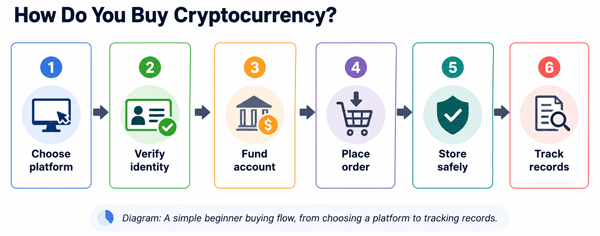
Diagram: A simple beginner buying flow, from choosing a platform to tracking records.
2. What Is Cryptocurrency?
Cryptocurrency is a type of digital asset that can be transferred electronically, usually through a blockchain network. A blockchain is a shared record of transactions maintained by many computers instead of one central database. Bitcoin, launched in 2009, is the best-known cryptocurrency. Ethereum is another major network, often used for apps, tokens, and smart contracts.
Unlike traditional money in a bank account, many cryptocurrencies are not issued by a government and are not controlled by a single company. Ownership is usually represented by cryptographic keys. Whoever controls the private key or wallet access controls the asset.
3. How Cryptocurrency Buying Works in Plain English
When you buy crypto through an exchange, you are usually trading regular money, such as dollars, pounds, euros, or rupees, for a digital asset. The exchange matches buyers and sellers or sells crypto directly to you. After the purchase, your account shows a crypto balance. You can sell it later, trade it for another crypto, send it to another wallet, or in some cases use it for payments.
The actual blockchain transaction may not happen immediately if you keep the asset inside the exchange. Many platforms record your balance internally until you withdraw to a personal wallet. This is convenient, but it also means you rely on the platform to safeguard the assets.
4. Step-by-Step: How to Buy Cryptocurrency Safely
4.1 Step 1: Decide Why You Are Buying Crypto
Before opening an account, clarify your goal. Are you learning with a small amount, investing long term, making a payment, or exploring blockchain apps? Your goal affects which platform, cryptocurrency, wallet, and risk level make sense. A beginner who wants to learn might start with a small Bitcoin or Ethereum purchase. Someone sending money to another wallet must pay closer attention to networks and withdrawal fees.
4.2 Step 2: Choose a Reputable Platform
Most beginners buy through a centralized exchange or regulated broker because it is simpler than using decentralized finance. Look for a platform with clear fees, strong security, two-factor authentication, withdrawal options, proof of where it operates legally, and a long operating history. Avoid platforms promoted through random messages, social media comments, or “guaranteed profit” groups.
4.3 Step 3: Create an Account and Verify Your Identity
Most legitimate platforms require identity verification. This may include your legal name, address, government ID, and sometimes a selfie. This process is called KYC, or Know Your Customer. It helps platforms meet anti-money-laundering rules. If a platform lets you trade large amounts with no checks, that is not automatically a benefit; it can be a risk signal.
4.4 Step 4: Secure Your Account Before Depositing Money
Use a unique password, enable two-factor authentication with an authenticator app or hardware key, and turn on withdrawal allowlisting if available. Do not rely only on SMS codes because phone numbers can be hijacked. Save backup codes offline. Check that the website address is correct before logging in.
4.5 Step 5: Deposit Funds
Common funding methods include bank transfer, debit card, credit card, wire transfer, mobile money, and payment apps depending on your country. Bank transfers are often cheaper but slower. Card purchases are usually faster but may carry higher fees. Some card issuers treat crypto purchases as cash advances, which can add extra charges.
4.6 Step 6: Choose the Cryptocurrency
Beginners usually start with well-known assets such as Bitcoin or Ethereum because they have deeper markets, more educational resources, and broader platform support. Smaller coins can move more dramatically, but they also carry higher risks, lower liquidity, and more scam potential. Do not buy a coin only because it is cheap per token; market capitalization, supply, use case, liquidity, and security matter more than price per coin.
4.7 Step 7: Place Your Order
A market order buys immediately at the available price. It is simple but may cost more in fast-moving markets. A limit order lets you choose the maximum price you are willing to pay; it may not fill if the market does not reach that price. Beginners making small purchases can use market orders, but limit orders are often better when the spread is wide or the asset is volatile.
4.8 Step 8: Review Fees and Confirm
Before confirming, check the total cost, trading fee, spread, network fee if withdrawing, and final amount of crypto you will receive. A platform may advertise low trading fees but include a wider spread. Always compare the preview price with the current market price.
4.9 Step 9: Decide Where to Store It
You can leave crypto on the exchange for convenience or transfer it to a personal wallet for more control. Exchange custody is easier for beginners but creates platform risk. Self-custody gives you control of the private keys, but losing your recovery phrase can mean losing access permanently.
4.10 Step 10: Keep Records
Save transaction dates, amounts, prices, fees, wallet addresses, and exchange statements. In many countries, selling, trading, spending, or earning crypto may be taxable. Good records make tax reporting easier and help you understand your real profit or loss.
5. Best Places to Buy Cryptocurrency: Main Options Compared
| Option | Best For | Pros | Cons |
|---|---|---|---|
| Centralized exchange | Most beginners and active buyers | Easy to use; many coins; fiat deposits; order history | Platform custody risk; fees vary; account freezes possible |
| Online broker or fintech app | Simple exposure with familiar interface | Beginner-friendly; may integrate with stocks or payments | Fewer coins; withdrawals may be limited; spreads may be higher |
| Decentralized exchange (DEX) | Experienced users with self-custody wallets | No central account; access to many tokens | More technical; higher scam-token risk; irreversible mistakes |
| Bitcoin ATM | Cash buyers in limited cases | Fast; cash access | Often very high fees; common scam payment channel |
| Peer-to-peer marketplace | Users with limited banking access | Flexible payment methods | Counterparty risk; scams; disputes; premiums |
6. Which Cryptocurrency Should a Beginner Buy First?
There is no single correct answer. For learning, many beginners choose a small amount of Bitcoin or Ethereum because they are widely supported and easier to research. That does not make them safe or guaranteed. They can still lose significant value.
| Crypto Type | Example | Beginner Considerations |
|---|---|---|
| Large-cap cryptocurrencies | Bitcoin, Ethereum | More liquid and widely covered, but still volatile. Better starting point than obscure tokens for many beginners. |
| Stablecoins | USDC, USDT and others | Designed to track a currency such as the U.S. dollar, but they still have issuer, reserve, regulatory, and platform risks. |
| Altcoins | Solana, Cardano, Polygon and many others | Can offer different technologies and communities, but risk varies widely. Research token supply, development, liquidity, and real use. |
| Meme coins and hype tokens | Dog-themed or trend-based tokens | Highly speculative. Prices often depend on attention and momentum rather than fundamentals. Beginners should be very cautious. |
| New presales or unknown tokens | Unlisted early-stage tokens | High scam and failure risk. Avoid buying because of pressure, celebrity promotion, or promises of guaranteed returns. |
7. Understanding Crypto Fees Before You Buy
Crypto costs are not always obvious. The price you see on a quick-buy screen can include several layers of cost. Always review the final confirmation page and compare costs across platforms.
| Fee or Cost | What It Means | Beginner Tip |
|---|---|---|
| Trading fee | A fee charged when your order executes. Often a percentage of the trade. | Advanced trading screens often show clearer maker/taker fees than instant-buy screens. |
| Spread | The difference between the buy price and sell price. | A “no commission” trade can still be expensive if the spread is wide. |
| Deposit fee | Cost to add money by card, bank transfer, wire, or another method. | Bank transfer is often cheaper than card funding, but slower. |
| Withdrawal fee | Fee to move cash or crypto out of the platform. | Check this before buying, especially for small amounts. |
| Network fee | Blockchain fee paid to process an on-chain transfer. | Fees change based on network congestion and blockchain used. |
| Conversion fee | Cost to swap one crypto for another. | Crypto-to-crypto swaps may trigger fees and tax events. |
| Inactivity or subscription fees | Some platforms charge optional subscription or account-related fees. | Do not subscribe unless the benefits exceed the cost. |
7.1 Fee Example: Why the “Real Cost” Matters
Suppose you want to buy $100 of Bitcoin. Platform A charges a 1.49% trading fee and a small spread. Platform B advertises zero commission but includes a 2.5% spread. Platform B may look cheaper, but your effective cost could be higher. The practical rule is simple: compare how much crypto you receive after all costs, not just the advertised commission.
8. Market Order vs Limit Order
| Order Type | How It Works | Pros | Cons |
|---|---|---|---|
| Market order | Buys or sells immediately at the best available price. | Fast and simple. | Final price can be worse during volatility or low liquidity. |
| Limit order | Buys only at your chosen price or better. | More control over price. | May not execute if the market does not reach your price. |
| Recurring buy | Automatically buys a fixed amount on a schedule. | Reduces timing stress; supports dollar-cost averaging. | Fees can add up; does not remove market risk. |
9. Should You Keep Crypto on an Exchange or Use a Wallet?
This is one of the most important decisions after buying. There are two broad custody choices: custodial and self-custodial.
| Storage Method | Who Controls the Keys? | Best For | Main Risk |
|---|---|---|---|
| Exchange account | The platform controls custody. | Beginners, small balances, frequent trading. | Platform hack, failure, withdrawal pause, account issue. |
| Software wallet | You control the recovery phrase. | Learning self-custody and using blockchain apps. | Malware, phishing, lost seed phrase. |
| Hardware wallet | You control keys stored offline. | Longer-term storage and larger balances. | Device setup mistakes, lost recovery phrase, fake devices. |
| Paper/offline backup | You control a written backup. | Recovery phrase backup only, not daily use. | Fire, theft, damage, poor storage. |
9.1 Beginner Wallet Safety Rules
- Never share your seed phrase or private key with anyone.
- Write your recovery phrase offline and store it somewhere private and durable.
- Do not take a screenshot of your seed phrase or save it in cloud notes.
- Use a small test transfer before sending a large amount.
- Confirm the blockchain network before withdrawing. Sending to the wrong network can cause permanent loss.
- Buy hardware wallets only from reputable official sources and check setup instructions carefully.
10. Key Risks of Buying Cryptocurrency
10.1 Price volatility
Crypto prices can move dramatically in minutes, hours, or days. A coin can fall 20%, 50%, or more even if nothing is wrong with your account.
10.2 Total loss risk
Some assets fail, lose liquidity, or become worthless. Smaller tokens are especially vulnerable.
10.3 Scams and phishing
Fake exchanges, fake support agents, romance scams, investment groups, giveaway scams, and wallet-draining links are common.
10.4 Custody risk
If a platform fails, freezes withdrawals, or is hacked, you may not have the same protections as a bank account.
10.5 Technical mistakes
Wrong wallet addresses, wrong networks, lost seed phrases, and malicious smart contracts can cause irreversible losses.
10.6 Regulatory risk
Rules differ by country and can change. Some coins, platforms, or services may become restricted.
10.7 Tax risk
Selling, trading, spending, staking, mining, or receiving crypto can create taxable events in many jurisdictions.
10.8 Liquidity risk
A coin may look valuable on paper but be hard to sell at a fair price if trading volume is low.
11. Common Crypto Scams Beginners Should Avoid
| Scam Type | How It Works | How to Protect Yourself |
|---|---|---|
| Guaranteed profit schemes | Someone promises fixed returns or “risk-free” crypto gains. | Assume guaranteed crypto profit claims are false. |
| Fake support | A scammer pretends to be exchange or wallet support and asks for your seed phrase. | Real support will not ask for private keys or seed phrases. |
| Romance or friendship scams | A person builds trust and then pushes you into a fake investment platform. | Do not invest through links sent by online acquaintances. |
| Pump-and-dump groups | Influencers or groups hype a low-liquidity token before selling on followers. | Avoid buying based on urgent group signals. |
| Fake airdrops and wallet drainers | A link asks you to connect your wallet and approve a transaction that drains funds. | Use a separate wallet for experiments and read approvals carefully. |
| Crypto ATM payment demands | A caller demands payment through a crypto ATM for taxes, fines, tech support, or emergencies. | Legitimate businesses and agencies do not demand crypto payment to solve urgent problems. |
12. Taxes: What Beginners Need to Know
Crypto tax rules vary by country, but a common pattern is that gains and income from digital assets may be taxable. In the United States, the IRS says income from digital assets is taxable and taxpayers may have to report digital asset transactions. Brokers are also subject to digital asset reporting rules for certain transactions.
Events that may be taxable in many places include selling crypto for cash, trading one crypto for another, spending crypto, earning staking rewards, mining, receiving airdrops, or receiving crypto as payment. Merely buying crypto with cash and holding it is often not a taxable sale by itself, but you still need records of your cost basis.
13. Practical Beginner Strategy: A Safer First Purchase
Here is a cautious beginner scenario. A new buyer decides to learn with $50 rather than investing a large amount. They choose a reputable exchange, enable an authenticator app, deposit by bank transfer to reduce fees, buy a major cryptocurrency, and leave it on the exchange while learning. After understanding wallets, they test a small withdrawal to a software wallet. Only after they are comfortable with recovery phrases and test transfers do they consider a hardware wallet for larger balances.
14. Best Practices Checklist Before You Buy
- Understand what the cryptocurrency does and why you are buying it.
- Use a reputable platform available legally in your country.
- Enable strong two-factor authentication before depositing money.
- Start with a small amount while learning.
- Check the full cost: trading fee, spread, deposit fee, withdrawal fee, and network fee.
- Avoid leverage, margin, futures, and options as a beginner.
- Do not chase coins because of social media hype.
- Use a test transaction before moving large amounts.
- Keep tax and transaction records from day one.
- Have a plan for when you will buy, sell, hold, or stop.
15. Pros and Cons of Buying Cryptocurrency
| Potential Benefits | Important Drawbacks |
|---|---|
| Easy access to digital assets and blockchain networks. | High volatility and risk of large losses. |
| Can diversify a small part of a high-risk portfolio. | No guaranteed returns, income, or protection from losses. |
| Transfers can be fast and global depending on the network. | Transactions can be irreversible and technically unforgiving. |
| Self-custody allows direct control of assets. | Self-custody requires serious responsibility for keys and backups. |
| Some assets support decentralized apps, payments, or programmable finance. | Many projects fail, are overhyped, or are outright scams. |
16. Beginner Mistakes to Avoid
- Investing because a coin is trending rather than understanding it.
- Putting emergency savings into crypto.
- Using leverage or borrowing to buy crypto.
- Ignoring spreads and withdrawal fees on small purchases.
- Sending crypto to the wrong address or wrong network.
- Keeping large balances on an exchange without understanding custody risk.
- Sharing wallet recovery phrases with “support” or friends.
- Assuming stablecoins are the same as insured bank deposits.
- Forgetting that crypto-to-crypto trades may have tax consequences.
- Buying obscure tokens because the price per coin looks cheap.
17. How Much Cryptocurrency Should a Beginner Buy?
There is no universal amount. A sensible beginner rule is to start with an amount small enough that losing it would not harm your rent, bills, savings, debt payments, or emergency fund. For many people, that means starting with a tiny learning amount. More experienced investors often limit crypto to a small, high-risk portion of a diversified portfolio. The right amount depends on your finances, risk tolerance, investment time horizon, and local laws.
18. When You Should Not Buy Cryptocurrency
Do not buy crypto if you need the money soon, do not understand what you are buying, are reacting to fear of missing out, are being pressured by someone online, plan to borrow money to invest, or cannot handle a major price drop. Waiting and learning is often better than rushing.
19. Frequently Asked Questions
19.1 What is the easiest way to buy cryptocurrency?
For most beginners, the easiest way is to use a reputable centralized exchange or broker, verify your identity, deposit money, and place a small order. Ease should not be the only factor; compare security, fees, withdrawals, and availability in your country.
19.2 Can I buy less than one Bitcoin?
Yes. You can buy a fraction of Bitcoin or many other cryptocurrencies. You do not need to buy a whole coin.
19.3 Is cryptocurrency safe for beginners?
Crypto can be used safely in small, careful steps, but it is not low risk. Beginners face price volatility, scams, custody risks, and technical mistakes. Education and small test amounts are important.
19.4 What is the minimum amount needed to buy crypto?
Minimums vary by platform and payment method. Some exchanges allow very small purchases, but fees can make tiny purchases inefficient.
19.5 Should I buy crypto with a credit card?
Usually not as a first choice. Credit card purchases can have higher platform fees, card issuer fees, and possible cash advance charges. Bank transfer is often cheaper where available.
19.6 Should I move my crypto to a wallet?
If the amount is small and you are still learning, exchange custody may be simpler. For larger long-term holdings, many people prefer self-custody, but only after learning seed phrase safety and test transfers.
19.7 Can I lose more than I invest?
If you simply buy crypto without leverage, your loss is generally limited to the amount invested. If you use leverage, margin, futures, options, or borrowing, you can lose much more and face liquidation or debt.
19.8 Are stablecoins risk-free?
No. Stablecoins are designed to track another asset, usually a fiat currency, but they can carry issuer, reserve, redemption, platform, regulatory, and technical risks.
19.9 Do I pay tax when I buy crypto?
Buying with cash and holding may not be taxable in some jurisdictions, but selling, trading, spending, or earning crypto often can be. Keep records and get local tax advice.
19.10 How do I know if a crypto platform is legitimate?
Check whether the platform operates legally in your country, publishes clear fees, has strong security features, supports withdrawals, has a real company presence, and is not promoted mainly through unsolicited messages or guaranteed-profit claims.
19.11 What is the safest crypto to buy?
No cryptocurrency is completely safe. Larger assets may have more liquidity and longer track records, but they can still fall sharply. Safety depends on asset risk, platform risk, custody, security habits, and your financial situation.
19.12 Is it better to buy all at once or gradually?
Gradual buying, often called dollar-cost averaging, can reduce the stress of timing one purchase. It does not guarantee profit or protect against long-term price declines, but it can be practical for beginners.
20. Final Takeaway
Buying cryptocurrency is not difficult, but buying it responsibly takes preparation. Choose a reputable platform, secure your account, understand the asset, review every fee, start small, avoid hype, and take custody seriously. Crypto can be part of a broader financial plan for some people, but it should never replace emergency savings, basic investing discipline, or common sense risk management.
Sources Consulted and Checked
These sources were consulted and checked while preparing this document to support accuracy and responsible presentation.
- SEC Investor.gov - Crypto Asset Custody Basics for Retail Investors
- FINRA - Crypto Assets and Risks
- FTC - What To Know About Cryptocurrency and Scams
- IRS - Digital Assets
- Kraken - Fee Schedule and Maker/Taker Fees
- Binance.US - Cryptocurrency Trading Fees
Reader Advice
Cryptocurrency can be useful, innovative, and easy to access, but it is also volatile, technically complex, and a common target for scams. Crypto prices can rise quickly and fall just as quickly. Transactions are often irreversible. Some platforms are not protected the same way traditional bank or brokerage accounts are. Treat crypto as a high-risk asset, not as a guaranteed path to wealth. This article is provided for educational and informational purposes only and is not personalized financial, investment, legal, tax, or professional advice or a recommendation to buy, sell, or hold any cryptocurrency. Cryptocurrency involves substantial risks, including price volatility, scams, platform or custody failures, technical errors, irreversible transactions, loss of wallet access, liquidity problems, and possible loss of the entire amount invested. Rules, policies, laws, tax treatment, platform terms, fees, and statistics can change over time and vary by country or region, so readers should verify current information through official regulators, tax authorities, and the relevant platform before making a decision. Consider your financial circumstances and risk tolerance, avoid investing money needed for essential expenses, and seek advice from an appropriately qualified professional where necessary.