How to Buy Cryptocurrency in the US: Complete Beginner's Guide to Buying Crypto Safely
Buying cryptocurrency in the United States can take only a few minutes. Buying it responsibly takes more thought. The difficult decisions are not where to click. They are which platform to trust, which fees are hiding inside the quoted price, how much risk you can afford, how you will store the asset, and how you will document every taxable transaction.
This guide explains the complete process for a first purchase, from checking your finances and comparing platforms to placing an order, moving coins to a wallet, avoiding scams, and preparing for U.S. taxes. It is designed for beginners, but it also includes the details experienced buyers use to reduce costs and prevent avoidable losses.
1. How to Buy Cryptocurrency in the US: Quick Answer
- Choose a U.S.-available crypto exchange, broker, or payment app with clear fees, strong security, and withdrawal support.
- Create an account and complete identity verification using accurate personal information.
- Enable app-based two-factor authentication before depositing money.
- Link a bank account or another payment method; bank transfers are usually cheaper than cards.
- Research the asset, decide how much you can afford to lose, and choose a market or limit order.
- Review the total price, spread, trading fee, deposit fee, and withdrawal fee before confirming.
- Secure the crypto on the platform or transfer it to a wallet after testing with a small amount.
- Save confirmations, cost basis, fees, wallet addresses, and tax documents.
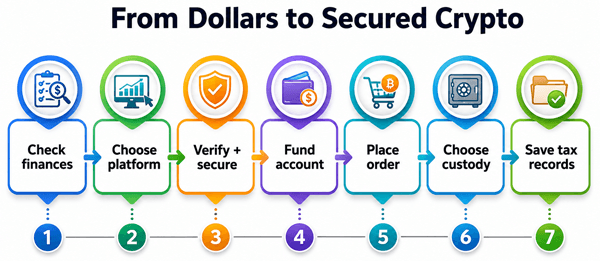
Figure 1. A beginner-safe buying process: decide, verify, execute, secure, and document.
1.1 Before You Start: What You Need
| Requirement | Why it matters | Practical note |
|---|---|---|
| Age and eligibility | Most U.S. retail platforms require users to be at least 18 and located in a supported state. | Availability and features can vary by state. |
| Identity documents | Regulated platforms generally collect identity information to meet anti-money-laundering obligations. | Expect name, date of birth, address, Social Security number, and government ID. |
| Payment method | Determines speed, cost, limits, and how soon withdrawals are available. | ACH is often economical; debit cards are faster but commonly cost more. |
| Secure device and email | Your email and phone can become pathways into the account. | Use a unique email password and avoid public Wi-Fi. |
| Risk budget | Crypto can fall sharply or become inaccessible. | Use money not needed for bills, emergencies, or near-term goals. |
| Recordkeeping system | The IRS treats digital assets as property. | Track every purchase, sale, swap, reward, payment, and transfer fee. |
2. Is It Legal to Buy Cryptocurrency in the US?
Yes. Individuals generally may buy, own, sell, and transfer cryptocurrency in the United States. However, the legal and regulatory framework is fragmented. Federal agencies may regulate different activities or products, while states may impose money-transmission, virtual-currency, or consumer-protection requirements on businesses serving residents.
For buyers, the practical rule is simple: use a platform that explicitly supports your state and provides the required disclosures. Do not assume that a service available elsewhere is authorized to serve you. New York is a prominent example: businesses conducting covered virtual-currency activity involving New York or a New York resident generally need authorization from the New York Department of Financial Services, such as a BitLicense or approved trust charter.
3. Where Can You Buy Cryptocurrency?
Americans can buy crypto through several channels. The right choice depends on whether you prioritize simplicity, low trading costs, coin selection, self-custody, or traditional brokerage reporting.
| Method | Best for | Main advantage | Main drawback | Key question |
|---|---|---|---|---|
| Centralized crypto exchange | Most buyers and active traders | Broad selection, order books, recurring buys, withdrawals | Platform/custody risk; complex fee schedules | Can you withdraw the exact asset and network you want? |
| Brokerage or investing app | Investors who want simplicity | Familiar interface and consolidated investing | Higher spreads or fewer crypto features may apply | Do you own transferable crypto or only price exposure? |
| Payment app | Small, convenient purchases | Fast onboarding and familiar payments | Limited order control, assets, or wallet functions | What are the spread and withdrawal restrictions? |
| Bitcoin ATM | Cash buyers with limited alternatives | Cash access and physical locations | Often very high total costs; scam risk | What is the all-in price versus the market price? |
| Peer-to-peer marketplace | Experienced users needing specific methods | Flexible payment choices | Counterparty, chargeback, fraud, and dispute risk | Is escrow provided and how are disputes handled? |
| Decentralized exchange | Experienced self-custody users | On-chain trading without a central order custodian | Wallet, smart-contract, token, gas, and irreversible-error risks | Have you verified the token contract and network? |
| Spot crypto ETP/ETF | Traditional investors seeking price exposure | Brokerage-account convenience; no wallet management | You generally do not receive spendable or transferable coins | Do you want ownership of coins or only investment exposure? |
4. Step-by-Step: How to Buy Cryptocurrency in the US
4.1 Step 1: Put Your Financial Foundation First
Before choosing a coin, decide whether crypto belongs in your finances at all. It should not replace an emergency fund, insurance, high-interest debt repayment, or contributions needed to capture an employer retirement match. Because crypto prices can move violently and platforms can fail, treat the purchase as high-risk capital.
- Do not use rent, tuition, tax money, emergency savings, or borrowed money.
- Set a maximum dollar amount and a maximum percentage of your investable portfolio.
- Write down your purpose: long-term speculation, learning, payments, or portfolio diversification.
- Decide in advance what would make you sell, hold, or stop buying.
4.2 Step 2: Choose the Type of Cryptocurrency
“Cryptocurrency” is not one uniform asset class. Bitcoin, smart-contract platform tokens, stablecoins, governance tokens, and meme coins can have very different purposes and risks. A low unit price does not mean a coin is cheap; market capitalization, supply, liquidity, and token distribution matter more than the price of one token.
- Bitcoin: The oldest and most widely recognized crypto asset. Its price is volatile, but it generally has deeper liquidity and broader infrastructure than small tokens.
- Ether and smart-contract platform tokens: Used to pay network fees and interact with applications. Risks include technical changes, competition, smart contracts, and network economics.
- Stablecoins: Designed to track a reference asset such as the U.S. dollar. They can still face reserve, issuer, redemption, regulatory, liquidity, and depegging risk.
- Small-cap or newly issued tokens: May offer large upside but often carry thin liquidity, concentrated ownership, manipulation, disclosure, and survival risks.
- Meme coins: Usually driven more by attention and speculation than cash flows or established utility. Extreme volatility and manipulation risk are common.
4.3 Step 3: Compare Platforms Using a Decision Framework
Do not choose solely because an app appears first in a search result or offers a signup bonus. Compare the complete buying and ownership experience.
- State availability and legal entity: Confirm the platform serves your state and identify the company that will hold your money or crypto.
- Security: Look for app-based or hardware-key 2FA, withdrawal address controls, login alerts, session management, and clear incident procedures.
- Asset and network support: The same token can exist on different networks. Confirm both the asset and intended withdrawal network are supported.
- Fee transparency: Compare trading fees, spreads, card charges, deposit and withdrawal fees, network fees, subscriptions, and inactivity terms.
- Liquidity and execution: A low posted fee can be offset by a wide spread or poor execution, especially for small tokens.
- Custody and withdrawals: Check whether withdrawals are allowed, what limits apply, and whether there are holding periods after deposits.
- Customer support: Review available support channels and how the platform handles account locks, unauthorized access, and complaints.
- Tax records: Prefer downloadable transaction histories and clear Form 1099-DA support, while keeping your own records.
| Five-Minute Platform Verification | Five-Minute Platform Verification |
|---|---|
| Before depositing | Confirm the exact legal entity, state availability, complete fee schedule, withdrawal support, custody terms, and an official support path. Save a copy or screenshot of the terms that apply on the day you open the account. |
4.4 Step 4: Create and Verify Your Account
Use the platform’s official website or verified app-store listing. Fake exchange sites and cloned apps are common. Type the address yourself, bookmark it, and verify the domain before entering personal information.
- Enter your legal name, date of birth, residential address, email, and phone number.
- Create a long, unique password using a password manager.
- Complete identity verification. You may be asked for a driver’s license, passport, selfie, or proof of address.
- Review the user agreement, fee schedule, privacy policy, custody terms, and dispute process.
- Confirm that the account name matches the name on the bank account you plan to link.
Identity verification can be immediate or can take longer when documents are blurry, details do not match, or the platform needs additional review. Never send documents to a person who contacts you through social media or a messaging app claiming to be “support.”
4.5 Step 5: Secure the Account Before Funding It
- Enable authenticator-app 2FA or a hardware security key. SMS is better than no second factor, but it is more exposed to SIM-swap attacks.
- Secure the email account linked to the exchange with its own unique password and 2FA.
- Turn on login, password-change, trade, and withdrawal alerts.
- Use withdrawal address allowlisting when available.
- Set an anti-phishing code if the platform supports one.
- Record backup codes offline and keep them separate from your phone.
- Never share a one-time code, screen, seed phrase, or remote access to your device.
4.6 Step 6: Link a Payment Method
Funding choice affects cost and timing. A platform may let you connect a bank account through ACH, send a wire, use a debit card, or deposit crypto from another wallet. Credit-card purchases may be blocked, treated as cash advances, or carry high fees and interest.
| Method | Typical speed | Typical cost pattern | Advantages | Watch for |
|---|---|---|---|---|
| ACH bank transfer | Often same day to several business days | Usually low or no deposit fee | Convenient and economical | Withdrawal holds; bank-linking privacy; return risk |
| Bank wire | Same day or next business day when sent correctly | Bank and platform wire fees may apply | Useful for larger transfers | Incorrect instructions; no easy reversal |
| Debit card | Often immediate | Commonly higher percentage fee or spread | Fast and simple | Lower limits; fraud alerts; expensive execution |
| Credit card | Often unavailable | Potential platform fee, cash-advance fee, and immediate interest | Speed only | Debt-funded speculation and very high total cost |
| Crypto deposit | Depends on network confirmations | Network fee plus possible conversion costs | Move existing crypto | Wrong network/address can cause permanent loss |
4.7 Step 7: Decide How Much to Buy
You do not need to buy a whole bitcoin or a whole ether. Most platforms allow fractional purchases. Start with a small amount while you learn the platform, tax records, withdrawals, and wallet process.
Simple position-size formula: maximum crypto allocation × investable portfolio = maximum total crypto exposure.
Example: If an investor has $20,000 of investable assets and sets a 3% crypto limit, the maximum exposure is $600. That is a risk boundary, not a recommendation. The investor could buy gradually rather than investing the full amount at once.
4.8 Step 8: Choose a Market Order, Limit Order, or Recurring Buy
- Market order: Buys immediately at the best available prices. It prioritizes execution, not a guaranteed price. The final average may differ from the displayed quote, especially in a fast or thin market.
- Limit order: Sets the highest price you are willing to pay. It provides price control but may never fill, may fill only partly, or may remain open.
- Recurring buy: Automatically invests on a schedule. It can reduce timing pressure but does not guarantee profit and may create repeated fees or many tax lots.
- Dollar-cost averaging: Investing equal dollar amounts periodically. It spreads entry points but can underperform a lump-sum purchase in a rising market and does not protect against a long-term decline.
4.9 Step 9: Review the Order and Confirm
The confirmation screen should show enough information to understand the transaction. Pause if the platform hides the unit price, fees, or amount received.
- U.S. dollars you are spending
- Asset and quantity you will receive
- Quoted unit price
- Trading fee or transaction fee
- Spread or markup, if disclosed
- Payment-method fee
- Estimated total cost
- When the crypto becomes available to trade or withdraw
All-in cost formula: cash paid + explicit fees + withdrawal/network fees − fair market value of crypto received. The spread is reflected in the difference between the execution price and a representative market price.
4.10 Step 10: Verify the Purchase and Save Records
After the order executes, confirm the amount, price, fee, time, and transaction ID. Download or save the receipt. Your records should allow you to reconstruct cost basis even if the platform later closes, restricts access, changes its export format, or reports incomplete basis information.
5. Cryptocurrency Fees Explained
The cheapest-looking platform is not always the cheapest. Compare total execution cost for the same asset, dollar amount, payment method, and withdrawal plan.
| Cost | How it works | When it appears | How to reduce it |
|---|---|---|---|
| Trading fee | Percentage or tiered maker/taker charge | When an order executes | Use lower-cost trading interface; compare volume tiers |
| Spread/markup | Difference embedded between reference price and your quote | Simple-buy, instant-buy, conversion, or “no fee” screens | Compare execution quote with independent price and order book |
| Card processing fee | Percentage or fixed funding charge | Debit or credit purchase | Use ACH or wire when appropriate |
| Deposit fee | Charge to add dollars or crypto | Funding the account | Choose supported low-cost rails |
| Withdrawal fee | Platform fee for sending dollars or crypto out | Cash or crypto withdrawal | Batch withdrawals; compare platform schedules |
| Network/gas fee | Paid to blockchain validators or network participants | On-chain transfer or decentralized transaction | Choose timing/network carefully; avoid repeated tiny transfers |
| Slippage | Execution at worse prices across the order book | Market orders and low-liquidity assets | Use limit orders and liquid pairs; reduce order size |
| Subscription fee | Monthly plan for bundled features or fee discounts | Premium plans | Calculate break-even based on actual volume |
| Tax software/professional fee | Record reconciliation and filing support | Tax preparation | Maintain clean records from the first transaction |
5.1 Fee Example: Why “No Trading Fee” Can Still Cost More
Assume a reference bitcoin price of $60,000. Platform A charges a transparent 0.6% trading fee and executes near the reference price. A $1,000 order costs about $6 in trading fees. Platform B advertises no trading fee but quotes bitcoin at $60,900, a 1.5% markup. The buyer receives roughly $985.22 of reference-value bitcoin before any withdrawal cost. The no-fee route is more expensive in this simplified example.
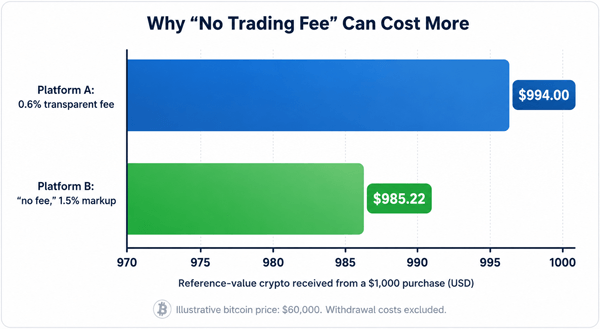
Figure 2. An advertised “zero-fee” route can deliver less crypto when the quoted price includes a larger markup.
6. Where Should You Store Cryptocurrency After Buying?
Custody means control and safekeeping of the cryptographic keys that authorize transactions. The key decision is whether to leave crypto with a third-party custodian or move it to a wallet you control.
| Option | Advantages | Risks | Best fit |
|---|---|---|---|
| Exchange/custodial account | Easy trading, recovery processes, no seed phrase | Platform failure, freeze, hack, account takeover, withdrawal restrictions | Small active balances and beginners who understand custodian risk |
| Software hot wallet | User control and convenient on-chain access | Malware, phishing, malicious approvals, lost seed phrase | Regular on-chain users with good security habits |
| Hardware wallet/cold storage | Keys kept offline for stronger isolation | Device loss, backup failure, counterfeit device, user error | Long-term holdings and users able to manage backups |
| Multisignature setup | Multiple keys required; reduces single-key failure | Complexity, coordination, recovery design | Larger balances and advanced users |
The SEC’s 2025 custody bulletin emphasizes evaluating how keys are controlled, what happens if a custodian fails, what fees apply, and what recovery options exist. Self-custody removes some intermediary risk but replaces it with personal operational risk. There is no customer-service reset for a lost seed phrase.
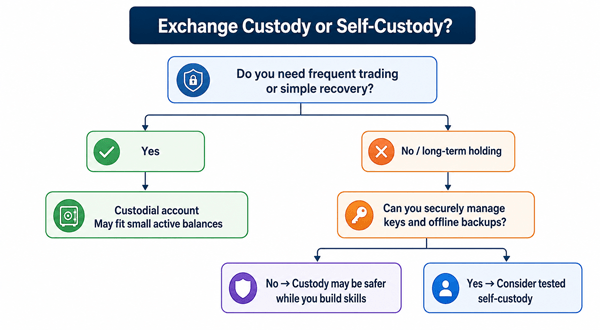
Figure 3. Custody is a trade-off between intermediary risk and personal key-management risk.
6.1 How to Transfer Crypto to a Wallet Safely
- Buy a wallet from the manufacturer or a trusted channel; initialize it yourself.
- Write the recovery phrase offline. Never photograph it, email it, enter it into a website, or store it in cloud notes.
- Confirm the receiving asset and network. “USDC,” for example, may be supported on several networks that are not interchangeable at every destination.
- Copy the receiving address and verify the first and last characters on both devices.
- Send a small test transaction. Wait for confirmation and verify receipt.
- Send the remaining amount only after the test succeeds.
- Record the transaction ID, date, asset, amount, network fee, and purpose.
7. US Cryptocurrency Taxes: What Buyers Need to Know
For federal income-tax purposes, the IRS treats digital assets as property. Simply buying crypto with U.S. dollars and holding it generally does not create a capital gain or loss. Tax consequences commonly arise when you sell, swap, spend, receive, earn, or otherwise dispose of or acquire crypto in a taxable way.
| Activity | Typical federal tax treatment | Record to keep |
|---|---|---|
| Buy crypto with U.S. dollars | Generally not a taxable disposition | Date, quantity, USD cost, purchase fee, cost basis |
| Transfer between your own wallets | Generally not taxable, but fees and records matter | Addresses, transaction ID, ownership evidence, fee |
| Sell crypto for dollars | Capital gain or loss; ordinary rules may apply in special circumstances | Proceeds, basis, dates, fees |
| Swap one crypto for another | Taxable disposition of the crypto given up | Fair market value, basis, both assets, fees |
| Spend crypto on goods or services | Taxable disposition; gain or loss may arise | Value at payment, basis, receipt |
| Receive crypto for work or business | Generally income at fair market value; later disposition may create gain/loss | Date, value, payer, business records |
| Mining, staking, rewards, airdrops | Treatment depends on facts; income may arise when received or controlled | Value, date/time, wallet, platform statement |
| Gift crypto | Special basis and reporting rules may apply | Donor basis, date, fair market value, gift documentation |
7.1 Form 1099-DA and Recordkeeping
U.S. broker reporting for digital-asset dispositions began with transactions on or after January 1, 2025. The IRS says brokers report gross proceeds on Form 1099-DA. Basis reporting applies to certain covered digital assets beginning with assets acquired after 2025 and later disposed of through the same custodial broker. A form may not contain every fact needed for your return, and using a foreign platform does not remove your reporting duty. Taxpayers must report income, gains, and losses whether or not they receive Form 1099-DA.
- Maintain a transaction ledger independent of the platform.
- Track cost basis by wallet or account using the method permitted for your facts and tax year.
- Include acquisition fees in basis when appropriate and reduce proceeds by disposition costs when appropriate.
- Reconcile transfers so they are not mistakenly treated as sales.
- Keep wallet addresses, transaction hashes, CSV exports, statements, and screenshots.
- Consult a qualified tax professional for staking, mining, DeFi, gifts, inherited assets, business activity, foreign accounts, or high transaction volume.
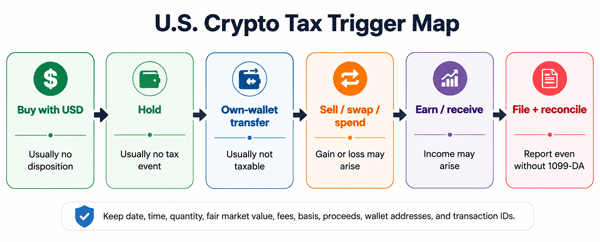
Figure 4. Buying and holding are usually not dispositions; selling, swapping, spending, and earning commonly create reporting consequences.
8. Major Risks of Buying Cryptocurrency
- Price volatility: Prices can fall rapidly, trade continuously, and react to leverage, regulation, hacks, token unlocks, sentiment, or market liquidity.
- Permanent loss: A token can fail, a stablecoin can lose its peg, a project can be abandoned, or demand can collapse.
- Platform insolvency and custody risk: Customer assets may become frozen or entangled in bankruptcy. Contract terms and asset segregation matter.
- Hacking and account takeover: Attackers target exchanges, wallets, email accounts, phones, browser extensions, and recovery processes.
- Scams and manipulation: Fake exchanges, impersonators, romance/investment scams, pump-and-dumps, recovery scams, and malicious tokens are widespread.
- Liquidity and execution risk: You may not be able to sell a small token at the displayed price, especially during stress.
- Regulatory and legal change: Rules, product availability, reporting, and platform operations can change.
- Technology and network risk: Software bugs, smart-contract exploits, chain congestion, forks, bridges, and validator failures can affect access or value.
- Operational error: Wrong addresses, networks, memo tags, approvals, or seed-phrase handling can cause irreversible loss.
- Tax complexity: Multiple wallets, swaps, rewards, and missing basis records can create expensive reconciliation and filing errors.
The CFTC advises that virtual currencies are frequent targets for hackers and fraudsters and that recourse may be limited if assets are stolen. The FDIC’s crypto fact sheet explains that deposit insurance protects eligible bank deposits—not crypto assets—and does not protect against the failure of a nonbank crypto company.
9. How to Avoid Cryptocurrency Scams
The FTC’s central warnings are straightforward: guaranteed returns are a scam signal, and a legitimate government agency or business will not tell you to buy cryptocurrency to fix an account, protect money, pay a debt, or avoid arrest.
- Never buy or send crypto because a stranger, online romantic interest, “investment coach,” celebrity impersonator, employer, bank representative, or government agent tells you to.
- Never install remote-access software or share your screen with someone offering account help.
- Ignore unsolicited messages promising guaranteed returns, proprietary bots, arbitrage, mining income, or risk-free staking.
- Check the exact website domain. Sponsored search ads can lead to impostor sites.
- Do not connect a wallet to an unfamiliar site or sign a transaction you do not understand.
- Never disclose a seed phrase or private key. Real support staff do not need it.
- Be skeptical of a platform that shows profits but demands a “tax,” “unlock fee,” or additional deposit before withdrawals.
- Avoid sending money through a Bitcoin ATM at someone else’s direction. The FTC has repeatedly warned about crypto ATM scams.
- If money is lost, beware of recovery companies demanding upfront crypto payments.
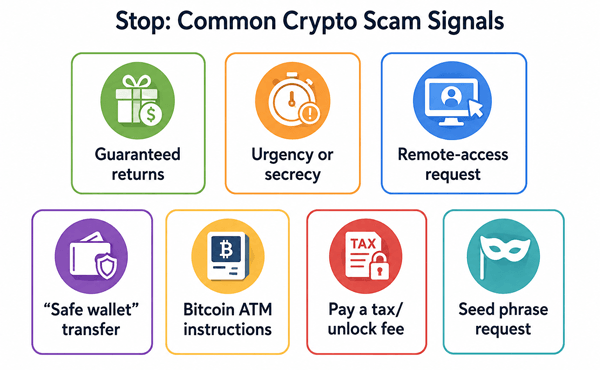
Figure 5. Any one signal warrants a pause; several together strongly indicate fraud.
10. Common Beginner Mistakes
| Mistake | Why it hurts | Better practice |
|---|---|---|
| Buying from hype or fear of missing out | Encourages emotional entry after sharp rises | Use a written thesis, position limit, and cooling-off period |
| Using a card for convenience | Fees and possible cash-advance interest compound risk | Prefer lower-cost bank funding when suitable |
| Ignoring the spread | A zero-fee quote can hide a costly markup | Compare final quantity and execution price |
| Buying an asset because its unit price is low | Unit price says little about valuation | Study supply, market cap, liquidity, ownership, and use case |
| Leaving every asset on one exchange | Creates a single point of failure | Match custody method to amount, activity, and skill |
| Moving the full balance first | A network or address error can be irreversible | Send a test transaction |
| Storing a seed phrase online | Cloud compromise can empty the wallet | Use secure offline backups |
| Trading constantly | Fees, spreads, slippage, and taxes accumulate | Use a plan and measure after-tax results |
| No tax records | Reconstruction can be costly or impossible | Export and reconcile regularly |
| Assuming “regulated” means insured | Licensing does not guarantee against loss | Read custody and insurance terms carefully |
11. Should You Buy Cryptocurrency?
Crypto may be reasonable only when it fits a broader financial plan and you understand both investment and operational risk. The following framework is more useful than asking whether crypto is universally “good” or “bad.”
11.1 Crypto May Be a Poor Fit If You…
- lack an emergency fund or carry expensive revolving debt
- need the money within the next several years
- would panic during a severe decline
- do not understand the asset or platform
- plan to borrow, use leverage, or buy on credit
- cannot maintain secure accounts and tax records
- expect guaranteed income or quick wealth
11.2 A Small Allocation May Be More Defensible If You…
- have stable finances and adequate emergency reserves
- can lose the entire amount without harming important goals
- understand the asset, platform, custody, and tax consequences
- set a strict allocation cap
- avoid leverage and high-cost funding
- use strong security and keep independent records
- treat the purchase as speculation rather than a promise
12. Frequently Asked Questions
12.1 What is the easiest way to buy cryptocurrency in the US?
For many beginners, the easiest route is a reputable U.S.-available centralized platform funded by ACH. Ease should not replace checks for fees, withdrawals, security, state availability, and custody terms.
12.2 Can I buy cryptocurrency with a bank account?
Yes. Many platforms support ACH transfers or bank wires. ACH is often inexpensive but may involve deposit or withdrawal holds.
12.3 Can I buy crypto with a debit card?
Often yes, but card purchases commonly have higher fees, spreads, or lower limits than bank transfers.
12.4 Can I buy crypto with a credit card?
Some issuers and platforms prohibit it. Where permitted, the transaction may be treated as a cash advance with fees and immediate interest. Borrowing to buy a volatile asset is especially risky.
12.5 How much money do I need to buy bitcoin?
You can usually buy a fraction of a bitcoin, sometimes with only a few dollars. Small purchases may be disproportionately affected by minimum fees and withdrawal costs.
12.6 Do I need a wallet before buying cryptocurrency?
No. A custodial platform can hold the asset, but you should decide your custody plan before the purchase. A personal wallet is necessary when you want self-custody or on-chain use.
12.7 Is cryptocurrency insured by the FDIC?
Crypto assets are not FDIC-insured deposits. A platform may hold some customer cash at an insured bank under specific arrangements, but coverage depends on the structure and records. Read the exact terms.
12.8 Is SIPC protection available for cryptocurrency?
Do not assume it is. Protection depends on the account, firm, and asset, and SIPC does not protect against market losses. Ask the brokerage exactly what is and is not covered.
12.9 Is buying cryptocurrency taxable?
Buying with dollars and holding generally is not a taxable disposition. Selling, swapping, spending, earning, or receiving crypto can create income, gain, or loss.
12.10 Will I receive Form 1099-DA?
A broker may issue Form 1099-DA for reportable dispositions. Requirements began for 2025 transactions, with basis reporting for certain covered transactions beginning in 2026. You must report taxable activity even without a form.
12.11 Can I buy crypto anonymously in the US?
Mainstream regulated platforms generally require identity verification. Attempts to avoid lawful verification can expose you to scams, loss, or legal problems.
12.12 What is the safest cryptocurrency to buy?
No cryptocurrency is risk-free. Larger, more liquid assets may have longer histories and deeper markets, but they can still lose substantial value. “Safety” also depends on platform, custody, position size, and behavior.
12.13 What is the best cryptocurrency for beginners?
There is no universally best asset. Beginners should prioritize assets they can explain and independently research, with sufficient liquidity and transparent market data, rather than chasing the newest token.
12.14 Is it better to use a market order or limit order?
A market order favors speed; a limit order favors price control. For liquid assets and small purchases, the difference may be modest, but limit orders can reduce unexpected execution prices.
12.15 Should I use dollar-cost averaging?
It can spread timing risk and reduce emotional decisions, but it does not guarantee profit or prevent loss. Check recurring-purchase fees and keep records for each tax lot.
12.16 How do I cash out cryptocurrency?
Sell it on a platform that supports the asset and withdraw dollars to a linked bank account. Review trading fees, spread, withdrawal limits, holds, taxes, and bank information first.
12.17 Can I reverse a cryptocurrency purchase or transfer?
A platform order may sometimes be canceled before execution, but completed blockchain transfers are generally irreversible. Contact the platform immediately if an exchange-account transaction appears unauthorized.
12.18 What should I do if a crypto platform freezes my account?
Use official support channels, document every communication, gather transaction records, and follow the platform’s appeal process. Depending on the issue, you may also submit a complaint to the CFPB, state regulator, FTC, SEC, CFTC, or law enforcement.
12.19 Are Bitcoin ATMs a good way to buy crypto?
They can provide cash access, but total fees and markups are often high. They are also heavily used in impersonation scams. Never use one because someone on the phone directs you to.
12.20 Can I keep crypto on an exchange forever?
You can, but doing so leaves you exposed to platform and account risk. Self-custody introduces different risks. Review the balance, purpose, skill level, and recovery plan rather than using one rule for everyone.
13. Final Cryptocurrency Buying Checklist
- ☐ I have emergency savings and am not using money needed for essential goals.
- ☐ I have set a maximum dollar amount and portfolio percentage.
- ☐ I understand the asset’s purpose, supply, liquidity, and key risks.
- ☐ The platform supports my state and I know the legal entity serving me.
- ☐ I compared the all-in cost, not just the advertised fee.
- ☐ I know whether I can withdraw the asset and which networks are supported.
- ☐ I enabled strong 2FA and secured my email account.
- ☐ I understand the order type and reviewed the final quantity and price.
- ☐ I have a custody plan and will test any wallet transfer.
- ☐ I will keep independent tax and transaction records.
- ☐ I will never send crypto because an unsolicited person tells me to.
14. The Bottom Line
The mechanics of buying cryptocurrency in the United States are simple: open an eligible account, verify your identity, fund it, choose an asset, place an order, and secure the result. The quality of the decision depends on everything surrounding those clicks.
A responsible buyer limits the position, compares the total cost, uses strong authentication, understands custody, tests withdrawals, avoids unsolicited advice, and keeps tax records from the start. Crypto may offer innovation and potential upside, but it also combines market, technology, platform, fraud, and operational risks in a way few traditional assets do. Approach it as a high-risk allocation—not a substitute for a complete financial plan.
Sources Consulted and Checked
These sources were consulted for preparing this document and checking its accuracy.
- Internal Revenue Service — Digital assets
- Internal Revenue Service — Understanding your Form 1099-DA
- U.S. Securities and Exchange Commission, Investor.gov — Crypto Asset Custody Basics for Retail Investors
- Federal Trade Commission — What To Know About Cryptocurrency and Scams
- Federal Trade Commission — Bitcoin ATMs: A Payment Portal for Scammers
- Federal Deposit Insurance Corporation — Crypto Fact Sheet
- New York State Department of Financial Services — Virtual Currency Business Licensing
Reader Advice
This article is provided for educational and informational purposes only and should not be considered financial, investment, legal, tax, or professional advice. Cryptocurrency is a high-risk asset class, and the value of digital assets can fluctuate significantly. Any investment decision should be based on your individual financial situation, risk tolerance, investment objectives, and, where appropriate, consultation with a qualified financial, legal, or tax professional.
The cryptocurrency industry is continually evolving. Laws, regulations, tax rules, exchange policies, fees, and security practices may change over time and can vary by jurisdiction. Although every effort has been made to ensure the accuracy of the information at the time of publication, no guarantee is made that all information will remain current, complete, or applicable to your circumstances.
Before buying, selling, trading, or storing cryptocurrency, always verify the latest requirements and guidance through official sources, such as relevant government agencies, financial regulators, tax authorities, and the official websites of cryptocurrency exchanges and wallet providers. Conduct your own research, understand the risks involved, and never invest money you cannot afford to lose.