Centralized vs Decentralized Exchanges: Key Differences, Pros, Cons, Risks and Best Use Cases
Crypto exchanges are the places where people buy, sell, or swap digital assets such as Bitcoin, Ether, stablecoins, and thousands of other tokens. But not all exchanges work the same way. The two main types are centralized exchanges, often called CEXs, and decentralized exchanges, often called DEXs.
A centralized exchange is run by a company. You create an account, deposit funds, and the platform helps match buyers and sellers. A decentralized exchange is usually a set of smart contracts on a blockchain. You connect your crypto wallet and trade directly from that wallet, without giving custody of your assets to the exchange.
The biggest difference is trust. On a CEX, you trust a company to secure funds, process withdrawals, follow rules, and keep accurate records. On a DEX, you trust code, your own wallet habits, the blockchain network, and the liquidity available in smart contracts. Neither option is automatically safer or better. The right choice depends on your experience level, what you want to trade, how much control you want, and how much responsibility you are ready to take.
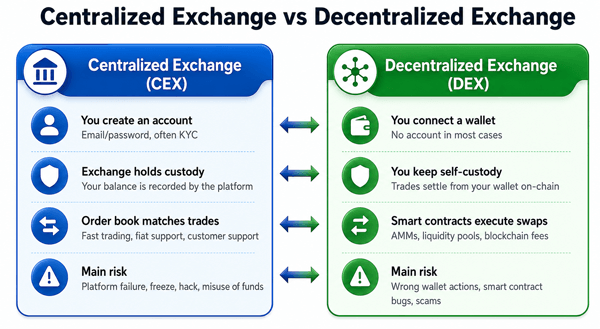
Figure: A beginner-friendly view of how CEXs and DEXs differ by custody, trading process, and risk.
1. Quick Answer: CEX vs DEX in Simple Words
| Question | Centralized Exchange (CEX) | Decentralized Exchange (DEX) |
|---|---|---|
| Who runs it? | A company or organization. | Smart contracts and community or protocol governance. |
| Do you give up custody? | Usually yes while funds sit on the exchange. | Usually no; you trade from your own wallet. |
| Is it beginner-friendly? | Generally easier for beginners. | More technical and less forgiving. |
| Can you use bank cards or fiat money? | Often yes, depending on country and platform. | Usually no direct fiat support; you mostly trade crypto-to-crypto. |
| How are trades matched? | Usually through an order book controlled by the platform. | Often through automated market makers and liquidity pools, though some DEXs use on-chain order books. |
| Main advantage | Convenience, speed, fiat access, support, and deeper liquidity for major coins. | Self-custody, permissionless access, transparency, and direct on-chain settlement. |
| Main risk | Custodial risk, platform failure, freezes, hacks, or unclear reserves. | Smart contract risk, wallet mistakes, scams, slippage, MEV, and no customer support. |
2. What Is a Centralized Exchange?
A centralized exchange is a crypto trading platform operated by a company. Examples of the CEX model include platforms where users sign up with an account, complete identity checks in many jurisdictions, deposit money or crypto, and trade through the exchange interface.
In simple terms, a CEX works more like a traditional brokerage or online trading platform. It keeps internal records of each user balance, matches buy and sell orders, and processes withdrawals when users move funds out. The blockchain usually becomes involved when you deposit crypto into the exchange or withdraw crypto from it. Trades that happen inside the platform may be recorded in the exchange database rather than directly on-chain each time.
2.1 How a CEX works step by step
- You create an account and may need to complete know-your-customer identity checks.
- You deposit fiat money, such as dollars, euros, or local currency, or you deposit crypto.
- You place a market order, limit order, or other trade through the platform.
- The exchange matches your order against other users or available liquidity.
- Your account balance updates inside the exchange system.
- When you withdraw crypto, the exchange sends an on-chain transaction to your wallet.
2.2 Common CEX features
- Fiat deposits and withdrawals through bank transfer, card, or other payment methods where supported.
- Order books with market, limit, stop, and advanced order types.
- Mobile apps, customer support, password recovery, and account security tools.
- High liquidity on major trading pairs such as BTC/USDT or ETH/USD.
- Extra products such as staking, lending, futures, margin trading, or earn programs, depending on the platform and local rules.
3. What Is a Decentralized Exchange?
A decentralized exchange is a crypto trading system that lets users trade through blockchain-based smart contracts. Instead of opening a normal platform account, you connect a self-custody wallet such as a browser wallet, mobile wallet, or hardware wallet. You approve transactions from your wallet, and the trade settles on-chain.
Most popular DEXs use an automated market maker model. In an AMM, traders do not need a traditional buyer or seller on the other side at that exact moment. Instead, they swap against liquidity pools funded by other users. Liquidity providers deposit token pairs into pools and may earn a share of trading fees. This model has made DEX trading possible without a central order book, but it also creates unique risks such as slippage, impermanent loss for liquidity providers, and smart contract exploits.
3.1 How a DEX swap works step by step
- You open a crypto wallet and connect it to a DEX interface.
- You choose the token you want to sell and the token you want to buy.
- The DEX shows an estimated price, network fee, price impact, and slippage tolerance.
- You approve token spending if needed. This gives the smart contract permission to move a specific token from your wallet.
- You confirm the swap transaction in your wallet.
- The blockchain processes the transaction and the new token appears in your wallet if the swap succeeds.
3.2 Common DEX features
- Wallet-based access rather than normal account login.
- Crypto-to-crypto swaps across tokens on the same blockchain or through bridges and aggregators.
- Public on-chain transaction history.
- Liquidity pools and automated market makers.
- Access to newer or more niche tokens before they appear on major centralized platforms.
4. Key Differences Between Centralized and Decentralized Exchanges
| Area | CEX | DEX | What it means for beginners |
|---|---|---|---|
| Custody | The exchange usually holds your deposited funds. | You keep assets in your own wallet until a transaction is signed. | CEXs are easier, but you rely on the platform. DEXs give control, but mistakes are your responsibility. |
| Account setup | Account, password, and often identity verification. | Wallet connection, usually no account in the traditional sense. | CEXs can feel familiar. DEXs require wallet knowledge. |
| Fiat access | Often supports bank transfers, cards, and local payment rails. | Usually crypto-to-crypto only. | Most beginners use a CEX first to buy initial crypto. |
| Trade execution | Mostly off-chain internal matching through order books. | On-chain smart contract transactions. | DEX trades may cost network fees and can fail if conditions change. |
| Speed | Fast internal trades; withdrawals depend on blockchain network. | Depends on blockchain speed and congestion. | A CEX is often faster for frequent trading. |
| Fees | Trading fees plus deposit/withdrawal fees. | Protocol fee plus blockchain gas fee and possible aggregator fee. | DEXs can be cheap on some chains and expensive on congested networks. |
| Customer support | Usually available, though quality varies. | Usually none for transactions; community support only. | A DEX mistake may be irreversible. |
| Transparency | Users rely on platform reporting, audits, and proof-of-reserves where available. | Transactions and contracts are visible on-chain, but code can still be hard to understand. | Transparency does not remove risk. |
| Token access | Usually curated listings. | Much broader access, including risky new tokens. | DEXs make it easier to buy scams by accident. |
| Regulatory exposure | More likely to be regulated, licensed, or restricted by jurisdiction. | Regulation is more complex and varies by protocol, interface, and location. | Access, features, and legal protections can differ widely by country. |
5. Pros and Cons of Centralized Exchanges
5.1 CEX advantages
- Easy onboarding: A CEX is often the simplest way to buy crypto with fiat money.
- Better beginner experience: Password recovery, account dashboards, charts, support pages, and mobile apps reduce friction.
- High liquidity for major assets: Large CEXs can handle bigger trades with less price impact on popular pairs.
- Advanced tools: Limit orders, recurring buys, tax reports, portfolio tracking, and institutional trading tools are common.
- Customer support: If you lose access to an account, there may be a recovery process.
5.2 CEX disadvantages and risks
- Custodial risk: If the exchange freezes withdrawals, is hacked, mismanages funds, or becomes insolvent, users may lose access to assets.
- Counterparty risk: Your balance is a claim on the platform until you withdraw to your own wallet.
- Privacy trade-offs: Identity verification may be required, and the platform may collect personal and transaction data.
- Withdrawal limits and account freezes: Compliance checks, technical incidents, or policy decisions can delay access to funds.
- Product complexity: Margin, leverage, futures, and yield products can expose beginners to large losses.
6. Pros and Cons of Decentralized Exchanges
6.1 DEX advantages
- Self-custody: You do not need to leave funds on a trading company’s balance sheet.
- Permissionless access: In many cases, anyone with a compatible wallet and network funds can interact with the protocol.
- Transparency: Smart contracts, pool balances, and transactions are generally visible on-chain.
- Broad token access: DEXs often list long-tail assets before centralized platforms do.
- Composability: DEXs can connect with other DeFi tools such as lending markets, wallets, bridges, and portfolio dashboards.
6.2 DEX disadvantages and risks
- No simple password recovery: If you lose your seed phrase or private key, no exchange support team can restore the wallet.
- Smart contract risk: Bugs, exploits, faulty upgrades, or oracle issues can lead to losses.
- Scam token risk: Anyone can create a token with a familiar-looking name or ticker.
- Slippage and price impact: Small liquidity pools can produce a much worse final price than expected.
- MEV and front-running: Bots may reorder or sandwich transactions on some networks.
- Gas fees and failed transactions: You may pay network fees even if a transaction fails.
- Bridge risk: Moving assets across chains can add another layer of smart contract and operational risk.
7. Main Risks: CEX vs DEX
| Risk | More common on CEX? | More common on DEX? | How to reduce it |
|---|---|---|---|
| Exchange insolvency or withdrawal freeze | High | Low | Do not keep long-term holdings on an exchange unnecessarily. Use reputable platforms and withdraw to self-custody when appropriate. |
| Wallet key loss | Low | High | Use a hardware wallet for meaningful balances. Back up seed phrases offline. Never share them. |
| Smart contract exploit | Low to medium | High | Prefer established protocols, check audits, avoid unaudited new pools, and limit approvals. |
| Phishing | High | High | Use bookmarks, verify URLs, avoid links in messages, and consider a separate wallet for DeFi. |
| Fake or scam tokens | Medium | High | Verify contract addresses through official project channels and block explorers. |
| High slippage | Medium | High | Check liquidity, price impact, and slippage settings before trading. |
| Regulatory restrictions | High | Medium | Use platforms available in your jurisdiction and understand local rules. |
| Leverage liquidation | High on derivatives platforms | Medium in some DeFi lending or perpetual protocols | Avoid leverage as a beginner. Understand liquidation prices before borrowing or trading with margin. |
8. Which Is Safer: A CEX or a DEX?
There is no universal answer because CEXs and DEXs fail in different ways. A reputable centralized exchange may be safer for a beginner making a small first purchase because the interface is clearer, fiat access is easier, and account recovery may exist. But a CEX also creates custodial risk because the platform controls deposited assets until withdrawal.
A DEX can be safer for users who understand wallets, verify contracts, and want to keep custody. However, it can be much riskier for someone who clicks the wrong approval, uses a fake website, buys a scam token, or loses a seed phrase. Self-custody gives control, but it also removes many safety nets.
A practical rule: use a CEX for fiat onboarding, simple purchases, and liquid major markets; use a DEX only after you understand wallets, network fees, token approvals, and how to verify contract addresses.
9. Best Use Cases for Centralized Exchanges
- Buying crypto with local currency: Most beginners start on a CEX because bank and card payments are easier.
- Selling crypto back to fiat: CEXs are usually more practical for cashing out to a bank account.
- Trading large, liquid assets: Major pairs often have deeper liquidity and lower spreads on large CEXs.
- Using advanced order types: Limit orders, stop orders, and portfolio tools are more accessible on CEXs.
- When customer support matters: A CEX may help with account access, transaction questions, or compliance documents.
10. Best Use Cases for Decentralized Exchanges
- Swapping tokens directly from a wallet: DEXs are useful when you already hold crypto on-chain.
- Accessing DeFi-native assets: Many tokens appear on DEXs before they are listed on major CEXs.
- Maintaining self-custody: DEXs let users trade without depositing funds into an exchange account.
- Using DeFi strategies: Liquidity provision, on-chain arbitrage, and protocol participation often require DEX access.
- Trading on networks with low fees: DEXs can be practical on chains or layer-2 networks where transaction costs are low.
11. Real-World Scenarios
| Scenario | Better fit | Why |
|---|---|---|
| A beginner wants to buy $100 of Bitcoin using a debit card. | CEX | Fiat onboarding, simpler interface, and clearer buying process. |
| A user holds ETH in a wallet and wants to swap a small amount for a DeFi token. | DEX | Direct wallet-to-wallet swap without depositing to a platform. |
| A trader wants to place a limit order on BTC with tight spreads. | CEX | Order books and deep liquidity are usually better for major pairs. |
| A user wants to buy a brand-new meme token. | DEX, but high risk | DEXs may have early access, but fake tokens, low liquidity, and rug pulls are common. |
| A long-term holder wants to reduce platform risk. | Self-custody, possibly after using a CEX | Buy on a CEX if needed, then withdraw to a wallet after learning safe custody. |
| A user wants to provide liquidity and earn trading fees. | DEX | Liquidity pools are a core DeFi use case, but impermanent loss and smart contract risk must be understood first. |
12. Fees: What Beginners Often Miss
CEX fees usually look simple at first: a trading fee, a spread, and sometimes a deposit or withdrawal fee. However, the real cost can include hidden spread, conversion fees, card fees, and blockchain withdrawal fees.
DEX fees are different. You may pay a protocol fee, a blockchain network fee, and sometimes an aggregator fee. The quoted price can also change before your transaction confirms. On high-fee networks, a small DEX trade can become uneconomical. On low-fee networks or layer-2 chains, DEX swaps can be much cheaper.
| Cost type | CEX | DEX |
|---|---|---|
| Trading fee | Usually shown as maker/taker fee or simple percentage. | Protocol fee, often built into the swap. |
| Spread | May be visible or hidden in simple buy/sell interfaces. | Reflected in pool price, route, and liquidity. |
| Network fee | Usually paid when withdrawing crypto. | Paid for every on-chain transaction. |
| Failed transaction cost | Rare for internal trades. | Possible; gas may be spent even if swap fails. |
| Price impact | Usually lower on deep major pairs. | Can be high in small liquidity pools. |
13. Security Best Practices for CEX Users
- Use a strong, unique password and a password manager.
- Enable two-factor authentication with an authenticator app or hardware security key, not SMS if avoidable.
- Whitelist withdrawal addresses if the platform supports it.
- Avoid keeping long-term holdings on an exchange unless you have a clear reason.
- Check proof-of-reserves, audit information, licensing claims, and withdrawal history, but do not treat any single signal as a guarantee.
- Be careful with leverage, margin, and yield products. Higher yield usually means higher risk.
- Use official apps and bookmarked websites. Phishing pages often copy exchange login screens.
14. Security Best Practices for DEX Users
- Use a separate wallet for DeFi activity and keep long-term savings in a colder wallet.
- Verify the website URL before connecting your wallet.
- Verify token contract addresses through official project websites, reputable data sites, or block explorers.
- Start with a small test transaction when using a new protocol or network.
- Review token approvals and revoke unnecessary permissions.
- Set reasonable slippage. Very high slippage can expose you to bad execution or sandwich attacks.
- Avoid unaudited protocols, anonymous teams with no track record, and pools promising unrealistic returns.
- Never type your seed phrase into a website. A legitimate DEX does not need it.
15. Common Beginner Mistakes and Misconceptions
- Mistake: Thinking “decentralized” automatically means safe. Reality: code, liquidity, governance, bridges, and wallet behavior can all fail.
- Mistake: Thinking a CEX balance is the same as coins in your wallet. Reality: until withdrawal, you rely on the exchange to honor your balance.
- Mistake: Buying a token because it has the same ticker as a famous project. Reality: token tickers are not unique; contract addresses matter.
- Mistake: Ignoring slippage. Reality: the final DEX price may be worse than the quote, especially in thin pools.
- Mistake: Approving unlimited token spending without checking the contract. Reality: a malicious or exploited contract may drain approved tokens.
- Mistake: Using leverage too early. Reality: crypto volatility can liquidate positions quickly.
16. How to Choose Between a CEX and a DEX
Use this simple decision framework:
| Your priority | Consider |
|---|---|
| I am buying crypto for the first time. | A reputable CEX with fiat support and simple withdrawals. |
| I want full control of my assets. | A self-custody wallet and, when needed, a DEX. |
| I want to trade major coins frequently. | A liquid CEX, while managing custodial risk carefully. |
| I want to explore DeFi tokens. | A DEX, but only after learning wallet safety and token verification. |
| I need customer support and account recovery. | A CEX. |
| I care most about on-chain transparency. | A DEX or other on-chain protocol. |
| I am trading small amounts on a high-fee blockchain. | A CEX or a lower-fee network may be more practical. |
17. A Balanced Beginner Strategy
Many users do not need to choose only one. A common approach is to use a centralized exchange for fiat onboarding and cashing out, then move longer-term holdings to a self-custody wallet once they understand wallet security. More experienced users may also use DEXs for on-chain swaps, DeFi participation, or tokens that are not available on a CEX.
For beginners, the safest path is usually gradual: start with small amounts, learn how deposits and withdrawals work, practice self-custody with money you can afford to risk, and avoid complex products until you understand the downside.
18. Comparison Summary
| Category | CEX is usually better when... | DEX is usually better when... |
|---|---|---|
| Beginner ease | You want simple buying, selling, and support. | You already understand wallets and on-chain transactions. |
| Custody | You accept temporary platform custody for convenience. | You want to keep control of your assets. |
| Fiat access | You need bank or card payments. | You already have crypto in a wallet. |
| Token choice | You want established, curated assets. | You want broader token access and accept higher risk. |
| Large trades | You trade major pairs and need deep liquidity. | The on-chain pool or aggregator route has enough liquidity. |
| Risk profile | You worry more about wallet mistakes than platform risk. | You worry more about platform custody than wallet responsibility. |
19. FAQs About Centralized and Decentralized Exchanges
19.1 What is the main difference between a CEX and a DEX?
A CEX is run by a company and usually holds user funds while they are on the platform. A DEX lets users trade through smart contracts from their own wallets. The core difference is the trust model: company custody versus self-custody and code-based execution.
19.2 Is Binance or Coinbase a CEX or DEX?
Platforms such as Coinbase and Binance operate centralized exchange services. Some companies may also offer wallets or DeFi-related tools, but the normal account-based trading platform is a CEX model.
19.3 Is Uniswap a DEX?
Yes. Uniswap is a well-known decentralized exchange protocol that uses automated market maker liquidity pools. Users trade by connecting a compatible wallet and confirming on-chain transactions.
19.4 Can I lose money on a DEX?
Yes. You can lose money through bad trades, slippage, scam tokens, smart contract exploits, fake websites, malicious approvals, bridge failures, or lost private keys.
19.5 Can I lose money on a CEX?
Yes. You can lose money through market moves, hacks, platform insolvency, withdrawal freezes, account compromise, leverage liquidation, or risky products offered by the platform.
19.6 Do DEXs require KYC?
Many DEX protocols do not require a traditional account or KYC to interact with smart contracts, but interfaces, jurisdictions, and compliance tools vary. Laws and access rules can change.
19.7 Why are DEX fees sometimes high?
DEX trades happen on-chain, so you pay blockchain network fees. When a network is congested, gas fees can rise. Small trades can become expensive on high-fee networks.
19.8 What is slippage on a DEX?
Slippage is the difference between the expected price and the final executed price. It happens when pool prices move, liquidity is thin, or the trade is large relative to pool size.
19.9 Should beginners use DEXs?
Beginners can use DEXs, but only after learning wallet safety, token approvals, contract verification, network fees, and slippage. Starting with small test amounts is wise.
19.10 Which is better for long-term holding?
For many long-term holders, self-custody reduces exchange counterparty risk. However, self-custody is only safer if the user can protect the wallet, seed phrase, and devices properly.
20. Final Takeaway
Centralized and decentralized exchanges solve different problems. A centralized exchange offers convenience, fiat access, speed, customer support, and familiar account tools, but it requires trust in the platform. A decentralized exchange offers self-custody, on-chain transparency, and broad token access, but it requires stronger personal responsibility and exposes users to smart contract, wallet, liquidity, and scam risks.
For most beginners, the best approach is not to treat one model as always superior. Use the right tool for the job, keep position sizes reasonable, avoid products you do not understand, and build security habits before taking bigger risks.
Sources Consulted and Checked
These sources were consulted and checked while preparing this article to support accuracy and provide reliable background information.
- SEC Investor.gov, “Exercise Caution with Crypto Asset Securities: Investor Alert” (March 23, 2023).
- FINRA, “Crypto Assets,” investor education page.
- OECD, “Concentration of DeFi’s Liquidity” (2024), including background on DEXs and AMMs.
- Financial Stability Board, “The Financial Stability Risks of Decentralised Finance” (February 16, 2023).
- Chainalysis, “2025 Crypto Crime Trends” and related 2024 stolen-funds reporting.
- CFTC Technology Advisory Committee materials on DeFi, DEX liquidity pools, and AMM incentives.
Reader Advice
This article is educational and does not provide financial, legal, tax, or investment advice. Crypto assets are volatile and can result in total loss. Readers should do their own research and consider local rules before using any exchange or protocol. This article is provided for general educational and informational purposes only and is not personalized financial, investment, tax, or legal advice or a recommendation to use any exchange, wallet, token, or protocol. Crypto trading, self-custody, smart contracts, leverage, and newer tokens can involve significant risk, including scams, technical failures, account restrictions, irreversible transactions, and partial or total loss. Rules, policies, laws, fees, platform features, and statistics can change over time and vary by country or region, so verify important details through current official sources and consider qualified professional advice before making a decision.