Crypto On-Ramps & Off-Ramps in the US: Complete Guide to Buying, Selling & Cashing Out Crypto
1 Quick Answer: What Is a Crypto On-Ramp or Off-Ramp?
A crypto on-ramp is a service or payment route that converts traditional money—such as U.S. dollars in a bank account—into cryptocurrency. A crypto off-ramp does the reverse: it converts cryptocurrency into dollars or another form of spendable value.
Simple example: You transfer $500 from your checking account to a regulated crypto platform and buy bitcoin. The bank transfer plus the platform form the on-ramp. Months later, you sell the bitcoin and send the dollar proceeds back to your bank. That route is the off-ramp.
| Route | Typical direction | Common examples | Best suited for |
|---|---|---|---|
| On-ramp | USD → crypto | Bank transfer, debit card, wire, payment app, crypto ATM | Buying or funding a wallet |
| Off-ramp | Crypto → USD | Sell on an exchange, withdraw to bank, debit card spending, ATM cash-out | Cashing out or spending |
| Crypto-to-crypto route | One token → another | Swap service or decentralized exchange | Changing assets; not a true fiat off-ramp |
Key takeaway: The visible trading fee is only one part of the cost. The spread, network fee, withdrawal fee, bank fee, and tax consequences may matter more.
1. Why On-Ramps and Off-Ramps Matter
Crypto networks do not normally connect directly to your checking account. On-ramps and off-ramps bridge two different financial systems: the traditional banking and card system, and blockchain-based assets. The quality of that bridge affects your total cost, speed, privacy, tax records, security, and ability to recover from mistakes.
- A good route makes the total price and delivery amount clear before you approve the transaction.
- A poor route may hide costs in the exchange rate, delay withdrawals, impose low limits, or provide weak support when something goes wrong.
- Some routes are convenient but expensive; others are cheaper but slower or more complex.
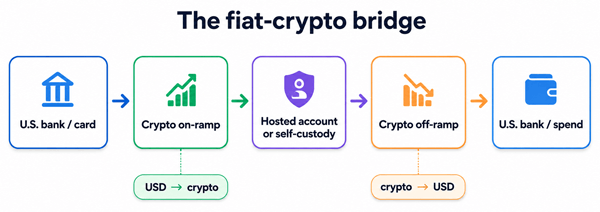
Figure 1. On-ramps and off-ramps connect bank money, crypto custody, and cash-out routes.
2. How Crypto On-Ramps and Off-Ramps Work
2.1 The on-ramp process
- Create an account with a provider that supports your state and chosen payment method.
- Complete identity verification, commonly including your legal name, date of birth, address, government ID, and sometimes a selfie or source-of-funds review.
- Link or initiate a payment method such as ACH, debit card, bank wire, or digital wallet.
- Choose the crypto asset and enter the purchase amount.
- Review the quoted price, spread, fee, and expected amount of crypto.
- Confirm the purchase. The provider credits crypto to a hosted account or sends it to a wallet address.
- Wait through any withdrawal hold before moving the crypto elsewhere.
2.2 The off-ramp process
- Confirm that the platform supports deposits for the exact asset and blockchain network you will use.
- Generate or copy the deposit address and, where required, a memo or destination tag.
- Send a small test transaction when the amount is meaningful.
- Wait for the required blockchain confirmations.
- Sell the crypto for U.S. dollars or another supported fiat balance.
- Review fees, spread, limits, and the estimated bank-arrival time.
- Withdraw by ACH, wire, eligible card, check, or another supported method.
- Save the transaction record and tax-lot information.
Warning: Blockchain transfers are usually irreversible. Sending an asset to the wrong address, wrong network, or missing memo can permanently lose funds or require a costly recovery process.
3. Main Types of Crypto On-Ramps and Off-Ramps in the US
| Method | Typical speed | Relative cost | Main strengths | Main weaknesses |
|---|---|---|---|---|
| Centralized crypto platform | Minutes to several business days | Low to medium | Liquidity, records, recurring buys, bank withdrawals | Custody and account-freeze risk |
| Bank ACH transfer | 1–5 business days; instant credit may be offered | Usually low | Low-cost routine purchases and withdrawals | Holds, reversals, bank compatibility |
| Bank wire | Same day or next business day | Medium; fixed fees common | Large transfers, clear banking trail | Bank cutoffs and wire fees |
| Debit card | Usually near-instant | High | Fast and simple | Higher fees, lower limits, fraud controls |
| Payment app or fintech app | Often instant inside the app | Medium to high | Convenient for beginners | Limited assets, transfer restrictions, spread |
| Crypto ATM/kiosk | Minutes | Very high | Cash access, no bank link in some cases | Large spread/fees, scam risk, low limits |
| Peer-to-peer marketplace | Varies | Variable | More payment choices | Counterparty, chargeback, fraud and compliance risk |
| Decentralized exchange + third-party ramp | Minutes to hours | Variable | Self-custody and broad token access | Smart-contract, network, slippage and support risk |
| Crypto-linked card | Near-instant at purchase | Medium | Spend without manual bank withdrawal | Conversion spread, rewards/tax complexity |
3.1 Centralized Exchanges and Broker Platforms
For most U.S. consumers, a centralized platform is the most practical route. It may operate as a broker, marketplace, custodian, or a combination. The user funds an account, buys or sells crypto, and may withdraw dollars to a bank or crypto to a personal wallet.
Expert tip: Check whether you are using a simple “instant buy” screen or an order-book trading screen. The simple screen may be easier, but it can include a wider spread or higher convenience fee.
3.2 Banks, ACH, and Wire Transfers
ACH transfers are often the lowest-cost method for ordinary U.S. purchases and withdrawals. However, a platform may let you trade immediately while delaying external crypto withdrawals until the bank transfer fully settles. Wires are often better for large or time-sensitive transfers, but both the sending bank and platform may charge fees.
3.3 Debit Cards and Mobile Wallets
Debit cards provide speed but usually cost more because of card-network fees, fraud exposure, and chargeback risk. Credit cards are less commonly supported and may be treated by the card issuer as a cash advance, potentially triggering a cash-advance fee and immediate interest. Never assume a card purchase is free merely because the platform advertises “zero commission.”
3.4 Crypto ATMs and Kiosks
A crypto ATM can convert cash into crypto and, at some machines, crypto into cash. Convenience is the main benefit. The trade-off is often a large markup, transaction fee, lower limits, and elevated scam risk. FinCEN has specifically highlighted the use of convertible virtual currency kiosks in scam payments and illicit activity.
3.5 Peer-to-Peer and Decentralized Routes
Peer-to-peer markets connect buyers and sellers, often with escrow. Decentralized exchanges let users swap tokens directly from self-custody wallets. Neither automatically creates a dollar exit. You still need a bank-connected provider, cash buyer, card program, or other fiat route. These methods add counterparty, smart-contract, network, token-liquidity, and recordkeeping risk.
4. How to Choose the Right On-Ramp or Off-Ramp
| Question | Why it matters | What to verify |
|---|---|---|
| Is it available in your state? | State rules and platform coverage differ | Eligibility page and regulator/license information |
| What is the total all-in cost? | A low stated fee can hide a poor exchange rate | Final crypto received or dollars deposited |
| How fast do you need access? | Fast methods usually cost more | Funding time, settlement hold, withdrawal time |
| Will you use self-custody? | Some services restrict external transfers | Crypto withdrawal support and limits |
| How large is the transaction? | Fixed fees favor larger transfers; limits may apply | Daily/monthly limits and wire support |
| What records will you receive? | Accurate tax reporting requires basis and proceeds data | CSV exports, statements, Form 1099-DA handling |
| What happens if the account is reviewed? | Compliance reviews can delay access | Support channels and source-of-funds requirements |
| How is cash held? | Crypto and cash balances may have different protections | Custody terms and pass-through insurance conditions |
Decision rule: For a routine purchase, prioritize regulated availability, transparent total cost, strong security, bank-transfer support, reliable records, and the ability to withdraw to your own wallet. For urgent purchases, accept a higher fee only after comparing the final amount received.
5. Step-by-Step: How to Buy Crypto in the US
5.1 Decide whether you need custody or self-custody
With hosted custody, the platform controls the private keys and you access the account through a login. With self-custody, you control the wallet keys and bear full responsibility for backups and transactions. Beginners may start with hosted custody, but should understand the platform’s insolvency, freeze, and withdrawal risks.
5.2 Verify the provider
- Confirm that it serves your state and publishes legal entity and licensing information.
- Read the fee schedule, custody terms, withdrawal policy, and complaint process.
- Use the official app store listing or type the website address yourself; avoid sponsored links sent through messages.
- Check whether the asset and network you plan to use are supported for both deposits and withdrawals.
5.3 Secure the account before funding it
- Use a unique password stored in a reputable password manager.
- Enable an authenticator app or security key rather than relying only on SMS.
- Turn on withdrawal allowlisting, anti-phishing codes, and login alerts where available.
- Secure the email account linked to the platform with equal care.
5.4 Compare payment routes
Run the same dollar amount through ACH and debit-card quote screens. Compare the final crypto amount—not only the displayed fee. For a large purchase, ask whether a wire lowers the percentage cost.
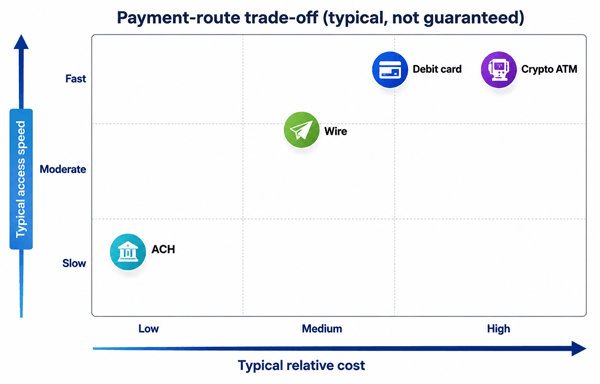
Figure 2. Typical speed-versus-cost trade-off. Actual timing, limits, and pricing vary by provider, state, and account.
5.5 Place the order
A market order prioritizes immediate execution but may suffer slippage. A limit order sets the maximum price you will pay but may not fill. On simple brokerage screens, the platform may quote a fixed price that already contains a spread.
5.6 Withdraw carefully if using self-custody
- Copy and paste the address; do not type it manually.
- Match the blockchain network exactly.
- Check the first and last characters after pasting to detect clipboard malware.
- Send a small test amount before a large transfer.
- Store the recovery phrase offline and never share it with support staff or anyone else.
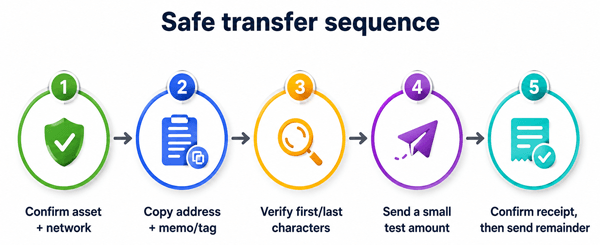
Figure 4. A small test transfer reduces but cannot eliminate. address, network, and memo errors.
6. Step-by-Step: How to Cash Out Crypto to a US Bank
- Choose a platform that supports the asset, network, your state, and your bank withdrawal method.
- Complete verification before sending a large amount. A compliance review after deposit may delay access.
- Copy the platform’s deposit address and required memo/tag.
- Send a test transaction.
- After confirmation, sell using a limit or market order, or accept a broker quote after reviewing the spread.
- Withdraw dollars through ACH or wire.
- Confirm the bank account name matches the platform account name.
- Download the trade confirmation, deposit record, withdrawal record, and tax report.
Practical caution: Do not send a large balance to a new off-ramp before confirming withdrawal limits, bank compatibility, account verification, and source-of-funds requirements.
7. Fees and Hidden Costs
| Cost | Where it appears | How to reduce it |
|---|---|---|
| Trading fee | Buy/sell order | Use lower-cost order interface; compare tiers |
| Spread or markup | Difference between market and quoted price | Compare final proceeds with an independent market reference |
| Card fee | Debit/credit purchase | Use ACH or wire when practical |
| Network/miner fee | Blockchain withdrawal | Choose timing/network carefully; batch transfers |
| Platform withdrawal fee | Crypto or fiat withdrawal | Review fee schedule and minimums |
| Wire fee | Sending/receiving bank | Compare ACH; ask about bank fee waivers |
| Slippage | Large or illiquid orders | Use liquid markets and limit orders |
| ATM markup | Cash kiosk quote | Compare with online platform before paying |
| Foreign transaction/currency fee | Non-US provider or card routing | Use a US-supported dollar route |
| Tax cost | Gain recognized on sale or spending | Track basis and plan sales deliberately |
7.1 All-in cost example
Suppose you want to buy $1,000 of bitcoin. Route A charges a 1.5% fee and quotes a price 1% above the market. Route B charges a visible 0.6% fee with a 0.2% spread. Ignoring network costs, Route A’s approximate all-in cost is 2.5% ($25), while Route B’s is 0.8% ($8). The advertised fee alone would understate the difference.
Formula: Approximate all-in purchase cost = payment fee + trading fee + spread + withdrawal/network fees. For a cash-out, also include slippage, bank fees, and potential tax.
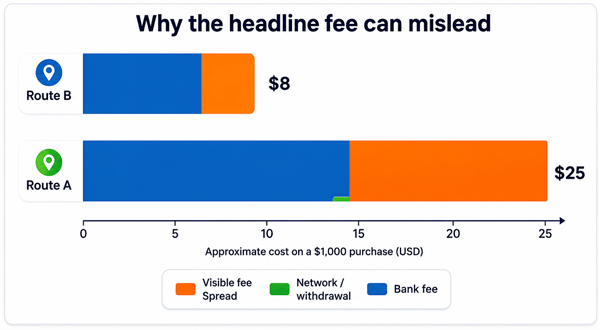
Figure 3. All-in purchase-cost comparison using the article’s $1,000 example, before network costs.
8. US Tax Implications of On-Ramps and Off-Ramps
The IRS treats digital assets as property for federal income-tax purposes. Buying crypto with U.S. dollars is generally not, by itself, a taxable disposal. Selling crypto for dollars, exchanging one digital asset for another, or spending crypto can create a taxable gain or loss. Income received in crypto—such as compensation, rewards, or business payments—may also be taxable under the rules applicable to that income type.
8.1 What an off-ramp can trigger
| Action | Typical federal tax result | Record needed |
|---|---|---|
| Buy crypto with USD | Usually establishes cost basis; no disposal | Date, quantity, fees, dollar cost |
| Sell crypto for USD | Capital gain or loss for investment property | Proceeds, basis, holding period, fees |
| Swap BTC for ETH | Taxable disposition of BTC | Fair market value and basis |
| Spend crypto on goods | Taxable disposition | Value of goods and crypto basis |
| Receive crypto for work | Ordinary income generally measured at receipt value | Date, value, payer, later basis |
| Transfer between your own wallets | Generally not a sale, but transfer fees may complicate records | Both addresses and transaction ID |
8.2 Form 1099-DA and basis records
Broker reporting on Form 1099-DA began for certain digital-asset sales and exchanges occurring in 2025. For 2025 transactions, most statements report gross proceeds but not basis. For sales after 2025, brokers generally must report gross proceeds for digital assets and basis for covered digital assets, while basis reporting for noncovered assets may remain incomplete. Taxpayers should therefore keep independent records rather than relying on the form alone.
Expert tip: Reconcile records before moving assets across platforms. A receiving platform may know the sale proceeds but not the original purchase basis, which can make automated tax reports incomplete.
8.3 Capital gains basics
A gain or loss is generally the amount realized minus adjusted basis. Holding period matters: assets held for one year or less are generally short-term; assets held more than one year are generally long-term. Tax rates and deductibility limits depend on the taxpayer’s circumstances and current law.
9. US Regulation and Consumer Protection
There is no single “crypto on-ramp license” that replaces all other rules. Depending on the business model, a provider may be subject to federal anti-money-laundering requirements, state money-transmitter or virtual-currency licensing, securities or commodities laws, sanctions compliance, tax reporting, privacy rules, and banking-partner controls.
9.1 FinCEN and money-services-business rules
FinCEN guidance explains that administrators and exchangers of convertible virtual currency can be money transmitters, while a person merely using virtual currency to buy goods or services is generally treated differently. Covered businesses may need to register as money services businesses and maintain anti-money-laundering, recordkeeping, reporting, and monitoring programs.
9.2 State licensing
State treatment remains important. Most states regulate virtual-currency transmission through money-transmission laws, while some use specialized frameworks. Coverage, exemptions, permissible investments, bonding, consumer disclosures, and examination requirements can differ. A platform available in one state may restrict features in another.
9.3 Securities and commodities oversight
The legal treatment of a token or transaction depends on facts and circumstances. The CFTC has authority over derivatives and anti-fraud or anti-manipulation matters in certain commodity transactions, while the SEC has authority where securities laws apply. A platform’s registration for one activity does not automatically protect every product it offers.
9.4 Payment stablecoin framework
Payment stablecoins now have a separate federal framework under the GENIUS Act, signed on July 18, 2025. Implementation is still being completed through agency rulemaking, and the Act generally becomes effective on January 18, 2027, or earlier if final implementing rules trigger the statutory timeline. This framework does not make stablecoins FDIC-insured or eliminate issuer, reserve, redemption, liquidity, or depeg risk.
9.5 FDIC insurance and cash balances
Crypto assets are not FDIC-insured. Dollar balances may qualify for pass-through deposit insurance only when specific legal and recordkeeping conditions are met and the money is actually held as a deposit at an insured bank. FDIC insurance protects eligible bank deposits against an insured bank’s failure; it does not insure a crypto company’s failure, theft, token price loss, or blockchain transaction.
Warning: A provider’s statement that it “works with an FDIC-insured bank” does not mean your crypto is insured. Read exactly which cash balances, account structures, and failure scenarios are covered.
9.6 Why Providers Ask for ID and Source of Funds
Identity checks are part of customer-identification, anti-money-laundering, sanctions, fraud, and risk-management controls. Higher-risk activity—such as large transfers, rapid movement through multiple wallets, privacy-enhancing tools, unusual geography, account-name mismatches, or suspected scams—may trigger enhanced review. Legitimate users should maintain bank statements, trade confirmations, transaction hashes, and a clear explanation of how funds were acquired.
10. Security Risks, Fraud, and Account Freezes
| Risk | How it happens | Best defense |
|---|---|---|
| Phishing | Fake login, support message, or QR code | Use bookmarks, security keys, anti-phishing code |
| SIM swap | Attacker takes over phone number | Avoid SMS-only 2FA; add carrier PIN |
| Address poisoning/clipboard malware | Wrong address inserted during transfer | Verify characters and use allowlists/test sends |
| Romance or investment scam | Victim is instructed to buy and send crypto | Never send to strangers or “account managers” |
| Recovery scam | Fraudster promises to recover lost crypto for a fee | Report through official channels; never pay upfront |
| Account takeover | Reused password or compromised email | Unique passwords and secure email |
| Platform insolvency | Custodian cannot return assets | Limit custodial balances; understand terms |
| Smart-contract exploit | Faulty or malicious decentralized application | Use audited, reputable protocols; limit approvals |
| Stablecoin/depeg risk | Token loses target value or redemption access | Understand reserve, issuer, liquidity, and legal risk |
| Compliance freeze | Activity triggers review | Maintain records and respond through official support |
Government agencies repeatedly warn that scammers favor cryptocurrency because transfers can move quickly and may be difficult to reverse. Common red flags include guaranteed returns, requests to pay “taxes” or “unlock fees” before withdrawal, urgent instructions from supposed government or bank officials, and pressure to use a crypto ATM.
Stop immediately if: Someone tells you to keep the transaction secret, install remote-access software, move money to a “safe wallet,” or pay additional crypto to release profits. These are classic scam patterns.
10.1 What to Do if an Account Is Frozen
- Do not create multiple accounts or attempt to evade the review; that can worsen the issue.
- Use only official support channels and save ticket numbers.
- Provide clear, consistent documents requested by the provider.
- Prepare transaction hashes, bank statements, proof of income or sale, wallet ownership evidence, and explanations of counterparties.
- Notify your bank promptly if unauthorized transfers occurred.
- Report suspected fraud to appropriate federal, state, and local channels.
- Consult an attorney for large balances, prolonged restrictions, or legal process.
11. Real-World Examples
11.1 Example 1: A low-cost recurring buyer
Jordan buys $200 of bitcoin each month. Jordan links a bank account by ACH, uses a low-fee trading interface, and withdraws to a personal wallet only after the balance is large enough that the network fee is a small percentage. Jordan records each purchase price and fee. This approach favors cost efficiency over immediate withdrawals.
11.2 Example 2: A time-sensitive large purchase
Maya wants to buy $40,000 of crypto. A debit card is fast but carries a high percentage fee and a low limit. Maya verifies the platform in advance, confirms a higher account limit, sends a bank wire, places limit orders in a liquid market, and performs a test withdrawal. Fixed wire fees are small relative to the transaction size.
11.3 Example 3: Cashing out after a gain
Luis bought an asset for $4,000 and later sells it for $10,000. Before off-ramping, Luis checks the original basis, holding period, platform fee, and estimated tax. The cash-out creates a $6,000 gain before adjustments. Luis keeps enough dollars aside for tax rather than reinvesting the full proceeds.
11.4 Example 4: A misleading “zero-fee” offer
A service advertises zero trading fees but quotes a purchase price 2.4% above a broad market reference and adds a withdrawal charge. Another service charges 0.7% explicitly and quotes close to the market. The second route produces more crypto despite the visible fee.
11.5 Example 5: A scam through a crypto ATM
A caller claiming to be from a government agency says Priya must deposit cash into a crypto kiosk to avoid arrest. The caller provides a QR code for the destination wallet. Legitimate agencies do not demand payment this way. Priya should stop, contact the agency through a verified number, notify the kiosk operator, and report the attempted fraud.
12. Common Mistakes to Avoid
| Mistake | Why it is costly | Better approach |
|---|---|---|
| Choosing by advertised fee only | Spread can exceed the fee | Compare final amount received |
| Sending on the wrong network | Funds may be unrecoverable | Match asset, network, address, and memo |
| Skipping a test transfer | A small error affects the full balance | Test first |
| Ignoring withdrawal holds | Funds may not be movable when needed | Review settlement policy |
| Leaving all assets on one platform | Concentrates custody and insolvency risk | Use appropriate diversification/self-custody |
| Weak two-factor authentication | SMS and passwords can be compromised | Use authenticator or security key |
| Poor tax records | Basis errors can overstate tax or cause filing problems | Track every lot and transfer |
| Trusting “support” in DMs | Impersonators target distressed users | Use official in-app/site support |
| Using borrowed money | Volatility can create debt and forced selling | Use only risk capital |
| Cashing out without liquidity planning | Large sales may create slippage and tax surprises | Stage orders and estimate taxes |
13. A Practical Decision Framework
13.1 Best fit by user goal
| Goal | Usually best starting point | Why |
|---|---|---|
| Lowest cost for routine buying | ACH + liquid platform + low-fee order interface | Reduces payment and spread costs |
| Fast small purchase | Debit card or instant bank funding | Speed and convenience |
| Large transfer | Verified account + bank wire | Higher limits and clear bank trail |
| Cash purchase | Crypto ATM only after fee/scam checks | May work without bank link |
| Move to self-custody | Platform with reliable crypto withdrawals | Direct wallet transfer support |
| Cash out to bank | Liquid platform + ACH/wire withdrawal | Better records and banking connection |
| Spend without manual sale | Crypto-linked card | Automatic conversion, but tax records matter |
| Privacy-sensitive lawful use | Understand provider data policy and legal obligations | Regulated ramps still require compliance |
13.2 Pre-Transaction Checklist
- Provider serves my state and supports my exact asset/network.
- I understand the total quoted cost, not just the headline fee.
- My account and email use strong, unique security.
- I know the funding, settlement, and withdrawal timeline.
- I have verified limits and bank compatibility.
- I will use a test transfer for a meaningful amount.
- I can document the source of funds and ownership of wallets.
- I am keeping purchase, transfer, and tax records.
- I am not acting because of pressure, secrecy, or guaranteed returns.
14. Frequently Asked Questions
14.1 What is the easiest crypto on-ramp in the US?
For many beginners, a regulated centralized platform connected to a bank account by ACH is the easiest balance of cost, usability, records, and support. Availability and features vary by state.
14.2 What is the cheapest way to buy crypto with dollars?
ACH funding combined with a liquid trading interface is often cheaper than debit cards or crypto ATMs. Compare the final crypto received because the spread can change the answer.
14.3 Can I buy crypto directly from my bank?
Some banks or fintech partners provide crypto access, while others only allow transfers to third-party platforms. Confirm whether you can withdraw the crypto to an external wallet and what protections apply.
14.4 Can I cash out crypto to any bank account?
Usually the bank account must be supported, verified, and held in the same legal name. Banks and platforms may block or review certain transfers.
14.5 How long does a crypto off-ramp take?
Blockchain confirmation may take minutes or longer. Selling can be immediate, while ACH withdrawals often take one or more business days and wires may arrive the same or next business day.
14.6 Is converting crypto to dollars taxable?
Generally yes when the sale produces a gain or loss. The tax is based on proceeds, adjusted basis, fees, and holding period—not merely the amount withdrawn to the bank.
14.7 Is transferring crypto to my own wallet taxable?
A transfer between wallets you own is generally not a sale, but you should retain evidence of ownership and track any fees and lot movement.
14.8 Are crypto on-ramp funds FDIC-insured?
Crypto assets are not FDIC-insured. Certain dollar balances may qualify for pass-through coverage if all legal and recordkeeping conditions are satisfied.
14.9 Why is my crypto withdrawal on hold?
A provider may be waiting for bank settlement, completing identity or source-of-funds review, responding to suspected fraud, or enforcing account limits.
14.10 Can I use a credit card to buy crypto?
Some routes may allow it, but the issuer may treat the purchase as a cash advance with fees and immediate interest. Debit or bank transfer is usually more practical.
14.11 Are crypto ATMs safe?
A legitimate machine can work as designed, but fees are often high and scammers frequently direct victims to kiosks. Never use one because of an urgent instruction from a stranger or supposed official.
14.12 What is the difference between an exchange and an on-ramp?
An exchange is a venue or service for trading. An on-ramp is the route from fiat money into crypto. Many exchanges include an on-ramp, but a decentralized exchange usually requires a separate fiat ramp.
14.13 Can a decentralized exchange be an off-ramp?
Not by itself unless it connects to a service that delivers fiat. A token swap remains within crypto; you still need a bank, card, cash, or payment provider to receive dollars.
14.14 Do I need to report every crypto sale?
Tax reporting rules generally require taxable dispositions to be reported even when no information form is received. Keep complete records and consult current IRS guidance.
14.15 What should I do before cashing out a large amount?
Verify limits, complete identity checks, confirm bank and network support, test the route, estimate tax, document source of funds, and consider staged execution to reduce operational risk and slippage.
15. Final Takeaway
The best crypto on-ramp or off-ramp is not simply the fastest or the one with the lowest advertised fee. It is the route that is lawful in your state, transparent about total cost, secure, liquid enough for your transaction, compatible with your bank and wallet, and capable of producing reliable records.
For most U.S. users, a verified platform funded by ACH is a sensible starting point. Debit cards can be useful when speed matters, wires can suit large transfers, and crypto ATMs should be treated as a high-cost specialist option. Whatever route you choose, verify the address and network, use strong account security, keep tax records, and stop immediately when anyone pressures you to send crypto.
15.1 Sources Consulted and Checked
The following sources were consulted and checked when preparing this article for accuracy.
This guide was reviewed against official and primary-source material available as of August 2, 2026. Platform fees and terms are discussed generically because they change frequently and differ by account, state, asset, payment method, and transaction size.
- Financial Crimes Enforcement Network (FinCEN): Application of FinCEN’s Regulations to Persons Administering, Exchanging, or Using Virtual Currencies.
- FinCEN: Notice on the Use of Convertible Virtual Currency Kiosks for Scam Payments and Other Illicit Activity.
- Internal Revenue Service: Digital assets.
- Internal Revenue Service: Frequently asked questions on digital asset transactions.
- Internal Revenue Service: Final regulations and related IRS guidance for reporting by brokers on sales and exchanges of digital assets.
- Federal Deposit Insurance Corporation: Financial Products That Are Not Insured by the FDIC.
- Federal Deposit Insurance Corporation: Deposit Insurance.
- Commodity Futures Trading Commission: Understand the Risks of Virtual Currency Trading.
- Consumer Financial Protection Bureau: What are some classic warning signs of possible fraud and scams?.
- Consumer Financial Protection Bureau: An analysis of consumer complaints related to crypto-assets.
- Conference of State Bank Supervisors: State regulators settle with Abra; overview of state virtual-currency licensing.
- Conference of State Bank Supervisors: Money Transmission Modernization Act.
- Internal Revenue Service: Instructions for Form 1099-DA (2026).
- U.S. Government Publishing Office: Public Law 119-27, the GENIUS Act.
- U.S. Department of the Treasury: Proposed rules implementing the GENIUS Act.
15.2 Reader Advice
The information in this article is provided for educational and informational purposes only and should not be considered financial, investment, tax, legal, or professional advice. Cryptocurrency regulations, tax rules, exchange policies, and compliance requirements in the United States can change over time and may vary depending on your state and individual circumstances.
Before making any financial decisions or using a cryptocurrency platform, always verify the latest information through official sources, such as relevant government agencies, financial regulators, tax authorities, or the service provider itself. Consider consulting a qualified financial, tax, or legal professional if you need advice tailored to your situation.
While every effort has been made to ensure the accuracy of the information at the time of publication, no guarantee is made that all information will remain current, complete, or applicable to your specific circumstances. Always conduct your own research and make informed decisions based on the most up-to-date official guidance.