Crypto Fees Explained: Meaning, How It Works, Examples, Benefits and Risks
1. What Are Crypto Fees?
Crypto fees are the costs you pay when you buy, sell, trade, transfer, or use cryptocurrency. Some fees go to a blockchain network. Some go to an exchange or wallet provider. Some are visible before you confirm a transaction, while others are hidden inside the price you receive. Understanding these fees helps you avoid surprises, choose the right network, and decide whether a crypto transaction is worth doing.
In simple terms, a crypto fee is a payment required to process a crypto-related action. That action may be sending Bitcoin to another wallet, swapping tokens on a decentralized exchange, buying crypto with a card, withdrawing coins from an exchange, or using a smart contract. Fees vary by blockchain, platform, transaction size, network demand, and the type of service you use.
SHORT answer: Crypto fees are transaction costs paid to blockchain validators, miners, exchanges, brokers, or payment processors. Network fees help secure and prioritize blockchain transactions. Platform fees pay the service provider. The total cost may include a network fee, trading fee, spread, withdrawal fee, deposit fee, and conversion fee.
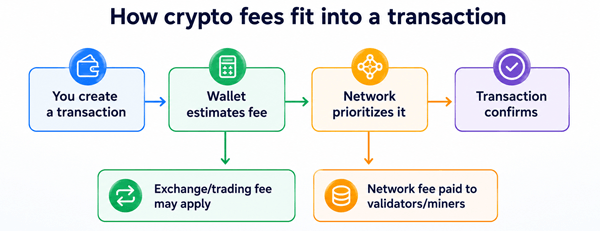
Diagram: A crypto payment may involve both blockchain network fees and platform fees. These are separate costs.
2. Main Types of Crypto Fees
| Fee type | Where it appears | Who usually receives it | Beginner example |
|---|---|---|---|
| Network fee / transaction fee | Sending crypto on-chain | Miners or validators securing the blockchain | Paying Bitcoin transaction fee to get included in a block |
| Gas fee | Smart contract chains such as Ethereum | Validators; on Ethereum, the base fee is burned and priority fee tips validators | Sending ETH, minting an NFT, or swapping tokens |
| Trading fee | Centralized exchanges and some brokers | The exchange or broker | Buying $500 of BTC and paying 0.6% trading fee |
| Spread | Broker-style buy/sell quotes | Platform or market maker through price difference | BTC market price is $60,000, but your buy quote is $60,300 |
| Withdrawal fee | Moving crypto from a platform to your wallet | Exchange or network, depending on fee design | Withdrawing USDT from an exchange to an external wallet |
| Deposit / payment processing fee | Card, bank, or payment app purchase | Payment processor, bank, or platform | Buying crypto with a debit card may cost more than bank transfer |
| Conversion fee | Swapping fiat or one crypto for another | Exchange, broker, or liquidity provider | Converting ETH to USDC inside an app |
3. How Crypto Fees Work
Crypto fees are not all calculated the same way. The most important distinction is between blockchain network fees and platform fees.
3.1 Network fees pay for blockchain settlement
When you send crypto on a public blockchain, your transaction must be checked and added to a block or similar ledger structure. Because block space is limited, users compete for inclusion. Higher fees usually make a transaction more attractive to miners or validators, especially when the network is busy.
This means the fee is usually based on how much network capacity your transaction uses, not on how much money you send. Sending $10,000 of Bitcoin can cost less than sending $20 if the $20 transaction is technically more complex or the network is congested.
3.2 Bitcoin-style fees are often priced in sats per vByte
Bitcoin fees are commonly estimated using a fee rate, often shown as satoshis per virtual byte, or sat/vB. A satoshi is the smallest unit of Bitcoin. A vByte measures the data size of a transaction. A larger transaction or a higher fee rate costs more.
Simple formula: Bitcoin transaction fee = transaction size in vBytes x fee rate in sat/vB.
| Example transaction size | Fee rate | Fee in satoshis | What it means |
|---|---|---|---|
| 140 vBytes | 10 sat/vB | 1,400 sats | Low-fee example when the network is calm |
| 140 vBytes | 50 sat/vB | 7,000 sats | Higher cost when users compete for block space |
| 250 vBytes | 50 sat/vB | 12,500 sats | Larger transaction at the same fee rate costs more |
3.3 Ethereum gas fees pay for computation and block space
On Ethereum and similar smart contract chains, fees are usually called gas fees. Gas measures the computational work required by a transaction. Sending ETH is relatively simple. Swapping tokens, minting NFTs, or interacting with a DeFi protocol usually uses more gas.
Ethereum fees include a base fee set by the protocol and a priority fee, also called a tip, that can make the transaction more attractive to validators. The base fee changes with network demand. The maximum fee you approve is not always the final amount spent because unused gas can be refunded depending on transaction design.
Simple formula: Ethereum fee = gas used x effective gas price. The effective gas price includes the base fee plus the priority fee, within the maximum fee you approve.
3.4 Exchange fees are business fees, not blockchain fees
When you buy or sell crypto on a centralized exchange, the platform may charge a trading fee. Many exchanges use maker-taker pricing. A maker order adds liquidity to the order book. A taker order fills immediately against existing liquidity. Taker fees are often higher because the order removes liquidity.
A beginner should also watch the spread. A platform may advertise low or zero commission but quote a less favorable buy or sell price. The real cost is the total difference between the market price and the final price you receive, plus any listed fee.
4. Practical Examples of Crypto Fees
4.1 Sending Bitcoin to a hardware wallet
You withdraw BTC from an exchange to your own wallet. You may pay an exchange withdrawal fee and/or a Bitcoin network fee. The fee is not based on the dollar amount alone. It depends on the transaction data size and the fee rate needed for the speed you choose. If the network is busy, the same withdrawal can cost more than it would during a quieter period.
4.2 Buying ETH on an exchange
You buy $1,000 of ETH. The exchange may charge a trading fee, such as a percentage of the order. If you buy through a simple instant-buy interface, the displayed price may also include a spread. If you later move the ETH to your own wallet, you may pay a withdrawal fee and an Ethereum network fee.
4.3 Swapping tokens on a decentralized exchange
You swap USDC for another token using a DeFi app. You may pay an Ethereum gas fee, a liquidity provider fee built into the swap, and price slippage if the pool is not very liquid. If the transaction fails, the blockchain may still charge gas because validators still processed the attempted action.
4.4 Moving stablecoins across networks
You want to send USDT or USDC to another person. The cost can differ greatly depending on the network you choose. Ethereum may be more expensive during congestion, while some alternative networks may be cheaper. However, the sender and receiver must use the same asset on the same supported network. Sending to the wrong network is a common and costly mistake.
5. Network Fees vs Exchange Fees vs Spreads
| Question | Network fee | Exchange trading fee | Spread | Withdrawal fee |
|---|---|---|---|---|
| Who sets it? | Blockchain fee market or protocol | Exchange pricing schedule | Platform quote or market liquidity | Exchange policy and/or network cost |
| When paid? | On-chain transaction | Buying or selling on exchange | When accepting quoted price | Moving crypto off platform |
| Can it change quickly? | Yes, often in real time | Usually less often | Yes, with market conditions | Yes, especially dynamic withdrawals |
| Can you avoid it? | Not if using the blockchain directly | Sometimes by choosing platform/order type | Reduce by using limit orders or better venues | Sometimes by choosing network/timing |
6. Benefits of Crypto Fees
- They help protect blockchains from spam by making every transaction carry a cost.
- They reward or compensate miners and validators for securing the network.
- They help allocate limited block space to users who value faster confirmation.
- They support exchange and wallet services that provide liquidity, custody, customer support, and user-friendly interfaces.
- They can encourage efficient behavior, such as batching transactions or using lower-cost networks when appropriate.
7. Risks and Limitations of Crypto Fees
- Fees can become expensive during network congestion.
- A small crypto transfer can become uneconomical if the fee is high relative to the amount sent.
- Some platforms hide costs in spreads rather than showing a clear commission.
- Choosing the wrong network can lead to delayed funds or permanent loss if the receiving platform does not support that network.
- Smart contract transactions can fail while still consuming gas.
- Bridging assets between blockchains can add extra fees and security risks.
- Fee estimates are not guarantees; a transaction can remain pending if the selected fee is too low.
8. How to Reduce Crypto Fees: Practical Best Practices
- Check the total cost before confirming, including fee, spread, withdrawal cost, and network choice.
- Avoid sending tiny amounts on expensive networks because the fee may be a large percentage of the transfer.
- Use limit orders on exchanges when appropriate, because they can reduce spread costs and may qualify for lower maker fees.
- Send during quieter network periods if the transfer is not urgent.
- Choose the right network, but only if both sender and receiver support the same asset on that network.
- Batch transfers when possible instead of making many separate transactions.
- Keep enough native coin for gas, such as ETH for Ethereum transactions or SOL for Solana transactions.
- Use reputable wallets that show estimated confirmation time and allow fee adjustment.
- Do a small test transfer when moving large amounts to a new address or network.
- Read the fee page of any exchange you use, because fees differ by country, payment method, asset, network, and account tier.
9. Common Beginner Mistakes and Misconceptions
| Misconception | Better understanding |
|---|---|
| Mistake: Thinking the fee depends only on the amount sent | Reality: Network fees usually depend on data size, gas, congestion, and priority, not simply the dollar value. |
| Mistake: Assuming “zero fee” means free | Reality: The cost may be included in the spread or exchange rate. |
| Mistake: Choosing the cheapest network without checking compatibility | Reality: The receiver must support that exact token and network. |
| Mistake: Forgetting gas tokens | Reality: You may need the chain’s native token to move or swap other tokens. |
| Mistake: Ignoring failed transaction costs | Reality: On smart contract chains, failed attempts may still consume gas. |
10. Crypto Fee Checklist Before You Confirm a Transaction
- What is the exact fee in crypto and in your local currency?
- Is the fee a network fee, a platform fee, a spread, or a combination?
- Is the transaction urgent, or can you wait for a cheaper time?
- Are you using the correct network for the receiving wallet or exchange?
- Is the fee reasonable compared with the amount being transferred?
- Could a limit order, bank transfer, batch transaction, or different supported network reduce the cost?
- Do you understand whether the fee is refundable if the transaction fails?
11. FAQs About Crypto Fees
11.1 What is a crypto fee in simple words?
A crypto fee is the cost of using a crypto network or crypto service. It may pay blockchain validators, an exchange, a wallet provider, a payment processor, or a liquidity provider.
11.2 Why are crypto fees sometimes so high?
Fees rise when many people want to use the same blockchain or service at the same time. Blockchains have limited capacity, so users compete for space by paying higher fees.
11.3 Are crypto fees refundable?
Usually no. Blockchain network fees are generally not refundable once a transaction is broadcast or processed. Some unused gas on Ethereum-style transactions may not be spent, but gas used by a failed transaction can still be charged.
11.4 Who gets Bitcoin transaction fees?
Bitcoin transaction fees are paid to miners who include transactions in blocks.
11.5 Who gets Ethereum gas fees?
Ethereum fees include a protocol-set base fee and a priority fee. The priority fee acts as a tip to validators. The base fee is handled by the protocol rather than paid as a normal platform commission.
11.6 Do I pay fees when receiving crypto?
Usually the sender pays the network fee, but some platforms may charge deposit or crediting fees. Always check the platform’s rules.
11.7 What is the difference between gas and a transaction fee?
Gas is the unit used by Ethereum-style networks to measure computational work. A gas fee is a type of transaction fee.
11.8 Can I send crypto with no fee?
On most public blockchains, a meaningful network fee is required or expected. Some platforms may subsidize fees for certain assets or networks, but the cost is usually paid somewhere by someone.
11.9 What is a maker fee and taker fee?
A maker fee applies when your order adds liquidity to an exchange order book. A taker fee applies when your order immediately matches existing liquidity. Taker fees are often higher.
11.10 How can beginners avoid overpaying?
Compare the total cost, avoid rushed transactions, check network compatibility, use limit orders where suitable, and avoid tiny transfers on expensive networks.
12. Final Takeaway
Crypto fees are a normal part of using digital assets, but they are not all the same. Network fees pay for blockchain processing. Gas fees pay for computation on smart contract chains. Exchange fees, withdrawal fees, spreads, and payment processing fees are service costs. The smartest approach is to look at the total cost before confirming, choose compatible networks carefully, and avoid transactions where the fee is too large compared with the value being moved.
Sources Consulted and Checked
These sources were consulted while preparing this document and checking its accuracy.
- Bitcoin.org Developer Guide - Transactions: Explains Bitcoin transaction fees and how minimum relay fees and block inclusion affect transactions.
- Ethereum.org Developer Docs - Gas and Fees: Explains Ethereum gas, base fee, priority fee, and how transaction fees are calculated.
- Coinbase Help - Pricing and Fees / Exchange Fees / Withdrawal Fees: Used for examples of platform fees, maker-taker fees, withdrawal minimums, and processing/network fee disclosures.
- Mempool.space FAQ: Used for practical understanding of fee rate, mempool conditions, and confirmation speed.
Reader Advice
This article is provided for educational and informational purposes only and is not personalized financial, investment, tax, legal, or other professional advice or a recommendation to buy, sell, hold, transfer, or use any digital asset. Crypto transactions may involve price volatility, network congestion, changing fees, failed or irreversible transfers, platform or smart-contract risks, and possible loss of funds, especially when an incorrect address, asset, or network is used. Rules, policies, laws, tax treatment, platform terms, and statistics can change over time and vary by country or region. Before making a decision, verify current information through official blockchain, wallet, exchange, regulator, and government sources, review all fees and network details shown at confirmation, and seek suitably qualified professional advice where appropriate.