KYC and AML in Crypto: Complete Guide, Examples, Risks and Best Practices
Crypto can move value quickly across borders, often without a bank in the middle. That speed is useful, but it also creates risks. Criminals may try to use crypto exchanges, wallets, mixers, fake accounts, and stolen identities to hide money from scams, ransomware, darknet markets, sanctions evasion, corruption, or terrorist financing.
That is where KYC and AML come in. KYC means “Know Your Customer.” AML means “Anti-Money Laundering.” In crypto, these controls help businesses understand who their customers are, detect suspicious activity, protect users, and meet legal obligations.
This guide explains KYC and AML in crypto from the ground up. It is written for beginners, but it also includes practical examples, compliance workflows, risks, best practices, and common mistakes for exchanges, wallet providers, fintechs, Web3 platforms, and ordinary crypto users.
1. Quick answer: What are KYC and AML in crypto?
KYC is the process of identifying and verifying customers. AML is the broader program used to prevent, detect, and report money laundering, terrorist financing, sanctions violations, fraud, and other financial crime. In a crypto exchange, KYC might include asking for a legal name, date of birth, government ID, selfie, proof of address, and source-of-funds information. AML includes risk scoring, sanctions screening, blockchain wallet checks, transaction monitoring, suspicious activity reporting, record keeping, and staff training.
| Term | Simple meaning | Crypto example |
|---|---|---|
| KYC | Checking who the customer is. | A user uploads a passport and takes a selfie before buying Bitcoin. |
| CDD | Customer due diligence: collecting and verifying basic customer information. | An exchange checks name, address, date of birth, and ID validity. |
| EDD | Enhanced due diligence for higher-risk customers. | A platform asks a high-volume trader for source-of-wealth documents. |
| AML | Systems that stop, detect, and report financial crime. | Monitoring deposits from darknet markets, sanctioned wallets, or scam clusters. |
| Travel Rule | Rules requiring certain sender and receiver information to accompany qualifying crypto transfers. | A VASP shares originator and beneficiary information with another VASP for an in-scope transfer. |
2. Why KYC and AML matter in crypto
Public blockchains are transparent in one way: transactions are visible on-chain. But wallet addresses are usually pseudonymous, meaning the address itself does not automatically show the real person behind it. That is why a suspicious wallet can be visible while the owner remains hard to identify.
FATF describes virtual assets as digital representations of value that can be digitally traded, transferred, or used for payment. FATF also warns that, without proper regulation, virtual assets can be misused for money laundering and terrorist financing. FATF expects virtual asset service providers to apply preventive measures such as customer due diligence, record keeping, and suspicious transaction reporting.
Recent reporting also shows why this matters. Reuters reported in January 2026 that Chainalysis researchers estimated money launderers received at least $82 billion in cryptocurrency in 2025, up from $10 billion in 2020. The same report noted that blockchain records show wallet addresses, but identifying who controls those wallets remains difficult.
3. How KYC works on a crypto exchange
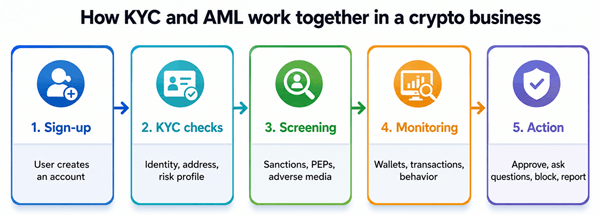
A typical crypto KYC process is not just a one-time ID upload. Good platforms use a risk-based approach, meaning they collect more information when the customer, product, country, payment method, or transaction pattern is higher risk.
- Account creation: The user provides an email, phone number, password, and country of residence.
- Identity collection: The platform asks for legal name, date of birth, address, and sometimes tax identification details.
- Document verification: The user uploads a government ID, passport, residence card, or driving licence.
- Liveness or selfie check: The platform checks that the person is real and matches the ID document.
- Screening: The platform checks sanctions lists, politically exposed person (PEP) databases, and adverse media sources.
- Risk rating: The platform assigns a risk score based on identity, geography, product use, transaction size, funding source, and behavior.
- Ongoing review: The platform updates customer information and reviews activity over time.
4. How AML works in crypto
AML is the larger system around KYC. It continues after onboarding and focuses on behavior, transactions, wallet exposure, and reporting. A crypto AML program normally includes written policies, a compliance officer, customer due diligence, sanctions screening, blockchain analytics, transaction monitoring, suspicious activity escalation, staff training, independent testing, and record keeping.
| AML control | What it does | Practical crypto use |
|---|---|---|
| Sanctions screening | Checks customers and wallets against sanctions exposure. | Blocks or investigates a deposit linked to a sanctioned address. |
| Blockchain analytics | Traces wallet histories and risky exposure. | Flags funds that passed through a mixer or ransomware wallet. |
| Transaction monitoring | Looks for unusual activity patterns. | Detects rapid deposits, swaps, and withdrawals to unrelated wallets. |
| Case investigation | Reviews alerts and gathers evidence. | A compliance analyst checks wallet history and customer explanations. |
| Suspicious reporting | Reports suspicious activity to the relevant authority where required. | A regulated exchange files a report after suspected laundering. |
| Record keeping | Keeps evidence for audits and investigations. | Stores KYC documents, alert notes, and transfer information. |
5. Important crypto KYC and AML rules to know
However, several global and regional standards shape most crypto compliance programs.
FATF is the global standard-setter for anti-money laundering and counter-terrorist financing. Its virtual asset guidance expects VASPs to apply preventive measures similar to financial institutions. FATF’s Travel Rule expectations require originator and beneficiary information to be collected, held, and transmitted for qualifying virtual asset transfers.
In the United States, FinCEN guidance explains that convertible virtual currency can be treated as “value that substitutes for currency,” and that money transmission involving such value can fall under Bank Secrecy Act obligations. In the United Kingdom, cryptoasset businesses carrying out in-scope activity must register with the FCA under the Money Laundering Regulations and comply with AML/CTF requirements. In the European Union, Regulation (EU) 2023/1113 and EBA guidance set information requirements for transfers of funds and certain crypto-assets, with EBA Travel Rule guidelines applicable from 30 December 2024.
| Jurisdiction / standard | What beginners should know | Why it matters |
|---|---|---|
| FATF | Sets global AML/CFT standards for countries and VASPs. | Many national crypto rules are based on FATF recommendations. |
| United States / FinCEN | Many crypto money transmission businesses must follow BSA AML obligations. | Registration, AML programs, reporting, and record keeping may apply. |
| European Union | Crypto-asset transfer information rules apply under Regulation (EU) 2023/1113 and EBA guidance. | CASPs need procedures for complete transfer information and missing data. |
| United Kingdom / FCA | In-scope cryptoasset businesses must register for AML/CTF supervision. | Operating without required registration can create enforcement risk. |
6. Real-world KYC and AML examples in crypto
6.1. Example 1: A normal retail user
A beginner signs up to buy $200 worth of Bitcoin with a bank card. The exchange verifies their ID, confirms the card is in their name, screens them against sanctions lists, and allows the purchase. This is low-risk if the user profile and transaction pattern are consistent.
6.2. Example 2: A suspicious layering pattern
A customer deposits crypto from several wallets, swaps it through multiple assets, then withdraws everything within minutes to a new wallet. The exchange may pause the withdrawal, ask questions, review blockchain exposure, and escalate the case if the explanation is weak.
6.3. Example 3: A sanctioned wallet exposure
A deposit comes from a wallet that has direct or indirect links to a sanctioned address. A compliant platform should block, freeze, reject, or investigate the transaction according to law and internal policy.
6.4. Example 4: High-risk business activity
A crypto over-the-counter desk handles large trades for corporate clients. It should verify company ownership, directors, beneficial owners, source of funds, source of wealth, expected volumes, and purpose of activity.
6.5. Example 5: Self-hosted wallet transfer
A customer withdraws to a private wallet they control. The risk depends on the jurisdiction, transfer size, wallet history, customer profile, and whether the business can reasonably verify wallet ownership or assess wallet exposure.
7. Benefits and drawbacks of KYC in crypto
| Benefits | Drawbacks or concerns |
|---|---|
| Helps prevent criminals from using regulated platforms. | Creates privacy concerns because sensitive identity documents are collected. |
| Can reduce fraud, account takeovers, and fake accounts. | Onboarding can be slower and frustrating for legitimate users. |
| Makes it easier for platforms to work with banks and payment partners. | Poorly designed checks may exclude users who lack standard documents. |
| Supports investigations and victim recovery when crime occurs. | Data breaches can expose personal information if security is weak. |
| Builds trust with regulators, institutions, and mainstream users. | Overly aggressive controls can create false positives and freeze legitimate funds. |
8. Key crypto money laundering risks
- Pseudonymous wallets: Addresses are visible, but the person behind them may not be obvious.
- Cross-border transfers: Crypto can move quickly between countries with different rules.
- Mixers and tumblers: These tools can be used to obscure transaction trails, although not all privacy tools are used for crime.
- Chain hopping: Criminals may swap between coins, tokens, bridges, and blockchains to complicate tracing.
- Mule accounts: Criminals may use fake, stolen, rented, or coerced identities to pass KYC.
- DeFi exposure: Decentralized protocols may not have the same customer controls as regulated intermediaries.
- Scams and ransomware: Illicit proceeds may be moved into exchanges, stablecoins, OTC brokers, gambling sites, or peer-to-peer channels.
- Sanctions evasion: High-risk actors may attempt to use crypto to avoid restrictions.
9. Best practices for crypto businesses
- Use a risk-based approach instead of treating every customer the same. Higher-risk customers, products, countries, and transaction patterns should trigger stronger checks.
- Collect only the data you need, but protect it seriously. KYC data is sensitive and should be encrypted, access-controlled, retained only as required, and deleted when no longer needed under applicable rules.
- Screen customers and wallets before allowing risky activity. Screening should include sanctions, PEPs, adverse media, and blockchain exposure where relevant.
- Monitor behavior after onboarding. A clean ID does not guarantee clean activity. Watch for rapid movement, structuring, unusual volumes, suspicious counterparties, and activity inconsistent with the customer profile.
- Document decisions. Regulators and auditors care not only that you made a decision, but why you made it.
- Build clear escalation paths. Front-line support, fraud teams, compliance analysts, and legal teams should know what to do when an alert appears.
- Keep Travel Rule data complete and accurate. Missing, placeholder, or inconsistent originator and beneficiary data can create compliance exposure.
- Train staff regularly. Crypto typologies change quickly, especially scams, mule networks, bridges, mixers, and sanctions evasion methods.
- Test the program independently. Internal audit, external audit, or independent reviews can find gaps before regulators or criminals do.
- Do not copy a bank AML program without adapting it. Crypto has unique wallet, blockchain, custody, smart-contract, and on-chain risk features.
10. Best practices for crypto users
- Use reputable platforms that clearly explain their KYC, security, fees, and withdrawal rules.
- Never buy, sell, or rent verified accounts. This can expose you to fraud, tax problems, frozen funds, or criminal investigations.
- Do not accept crypto transfers from strangers for a fee. You may be used as a money mule.
- Be cautious with “investment managers,” romance contacts, Telegram groups, and guaranteed-profit schemes.
- Keep records of deposits, withdrawals, trades, wallet addresses, and source of funds.
- Protect your identity documents. Upload them only to legitimate platforms and enable strong account security.
- Understand that a platform may ask follow-up questions. That does not always mean you did something wrong; it may be required by policy or law.
11. Common misconceptions about KYC and AML in crypto
| Misconception | Reality |
|---|---|
| “Crypto is completely anonymous.” | Most major blockchains are public, but wallet owners may be pseudonymous. Analytics and KYC can connect activity to real-world identities. |
| “KYC stops all crime.” | KYC reduces risk, but criminals can use stolen IDs, mule accounts, synthetic identities, and unregulated channels. |
| “Only exchanges need AML.” | Many service providers may have obligations depending on activity and jurisdiction, including custodians, brokers, payment platforms, and some transfer services. |
| “Privacy means criminal activity.” | Privacy is a legitimate concern. The compliance goal is to manage risk without collecting or exposing unnecessary personal data. |
| “If a transaction is on-chain, it is automatically safe.” | On-chain visibility helps, but it does not prove legitimacy. Context, counterparties, customer profile, and source of funds still matter. |
12. Crypto KYC and AML checklist
| Area | Minimum practical checklist |
|---|---|
| Governance | Named compliance owner, written policies, board or senior management oversight. |
| Customer onboarding | Identity verification, beneficial ownership for entities, risk rating, sanctions and PEP checks. |
| Wallet controls | Blockchain analytics, risky exposure rules, self-hosted wallet policy, chain-hop detection. |
| Monitoring | Rules and scenarios for unusual deposits, withdrawals, swaps, velocity, structuring, and high-risk counterparties. |
| Investigations | Case notes, evidence, customer outreach templates, escalation rules, decision logs. |
| Reporting | Suspicious activity procedures, regulator/FIU reporting timelines, record retention. |
| Data protection | Encryption, access controls, vendor due diligence, breach response, retention limits. |
| Review | Training, independent testing, metrics, quality assurance, model/rule tuning. |
13. FAQs about KYC and AML in crypto
13.1. Is KYC required for all crypto wallets?
No. A self-custody wallet app may let you create a wallet without KYC because you control the keys directly. However, regulated exchanges, custodians, brokers, and other service providers often must perform KYC depending on jurisdiction and services.
13.2. Why does a crypto exchange ask for my ID?
It may be required to verify your identity, reduce fraud, comply with AML laws, screen for sanctions, and understand whether your activity matches your profile.
13.3. Can I buy crypto without KYC?
In some places and channels, yes, but the risk can be higher. Non-KYC services may have lower limits, higher fraud risk, weaker consumer protection, or legal restrictions. Always follow local law.
13.4. What is enhanced due diligence?
Enhanced due diligence is deeper review for higher-risk customers or activity. It may include source-of-funds checks, source-of-wealth documents, business ownership verification, or senior compliance approval.
13.5. What is the Crypto Travel Rule?
The Travel Rule requires certain originator and beneficiary information to accompany qualifying crypto transfers between regulated entities. Exact thresholds and scope vary by jurisdiction.
13.6. Does AML mean exchanges can freeze my funds?
A platform may pause or restrict transactions when required by law, sanctions rules, fraud controls, court orders, or internal risk policies. Good platforms should have clear processes and communication where legally allowed.
13.7. Is KYC safe?
KYC can be safe when a business uses strong data security, limited access, encryption, retention controls, and reliable vendors. It becomes risky when platforms collect too much data or protect it poorly.
13.8. What documents are used for crypto KYC?
Common documents include passport, national ID, driving licence, proof of address, selfie or liveness video, company registration documents, beneficial ownership details, and source-of-funds evidence.
13.9. What happens if my KYC fails?
The platform may ask for clearer documents, additional proof, or updated information. If risk remains too high, it may limit, reject, or close the account according to its policies and legal obligations.
13.10. Are DeFi platforms subject to AML rules?
It depends on the jurisdiction and the platform design. Truly decentralized software is treated differently from a company that controls a front end, custody, fees, governance, or customer relationships. This is a fast-changing legal area.
14. Final thoughts
KYC and AML are not just paperwork. In crypto, they are the controls that connect real-world identity, customer risk, wallet activity, and suspicious behavior. A strong program helps legitimate users access digital assets while making it harder for criminals to use regulated platforms.
For beginners, the main idea is simple: KYC checks who you are; AML checks whether activity looks safe, legal, and consistent over time. For businesses, the best approach is risk-based, privacy-aware, well-documented, and continuously updated as criminals, technology, and regulations change.
Sources Consulted and Checked
These sources were consulted and checked while preparing this document to support accuracy and reliability.
- Financial Action Task Force (FATF), Virtual Assets topic page, accessed June 2026.
- FATF, Sixth targeted update on implementation of AML/CFT measures for virtual assets and VASPs, published 26 June 2025.
- European Banking Authority, Travel Rule Guidelines under Regulation (EU) 2023/1113, application date 30 December 2024.
- EUR-Lex, Regulation (EU) 2023/1113 on information accompanying transfers of funds and certain crypto-assets.
- FinCEN, Guidance FIN-2019-G001 on application of FinCEN regulations to convertible virtual currencies, 9 May 2019.
- UK Financial Conduct Authority, Cryptoassets: AML/CTF regime.
- Reuters, “Crypto money-laundering hit $82 billion in 2025, researchers say,” 27 January 2026.
Reader Advice
Crypto rules vary by country, so businesses should not treat this article as legal advice. This article is provided for general educational and informational purposes only and is not personalized legal, financial, tax, compliance, or investment advice or a recommendation. Crypto rules, policies, laws, regulatory expectations, enforcement practices, and statistics can change over time and vary by country or region, so readers should confirm current requirements through official authorities and qualified professionals before acting. Crypto and compliance decisions may involve financial loss, account restrictions, privacy and data-security concerns, fraud, sanctions exposure, tax consequences, and other legal or operational risks; consider your circumstances carefully and use reputable, properly regulated services where applicable.