Crypto Debit Cards and Payments: Complete Guide, Examples, Risks and Best Practices
Crypto debit cards make digital assets easier to spend in the real world. Instead of manually selling crypto, transferring cash to a bank, and then using a normal debit card, a crypto card can convert crypto to regular money at or before the time of purchase. To the merchant, the payment usually looks like an ordinary card transaction. To you, it may feel like spending from a crypto wallet.
That convenience is useful, but it also creates risks. A simple coffee purchase can involve a crypto sale, a conversion spread, provider fees, local regulations, and a taxable event in some countries. The goal of this guide is to explain crypto debit cards and crypto payments in plain English so beginners can understand how they work, when they make sense, and how to use them safely.
Key takeaway: A crypto debit card is not magic internet money. It is usually a regular card-network payment connected to a crypto balance. The merchant is typically paid in local currency, while your provider handles the crypto-to-fiat conversion behind the scenes.
1. What Is a Crypto Debit Card?
A crypto debit card is a payment card linked to a crypto wallet, exchange account, or digital asset balance. It lets you spend value from crypto assets such as Bitcoin, Ether, stablecoins, or other supported tokens. In many cases, the card runs on a major payment network such as Mastercard or Visa, so it can be used anywhere that network and the card issuer allow.
The word debit matters. A debit card normally lets you spend money or value you already have. A crypto debit card generally does not give you a line of credit. If your balance is too low, the transaction may be declined unless the product also has a separate credit or overdraft feature.
There are two common models:
- Pre-funded card: You sell or convert crypto into fiat money first, then spend the fiat card balance.
- Real-time conversion card: You keep crypto in the app or wallet, and the provider converts enough crypto to fiat when you pay.
| Term | Beginner-friendly meaning |
|---|---|
| Crypto | A digital asset recorded on a blockchain or similar ledger. Bitcoin and Ether are common examples. |
| Fiat currency | Government-issued money such as USD, EUR, GBP, or PKR. |
| Stablecoin | A crypto asset designed to track another asset, often a currency like the U.S. dollar. |
| Conversion spread | The difference between the market price and the price used by the provider when converting crypto. |
| Custody | Who controls the crypto. A custodial provider holds it for you; self-custody means you control the wallet keys. |
| Settlement | The final movement of money between payment companies, banks, and the merchant. |
2. How Crypto Debit Cards Work Step by Step
Most crypto debit card transactions follow a process similar to this:
- You choose which crypto balance funds the card, such as USDC, Bitcoin, or Ether.
- You use the card online, in an app, at an ATM, or at a physical checkout.
- The card issuer or crypto platform checks your available balance and rules for that transaction.
- If the purchase is approved, the provider converts crypto to fiat currency, either instantly or from a pre-converted balance.
- The merchant receives local currency through the card network and acquiring bank, not necessarily crypto.
- The provider records the transaction, fees, exchange rate, and crypto amount used.
This distinction is important: many merchants are not directly accepting Bitcoin, Ether, or stablecoins when you use a crypto debit card. They are accepting a normal card payment. The crypto part usually happens between you and the card provider.
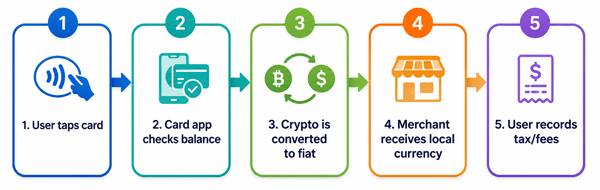
Diagram: Typical crypto debit card payment flow. In most card transactions, the merchant receives fiat currency while the provider handles crypto conversion.
Mastercard describes crypto cards as products where crypto and fiat are converted outside the payment network before settlement, because most merchants still price and receive payment in local currency. Its Crypto Card Program says these cards can support everyday transactions across large card acceptance networks. [1][2]
Some newer wallet-linked cards claim to keep funds in self-custody until payment. For example, MetaMask Card says users maintain self-custody until the moment they pay and can spend where Mastercard is accepted, subject to availability and terms. [3] Product details change, so always check the current card terms before applying.
3. Crypto Debit Cards vs Crypto Payments vs Normal Debit Cards
| Feature | Crypto debit card | Direct crypto payment | Normal debit card |
|---|---|---|---|
| What funds it | Crypto balance, stablecoin balance, or converted fiat balance | Crypto sent from wallet to merchant wallet | Bank account or prepaid fiat balance |
| What merchant usually receives | Fiat currency through card rails | Crypto, stablecoin, or converted crypto via processor | Fiat currency |
| Beginner ease | High, if the provider is reputable and available | Medium to low; wallet mistakes can be costly | High |
| Tax complexity | Can be high if each purchase disposes of crypto | Can be high for the same reason | Usually low for ordinary spending |
| Refund process | May follow card-provider rules; crypto price changes can matter | Depends on merchant and blockchain transaction details | Standard card/bank process |
| Best use case | Spending crypto value with card convenience | Paying crypto-native merchants, cross-border settlement, Web3 use | Everyday spending from bank money |
4. Types of Crypto Cards and Payment Products
4.1 Custodial exchange cards
These cards are issued through a centralized crypto exchange or financial app. You keep assets in the platform account, select a funding asset, and spend through the card. They are easy for beginners, but you rely heavily on the provider for custody, compliance, uptime, customer support, and account access.
4.2 Self-custody wallet cards
These are connected to a wallet where you control your keys until a transaction occurs. They may appeal to users who prefer not to hold a large balance on an exchange. However, the product still depends on partners for card issuing, compliance, conversion, and settlement.
4.3 Stablecoin cards
These cards are funded mainly by stablecoins such as USDC or USDT. They can reduce price-volatility risk compared with spending Bitcoin or Ether, but they still carry stablecoin, issuer, platform, and regulatory risk.
4.4 Crypto rewards cards
Some cards spend fiat but pay rewards in crypto. These are different from crypto debit cards. The spending may be ordinary card spending, while the reward is a small crypto purchase or allocation. Rewards can fall in value and may have tax implications.
4.5 Merchant crypto payment processors
Businesses can use crypto payment processors to accept crypto or stablecoins at checkout. The processor may settle to the merchant in fiat or crypto. This is not the same as a consumer crypto debit card, but both are part of crypto payments.
5. Practical Examples
5.1 Buying coffee with Bitcoin
Sara bought $100 of Bitcoin months ago. That Bitcoin is now worth $160. She uses a crypto debit card to buy a $5 coffee. The card provider sells a small amount of her Bitcoin to cover the $5 purchase plus any fees. In many tax systems, this is treated as disposing of crypto. Sara may need to calculate gain or loss on the portion of Bitcoin sold.
5.2 Spending stablecoins while traveling
Ali holds USDC and travels abroad. His card converts USDC into the local currency at checkout. This can be convenient if his bank card has high international fees. However, he still needs to compare the card provider’s exchange rate, crypto conversion spread, ATM fees, foreign transaction fees, and local card acceptance.
5.3 Freelancer receiving crypto and using a card
A freelancer receives payment in crypto and uses a card for business expenses. This may create two separate recordkeeping needs: income received at fair market value and later gains or losses when the crypto is spent or converted. For business users, accounting discipline is especially important.
5.4 Refund after crypto price changes
Nadia buys a $300 item using a crypto card. A week later she returns it. The merchant may refund $300 in fiat value to the card account, but the amount of crypto originally sold may not be restored. If the crypto price moved sharply, the refund may not feel identical to reversing the original crypto transaction.
6. Benefits of Crypto Debit Cards
- Convenience: You can spend crypto value without manually selling it first.
- Wider acceptance: Card-network payments can work at many merchants that do not directly accept crypto.
- Travel flexibility: Some cards support multiple currencies or international spending, subject to fees and availability.
- Faster access to crypto value: Users can move from crypto balance to spending power quickly.
- Budget separation: A dedicated card can separate crypto-funded spending from a main bank account.
- Potential rewards: Some providers offer cashback or crypto rewards, though these should not be treated as guaranteed profit.
7. Risks, Costs, and Limitations
7.1 Taxable events and recordkeeping
For U.S. federal tax purposes, the IRS treats digital assets as property, not currency. The IRS says taxpayers should answer Yes to the digital asset question when they dispose of digital assets in exchange for property, goods, or services, and it tells taxpayers to keep records of purchases, receipts, sales, exchanges, dispositions, and fair market values. [4] The IRS FAQs also state that paying for services with digital assets can create capital gain or loss. [5]
Tax rules vary by country, but the practical lesson is universal: do not assume small card purchases are tax-free or record-free. Keep transaction history and speak with a qualified tax professional in your jurisdiction.
7.2 Fees and hidden spreads
A crypto card can have several cost layers: crypto conversion spread, network fees, ATM fees, foreign exchange markup, monthly fees, inactivity fees, card replacement fees, and withdrawal limits. A card advertising “no fee” may still make money through the exchange rate or spread.
7.3 Price volatility
If you spend volatile crypto, your purchasing power can change quickly. A $100 crypto balance can become $80 or $120 before you use it. Stablecoins may reduce this issue, but stablecoins are not risk-free.
7.4 Custody and platform risk
If your card depends on a centralized exchange or app, you face account freezes, compliance reviews, outages, insolvency risk, cyberattacks, and customer support delays. Do not keep more value on a card platform than you can afford to have temporarily inaccessible.
7.5 Regulatory and country availability risk
Crypto card availability changes by country because issuers, banks, and networks must follow local laws. A card available today may pause services, change supported assets, or stop accepting new users in a region.
7.6 Refunds, disputes, and chargebacks
Card purchases may offer familiar dispute processes, but crypto conversion adds complexity. Refunds may come back as fiat value, card balance, or crypto equivalent depending on provider rules. Blockchain payments sent directly to a merchant are usually irreversible unless the merchant voluntarily refunds you.
7.7 Security and scams
Crypto cards combine normal card fraud risks with crypto-specific risks. Phishing, SIM swaps, fake support agents, malicious wallet approvals, and seed phrase theft can all lead to losses. A legitimate card provider will not ask for your seed phrase.
| Risk | What can go wrong | Best practice |
|---|---|---|
| Tax reporting | Every crypto-funded purchase may create a recordkeeping burden | Export monthly statements and transaction CSVs; track cost basis |
| Conversion costs | Small spreads can erase rewards | Compare total cost, not only headline fees |
| Volatility | Crypto value drops before or during spending | Use stable balances for near-term spending if suitable |
| Custody | Account frozen or provider fails | Keep only a planned spending amount on the platform |
| Fraud | Card details, app login, or wallet compromised | Use 2FA, card freeze, spending limits, and separate wallets |
| Availability | Card not supported in your country or merchant category | Check region, KYC, limits, excluded merchants, and travel rules |
8. How to Choose a Crypto Debit Card
Do not choose a crypto debit card only because it has a famous brand, high rewards, or a slick app. Compare the parts that affect real use.
- Check availability in your country and whether the provider is properly registered or partnered with regulated entities where required.
- Confirm which assets are supported, including whether stablecoins are available.
- Read the fee schedule, including conversion spread, ATM fees, foreign exchange fees, monthly fees, and card replacement fees.
- Understand custody. Ask whether funds are held by an exchange, issuer, wallet contract, bank partner, or self-custody wallet until payment.
- Review spending limits, ATM limits, merchant category restrictions, and geographic restrictions.
- Check tax reporting exports. A provider that offers clean CSV exports can save hours later.
- Test with a small transaction before relying on it for travel, bills, or emergencies.
- Read recent user complaints and support policies, but treat social media claims carefully because experiences vary by region.
9. Best Practices for Safe Everyday Use
- Use a separate spending wallet or account. Do not connect your life savings to a spending card.
- Keep only the amount you plan to spend soon. Treat the card balance like a hot wallet.
- Prefer stable, liquid assets for near-term spending if your goal is payment, not investment exposure.
- Turn on strong security: app-based 2FA, biometric login, card freeze, transaction alerts, and withdrawal allowlists where available.
- Never share your seed phrase, private keys, one-time codes, or remote access to your device.
- Download monthly statements and transaction exports before closing accounts or changing providers.
- Track cost basis if your jurisdiction taxes crypto disposals.
- Read the provider’s terms for refunds, disputes, chargebacks, ATM withdrawals, and account closures.
- Have a backup payment method when traveling. Crypto cards can fail because of issuer rules, local restrictions, connectivity, or compliance checks.
- Avoid using crypto cards for high-risk merchants, large one-off purchases, or situations where a refund may be likely unless you understand the rules.
10. Common Mistakes Beginners Make
| Mistake | Why it matters | Better approach |
|---|---|---|
| Assuming the merchant receives crypto | Most card purchases settle to merchants in fiat | Understand whether you are using a card payment or direct blockchain payment |
| Ignoring taxes | Small purchases can create many disposal records | Keep records from day one |
| Chasing rewards | Rewards may be outweighed by fees, spreads, or token price drops | Calculate net value after all costs |
| Keeping too much on the card | Card platforms and hot wallets carry operational risk | Hold only planned spending money |
| Not reading limits | ATM, country, merchant, and daily limits can block transactions | Review limits before travel or large purchases |
| Trusting fake support | Scammers impersonate exchanges and wallet teams | Use official app or website support only |
11. Misconceptions About Crypto Debit Cards
Misconception 1: “A crypto card lets every store accept Bitcoin.” Not exactly. In many cases the store receives local currency through normal card rails, while your provider handles conversion.
Misconception 2: “Stablecoin spending has no risk.” Stablecoins can reduce price volatility, but they still depend on issuer reserves, redemption rules, blockchain networks, smart contracts, regulation, and platform custody.
Misconception 3: “No annual fee means free.” A provider can charge through spreads, exchange rates, ATM fees, card issuance fees, or reward conditions.
Misconception 4: “Using a crypto card is private.” Card payments usually involve KYC, transaction monitoring, merchant data, and compliance checks. They are generally less private than using cash.
Misconception 5: “Crypto rewards are guaranteed profit.” Rewards can be reduced, capped, delayed, taxed, or paid in a token that falls in value.
12. For Merchants: Should You Accept Crypto Payments?
A merchant does not need to directly accept crypto just because customers use crypto debit cards. If a customer pays with a crypto card, the merchant may simply receive a normal card payment. Direct crypto acceptance is a different business decision.
Merchants considering direct crypto payments should evaluate settlement currency, accounting, refunds, fraud policies, volatility, tax reporting, customer demand, and integration complexity. Some payment processors can settle crypto payments into fiat to reduce volatility. Others allow merchants to keep crypto, which adds treasury and compliance responsibilities.
13. Simple Decision Framework
A crypto debit card may make sense if:
- You already hold crypto and want limited, controlled spending access.
- You understand the tax and recordkeeping obligations in your country.
- The total fees are lower than your alternatives for the specific use case.
- You are comfortable with the provider’s custody model, limits, and support quality.
A crypto debit card may not make sense if:
- You do not want to track gains, losses, or transaction records.
- You plan to spend volatile crypto needed for long-term investment goals.
- You need guaranteed access to funds for emergencies.
- The card is not clearly supported in your country or has vague terms.
- The rewards are the only reason you are interested.
14. Beginner Checklist Before Applying
- What company issues the card, and who holds the funds?
- Is the card available and compliant in my country?
- Which crypto assets can I spend?
- Is crypto converted at purchase, before purchase, or manually by me?
- What is the exact fee schedule and conversion spread?
- Are there daily, monthly, ATM, merchant category, or country limits?
- How do refunds and disputes work?
- Can I export transaction history for tax reporting?
- What happens if the provider freezes my account or exits my region?
- Do I have a backup card or bank account?
15. Frequently Asked Questions
15.1 Are crypto debit cards legal?
They can be legal where offered by properly authorized providers, but availability depends on local law, issuer rules, and compliance requirements. Always check your country and the provider’s current terms.
15.2 Do crypto debit cards improve my credit score?
Usually no. A debit card spends existing funds and normally does not report borrowing activity to credit bureaus. Crypto credit cards or secured credit products are different.
15.3 Can I withdraw cash from an ATM?
Some crypto debit cards allow ATM withdrawals, but limits and fees can be high. The withdrawal may also involve crypto conversion and tax records.
15.4 Is using a crypto card anonymous?
No. Most card products require identity verification and create transaction records. Card networks, issuers, apps, and merchants may process personal and transaction data.
15.5 What is the best crypto to spend?
For short-term spending, many users prefer stablecoins because they reduce price swings. However, stablecoins still have risks. The best choice depends on fees, availability, tax treatment, and your risk tolerance.
15.6 Do I pay tax when I use a crypto debit card?
Possibly. In the U.S., disposing of digital assets for goods or services can create gain or loss. Other countries have their own rules. Keep records and get local tax advice.
15.7 Can a crypto card be declined?
Yes. It can be declined for insufficient balance, unsupported merchant category, geographic restrictions, compliance checks, network issues, card limits, or provider outages.
15.8 Are crypto card rewards worth it?
Sometimes, but only after fees, spreads, caps, token price risk, and taxes. A 2% reward can be meaningless if conversion costs and volatility are higher.
15.9 What happens if I lose the card?
Freeze it immediately in the provider app if available, contact support, and review recent transactions. Also secure your email, phone number, and wallet accounts.
15.10 Should beginners use crypto debit cards?
Beginners can use them carefully for small amounts after understanding fees, custody, taxes, and security. They are not a replacement for basic financial planning or a safe place to store large crypto holdings.
16. Final Thoughts
Crypto debit cards are useful because they connect digital assets with everyday payment systems. They can make crypto easier to spend, especially when merchants do not directly accept blockchain payments. But the convenience comes with trade-offs: taxes, fees, conversion spreads, custody risk, volatility, regional restrictions, and security responsibilities.
The safest way to think about a crypto debit card is as a spending tool, not a savings account and not an investment strategy. Use small balances, understand the fee and tax consequences, keep records, and maintain backup payment options. When used carefully, crypto cards can be practical. When used casually without understanding the details, they can become expensive and risky.
Sources Consulted and Checked
The following sources were consulted and checked while preparing this document to support accuracy and clarity.
- Mastercard - What is a crypto card? (2026)
- Mastercard - Crypto Card Program
- MetaMask Card product page
- IRS - Digital assets
- IRS - Frequently asked questions on digital asset transactions
- IRS - Frequently asked questions on virtual currency transactions
- IRS - Final regulations and related guidance for broker reporting on digital assets
- Revolut - Crypto Card terms and tax notice example
- Stripe - Crypto cards: what businesses need to know
Reader Advice
This article is provided for educational and informational purposes only and is not personalized financial, tax, legal, investment, or regulatory advice or a recommendation to use any crypto card, asset, platform, or payment service. Crypto payments can involve price volatility, fees, tax consequences, fraud, custody or provider failure, account restrictions, and possible loss of funds. Laws, rules, policies, product availability, fees, and statistics can change over time and vary by country or region. Before making a decision, verify current details through official sources and the provider’s latest terms, assess whether the risks suit your circumstances, and seek qualified professional advice where appropriate.