Common Budgeting Mistakes to Avoid and How to Fix Them
A personal budget is not just a spreadsheet, app, or list of expenses. It is a simple plan for how your income will be used before it disappears. A good budget helps you pay bills on time, reduce money stress, save for future goals, avoid unnecessary debt, and make better everyday decisions. You will also find quick fixes, beginner-friendly budgeting examples, a checklist, and answers to common questions people search before creating a monthly budget.
But many people give up on budgeting because the first version of their budget does not work. They may forget irregular bills, set unrealistic spending limits, ignore small purchases, or treat a budget like a strict punishment. The problem is often not budgeting itself. The problem is the way the budget is built and used.
This guide explains the most common budgeting mistakes to avoid when managing your money. It is written for beginners, so every idea is explained in simple language with practical examples you can apply right away. In simple terms, a budgeting mistake is anything that makes your monthly budget less honest, less useful, or harder to repeat.
1. What Is a Budgeting Mistake?
A budgeting mistake is any habit, assumption, or planning error that makes your budget inaccurate, unrealistic, or difficult to follow. Some mistakes are obvious, such as spending more than you earn. Others are less obvious, such as forgetting annual insurance premiums, budgeting from gross income instead of take-home pay, or not adjusting your plan when life changes.
A budget should help you make decisions. If it constantly makes you feel confused, guilty, restricted, or behind, it may need to be improved rather than abandoned.
2. Quick Summary: Common Budgeting Mistakes and Fixes
| Budgeting mistake | Why it causes problems | Better approach |
|---|---|---|
| Budgeting from gross income | You plan with money you never actually receive after taxes and deductions. | Use take-home pay only. |
| Forgetting irregular expenses | Annual, seasonal, and occasional bills create surprise shortfalls. | Turn irregular costs into monthly sinking funds. |
| Making the budget too strict | Extreme cuts are hard to maintain and often lead to giving up. | Use realistic limits and leave room for small enjoyment. |
| Not tracking spending | You cannot fix what you cannot see. | Review spending weekly or at least monthly. |
| Ignoring debt payments | Debt grows through interest and late fees. | List minimums, due dates, and a payoff strategy. |
| No emergency fund | Unexpected costs force you back into debt. | Start with a small starter fund, then build gradually. |
| Copying someone else's budget | Different incomes, families, cities, debts, and goals require different plans. | Use examples as guides, not rules. |
| Never reviewing the budget | Your plan becomes outdated as income, prices, and priorities change. | Adjust the budget every month. |
| Budgeting without a clear goal | Without a goal, the budget can feel like restriction instead of progress. | Link each category to a purpose, such as bills, debt payoff, emergency savings, or planned fun. |
Mistake 1: Budgeting Based on Gross Income Instead of Take-Home Pay
Gross income is the amount you earn before taxes, insurance, retirement contributions, and other deductions. Take-home pay is the amount that actually reaches your bank account. Beginners often build a budget from gross income because it looks larger and easier to divide. This creates a budget that looks good on paper but fails in real life.
How to avoid it
- Check your payslip or bank deposit amount.
- Use your net monthly income as the starting point.
- If your income varies, use a conservative average based on recent months.
Example: If your salary is $4,000 per month but your take-home pay is $3,250, your budget must be built around $3,250. Planning around $4,000 creates a $750 gap before the month even begins.
Mistake 2: Not Knowing Where Your Money Is Actually Going
Many people estimate their spending from memory. This usually leads to underestimating categories like eating out, subscriptions, snacks, delivery fees, transportation, and impulse purchases. A budget based on guesses is more like a wish list than a money plan.
How to avoid it
- Look at your last 30 to 90 days of bank and card transactions.
- Group spending into simple categories such as housing, food, transport, debt, savings, bills, and personal spending.
- Circle categories where spending is higher than expected.
Practical tip: You do not need to track every penny forever. Even two or three months of honest tracking can reveal patterns that make your budget much more accurate. This is especially useful for finding hidden budget leaks and choosing realistic monthly spending limits.
Mistake 3: Forgetting Irregular and Non-Monthly Expenses
Some expenses do not happen every month, but they still happen. Examples include car registration, school fees, holiday gifts, insurance premiums, home repairs, medical visits, travel, birthdays, and annual subscriptions. If you do not plan for them, they feel like emergencies even when they are predictable.
How to avoid it
- Make a list of yearly and occasional expenses.
- Estimate the annual cost of each one.
- Divide each annual cost by 12 and save that amount monthly.
Example: If your annual car insurance is $720, save $60 each month. When the bill arrives, the money is already waiting. This type of planned saving is often called a sinking fund.
Mistake 4: Making the Budget Too Strict
A strict budget may feel responsible at first, but it can become exhausting. If your budget removes every small pleasure, gives no room for mistakes, and assumes perfect discipline, it is unlikely to last. A realistic budget is better than a perfect budget you abandon after one week.
How to avoid it
- Keep a small personal spending category.
- Plan for occasional treats instead of pretending you will never want them.
- Use flexible ranges for variable expenses like groceries and fuel.
A good budget should create control, not constant pressure. The goal is progress, not punishment.
Mistake 5: Treating Savings as Optional Leftover Money
Many beginners plan to save whatever is left at the end of the month. The problem is that money often gets spent when it has no clear job. Saving works better when it is treated like a planned expense.
How to avoid it
- Choose a specific savings goal.
- Move savings soon after income arrives.
- Start small if needed, even with a modest amount.
Example: Instead of saying, 'I will save if I can,' set a line item such as 'Emergency fund: $100.' This makes saving intentional.
Mistake 6: Ignoring Small Purchases
Small purchases can quietly damage a budget because they feel harmless individually. Coffee, snacks, app purchases, delivery fees, convenience store stops, and online add-ons may not seem important one by one, but they can become a large monthly amount.
How to avoid it
- Create a category for small personal spending.
- Set a weekly limit for convenience purchases.
- Use cash, a prepaid card, or a separate account if small spending is hard to control.
The goal is not to shame yourself for small purchases. The goal is to see the total and decide whether that money matches your priorities.
Mistake 7: Not Having an Emergency Fund
Without an emergency fund, one surprise expense can break the whole budget. A car repair, medical bill, urgent trip, or temporary income drop can force you to rely on credit cards, loans, or unpaid bills.
How to avoid it
- Start with a small starter emergency fund.
- Keep emergency money separate from everyday spending money.
- Use it for true unexpected needs, not normal monthly wants.
Beginner goal: Start with a small starter emergency fund you can actually reach, then work toward one month of essential expenses. Over time, many households try to build three to six months of essential expenses, but the right target depends on income stability, family needs, debt, and local costs.
Mistake 8: Failing to Separate Needs, Wants, and Goals
Budgeting becomes confusing when every expense feels equally important. Separating needs, wants, and goals helps you make better trade-offs. Needs keep your life running. Wants improve comfort and enjoyment. Goals move your future forward.
How to avoid it
- Needs: rent, basic groceries, utilities, transport, insurance, minimum debt payments.
- Wants: dining out, entertainment, upgrades, hobbies, non-essential shopping.
- Goals: emergency fund, debt payoff, retirement, education, home deposit, travel savings.
This separation does not mean wants are bad. It simply helps you decide what to reduce first when money is tight.
Mistake 9: Copying a Budget Rule Without Adjusting It
Budgeting rules like 50/30/20 can be helpful starting points, but they are not perfect for every situation. A person with high rent, variable income, large debt, or a low income may need a different structure.
How to avoid it
- Use budgeting rules as templates, not strict laws.
- Adjust categories based on your real income, fixed costs, debts, family size, and goals.
- Review whether the rule helps you make progress.
For example, someone paying off high-interest debt may temporarily put more than 20% toward debt repayment and emergency savings, while someone with very high rent may need a different balance until income or expenses change.
Mistake 10: Ignoring Debt Interest and Due Dates
Debt payments are not all the same. A loan with a high interest rate can cost much more over time than a low-interest loan. Missing due dates can also lead to fees, penalty rates, and stress.
How to avoid it
- List each debt with balance, minimum payment, due date, and interest rate.
- Pay all minimums on time.
- Then choose a payoff method, such as focusing on the highest-interest debt first or the smallest balance first.
The highest-interest method can save more money mathematically. The smallest-balance method can build motivation because you see debts disappear faster. These methods are often called the debt avalanche and debt snowball approaches.
Mistake 11: Not Planning for Lifestyle Creep
Lifestyle creep happens when spending rises automatically as income rises. A pay raise can disappear into bigger subscriptions, more eating out, more shopping, a more expensive car, or upgraded habits before you notice any real progress.
How to avoid it
- When income increases, decide in advance where the extra money will go.
- Split raises between savings, debt payoff, and some enjoyment.
- Avoid committing every raise to new fixed monthly expenses.
A useful rule is to upgrade your financial goals before upgrading your lifestyle.
Mistake 12: Using Too Many Budget Categories
Some people create a category for everything: coffee, lunches, groceries, snacks, toiletries, hobbies, streaming, clothing, gifts, apps, and more. Too much detail can make budgeting feel like homework. Other people use categories that are too broad and miss important patterns.
How to avoid it
- Use enough categories to guide decisions, but not so many that you avoid the budget.
- Start with 8 to 12 main categories.
- Add subcategories only where you need more control.
Beginner-friendly categories include housing, utilities, food, transport, insurance, debt, savings, personal spending, family expenses, giving, and irregular bills. If you are self-employed, also keep separate categories for taxes and business expenses.
Mistake 13: Not Involving Your Partner or Household
If you share money responsibilities with a spouse, partner, family member, or roommate, budgeting alone can create conflict. One person may follow the plan while the other spends without knowing the limits or priorities.
How to avoid it
- Discuss bills, goals, and responsibilities clearly.
- Agree on shared categories and personal spending amounts.
- Schedule a short monthly money check-in.
The goal is not to control another person. The goal is to make sure everyone understands the plan and has a voice in it.
Mistake 14: Forgetting to Budget for Fun
A budget with no room for fun often fails because people eventually feel deprived. Entertainment, hobbies, eating out, small gifts, and personal treats can be included responsibly when they are planned.
How to avoid it
- Create a realistic fun-money category.
- Decide the amount before the month begins.
- Enjoy it without guilt once bills, savings, and priorities are covered.
Budgeting is not about never spending. It is about spending on purpose.
Mistake 15: Not Reviewing and Adjusting the Budget
Your first budget will not be perfect. Prices change, income changes, goals change, and unexpected expenses happen. A budget should be reviewed regularly so it stays useful.
How to avoid it
- Review your budget weekly for 10 minutes.
- Do a deeper monthly review before the next month starts.
- Move money between categories when needed instead of pretending the plan is still accurate.
A budget is a living plan. Adjusting it is not failure; it is how budgeting works.
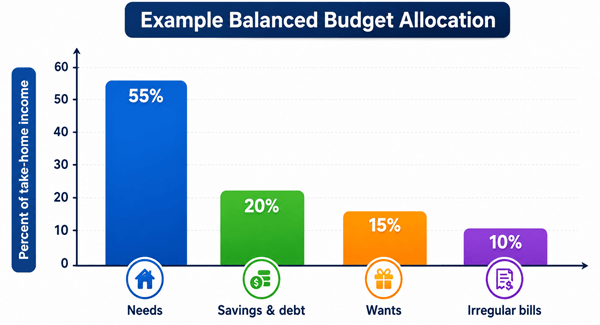
■ Simple Chart: A Balanced Budget Is Flexible, Not Perfect
The chart below shows one example of how a household might divide take-home income. It is not a rule for everyone. It is a visual reminder that a good budget usually includes essentials, savings or debt repayment, wants, and irregular expenses. Adjust the percentages for your location, family size, income level, debt, and short-term goals.
3. Simple Budgeting Flow Diagram
| Step | Question to ask | Result |
|---|---|---|
| 1. Income | How much money actually comes in after deductions? | Know your true monthly starting point. |
| 2. Essentials | What must be paid to keep life running? | Cover housing, food, transport, utilities, and basic insurance. |
| 3. Debt and savings | What needs to protect my future? | Pay minimums, save for emergencies, and fund goals. |
| 4. Wants | What can I enjoy without hurting priorities? | Set realistic personal and entertainment limits. |
| 5. Review | What changed this month? | Adjust before problems grow. |
4. Why Budgets Fail Even When People Have Good Intentions
Most budgets fail for practical reasons, not because people are lazy or bad with money. A beginner may be trying to control a complex financial life with a plan that is too simple, too strict, or based on incomplete information.
- The budget ignores real spending habits.
- The budget does not include irregular expenses.
- The person tries to change too many habits at once.
- The budget is reviewed only after money is already gone.
- The plan is based on guilt instead of clear priorities.
- Income is irregular, but the budget assumes the same amount every month.
A better approach is to treat your budget like a feedback system. Build a plan, test it, review what happened, and improve it next month. This makes the article’s core advice simple: do not chase a perfect budget; build a budget you can review, correct, and use consistently.
5. Budgeting Mistakes for Different Life Situations
| Situation | Common mistake | Practical fix |
|---|---|---|
| Low income | Trying to copy a budget designed for higher income households. | Focus first on essentials, assistance options, debt protection, and small emergency savings. |
| Irregular income | Budgeting from the best month instead of an average or low month. | Use a conservative baseline and save extra income during high months. |
| Student budget | Ignoring small daily expenses and semester costs. | Track food, transport, books, fees, and social spending separately. |
| Family budget | Not planning for school, healthcare, childcare, clothing, and seasonal costs. | Create family sinking funds for predictable but uneven expenses. |
| Freelancer budget | Forgetting taxes, unpaid time, and business expenses. | Separate business and personal money and set aside tax money from every payment. |
| Debt payoff | Paying extra randomly without a clear method. | Choose a payoff strategy and automate minimum payments. |
| High inflation or rising prices | Keeping last year's grocery, rent, or fuel numbers without checking current prices. | Update flexible categories monthly and protect essentials before increasing wants. |
| New job or pay raise | Letting extra income disappear into lifestyle creep. | Assign the increase to savings, debt payoff, and a small planned reward before spending it. |
■ How to Fix a Budget That Is Not Working
If your budget keeps failing, do not assume budgeting is not for you. Use this troubleshooting process.
- Compare your planned spending with actual spending for the last month.
- Identify the top two categories where you overspent.
- Ask whether the category was unrealistic, forgotten, or affected by a one-time event.
- Reduce one lower-priority category instead of cutting everything at once.
- Create sinking funds for expenses that surprised you.
- Set reminders for due dates and automate important payments where possible.
- Review again next month and make another small improvement.
■ Example: Fixing a Beginner Budget
Imagine Sara takes home $3,000 per month. Her first budget looks like this:
| Category | Original plan | Actual spending | Problem |
|---|---|---|---|
| Rent and utilities | $1,200 | $1,220 | Close enough; minor utility difference. |
| Groceries | $350 | $520 | Plan was too low for real food costs. |
| Eating out | $50 | $210 | Underestimated convenience spending. |
| Savings | $300 | $0 | Savings was treated as leftover money. |
| Car expenses | $150 | $420 | Forgot maintenance and registration. |
| Subscriptions | $20 | $75 | Did not review automatic payments. |
A better second-month budget might increase groceries, reduce eating out, cancel unused subscriptions, create a car sinking fund, and move savings right after payday. The improved budget is not stricter. It is more honest. This is a good example of realistic budgeting: the numbers improve because they match real life, not because every category was cut aggressively.
6. Pros and Cons of Budgeting
| Pros | Cons or limitations | How to handle the limitation |
|---|---|---|
| Helps you see where money goes. | Tracking can feel boring at first. | Use simple categories and review weekly. |
| Reduces surprise bills. | Irregular expenses require planning. | Use sinking funds. |
| Supports saving and debt payoff. | Progress may feel slow in the beginning. | Set small milestones and celebrate progress. |
| Improves decision-making. | A budget can feel restrictive if too strict. | Include realistic personal spending. |
| Can reduce money stress. | Unexpected events can still happen. | Build an emergency fund gradually. |
7. Best Practices for Avoiding Budgeting Mistakes
- Use take-home income, not gross income.
- Review the last few months of real spending before creating limits.
- Create a line item for savings instead of waiting for leftovers.
- Plan for irregular bills with monthly sinking funds.
- Keep categories simple enough to maintain.
- Review your budget before the month starts and again during the month.
- Use automation for important bills and savings when it helps.
- Leave room for small enjoyment so the budget is sustainable.
- Adjust the budget when circumstances change.
- Focus on progress over perfection.
- Check subscriptions and automatic payments at least every few months.
- Keep receipts or notes for cash spending so it does not disappear from the budget.
8. Budgeting Mistakes Checklist
| Question | Yes/No |
|---|---|
| Am I using take-home income instead of gross income? | |
| Have I reviewed my real spending from recent months? | |
| Have I included irregular expenses such as annual bills and repairs? | |
| Do I have a savings line item? | |
| Do I know all debt balances, minimum payments, and due dates? | |
| Is my budget realistic enough to follow? | |
| Have I included a small amount for personal enjoyment? | |
| Do I review and adjust my budget monthly? | |
| Do I have a plan for emergencies? | |
| Does my budget match my current life, income, and goals? |
■ Frequently Asked Questions
1. What is the biggest budgeting mistake beginners make?
The biggest mistake is creating a budget from guesses instead of real numbers. Before setting limits, review actual income, bills, debt payments, and spending patterns. A realistic budget is easier to follow than an idealized budget.
2. Why do I keep going over budget?
You may be underestimating variable expenses, forgetting irregular costs, making the budget too strict, or not tracking spending during the month. Compare planned spending with actual spending to find the exact cause.
3. Should I stop budgeting if my income is irregular?
No. Irregular income makes budgeting more important. Use a conservative baseline income, prioritize essentials first, and save extra income during higher earning months to cover lower earning months.
4. How many budget categories should I have?
Most beginners do well with 8 to 12 main categories. Too few categories can hide problems, while too many can make budgeting stressful and hard to maintain.
5. Is it bad to spend money on wants?
No. Wants are not bad when they fit within your income and priorities. A sustainable budget usually includes some planned fun or personal spending.
6. How often should I review my budget?
Review spending briefly once a week and do a deeper review once a month. Monthly reviews help you adjust for changing income, prices, goals, and upcoming expenses.
7. What should I do if I overspend?
Do not quit the budget. Look at which category went over, move money from a lower-priority category if possible, and adjust next month’s budget based on what you learned.
8. Do budgeting apps solve budgeting mistakes?
Apps can help with tracking and organization, but they do not make decisions for you. You still need realistic categories, clear priorities, regular reviews, and discipline.
9. What is a sinking fund?
A sinking fund is money saved gradually for a known future expense. For example, if holiday spending usually costs $600 per year, saving $50 per month creates a sinking fund for that expense.
10. Can a budget help me get out of debt?
Yes, a budget can help you make payments on time, avoid new debt, and choose how much extra money to put toward debt repayment. The budget should include all minimum payments and a clear payoff strategy.
11. What is the easiest budgeting method for beginners?
The easiest method is usually the one you will actually use. Some beginners prefer a simple zero-based budget, some prefer the 50/30/20 guideline, and others prefer envelopes or separate accounts. Start with the method that makes your spending easiest to see and review.
12. What should I include in a monthly budget?
A monthly budget should include take-home income, fixed bills, variable spending, minimum debt payments, savings goals, irregular expenses, and a small amount for personal spending. This keeps the budget practical instead of overly strict.
■ Final Thoughts: The Best Budget Is the One You Can Actually Use
Budgeting mistakes are common, especially when you are learning. The most important thing is not to create a perfect budget. The most important thing is to create a useful budget that reflects your real income, real expenses, real goals, and real life.
Start simple. Track honestly. Plan for irregular costs. Save intentionally. Review regularly. When your budget does not work, improve it instead of giving up. Over time, these small corrections can help you build more control, confidence, and financial stability.
Reader Advice: This article is for educational and informational purposes only and should not be taken as personal financial, legal, or tax advice. Please check the latest information from official sources or a qualified professional, as rules, products, fees, and policies can change over time.