Budgeting for Beginners: How to Create a Budget and Save Money
Budgeting is one of the most useful personal finance skills a beginner can learn. It helps you understand where your money goes, plan for upcoming expenses, reduce money stress, avoid unnecessary debt, and make steady progress toward savings goals.
A budget is not a punishment or a list of things you are no longer allowed to enjoy. A good budget is simply a plan for your money. It tells each dollar where to go before it disappears on random spending. When done well, budgeting gives you more control, not less freedom.
This guide explains budgeting in simple language, shows different budgeting methods, provides examples, and gives practical best practices you can use even if you have never made a budget before.
1. What Is Budgeting?
Budgeting is the process of planning how you will use your income over a specific period, usually one month. It compares the money coming in with the money going out, then helps you decide how much to spend, save, invest, and use for debt repayment.
In simple terms, budgeting answers three questions:
- How much money do I earn?
- Where does my money go?
- What should I change so my money supports my goals?
A personal budget can be written on paper, built in a spreadsheet, managed through a budgeting app, or tracked in a notebook. The tool matters less than consistency.
2. How Budgeting Works
Budgeting works by turning your income and expenses into a clear plan. You list your income, estimate or track your expenses, separate needs from wants, assign money to priorities, and review the results regularly.
- Calculate your monthly income after taxes.
- List fixed expenses such as rent, loan payments, insurance, and subscriptions.
- Estimate variable expenses such as groceries, fuel, transport, dining out, and personal spending.
- Set money aside for savings, emergency funds, and debt payments.
- Compare your planned budget with your actual spending at the end of the month.
- Adjust the next month’s budget based on what you learned.
The first budget is rarely perfect. That is normal. A budget improves as you learn your real spending patterns.
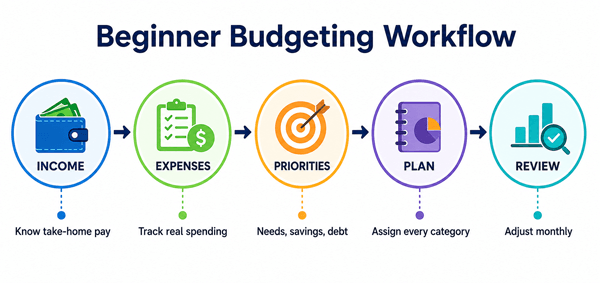
Figure: A simple budgeting workflow for beginners. Repeat the review step every month so the budget becomes more accurate over time.
3. Why Beginners Should Start Budgeting Early
Budgeting becomes easier when you start before money problems become serious. It helps you see small leaks in your finances before they turn into large problems.
| Benefit | How It Helps in Real Life |
|---|---|
| Better control | You know what you can afford before spending. |
| Less stress | Bills and savings goals become easier to plan. |
| Debt prevention | You are less likely to rely on credit cards or loans for normal expenses. |
| Faster savings | You can save intentionally instead of hoping money is left over. |
| Smarter decisions | You can compare choices using numbers, not guesses. |
| Long-term wealth building | Budgeting creates room for saving, investing, and debt reduction. |
4. Budgeting Terms Every Beginner Should Know
| Term | Simple Meaning | Example |
|---|---|---|
| Income | Money you receive | Salary, freelance income, business income, allowance |
| Fixed expense | A cost that stays mostly the same | Rent, loan payment, insurance premium |
| Variable expense | A cost that changes month to month | Groceries, fuel, electricity, dining out |
| Needs | Essential expenses | Housing, food, transport, medicine |
| Wants | Non-essential spending | Entertainment, upgrades, takeout meals |
| Savings | Money kept for future use | Emergency fund, home deposit, travel fund |
| Debt payment | Money used to repay borrowed money | Credit card, personal loan, student loan |
| Cash flow | The movement of money in and out | Income minus spending |
5. Step-by-Step Guide: How to Create a Budget for the First Time
Step 1: Know Your Take-Home Income
Start with the money you actually receive after taxes and mandatory deductions. This is your take-home income, not your gross salary. If your income changes each month, use a conservative average based on your lower-income months.
Example: If you earn $3,000 after taxes, your budget should be built around $3,000, not your pre-tax salary.
Step 2: List Your Fixed Expenses
Fixed expenses are usually easier to list because they repeat regularly. Include rent or mortgage, insurance, debt payments, internet, phone bill, subscriptions, school fees, and other regular commitments.
Step 3: Track Variable Expenses
Variable expenses are often where budgets fail because people underestimate them. Track food, transport, fuel, electricity, clothing, gifts, personal care, entertainment, and small daily purchases.
A beginner-friendly way to track spending is to review bank statements for the last 30 to 90 days and group spending into categories.
For better accuracy, include cash spending, digital wallet payments, buy-now-pay-later purchases, and small app subscriptions, because these are easy to miss when reviewing only one account.
Step 4: Separate Needs, Wants, Savings, and Debt
Not every expense has the same importance. Housing, groceries, medicine, and basic transport are needs. Streaming services, luxury upgrades, and frequent dining out are wants. Savings and debt payments should be treated as planned priorities, not leftovers.
Step 5: Choose a Budgeting Method
A budgeting method gives structure to your plan. Beginners often do best with a simple method they can follow consistently. The best method is the one that fits your income pattern, personality, and financial goals.
Step 6: Set Realistic Spending Limits
A budget should challenge you without becoming impossible. If you currently spend $600 a month on groceries, setting a goal of $250 may fail quickly. A more realistic first target might be $525, then gradually improving.
This makes the article more useful for real life: beginners usually succeed faster with gradual reductions, clear category limits, and a small buffer for mistakes.
Step 7: Review and Adjust Every Month
Your budget is a living plan. Prices change, income changes, and unexpected costs happen. Review your budget at the end of each month and ask what worked, what failed, and what needs to change.
6. Example Monthly Budget for a Beginner
The example below uses a monthly take-home income of $3,000. You can adjust the amounts based on your own income, country, family size, and priorities.
| Category | Planned Amount | Notes |
|---|---|---|
| Housing | $900 | Rent or mortgage and basic housing costs |
| Utilities | $200 | Electricity, water, gas, internet |
| Groceries | $400 | Food at home and basic household supplies |
| Transport | $250 | Fuel, public transport, maintenance |
| Insurance/Medical | $200 | Insurance premiums, medicine, routine care |
| Debt payments | $250 | Minimums plus extra if possible |
| Savings/Emergency fund | $300 | Pay yourself first |
| Personal and family spending | $250 | Clothing, personal care, small gifts |
| Entertainment/wants | $150 | Dining out, subscriptions, hobbies |
| Buffer/miscellaneous | $100 | Small surprises |
| Total | $3,000 | Income fully assigned |
This budget is only an example. A person living in a high-rent city may spend more on housing. A person with no debt may put more toward savings. A family with children may need a larger grocery and medical budget.
Use percentages as a starting point, but always adjust the budget for local prices, family size, debt obligations, healthcare needs, and transportation costs.
7. Popular Budgeting Methods for Beginners
There is no single perfect budget for everyone. Below are the most common budgeting methods and when each one works best.
| Budgeting Method | How It Works | Best For | Possible Limitation |
|---|---|---|---|
| 50/30/20 budget | 50% needs, 30% wants, 20% savings and debt repayment | Beginners who want a simple framework | May not fit low income, high debt, or high housing costs |
| Zero-based budget | Every dollar is assigned a job until income minus planned spending equals zero | People who want detailed control | Requires more tracking and discipline |
| Envelope system | Money is divided into spending categories, traditionally using cash envelopes | People who overspend in certain categories | Less convenient for digital payments |
| Pay-yourself-first budget | Savings are taken out first, then the rest is used for expenses | People focused on saving and investing | Can fail if basic expenses are not planned |
| Reverse budgeting | Start with goals first, then build spending around them | Goal-driven savers | Needs realistic goal amounts |
| Values-based budget | Spending is aligned with what matters most to you | People who dislike restrictive budgets | Requires honest reflection and regular review |
8. The 50/30/20 Budget Rule Explained
The 50/30/20 rule is one of the easiest budgeting methods for beginners. It divides after-tax income into three broad groups:
- 50% for needs: housing, groceries, utilities, transport, insurance, and basic bills.
- 30% for wants: entertainment, dining out, hobbies, upgrades, and lifestyle spending.
- 20% for savings and debt repayment: emergency fund, retirement savings, extra debt payments, and other goals.
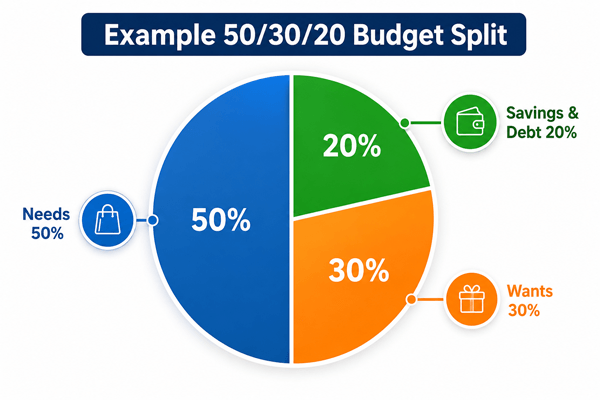
Figure: Example 50/30/20 budget split. Use it as a starting point, not a strict rule.
For a $3,000 monthly income, this method would suggest about $1,500 for needs, $900 for wants, and $600 for savings and debt repayment. If your needs are much higher than 50%, do not feel like you failed. Use the rule as a guide and adjust based on real life.9. Zero-Based Budgeting Explained
Zero-based budgeting means every dollar of income is given a purpose. The goal is: income minus expenses, savings, and debt payments equals zero. This does not mean you spend all your money. It means every dollar is planned.
Example: If you earn $3,000, you might assign $2,400 to expenses, $300 to savings, $200 to debt, and $100 to a buffer. Your remaining unassigned money is zero because everything has a job.
This method is useful if you often wonder where your money went. It creates strong awareness, but it can feel detailed for beginners. Start with broad categories, then add detail later.
To keep zero-based budgeting simple, create one small miscellaneous or buffer category so minor surprises do not break the whole plan.
10. Envelope Budgeting Explained
The envelope method divides money into categories such as groceries, transport, dining out, and clothing. Traditionally, people used physical envelopes with cash. Today, you can use separate bank accounts, prepaid cards, digital wallets, or app categories.
If your dining-out envelope has $100 for the month and you spend it by the 20th, you stop dining out until the next month. This method works well for people who struggle with impulse spending because the limit is visible.
11. Best Budgeting Method: Which One Should You Choose?
| Your Situation | Recommended Method | Why |
|---|---|---|
| You are brand new to budgeting | 50/30/20 budget | Simple categories make it easy to start. |
| You overspend often | Envelope system | Category limits are clearer and harder to ignore. |
| You have irregular income | Zero-based budget with a priority list | Helps you fund essentials first. |
| You want to save more | Pay-yourself-first budget | Savings happen before spending. |
| You have debt | Zero-based or debt-focused budget | Extra money can be directed toward repayment. |
| You dislike strict tracking | Values-based budget | Focuses on intentional choices, not perfection. |
12. How to Budget with Irregular Income
Irregular income is common for freelancers, business owners, commission-based workers, seasonal workers, and gig workers. Budgeting is still possible, but you need a more careful approach.
- Calculate your average monthly income from the last 6 to 12 months.
- Identify your lowest realistic monthly income and build a basic budget around that number.
- Create a priority list: food, housing, utilities, transport, insurance, debt minimums, then savings and wants.
- Keep a larger emergency fund because income may change from month to month.
- During high-income months, save extra instead of increasing lifestyle spending immediately.
For irregular income, the goal is stability. A separate “income buffer” account can help you pay yourself a steady monthly amount even when earnings fluctuate.
During higher-income months, first refill the income buffer, then fund emergency savings, taxes if applicable, annual bills, and debt repayment before increasing optional spending.
13. How to Budget When Money Is Tight
Budgeting can feel frustrating when income barely covers basic expenses. In that situation, the budget is not there to judge you. It is there to show what is possible and what needs attention.
- Start with essentials: food, housing, utilities, basic transport, and necessary medicine.
- Pay minimum debt payments if possible to avoid fees and credit damage.
- Pause or reduce non-essential subscriptions and lifestyle expenses.
- Look for bill negotiation, cheaper providers, shared transport, or meal planning opportunities.
- Consider income improvements such as overtime, side work, better job applications, or skills training.
- Use community support, benefits, or nonprofit advice if available and appropriate.
When money is very tight, cutting small costs may not be enough. The budget may reveal that income needs to increase, major expenses need to change, or debt needs professional help.
In urgent situations, prioritize food, safe housing, utilities, essential transport, and necessary medicine before unsecured debt or optional expenses.
14. Needs vs Wants: A Beginner-Friendly Way to Decide
One of the hardest parts of budgeting is deciding what is truly necessary. A need supports basic living, safety, work, health, or important responsibilities. A want improves comfort, convenience, status, or enjoyment.
| Expense | Need, Want, or Both? | Why |
|---|---|---|
| Groceries | Need | Basic food is essential. |
| Restaurant meals | Want | Convenient and enjoyable, but usually not essential. |
| Basic phone plan | Need | May be needed for work, family, and safety. |
| Latest phone upgrade | Want | Useful but often not necessary. |
| Rent | Need | Housing is essential. |
| Luxury apartment upgrade | Want or lifestyle choice | May improve comfort but can limit savings. |
| Transport to work | Need | Supports income and daily responsibilities. |
| Frequent ride-hailing for convenience | Want or mixed | Useful sometimes, costly if habitual. |
Some expenses can be both. Internet may be a need for work or study, while the most expensive package may be a want. Budgeting is about honest choices, not shame.
15. How Much Should You Save in Your Budget?
A common beginner goal is to save at least 10% to 20% of income, but the right amount depends on your situation. If you are behind on bills or dealing with high-interest debt, start small. Even a small automatic transfer builds the habit.
Useful savings goals include:
- A starter emergency fund for small surprises.
- A larger emergency fund that can cover several months of essential expenses.
- Short-term goals such as school fees, car repairs, travel, or moving costs.
- Long-term goals such as retirement, a home deposit, or financial independence.
The most important rule is to save before spending whenever possible. If savings only happen with leftover money, they often do not happen at all.
A starter emergency fund can be small at first; the goal is to create breathing room before building toward several months of essential expenses.
16. Budgeting and Debt Repayment
A budget is powerful for debt repayment because it shows how much extra money can go toward balances after essentials are covered. Always understand interest rates, minimum payments, due dates, and fees.
| Debt Strategy | How It Works | Good For | Trade-Off |
|---|---|---|---|
| Debt snowball | Pay extra on the smallest debt first while paying minimums on others | Motivation and quick wins | May cost more interest than avalanche |
| Debt avalanche | Pay extra on the highest-interest debt first | Saving the most interest | May take longer to feel progress |
| Debt consolidation | Combine debts into one payment, often at a lower rate | Simplifying payments | Can be risky if spending habits do not change |
| Balance transfer | Move card debt to a lower or 0% promotional rate | Short-term interest savings | Fees and deadlines matter |
For many beginners, the snowball method feels easier because early wins build confidence. The avalanche method is mathematically stronger when interest rates are high. Choose the method you can actually follow.
Before using consolidation or balance transfers, check fees, deadlines, interest rates after promotions, and whether the new payment is truly affordable.
17. Practical Budgeting Best Practices
- Use take-home income, not gross income.
- Track real spending before setting strict limits.
- Automate savings and essential bills when possible.
- Create a small buffer category for unexpected expenses.
- Review subscriptions every few months.
- Plan for irregular expenses such as gifts, repairs, school costs, insurance, and annual fees.
- Keep categories simple at first.
- Use separate accounts or envelopes for money you should not spend.
- Review your budget weekly for the first three months.
- Make your budget realistic enough to repeat.
- Add sinking funds for predictable but irregular costs such as annual insurance, school fees, holidays, repairs, and renewals.
- Use calendar reminders for bill due dates so the budget prevents late fees as well as overspending.
- Review large categories first, because rent, transport, food, and debt payments usually affect the budget more than tiny purchases.
18. Common Budgeting Mistakes Beginners Should Avoid
| Mistake | Why It Hurts | Better Approach |
|---|---|---|
| Making the budget too strict | You may quit quickly when life happens | Leave room for small wants and surprises |
| Ignoring small purchases | Small daily spending can become large monthly spending | Track coffee, snacks, delivery fees, and app purchases |
| Forgetting irregular expenses | Annual or seasonal bills feel like emergencies | Create sinking funds for predictable costs |
| Using unrealistic income numbers | The budget depends on money that may not arrive | Use take-home income or a conservative estimate |
| Not involving your partner or family | Conflicting spending habits can break the plan | Agree on shared goals and spending limits |
| Not reviewing the budget | You cannot improve what you do not check | Review weekly or monthly |
| Treating budgeting as punishment | Creates guilt and resistance | Budget for priorities and reasonable enjoyment |
19. Budgeting Tools: Paper, Spreadsheet, or App?
The best budgeting tool is the one you will use consistently. Beginners do not need complicated software. Start simple, then upgrade if needed.
Also consider privacy, cost, bank-sync permissions, export options, and whether the tool works in your country or with your bank.
| Tool | Pros | Cons | Best For |
|---|---|---|---|
| Notebook or paper | Simple, private, no technology needed | Manual tracking takes time | People who like writing things down |
| Spreadsheet | Flexible, customizable, good for analysis | Needs basic spreadsheet comfort | People who want control and detail |
| Budgeting app | Convenient, may sync transactions | May cost money or require data sharing | People who prefer automation |
| Banking categories | Already connected to spending | Categories may be limited or inaccurate | Basic tracking and quick reviews |
| Cash envelopes | Very visible limits | Less useful for online payments | Impulse spending control |
20. Simple Monthly Budgeting Checklist
- Record your take-home income.
- List bills and due dates.
- Estimate variable expenses.
- Set savings and debt goals.
- Assign money to each category.
- Track spending during the month.
- Review results at month-end.
- Adjust categories for next month.
- Celebrate progress, even if it is small.
21. Beginner Budget Template
Use this simple template as a starting point. Replace the example categories with your own numbers.
| Budget Category | Planned Amount | Actual Amount | Difference |
|---|---|---|---|
| Income | |||
| Housing | |||
| Utilities | |||
| Groceries | |||
| Transport | |||
| Insurance/Medical | |||
| Debt Payments | |||
| Savings | |||
| Personal Spending | |||
| Entertainment/Wants | |||
| Miscellaneous/Buffer | |||
| Total |
22. Mini Case Study: How Budgeting Changes Decisions
Sara earns $2,500 a month after taxes. She often feels broke before the month ends. After reviewing her spending, she notices $220 on food delivery, $90 on unused subscriptions, and $160 on impulse shopping. She does not cut everything. Instead, she reduces food delivery to $100, cancels $50 of subscriptions, and limits impulse shopping to $75.
This frees up $245 per month. She puts $150 toward an emergency fund and $95 toward credit card debt. After one year, if she stays consistent, she has redirected $2,940 toward better financial goals without completely removing enjoyment from her life.
23. Budgeting Myths and Misconceptions
| Myth | Reality |
|---|---|
| Budgeting is only for people with money problems. | Budgeting is useful at every income level because it improves decision-making. |
| A budget means you cannot enjoy life. | A realistic budget includes planned enjoyment. |
| Budgeting must be perfect. | A useful budget is more important than a perfect one. |
| Small expenses do not matter. | Small repeated expenses can quietly reduce savings. |
| High income removes the need for budgeting. | People can overspend at any income level if money is not managed intentionally. |
24. How to Stick to a Budget
Sticking to a budget is mostly about habits and systems, not willpower alone. Make the right action easy and the wrong action harder.
- Set automatic transfers to savings on payday.
- Use separate accounts for bills, spending, and savings.
- Check your budget before making non-essential purchases.
- Use a 24-hour rule for impulse purchases.
- Keep a small fun-money category to avoid feeling deprived.
- Review progress with a partner, friend, or accountability system.
- Adjust the plan instead of quitting after one bad week.
25. When Should You Change Your Budget?
Change your budget whenever your life changes. A budget that worked six months ago may not fit your current income, family needs, debt, or goals.
- Your income increases or decreases.
- Rent, utilities, school fees, or transport costs change.
- You take on new debt or pay off old debt.
- You get married, have a child, move, or change jobs.
- You start a new savings goal.
- Your budget repeatedly fails in the same category.
26. What Makes a Budget Successful?
A successful budget is realistic, clear, flexible, and connected to your goals. It should help you make better choices, not make you feel guilty every time you spend money.
The best budget usually has four qualities:
- It is based on real income and real expenses.
- It includes savings and debt repayment as planned categories.
- It leaves room for normal life and occasional surprises.
- It is reviewed and improved regularly.
27. Final Thoughts: Start Simple and Improve Over Time
Budgeting for beginners does not need to be complicated. Start by knowing your income, tracking your expenses, choosing a simple method, and reviewing your progress each month. Your first budget may be imperfect, but it will still teach you more than guessing.
The goal is not to control every penny forever. The goal is to build awareness, reduce waste, protect yourself from financial stress, and create room for the things that matter most: stability, freedom, savings, debt reduction, and long-term wealth.
Start small, stay consistent, and let the budget become a flexible decision-making system rather than a strict rulebook.
■ FAQs About Budgeting for Beginners
1. What is the best budgeting method for beginners?
The 50/30/20 budget is often the easiest starting point because it uses broad categories. However, if you overspend often, the envelope system may work better. If you want detailed control, try zero-based budgeting.
2. How often should I review my budget?
Review your budget weekly when you are starting. Once you are comfortable, a monthly review may be enough. Always review after major income or expense changes.
3. What should I do if I go over budget?
Do not quit. Check why it happened, reduce spending in another category if possible, and adjust next month’s budget. One bad week does not mean the whole plan failed.
4. Should I budget if I have debt?
Yes. Budgeting helps you pay essentials, avoid new debt, and find extra money for repayment. It also helps you choose a debt strategy such as snowball or avalanche.
5. How much should I spend on rent or housing?
There is no perfect number for everyone. Many people use housing guidelines as a starting point, but your real budget should consider income, debt, transport, family needs, and local costs.
6. Can I budget with cash only?
Yes. Cash budgeting can work well, especially with the envelope system. Just make sure you still track bills, savings, and digital payments.
7. Do budgeting apps really help?
They can help if you use them regularly. Apps are useful for tracking and reminders, but they cannot make decisions for you. A simple spreadsheet or notebook can also work.
8. What is a sinking fund?
A sinking fund is money saved gradually for a known future expense, such as car repairs, school fees, holidays, insurance, or annual subscriptions.
9. Why does my budget fail every month?
Common reasons include unrealistic limits, forgotten expenses, irregular income, emotional spending, or not reviewing the budget. Start by tracking actual spending for one full month.
10. Is budgeting the same as saving money?
No. Budgeting is the plan for all your money. Saving money is one part of that plan.
11. What is the easiest way to start budgeting today?
Write down your take-home income, list your essential bills, estimate food and transport, choose one savings goal, and track every purchase for the next 30 days. This simple start is enough to reveal your real spending pattern.
12. What is the difference between a budget and a spending plan?
They are often used in the same way. Some people prefer the phrase spending plan because it sounds more flexible and goal-focused than budget. The purpose is the same: decide where your money should go before it is spent.
Reader Advice: This article is for educational and informational purposes only and should not be taken as personal financial, legal, tax, or investment advice. Please check the latest information from official sources or a qualified professional, as rules, policies, prices, and financial products can change over time.