Best Budgeting Methods: Simple Ways to Save Money and Control Spending
Budgeting is one of the most useful personal finance skills because it turns your income into a plan. A good budget helps you decide where your money should go before it disappears into bills, shopping, subscriptions, debt payments, and small daily expenses.
The best budgeting method is not the one that looks perfect on paper. It is the one you can actually follow. Some people need a simple spending rule. Others need a detailed plan for every rupee or dollar. Some prefer cash envelopes, while others want automatic saving and investing before they spend anything.
This guide explains the most popular budgeting methods in plain English, shows how each method works, compares their strengths and limitations, and helps you choose the right approach for your income, habits, and financial goals. It is written for beginners searching for practical budgeting methods, personal budgeting tips, ways to save money, and simple systems for managing monthly income.
1. What Is a Budgeting Method?
A budgeting method is a system for organizing your income, expenses, savings, debt payments, and financial goals. It gives you rules for deciding how much to spend, save, invest, or use for debt repayment.
Without a method, budgeting can feel like guessing. You may track expenses for a few days, feel motivated, and then stop when life becomes busy. A method gives your budget structure, which makes it easier to repeat every month.
For example, one method may tell you to divide your income into needs, wants, and savings. Another may ask you to assign every unit of income to a specific job. Another may ask you to save first and spend only what remains. The right method also helps you compare choices, avoid impulse spending, and review your money habits without feeling overwhelmed.
2. Why Budgeting Methods Matter in Personal Finance
Personal finance is not only about earning more money. It is also about managing the money you already have. A budgeting method helps you make better decisions before emotions, pressure, and habits take over.
A clear budget can help you avoid overspending, reduce financial stress, prepare for emergencies, pay down debt, save for goals, and build wealth over time. It also helps you see trade-offs. If you spend more in one area, you may need to spend less somewhere else.
The right method also reduces decision fatigue. Instead of asking, “Can I afford this?” every time you want to buy something, your budget gives you a clear answer. This is especially helpful when prices rise, income changes, or financial responsibilities increase.
Best Budgeting Methods at a Glance
Use this table as a quick comparison before reading the detailed explanations below.
| Budgeting Method | Best For | How It Works | Difficulty | Main Limitation |
|---|---|---|---|---|
| 50/30/20 budget | Beginners who want a simple rule | Split after-tax income into needs, wants, and savings/debt repayment | Easy | May be too broad for high debt or low income |
| Zero-based budgeting | People who want detailed control | Give every unit of income a specific purpose before the month begins | Moderate | Requires regular tracking and review |
| Envelope budgeting | Overspenders and cash-focused households | Set category limits using cash envelopes or digital envelopes | Moderate | Can feel restrictive or harder with online payments |
| Pay-yourself-first budget | Saving, investing, and wealth building | Automatically save or invest first, then spend what remains | Easy | Does not control each spending category by itself |
| Reverse budgeting | People with clear financial goals | Start with goals, automate contributions, then manage remaining spending | Easy to moderate | Needs realistic goal amounts |
| Line-item budget | Families, irregular expenses, and detail lovers | List each income and expense category separately | Moderate | Can become too detailed if overdone |
| Priority-based budget | People with limited income or changing circumstances | Rank expenses by importance and fund essentials first | Easy to moderate | Requires honest choices and trade-offs |
| No-budget budget | People with stable income and strong discipline | Automate bills and savings, then monitor account balances | Easy | Risky for people who overspend or have variable income |
Chart: Budgeting Methods by Setup Effort and Spending Control
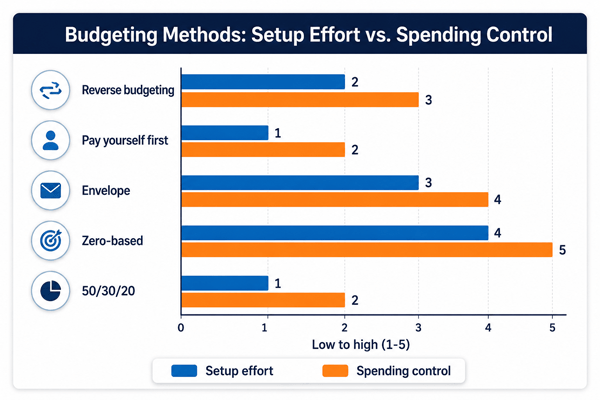
This chart is a practical guide, not a strict rule. A method that gives more control usually requires more attention and tracking.
1. The 50/30/20 Budget Method
The 50/30/20 budget is one of the easiest budgeting methods for beginners. It divides your after-tax income into three broad categories: 50% for needs, 30% for wants, and 20% for savings and debt repayment.
Needs include essentials such as rent, utilities, groceries, transport, insurance, and minimum debt payments. Wants include dining out, entertainment, non-essential shopping, hobbies, and lifestyle upgrades. Savings and debt repayment include emergency fund contributions, retirement savings, investments, and extra debt payments.
Example: If your monthly take-home income is 100,000, the 50/30/20 rule would suggest 50,000 for needs, 30,000 for wants, and 20,000 for savings and extra debt repayment. If your essential costs are already above 50%, treat the rule as a flexible starting point rather than a strict rule.
Pros
- Very easy to understand
- Flexible enough for most beginners
- Helps balance living today with saving for tomorrow
Cons
- May not work if basic living costs are more than 50% of income
- May be too loose for people with serious overspending habits
- Does not give detailed category limits
Best for: beginners, people with stable income, and anyone who wants a simple personal budget without tracking every small expense.
2. Zero-Based Budgeting
Zero-based budgeting means every unit of income is assigned a job before the month begins. At the end of your plan, income minus planned expenses, savings, and debt payments should equal zero. This does not mean you spend everything. It means every amount has a purpose.
For example, if your income is 100,000, you may assign 40,000 to rent, 15,000 to groceries, 10,000 to transport, 8,000 to utilities, 12,000 to debt payments, 10,000 to savings, and 5,000 to personal spending. Nothing is left unplanned.
This method is powerful because it forces you to be intentional. It is especially useful if you often wonder where your money went.
Pros
- Gives strong control over money
- Useful for paying off debt and managing tight budgets
- Works well with budgeting apps or spreadsheets
Cons
- Takes more time than simple methods
- Needs regular updates when expenses change
- Can feel frustrating if you aim for perfection
Best for: people who want detailed control, households with debt, variable expenses, or a strong need to stop money leaks.
3. Envelope Budgeting System
Envelope budgeting divides your spending money into separate categories such as groceries, transport, dining out, clothing, and entertainment. Traditionally, people used physical cash envelopes. Today, the same idea can be used with separate bank accounts, prepaid cards, or budgeting apps.
The rule is simple: when an envelope is empty, spending in that category stops until the next budget period. This creates a clear limit and makes overspending more visible.
Example: You set aside 12,000 for groceries, 6,000 for dining out, and 5,000 for personal shopping. If the dining-out envelope is empty by the 20th of the month, you stop eating out or move money from another envelope after making a conscious decision.
Pros
- Makes spending limits very clear
- Excellent for controlling impulse purchases
- Works well for categories that often get out of hand
Cons
- Physical cash can be inconvenient or unsafe
- Digital envelope systems require discipline
- May feel restrictive for people who dislike detailed limits
Best for: overspenders, beginners who need visible limits, families managing household categories, and people trying to control discretionary spending.
4. Pay-Yourself-First Budget
The pay-yourself-first method means you save or invest before spending on anything non-essential. Instead of waiting to see what is left at the end of the month, you treat saving as the first bill you pay.
This method works well because it uses automation and removes the temptation to spend money that should be saved. You can set automatic transfers to an emergency fund, investment account, retirement account, or debt repayment plan right after your income arrives.
Example: You receive 100,000 per month. On payday, 15,000 automatically goes to savings and 5,000 goes to extra debt repayment. You then manage bills and lifestyle spending with the remaining 80,000.
Pros
- Simple and powerful for building savings
- Encourages long-term wealth habits
- Works well with automation
Cons
- Does not tell you exactly how to manage the remaining spending
- Can cause cash-flow problems if savings targets are unrealistic
- Needs a separate plan for irregular expenses
Best for: people focused on saving, investing, emergency funds, retirement planning, or building long-term wealth.
5. Reverse Budgeting
Reverse budgeting is similar to pay-yourself-first budgeting, but it begins with specific goals. You decide your financial priorities first, automate money toward those goals, and then spend what remains responsibly.
For example, your goals may be building a three-month emergency fund, saving for a home down payment, paying off credit card debt, or investing for retirement. You calculate the monthly amount needed for those goals and build your budget around them.
This method is useful because it connects budgeting to motivation. You are not just cutting expenses; you are funding something meaningful.
Pros
- Goal-focused and motivating
- Simple once goals are clear
- Encourages automatic progress
Cons
- Can fail if goals are too aggressive
- Less useful for people who need category-by-category control
- Requires regular review when income or goals change
Best for: people who already know their main financial goals and want a simple system that prioritizes progress.
6. Line-Item Budgeting
A line-item budget lists each income source and each expense category separately. It may include rent, electricity, groceries, school fees, insurance, subscriptions, fuel, repairs, gifts, medical expenses, savings, and debt payments.
This method is common because it is easy to understand and can be built in a notebook, spreadsheet, or budgeting app. It gives more detail than the 50/30/20 method but does not require every unit of income to be assigned as strictly as zero-based budgeting.
Line-item budgeting is helpful for families and anyone with many recurring expenses. It is also useful for spotting forgotten costs such as annual subscriptions, vehicle maintenance, or seasonal school expenses.
Pros
- Clear and practical
- Good for families and households
- Makes hidden expenses easier to see
Cons
- Can become too complicated with too many categories
- Needs updating when prices change
- May focus too much on tracking and not enough on goals
Best for: families, people with many bills, and anyone who likes a clear monthly expense list.
7. Priority-Based Budgeting
Priority-based budgeting starts by ranking expenses from most important to least important. Essentials such as housing, food, utilities, transport to work, insurance, and minimum debt payments come first. Then you fund savings, debt payoff, and lifestyle spending based on what remains.
This method is especially useful when income is limited, irregular, or temporarily reduced. It helps you protect the most important areas before spending on lower-priority wants.
For example, if income is lower than expected this month, you may fully cover rent, groceries, utilities, and transport first. Then you reduce dining out, shopping, entertainment, or non-urgent upgrades.
Pros
- Useful during financial stress
- Helps prevent missed essential payments
- Encourages realistic trade-offs
Cons
- Can feel uncomfortable because it requires hard choices
- May not be detailed enough for long-term planning by itself
- Needs honest separation of needs and wants
Best for: irregular income, low-income months, financial recovery, job loss periods, and anyone trying to protect essentials first.
8. The No-Budget Budget
The no-budget budget is a very simple system. You automate savings and bills, avoid debt, and spend the rest as long as you do not overdraw your account or miss goals. It is called a no-budget budget because it avoids detailed category tracking.
This method can work for people with stable income, low debt, strong spending discipline, and already-funded emergency savings. It is not ideal for beginners who do not yet know where their money goes.
A safer version is to combine it with weekly account check-ins and spending alerts. That way, you keep the system simple without ignoring your finances.
Pros
- Very simple and low-maintenance
- Good for people who dislike detailed tracking
- Works well when savings are automated
Cons
- Risky for overspenders
- Not ideal for variable income or high debt
- Can hide lifestyle inflation
Best for: disciplined spenders with stable income, automated savings, and a healthy emergency fund.
Simple Diagram: How to Choose a Budgeting Method
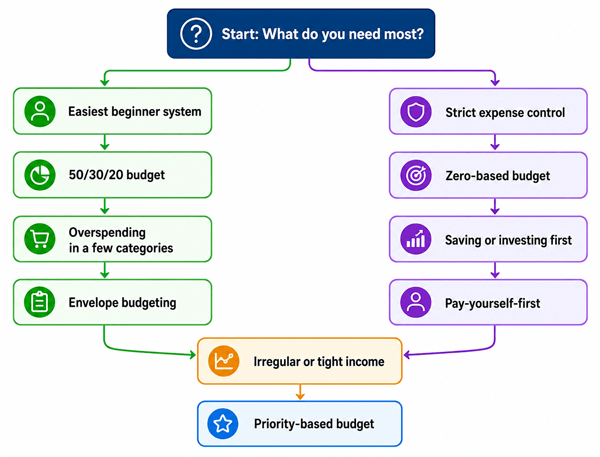
Use this diagram as a quick decision path. You can still combine methods if your situation needs more than one approach.
3. Which Budgeting Method Should You Choose?
The right method depends on your financial situation, not on what is popular. Use the table below as a practical shortcut.
| Your Situation | Recommended Method | Why It Fits |
|---|---|---|
| You are new to budgeting | 50/30/20 budget | Simple categories make it easier to start without feeling overwhelmed. |
| You keep overspending | Envelope budgeting or zero-based budgeting | Both methods create clear limits and make spending more visible. |
| You have debt to pay off | Zero-based budgeting | It helps you direct extra money toward debt instead of losing it to unplanned spending. |
| You want to save more | Pay-yourself-first or reverse budgeting | Savings happen automatically before lifestyle spending. |
| Your income changes each month | Priority-based budgeting plus zero-based planning | You can fund essentials first and adjust categories as income changes. |
| You dislike tracking every purchase | Pay-yourself-first or no-budget budget | Automation reduces daily effort while still supporting goals. |
| You manage a family budget | Line-item budget or envelope budgeting | Detailed household categories help everyone understand spending limits. |
How to Set Up Any Budgeting Method Step by Step
- 1. Calculate your take-home income. Use the amount that actually reaches your bank account after taxes and payroll deductions.
- 2. List fixed expenses. Include rent or mortgage, insurance, subscriptions, school fees, loan payments, and other predictable bills.
- 3. Estimate variable expenses. Include groceries, utilities, fuel, transport, dining out, clothing, personal care, and medical costs.
- 4. Separate needs, wants, savings, and debt payments. This makes your spending easier to understand.
- 5. Choose one budgeting method. Start with one system instead of mixing too many rules at once.
- 6. Set realistic spending limits. A budget that is too strict usually fails quickly.
- 7. Track progress weekly. A short weekly review is better than waiting until the month is over.
- 8. Adjust at the end of the month. Improve your budget based on real numbers, not guesses.
4. Practical Example: Choosing a Budget Method for a Beginner
Suppose Sara earns 120,000 per month after tax. She pays 45,000 for rent, 18,000 for groceries, 10,000 for transport, 12,000 for utilities and phone, 8,000 for minimum debt payments, and wants to build an emergency fund.
If Sara wants simplicity, she can use the 50/30/20 budget. But if she often overspends on dining out and shopping, envelope budgeting may help her set firm limits. If paying off debt quickly is her biggest goal, zero-based budgeting may be better because she can assign every extra amount toward debt repayment.
| Category | Amount | Budgeting Lesson |
|---|---|---|
| Needs | 85,000 | Needs are high, so a strict 50% target may not be realistic immediately. |
| Minimum debt payments | 8,000 | Debt must be included before lifestyle spending. |
| Emergency savings | 10,000 | A pay-yourself-first transfer can make saving automatic. |
| Wants and flexible spending | 17,000 | Envelope limits can prevent overspending in this area. |
Best choice for Sara: a hybrid approach. She can use pay-yourself-first for emergency savings, envelope budgeting for flexible spending, and a simple line-item budget for bills. A hybrid is fine as long as it is easy to maintain.
Common Budgeting Mistakes to Avoid
Choosing a method that is too complicated
A detailed budget is not helpful if you avoid updating it. Start simple and add detail only when needed.
Forgetting irregular expenses
Annual insurance, repairs, gifts, school costs, medical bills, and holidays can break a budget if you do not plan for them.
Being too strict
A budget with no room for enjoyment often fails. Include realistic personal spending.
Confusing tracking with budgeting
Tracking shows where money went. Budgeting decides where money should go before you spend it.
Not reviewing the budget
Prices, income, and priorities change. Review your budget at least once a month.
Ignoring small expenses
Small daily purchases can become large monthly amounts. Watch repeated habits, not just big bills.
Best Practices for Making Any Budget Work
- Use realistic numbers from recent bank statements instead of guessing.
- Automate savings and bill payments where possible.
- Keep categories simple at first; too many categories can create confusion.
- Build a small emergency fund before aggressively upgrading your lifestyle.
- Review spending weekly for 10 to 15 minutes.
- Use separate accounts or envelopes for money that must not be spent casually.
- Plan for fun money so your budget feels sustainable.
- Treat the first three months as practice. Your budget will improve with real data.
Can You Combine Budgeting Methods?
Yes. Many people get the best results by combining methods. For example, you can use the 50/30/20 budget as a broad framework, pay yourself first for savings, and use envelopes for problem categories such as dining out or shopping.
The key is to keep the system simple enough to use. A good hybrid budget should answer three questions clearly: How much must go to essentials? How much goes to goals? How much can I spend freely?
Tools You Can Use for Budgeting
| Tool | Best Use | Pros | Watch Out For |
|---|---|---|---|
| Notebook | Simple written budget | Low cost and easy to start | Manual tracking can be slow |
| Spreadsheet | Custom line-item or zero-based budget | Flexible and detailed | Requires setup and consistency |
| Budgeting app | Tracking and digital envelopes | Convenient and automated | May cost money or require bank access |
| Separate bank accounts | Bills, savings, and spending separation | Reduces accidental spending | Too many accounts can become confusing |
| Cash envelopes | Controlling problem spending categories | Very visible limits | Less convenient for online payments |
FAQs About Budgeting Methods
1. What is the best budgeting method for beginners?
The 50/30/20 budget is usually the best starting point because it is simple and easy to understand. Beginners who need more control may prefer zero-based budgeting or envelope budgeting.
2. Which budgeting method is best for saving money?
The pay-yourself-first method is often best for saving because it moves money into savings before you spend. Reverse budgeting is also useful when you have specific goals.
3. Which budgeting method is best for debt repayment?
Zero-based budgeting is often best for debt repayment because it helps you find extra money and assign it directly to debt. A priority-based budget can also help when income is tight.
4. Is the 50/30/20 rule realistic?
It can be realistic for some people, but not everyone. If housing, food, transport, or debt payments are high, needs may exceed 50% of income. In that case, use the rule as a guideline, not a strict requirement.
5. How often should I review my budget?
A quick weekly review helps you stay on track, while a monthly review helps you adjust categories for the next month.
6. Should I use a budgeting app or spreadsheet?
Use the tool you will actually maintain. Apps are convenient for automation, while spreadsheets are flexible and transparent. A notebook can also work well for a simple budget.
7. What if my income is irregular?
Use priority-based budgeting and build your budget around essentials first. When income is higher, save more for low-income months. A zero-based plan can also help you assign each payment when it arrives.
8. Can I budget without tracking every expense?
Yes, but only if savings and bills are automated and you have strong spending discipline. If you regularly overspend, tracking is important until your habits improve.
■ Final Thoughts: The Best Budget Is the One You Can Keep Using
The best budgeting methods for personal finance all have the same goal: helping you use your money with intention. The 50/30/20 budget is simple, zero-based budgeting gives strong control, envelope budgeting helps stop overspending, and pay-yourself-first budgeting supports saving and wealth building.
Do not wait for the perfect system. Choose one method, use it for one month, review what worked, and adjust. Budgeting is not about restriction or guilt. It is about making your money support your real life, your responsibilities, and your future goals.
Reader Advice: This article is for educational and informational purposes only and should not be taken as personal financial, legal, tax, or investment advice. Please check the latest information from official sources and consider a qualified professional because rules, policies, and personal circumstances can change over time.