Zero-Based Budgeting: Complete Guide with Examples, Benefits & Template
Zero-based budgeting is a budgeting method where you plan how every dollar of income will be used before the month begins. The goal is not to spend every dollar. The goal is to give every dollar a clear purpose, whether that purpose is rent, groceries, savings, debt repayment, investing, or fun money.
In simple terms, it is a plan-before-you-spend approach that helps turn income into clear categories instead of leaving money unassigned.
For beginners, zero-based budgeting can feel strict at first. But when used well, it is one of the clearest ways to understand where your money is going and how to make your spending match your priorities. This guide explains what zero-based budgeting means, how it works, who should use it, its benefits and limitations, and practical examples you can copy.
Because budgeting decisions can affect financial stability, use the examples below as general education and adjust them to your income, expenses, location, taxes, debt terms, and personal goals.
Quick Answer: What Is Zero-Based Budgeting?
Zero-based budgeting means your planned income minus your planned expenses, savings, debt payments, and giving equals zero.
| Formula | Meaning |
|---|---|
| Income - planned spending - savings - debt payments = 0 | Every dollar is assigned to a category before it is spent. |
Example: If your monthly take-home pay is $3,000, your budget should assign the full $3,000 across needs, wants, savings, debt, and other goals. At the end of the plan, there should be no unassigned money left.
Diagram: Simple Zero-Based Budgeting Flow
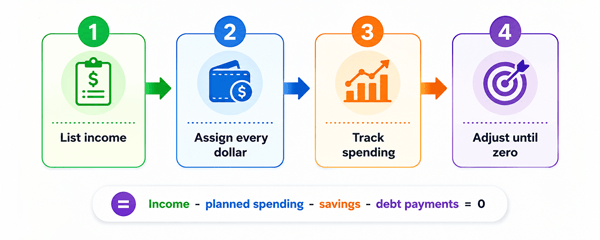
| Step 1 | Step 2 | Step 3 | Step 4 |
|---|---|---|---|
| List income | Assign every dollar | Track spending | Adjust until balance equals zero |
■ How Zero-Based Budgeting Works
Zero-based budgeting starts from zero every budgeting period, usually each month. Instead of copying last month’s spending and hoping it works, you decide what your income needs to do this month.
- Estimate your monthly take-home income. Use the money you actually expect to receive after taxes and deductions.
- List fixed expenses. These are costs that usually stay the same, such as rent, insurance, loan payments, and subscriptions.
- Estimate variable expenses. These change from month to month, such as groceries, fuel, electricity, medical costs, and dining out.
- Add savings and debt goals. Treat savings, emergency funds, investing, and extra debt payments as planned categories, not leftovers.
- Assign every dollar. Continue allocating money until income minus all categories equals zero.
- Track spending during the month. Compare actual spending to the plan so you can adjust before money runs out.
- Review at month-end. Learn what worked, what was unrealistic, and what needs to change next month.
■ Zero-Based Budgeting Example for a Beginner
Suppose Alex takes home $3,500 per month. Alex wants to cover bills, reduce credit card debt, build savings, and still have some money for entertainment. A zero-based budget could look like this:
| Category | Amount | Purpose |
|---|---|---|
| Income | $3,500 | Monthly take-home pay |
| Rent | $1,100 | Fixed housing cost |
| Utilities | $220 | Electricity, water, internet |
| Groceries | $450 | Food at home |
| Transportation | $300 | Fuel, transit, maintenance |
| Insurance | $180 | Car or other insurance |
| Minimum debt payments | $250 | Required monthly payments |
| Extra debt payment | $300 | Accelerates payoff |
| Emergency fund | $250 | Savings before spending leftovers |
| Retirement/investing | $200 | Long-term wealth building |
| Phone and subscriptions | $120 | Recurring bills |
| Dining out and entertainment | $250 | Planned wants |
| Clothing/personal care | $130 | Irregular personal costs |
| Giving/gifts/miscellaneous | $150 | Flexible category |
| Total assigned | $3,500 | Budget equals zero |
The budget equals zero because all $3,500 has been assigned. Alex is not broke. Alex simply has no money sitting around without a job.
■ Zero-Based Budgeting vs. Traditional Budgeting
| Feature | Zero-Based Budgeting | Traditional Budgeting |
|---|---|---|
| Starting point | Starts from zero each period | Often starts with last month or last year as the base |
| Main question | What should each dollar do this month? | How much should I spend compared with the usual amount? |
| Best for | People who want control, debt payoff, savings focus, or irregular income | People who want a simpler, less detailed system |
| Effort level | Higher at first, easier with practice | Usually lower |
| Flexibility | Very flexible if reviewed often | Can become outdated if spending patterns change |
■ Benefits of Zero-Based Budgeting
1. It Gives You Better Control Over Money
Many people do not overspend because they are careless. They overspend because their money does not have a clear plan. Zero-based budgeting reduces guesswork by showing exactly what each dollar is supposed to do.
2. It Makes Savings Intentional
With a normal budget, savings often happen only if money is left at the end of the month. With a zero-based budget, savings are included from the beginning. This can help you build an emergency fund, save for a car, prepare for yearly bills, or invest consistently.
3. It Helps Find Wasteful Spending
Because every category is reviewed, it becomes easier to notice unused subscriptions, frequent small purchases, high food delivery costs, or categories that do not match your priorities.
4. It Supports Debt Repayment
Zero-based budgeting works well with debt payoff strategies because it allows you to assign extra money to a specific debt instead of letting that money disappear into random spending.
5. It Works Well for Irregular Income
Freelancers, commission-based workers, and seasonal employees can use zero-based budgeting by budgeting only the income they actually have or reasonably expect. This helps avoid planning around money that may not arrive.
■ Drawbacks and Limitations
| Limitation | Why It Matters | How to Handle It |
|---|---|---|
| It takes time | Beginners may need several months to estimate expenses accurately | Start simple and improve one month at a time |
| It can feel restrictive | Some people dislike assigning every dollar | Include realistic fun money and flexible categories |
| It requires tracking | The plan only works if actual spending is checked | Use an app, spreadsheet, bank alerts, or a notebook |
| Unexpected costs can disrupt the budget | Car repairs or medical bills may break the plan | Build sinking funds and an emergency fund |
| Overly tight budgets fail | Unrealistic categories lead to frustration | Base the budget on real spending, not wishful thinking |
■ Who Should Use Zero-Based Budgeting?
Zero-based budgeting is especially useful if you want a clear, hands-on money plan. It may be a good fit if:
- You often wonder where your money went.
- You are trying to pay off debt.
- You want to build an emergency fund.
- Your income changes from month to month.
- You need a detailed plan to control spending.
- You are saving for several goals at the same time.
It may not be the best first choice if you strongly dislike tracking details or need a very low-maintenance method. In that case, a simpler method such as the 50/30/20 budget may be easier to start with.
■ Step-by-Step Guide to Creating a Zero-Based Budget
Step 1: Choose Your Budget Period
Most people use a monthly budget because rent, bills, paychecks, and subscriptions usually follow a monthly pattern. If you are paid weekly or biweekly, you can still create a monthly budget and then break it into paycheck-based mini budgets.
Step 2: Calculate Your Real Income
Use take-home income, not gross salary. Include salary, business income, side income, child support, regular benefits, or any reliable income source. If income is uncertain, use a conservative estimate or budget only the money already received.
Step 3: List Essential Expenses First
Start with true needs: housing, utilities, groceries, transportation, insurance, minimum debt payments, and essential medical costs. These categories protect your basic stability.
Step 4: Add Savings, Sinking Funds, and Debt Goals
A sinking fund is money saved gradually for a known future expense, such as car repairs, school fees, holiday gifts, insurance premiums, or annual subscriptions. These funds prevent predictable expenses from becoming emergencies.
Step 5: Add Wants and Lifestyle Spending
Entertainment, restaurants, hobbies, shopping, and travel should not be ignored. A realistic budget includes enjoyable spending within limits. Leaving wants out completely often causes the budget to fail.
Step 6: Adjust Until the Budget Equals Zero
If your budget has money left over, assign it to savings, debt, investing, or another goal. If your budget is negative, reduce nonessential categories, lower variable expenses, pause some goals, or look for ways to increase income.
Step 7: Track and Review Weekly
A budget is not a one-time document. Review it at least weekly. Move money between categories when real life changes, but keep the total plan balanced.
■ Example: Zero-Based Budget for Irregular Income
Imagine Priya is a freelancer. Some months she earns $2,800, and other months she earns $5,000. Instead of budgeting based on her best month, she uses a priority order:
- Cover basic needs: rent, utilities, groceries, transport, insurance.
- Pay minimum debt payments and business taxes.
- Add emergency savings.
- Fund irregular expenses and sinking funds.
- Add extra debt payoff, investing, and lifestyle spending only when income allows.
This makes her budget safer because essential expenses are handled before optional spending. In high-income months, extra money is assigned to savings, taxes, debt, and future low-income months.
■ Common Mistakes to Avoid
| Mistake | Better Practice |
|---|---|
| Budgeting with gross income | Use take-home pay after taxes and deductions. |
| Forgetting irregular expenses | Create sinking funds for annual, seasonal, and occasional costs. |
| Making categories too strict | Use realistic amounts based on past spending. |
| Not tracking actual spending | Check spending weekly so problems are caught early. |
| Treating zero as spending everything | Remember that savings, investing, and debt payoff are valid jobs for money. |
| Giving up after one bad month | Use the first few months as practice and improve gradually. |
Important Tip: If you use credit cards, still record purchases in the budget category when you make them, not only when the card bill is paid. This prevents double-counting and helps you avoid spending money that has already been assigned.
■ Best Practices for Making Zero-Based Budgeting Easier
- Keep categories simple at first. Too many categories can make the system hard to maintain.
- Use round numbers until you understand your real spending patterns.
- Automate savings and debt payments when possible.
- Create a miscellaneous category for small surprises.
- Review your budget before making large purchases.
- Use separate savings accounts for major goals if that helps you stay organized.
- Budget before the month begins, not after the money is already spent.
■ Zero-Based Budgeting Template
Use this basic structure to create your own zero-based budget:
| Budget Section | Planned Amount | Actual Amount | Difference |
|---|---|---|---|
| Income | |||
| Housing | |||
| Utilities | |||
| Groceries | |||
| Transportation | |||
| Insurance | |||
| Debt payments | |||
| Emergency fund | |||
| Sinking funds | |||
| Investing/retirement | |||
| Personal and family spending | |||
| Entertainment | |||
| Giving/gifts | |||
| Miscellaneous | |||
| Total assigned | |||
| Income minus assigned amount | Should equal zero |
■ Zero-Based Budgeting and the 50/30/20 Rule
The 50/30/20 rule divides income into 50% needs, 30% wants, and 20% savings or debt repayment. Zero-based budgeting is more detailed because it assigns every dollar to specific categories. You can combine both methods by using 50/30/20 as a starting guideline and then applying zero-based budgeting inside each group.
| Method | Best Use | Main Advantage |
|---|---|---|
| 50/30/20 budget | Simple beginner planning | Easy to understand and maintain |
| Zero-based budget | Detailed monthly control | Shows exactly where every dollar goes |
| Envelope or cash stuffing | Controlling variable spending | Creates visible spending limits |
| Pay-yourself-first budget | Prioritizing savings | Saves before lifestyle spending |
■ Frequently Asked Questions
1. Does zero-based budgeting mean I have zero money left?
No. It means every dollar has been assigned a job. Some of those jobs should be savings, investing, emergency funds, or debt repayment.
2. Is zero-based budgeting good for beginners?
Yes, if the beginner is willing to track spending and review the budget regularly. It teaches strong money awareness, but it may feel detailed at first.
3. How often should I update a zero-based budget?
Create a new plan before each month begins and review it weekly. Update it whenever income or expenses change.
4. What should I do if my budget does not equal zero?
If money is left over, assign it to a goal. If the budget is negative, reduce flexible spending, adjust goals, or find additional income.
5. Can I use zero-based budgeting with irregular income?
Yes. Budget conservatively, prioritize essentials first, and use high-income months to prepare for lower-income months.
6. What tools can I use?
You can use a budgeting app, spreadsheet, printable worksheet, bank alerts, cash envelopes, or a simple notebook. The best tool is the one you will actually maintain.
7. Is zero-based budgeting the same as cash stuffing?
No. Cash stuffing uses physical envelopes or separate categories to control spending. Zero-based budgeting is the planning method. The two can be used together.
8. What is the biggest reason zero-based budgets fail?
The most common reason is unrealistic planning. A budget based on ideal spending instead of real spending usually breaks quickly.
9. Is zero-based budgeting safe to do in an app?
Yes, but choose trusted tools, use strong passwords, enable two-factor authentication when available, and avoid sharing sensitive financial data with apps you do not understand or trust.
■ Helpful Publishing Notes for Readers
For best results, update your budget when income, prices, debt payments, interest rates, tax rules, or personal goals change. Budgeting tools, bank policies, app features, and financial rules can also change over time, so always check current details before making financial decisions.
■ Final Thoughts: Is Zero-Based Budgeting Worth It?
Zero-based budgeting is worth trying if you want a clear, practical system for controlling spending, building savings, and reaching financial goals. It is not magic, and it does require attention. But it can help you stop guessing, reduce waste, and make every dollar support a real priority.
The best way to start is simple: write down your income, list your expenses, add savings and debt goals, and adjust the numbers until the plan equals zero. Your first budget will not be perfect. That is normal. Each month gives you better information, and better information leads to better financial decisions.
Reader Advice: This article is for educational and informational purposes only and should not be taken as personal financial, legal, tax, or investment advice. Rules, prices, tools, and policies can change over time, so please check the latest information from official sources or a qualified professional before making decisions.