Budgeting on a Low Income: Practical Tips and Budget Template
1. Introduction: Budgeting When Money Is Tight
Budgeting on a low income can feel frustrating because the problem is not always overspending. Many people already live carefully, compare prices, delay purchases, and still feel short before the month ends. A useful budget should not shame you or pretend that small cuts solve every money problem. It should help you see what is possible, protect your basic needs, reduce surprises, and make clearer decisions with the money you actually have.
A low-income budget is different from a regular budget because there is less room for error. One late fee, one medical bill, one car repair, or one missed shift can affect rent, groceries, transport, and debt payments. That is why the goal is not perfection. The goal is control: knowing what must be paid first, what can wait, where to ask for help, and how to build small financial buffers over time.
This guide explains how low-income budgeting works, how to plan income and expenses, which bills to prioritize, how to handle irregular income, how to save when savings feel impossible, and what mistakes to avoid. The advice is written for beginners and focuses on practical steps you can use immediately. It also works as a practical low-income budget template and checklist for people who want a simple plan they can review every payday.
2. What Does Budgeting on a Low Income Mean?
Budgeting on a low income means creating a realistic plan for limited money so your highest-priority needs are covered first. It is not just writing down numbers. It is deciding, before money is spent, which expenses are essential, which can be reduced, which can be delayed, and which need outside support or negotiation.
A good low-income budget answers four basic questions:
- How much money is definitely coming in this month?
- Which expenses must be paid to keep housing, food, utilities, work, and safety stable?
- What bills are flexible, negotiable, or less urgent?
- What small amount can be set aside for emergencies, even if it is only a few dollars?
2. Why Budgeting Matters More When Income Is Low
When income is limited, budgeting is not about becoming rich quickly. It is about reducing financial damage and giving yourself more choices. Without a plan, money usually goes to the loudest bill, the nearest deadline, or the most stressful problem. With a plan, you can protect the basics first and avoid decisions that create bigger costs later.
| Budgeting benefit | What it helps you do | Practical example |
|---|---|---|
| Protect essentials | Pay needs before wants or low-priority bills | Rent, utilities, groceries, transport, and medicine are planned before subscriptions. |
| Avoid late fees | Know due dates and minimum payments | A $30 late fee is avoided by calling the provider before the due date. |
| Reduce stress | See the month on paper instead of guessing | You know which week will be tight and prepare early. |
| Make better trade-offs | Choose the least harmful option when money is short | You pay the electricity bill before an unsecured credit card if safety is at risk. |
| Build small buffers | Prepare for emergencies little by little | Saving $5 or $10 per week slowly reduces dependence on borrowing. |
Step 1: Start With Your Real Monthly Income
The first step is to list the money you can reasonably count on. Do not build your budget around hoped-for overtime, gifts, refunds, or side income unless that money is already confirmed. A low-income budget works best when it is based on the most reliable number, not the best-case number.
How to calculate income if your pay is regular
If you are paid the same amount every week, every two weeks, or every month, write down your take-home pay after taxes and deductions. Use net income, not gross income, because net income is the money you can actually spend.
How to calculate income if your pay changes
If your hours, tips, commissions, or freelance payments change, use a conservative estimate. Look at the last three to six months and base your budget on the lowest typical month. Any extra income can then be used for overdue bills, savings, debt, or next month's expenses.
| Income type | Budgeting method | Why it helps |
|---|---|---|
| Fixed monthly salary | Use your exact take-home pay | Simple and predictable |
| Hourly work | Use expected hours minus a safety margin | Prevents overspending if shifts are cut |
| Tips or commissions | Use a low average from past months | Avoids relying on uncertain money |
| Freelance or gig work | Budget only confirmed payments | Protects you from payment delays |
| Benefits or support payments | Use confirmed dates and amounts | Helps match bills to payment timing |
Step 2: List Expenses in Priority Order
When money is tight, a normal expense list is not enough. You need a priority list. This helps you decide what gets paid first if there is not enough money for everything.
Priority 1: survival and safety
Housing, basic food, essential utilities, medication, childcare needed for work, and transport to earn income.
Priority 2: legal and work obligations
Court-ordered payments, taxes, insurance required by law, and costs needed to keep a job.
Priority 3: debt minimums and important bills
Minimum debt payments, phone service needed for work, and bills that trigger serious penalties.
Priority 4: flexible spending
Clothing upgrades, entertainment, eating out, gifts, subscriptions, and nonurgent purchases.
Important note: Local rules, assistance programs, debt collection practices, utility protections, and benefit options can differ by country, state, or provider, so always confirm urgent decisions with official sources or a qualified nonprofit adviser where available.
Step 3: Build a Bare-Bones Budget First
A bare-bones budget is the minimum amount you need to get through the month. It removes nonessential spending temporarily so you can see the true cost of survival. This is useful when income is very low, when you lose hours, when an emergency happens, or when you are trying to catch up on bills.
| Category | Example items | Keep, reduce, or pause? | Notes |
|---|---|---|---|
| Housing | Rent or mortgage | Keep | Ask early about payment plans if short. |
| Utilities | Electric, water, gas | Keep/reduce | Use assistance programs where available. |
| Food | Groceries and basic household supplies | Keep/reduce | Plan meals around low-cost staples. |
| Transport | Fuel, bus fare, insurance | Keep | Prioritize getting to work and school. |
| Phone/internet | Basic service | Keep/reduce | Switch to a lower plan if possible. |
| Entertainment | Streaming, hobbies, eating out | Pause/reduce | Temporary cuts can free cash quickly. |
| Shopping | Nonurgent clothing, gadgets | Pause | Delay unless needed for work or safety. |
Step 4: Use a Simple Low-Income Budgeting Method
The best budgeting method is the one you can actually maintain. For low income, simple methods usually work better than complicated spreadsheets. Here are three practical options.
| Method | How it works | Best for | Limitations |
|---|---|---|---|
| Priority-based budget | Pay essentials first, then other bills by importance. | Very tight income and unpaid bills. | Requires hard choices when income is not enough. |
| Zero-based budget | Give every dollar a job until income minus expenses equals zero. | People who want detailed control. | Can feel strict if income changes often. |
| Cash envelope system | Set spending limits for categories using cash or separate accounts. | Groceries, fuel, and flexible spending. | Less convenient for online bills. |
Recommended approach for beginners
Start with a priority-based budget. Once essentials are protected, use a simple zero-based plan for the rest. This means every dollar is assigned to rent, food, transport, bills, debt, savings, or a planned expense. If your income is irregular, budget one paycheck at a time instead of trying to predict the entire month perfectly.
3. Example: Low-Income Monthly Budget
The example below shows how someone earning $1,200 per month might plan their money. The numbers are only examples. Your actual budget should reflect your location, family size, income, debt, and cost of living.
| Category | Amount | Reason | Possible adjustment |
|---|---|---|---|
| Rent and utilities | $550 | Keeps housing and basic services stable | Discuss payment plan before falling behind |
| Groceries | $260 | Covers basic meals and household supplies | Use meal planning, bulk staples, and discount stores |
| Transport | $120 | Needed for work and appointments | Use public transit, carpool, or combine trips |
| Debt minimums | $90 | Prevents default where possible | Ask for hardship options if needed |
| Emergency savings | $50 | Builds a small cushion | Start smaller if necessary |
| Other essentials | $130 | Phone, hygiene, school/work needs | Cut nonessential add-ons |
| Total | $1,200 | Income fully assigned | Review every payday |
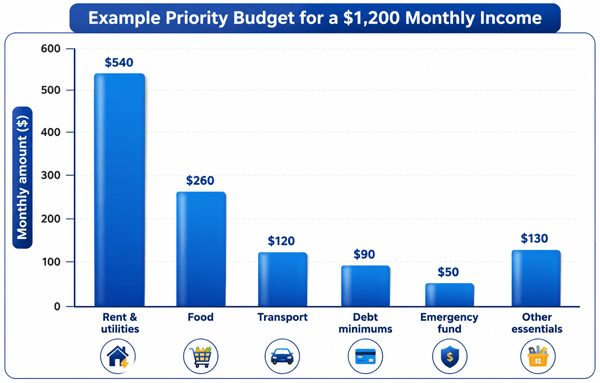
Chart: A sample priority budget for a $1,200 monthly income. Replace these amounts with your own numbers.
4. Simple Low-Income Budget Flow
Use this order when deciding where your next paycheck should go:
| 1. Income received | 2. Food, housing, utilities | 3. Work transport and medicine | 4. Minimum urgent bills | 5. Small savings or catch-up |
|---|
■ Practical Tips to Manage Money on a Low Income
1. Track spending for one week before changing everything
Write down every purchase for seven days. This reveals leaks such as snacks, delivery fees, small convenience purchases, unused subscriptions, or extra transport costs. The goal is not guilt. The goal is information.
2. Plan by payday, not only by month
If you are paid weekly or every two weeks, decide what each paycheck must cover before the next one arrives. Many budgets fail because all monthly bills are listed together, but the timing of cash is ignored.
3. Separate needs, wants, and obligations
Needs keep you housed, fed, safe, healthy, and able to work. Obligations are bills or debts you are expected to pay. Wants improve comfort but can usually wait. This separation makes decisions clearer when money is limited.
4. Create a tiny emergency fund
An emergency fund does not need to start at $1,000. Start with $5, $10, or any amount you can repeat. Even a small cushion can prevent a late fee, overdraft fee, or high-cost loan. If even that is difficult, choose a tiny amount you can repeat consistently instead of setting a goal that makes the budget fail.
5. Use sinking funds for predictable expenses
A sinking fund is money saved little by little for a future bill. For example, if school supplies cost $120 in six months, saving $20 per month is easier than finding $120 at once.
6. Call bill providers before missing payments
Many companies are more flexible before an account becomes seriously overdue. Ask about hardship plans, due-date changes, fee waivers, lower plans, or temporary payment arrangements.
7. Reduce food costs without sacrificing nutrition
Plan meals around affordable staples such as rice, beans, lentils, oats, eggs, potatoes, pasta, seasonal vegetables, frozen vegetables, and store-brand basics. Cook larger portions when possible and use leftovers intentionally.
8. Avoid expensive short-term borrowing where possible
Payday loans, cash advances, overdrafts, and buy-now-pay-later plans can make next month even harder. If you must borrow, compare total cost, repayment dates, and consequences before agreeing. Check whether a lower-cost community, employer, credit union, or nonprofit option is available before using high-cost credit.
9. Protect income first
Spending that helps you earn money can be essential. Work transport, phone access, uniforms, tools, childcare, and required documents may need priority because losing income makes every other problem worse.
10. Review the budget weekly
A low-income budget needs frequent check-ins because small changes matter. A ten-minute weekly review helps you catch shortages early and adjust before bills become emergencies.
■ How to Save Money When There Is Almost Nothing Left
Saving on a low income is difficult, and sometimes the honest answer is that income is not enough to cover basic costs. Still, small savings habits can help when there is any room at all. The key is to make the amount realistic and automatic when possible.
- Save coins or small digital round-ups if your bank offers them.
- Transfer a tiny amount on payday before flexible spending begins.
- Save windfalls such as refunds, bonuses, gifts, or overtime before spending them.
- Keep emergency savings separate from everyday spending so it is not used by accident.
- Use savings first for preventing bigger costs, such as late fees, essential repairs, or urgent transport.
5. What to Do If Income Is Not Enough for Basic Expenses
Sometimes budgeting cannot fix the gap. If your income does not cover housing, food, utilities, transport, and medicine, the budget is showing a real shortage, not a personal failure. In that situation, the next step is to reduce harm and look for support.
- Contact landlords, lenders, utility companies, and service providers early to ask about hardship options.
- Look for local food banks, community kitchens, school meal programs, or public assistance programs.
- Ask about utility assistance, rent support, medical charity care, or nonprofit credit counseling where available.
- Consider whether income can be increased through extra hours, training, a higher-paying role, freelancing, or selling unused items, but avoid plans that require upfront fees.
- Prioritize safety, housing, food, health, and work access over less urgent unsecured debts when impossible choices arise.
If you are unsure which bill is most urgent, compare the consequence of nonpayment first: loss of housing, loss of essential service, legal action, loss of income, fees, or credit score damage.
6. Debt Management on a Low Income
Debt can feel overwhelming when income is low. The safest first step is to list each debt, minimum payment, interest rate, due date, and consequence of nonpayment. Not all debts carry the same risk. Missing rent, utilities, taxes, court-ordered payments, or secured loans may create faster and more serious consequences than falling behind on unsecured consumer debt.
7. Debt snowball vs. debt avalanche
| Strategy | How it works | Best for | Watch out for |
|---|---|---|---|
| Debt snowball | Pay the smallest debt first while making minimum payments on others. | Motivation and quick wins. | May cost more interest. |
| Debt avalanche | Pay the highest-interest debt first while making minimum payments on others. | Saving the most interest over time. | Progress may feel slower. |
| Hardship plan | Ask creditors for lower payments, waived fees, or temporary relief. | When minimum payments are unaffordable. | Get terms in writing before relying on them. |
■ Common Low-Income Budgeting Mistakes to Avoid
1. Budgeting from gross income
Use take-home pay only. Gross income includes money you may never receive in your bank account.
2. Ignoring annual or irregular expenses
Plan monthly for school costs, repairs, insurance, holidays, clothing, and medical needs.
3. Cutting all joy forever
A budget that removes every small pleasure may not last. Keep a tiny realistic amount for personal spending if possible.
4. Paying whoever pressures you the most
Use priority order instead. The loudest bill is not always the most important bill.
5. Depending on overdrafts or payday loans
These can create a cycle where next month starts with less money.
6. Not adjusting after a change
Update the budget when hours, rent, benefits, debt payments, or family needs change.
■ A Simple Weekly Budget Routine
A low-income budget is easier when it becomes a short routine instead of a big monthly task.
| When | What to do | Time needed |
|---|---|---|
| Payday | Write income amount, pay priority bills, set grocery and transport limits. | 15 minutes |
| Midweek | Check remaining cash, food, fuel, and upcoming due dates. | 10 minutes |
| Before shopping | Make a list, check pantry, compare prices, and avoid unplanned purchases. | 10 minutes |
| End of week | Review what worked, what changed, and what must be adjusted. | 10 minutes |
8. Low-Income Budget Template
Use this template as a starting point. Fill in your real numbers and adjust it every payday. For best results, fill it in with bank statements, bills, receipts, or your banking app so the numbers reflect real spending rather than guesses.
| Budget line | Planned amount | Actual amount | Notes/action |
|---|---|---|---|
| Income | $ | $ | |
| Rent/housing | $ | $ | |
| Utilities | $ | $ | |
| Groceries | $ | $ | |
| Transport | $ | $ | |
| Phone/internet | $ | $ | |
| Medicine/health | $ | $ | |
| Childcare | $ | $ | |
| Debt minimums | $ | $ | |
| Savings | $ | $ | |
| Other essentials | $ | $ | |
| Flexible spending | $ | $ | |
| Total expenses | $ | $ | |
| Money left or short | $ | $ |
9. Pros and Cons of Budgeting on a Low Income
| Pros | Limitations |
|---|---|
| Helps protect essentials first. | Cannot solve a true income shortage by itself. |
| Reduces surprises and late fees. | Requires frequent updates when income changes. |
| Makes debt and bills easier to prioritize. | Some expenses may already be cut as low as possible. |
| Builds confidence through small wins. | Hard choices can still be stressful. |
■ Frequently Asked Questions
1. What is the best budget for low income?
The best budget for low income is usually a priority-based budget combined with a simple zero-based plan. Pay essentials first, assign every dollar a job, and review the plan every payday.
2. How can I budget if I do not earn enough?
Start by listing essentials and comparing them with reliable income. If income does not cover basic needs, reduce harm by prioritizing housing, food, utilities, health, and work access, then seek assistance, hardship plans, or ways to increase income.
3. Should I save money or pay debt first?
Cover essentials first. Then make required minimum debt payments if possible. After that, try to build a small emergency fund while paying down high-cost debt. A tiny emergency fund can prevent more borrowing.
4. How much should I spend on groceries on a low income?
There is no perfect number because food costs depend on family size, location, diet, and prices. Start with what you currently spend, plan meals around affordable staples, and reduce waste before setting an unrealistic target.
5. Is the 50/30/20 rule good for low income?
The 50/30/20 rule can be useful as a general idea, but it may not fit low-income households because needs can take more than 50% of income. A priority-based budget is often more realistic.
6. How do I stop living paycheck to paycheck?
Track spending, plan by payday, reduce avoidable fees, build a small emergency fund, and work on increasing income if basic expenses exceed earnings. The process is gradual, especially when income is limited.
7. What should I do first if I am behind on bills?
List overdue bills by consequence, not by pressure. Protect housing, utilities, food, health, transport, and legal obligations first. Contact providers early and ask for payment arrangements or hardship options.
8. Can I use a budgeting app on a low income?
Yes, a budgeting app can help if it makes tracking easier, but it is not required. A notebook, spreadsheet, printable budget template, or separate envelopes/accounts can work just as well if you review them regularly.
■ Final Thoughts: A Low-Income Budget Should Be Realistic, Not Perfect
Budgeting on a low income is not about blaming yourself for high prices, low wages, debt, or emergencies. It is a practical tool for making the best possible decisions with limited money. Start with reliable income, protect essentials first, use a bare-bones budget when needed, plan by payday, and build small buffers whenever possible.
The most useful budget is one you can keep using. Make it simple, update it often, and let it show you the truth. If the numbers do not work, that is important information. It means the next step may be support, negotiation, debt help, or income growth - not more self-criticism.
Reader Advice: This article is for educational and informational purposes only and should not be taken as financial, legal, tax, or professional advice. Please check the latest information from official sources or qualified advisers, as rules, programs, fees, and policies can change over time.