Budgeting for Freelancers: How to Manage Irregular Income
Budgeting for freelancers is different from budgeting with a fixed salary. A salaried worker usually knows when money will arrive and how much it will be. A freelancer may earn a lot in one month, very little the next month, and wait weeks for clients to pay invoices. That uncertainty can make normal budgeting advice feel unrealistic.
The solution is not to guess perfectly. The solution is to build a system that turns irregular income into a stable plan. A strong freelance budget helps you pay bills on time, prepare for taxes, handle business costs, save during good months, and stay calm during slow months.
This guide explains how freelancer budgeting works, how to plan with variable income, and how to create a practical system even if you are new to managing money. It is especially useful for freelancers, contractors, consultants, gig workers, creators, and self-employed professionals who do not receive the same paycheck every month.
1. What Is a Freelance Budget?
A freelance budget is a money plan designed for people whose income changes from month to month. It tracks income, personal expenses, business expenses, taxes, debt payments, savings, and cash reserves. The main goal is to avoid spending based on your best month and instead plan around a realistic, safe monthly amount.
For example, if you earn $5,000 in January, $2,000 in February, and $3,500 in March, your budget should not assume you can spend $5,000 every month. A freelance budget helps you smooth out those ups and downs. In simple words, it turns unpredictable freelance income into a more predictable personal spending plan.
2. Why Irregular Income Creates Budgeting Challenges
- Income timing is unpredictable. A client may pay late, projects may pause, or new work may take longer to close.
- Taxes are not automatically withheld. Many freelancers need to set aside money for income tax, self-employment tax, VAT/GST, or other local obligations.
- Business and personal money can mix. This makes it harder to see true profit and can lead to accidental overspending.
- Good months can create false confidence. A high-income month can tempt you to upgrade your lifestyle before the income is stable.
- Slow months can cause stress. Without a cash buffer, even normal business cycles can feel like emergencies.
- Irregular income can also make it harder to qualify for loans, plan large purchases, and make long-term savings decisions without proper records.
3. The Core Rule: Budget From Your Lowest Reliable Income
The safest way to budget as a freelancer is to build your regular lifestyle around your lowest reliable income, not your highest recent income. This does not mean you ignore better months. It means your essential bills should be affordable even when income is below average.
A practical method is to review your last 6 to 12 months of freelance income and identify a conservative monthly baseline. If your income history is short, start with your lowest expected month and adjust after you collect more data. This protects your budget from income spikes that may not repeat.
| Income method | How it works | Best for |
|---|---|---|
| Lowest-month method | Use your lowest recent month as your spending baseline. | New freelancers or unstable income |
| Average-income method | Average 6-12 months of income, then reduce it slightly for safety. | Freelancers with some history |
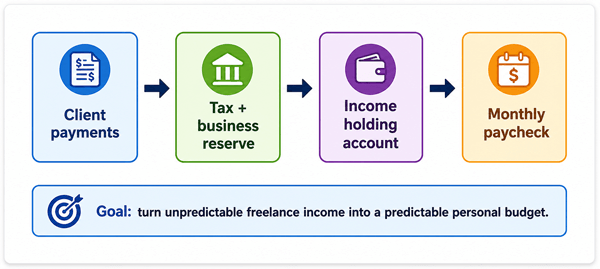
| Salary-from-business method | All client payments go into a holding account; you pay yourself a fixed monthly amount. | Freelancers who want stability |
4. Simple Freelancer Budgeting System
The best freelancer budget is simple enough to use every month. You do not need complex software to begin. You need a clear process.
- Track all client payments. Record when invoices are sent, when they are due, and when money actually arrives.
- Separate business and personal money. Use separate accounts or at least separate tracking categories.
- Set aside taxes first. Move tax money before you spend anything else.
- Pay necessary business costs. Include software, equipment, internet, marketing, banking fees, subcontractors, and professional services.
- Pay yourself a planned amount. Transfer a stable monthly paycheck to your personal account.
- Use extra income intentionally. Build reserves, pay debt, invest, or fund future goals.
Freelancer Income Flow Diagram
 <
<
5. Step-by-Step: How to Create a Budget With Irregular Income
Step 1: Calculate Your Basic Monthly Needs
Start by listing the expenses you must pay to keep your life and business stable. These are not luxuries. They are the bills that keep housing, food, utilities, transport, insurance, minimum debt payments, and essential business tools covered.
| Category | Examples | Monthly amount |
|---|---|---|
| Housing | Rent or mortgage | $1,000 |
| Utilities | Electricity, water, phone, internet | $250 |
| Food | Groceries and basic household items | $450 |
| Transport | Fuel, public transport, maintenance | $200 |
| Insurance | Health, business, car, renter/home | $300 |
| Debt minimums | Credit card, student loan, personal loan | $250 |
| Business essentials | Software, website, accounting, tools | $200 |
| Total baseline | Minimum needed to stay stable | $2,650 |
This number is your survival budget. It tells you the minimum amount your freelance work must support each month.
Step 2: Estimate a Conservative Monthly Income
Look at your income history. If you earned $3,200, $4,800, $2,700, $5,100, $3,600, and $2,900 over six months, your average is about $3,717. But your lowest month was $2,700. A safe personal budget may use $2,700 to $3,000 as the planned monthly income, not $3,717. This protects you from overcommitting. When higher months happen, you can use the extra money for reserves and goals instead of depending on it for everyday bills.
Step 3: Separate Personal Expenses From Business Expenses
Freelancers often get into trouble when all money sits in one account. Business revenue is not the same as personal spending money. Some of it belongs to taxes, tools, contractors, savings, and future months.
| Account or category | Purpose | Recommended use |
|---|---|---|
| Business income account | Receives client payments | Deposit all freelance income here first |
| Tax reserve | Holds money for tax bills | Move a percentage of every payment immediately |
| Business expenses | Pays work-related costs | Use for software, equipment, marketing, fees |
| Owner pay/personal account | Personal monthly spending | Transfer a planned paycheck |
| Emergency or buffer account | Covers slow months | Build with extra income |
Step 4: Set Aside Taxes Before Spending
Freelancers are often responsible for their own tax payments. The exact amount depends on your country, income level, business structure, deductions, and local rules. A common beginner-friendly approach is to set aside a fixed percentage of each payment until a qualified tax professional or official calculator gives you a more accurate number. For example, if you receive a $1,000 client payment and your estimated tax reserve is 25%, move $250 to your tax account immediately. Then plan with the remaining $750. This habit prevents tax money from being accidentally spent.
Step 5: Pay Yourself a Freelance Salary
One of the best ways to manage irregular income is to pay yourself a consistent monthly amount. Instead of spending directly from every client payment, treat your freelance work like a business and your personal life like an employee of that business. Example: Your freelance business receives $4,500 this month. You set aside $1,125 for taxes, $400 for business expenses, and $500 for your buffer. Then you transfer $2,475 to your personal account as your monthly paycheck. If next month income is only $2,800, your buffer can help keep your personal paycheck stable.
Step 6: Build a Slow-Month Fund
A slow-month fund is different from a normal emergency fund. It is money specifically saved to cover lower-income months, delayed invoices, client gaps, and seasonal work patterns. For freelancers, this fund is not optional; it is part of the business model.
- Begin with one month of basic expenses.
- Then grow it to three months.
- If your work is highly seasonal or project-based, aim for six months or more.
- Use extra income from strong months to refill the fund before increasing lifestyle spending.
Step 7: Plan for Irregular Expenses
Some expenses do not happen every month but can still damage your budget if you ignore them. These include annual software subscriptions, equipment replacement, insurance premiums, professional licenses, gifts, travel, car repairs, and medical costs. The solution is a sinking fund. Divide the future cost by the number of months until it is due.
| Future expense | Expected cost | Due in | Monthly sinking fund |
|---|---|---|---|
| Laptop replacement | $1,200 | 12 months | $100 |
| Annual software plan | $240 | 12 months | $20 |
| Professional course | $600 | 6 months | $100 |
| Holiday travel | $900 | 9 months | $100 |
Step 8: Review Your Budget Every Month
Freelancer budgeting improves with regular review. At the end of each month, compare planned income, actual income, planned spending, actual spending, unpaid invoices, upcoming bills, and reserve balances. This review helps you notice problems early and update your baseline as your freelance business grows.
■ Example Freelance Budget
Here is a sample budget for a freelancer who receives $4,000 in client payments in a month.
| Item | Amount | Notes |
|---|---|---|
| Client payments received | $4,000 | Gross freelance income |
| Tax reserve 25% | -$1,000 | Set aside before spending |
| Business expenses | -$400 | Software, internet, payment fees, tools |
| Slow-month fund | -$300 | Builds income stability |
| Personal paycheck | $2,300 | Transferred to personal account |
| Personal needs | -$1,800 | Rent, food, utilities, transport |
| Personal wants | -$250 | Dining, entertainment, hobbies |
| Personal savings/debt goals | -$250 | Emergency fund, debt, investing |
This budget works because it does not treat the full $4,000 as spendable personal income. It protects taxes, business costs, and future stability first.
6. Best Budgeting Methods for Freelancers
| Method | How it helps freelancers | Limitations |
|---|---|---|
| Zero-based budgeting | Gives every dollar a job, including taxes and reserves. | Requires regular tracking and discipline. |
| 50/30/20 budget | Simple structure for needs, wants, and savings. | May not fit low or highly variable income without adjustments. |
| Envelope method | Prevents overspending by assigning money to categories. | Can feel restrictive if income changes often. |
| Pay-yourself-first | Prioritizes savings, taxes, and reserves before lifestyle spending. | Needs a realistic income baseline. |
| Monthly salary method | Turns irregular income into predictable personal cash flow. | Requires a buffer to work well. |
For most freelancers, the strongest approach is a combination: use a holding account, pay yourself a monthly salary, use zero-based planning, and maintain a slow-month fund.
7. What Percentage Should Freelancers Save?
There is no single percentage that fits every freelancer, but a practical starting structure is:
- Taxes: 20% to 35% of each payment, depending on local tax rules and your situation.
- Business expenses: 5% to 20%, depending on your industry.
- Emergency and slow-month savings: 10% or more until reserves are strong.
- Retirement or long-term investing: a regular amount once basic stability is in place.
These are planning ranges, not tax advice. Adjust them based on your actual tax rate, profit margin, cost of living, debt, and financial goals. If your country has quarterly estimated taxes, VAT/GST filing, or self-employment contributions, add those deadlines to your budget calendar.
8. Common Freelancer Budgeting Mistakes
- Spending from gross income. Client payments are not all yours to spend because taxes and business costs must come out first.
- Ignoring taxes until the deadline. This can create large surprise bills and cash stress.
- Using best-month income as normal income. A great month should strengthen your reserves, not reset your lifestyle.
- Not tracking unpaid invoices. Money is not available until it is actually received.
- Mixing business and personal expenses. This makes profit, taxes, and real cash flow harder to understand.
- Skipping insurance and retirement planning. Freelancers often need to create benefits that employers usually provide.
- Forgetting to raise rates when costs rise. Better budgeting helps, but pricing also affects long-term stability.
9. Practical Tips to Manage Irregular Freelance Income
- Keep one month of expenses in your personal account and extra reserves in a separate savings account.
- Invoice quickly and clearly, with due dates and payment instructions.
- Follow up on late invoices before they become serious cash-flow problems.
- Use a simple spreadsheet or budgeting app to track income, taxes, expenses, and savings.
- Create a bare-bones budget for slow months and a normal budget for average months.
- Use high-income months to fund taxes, reserves, debt payoff, retirement, and planned purchases.
- Avoid long-term commitments based on short-term income spikes.
- Review pricing regularly. Sometimes a budgeting problem is also an underpricing problem.
- Keep records of invoices, receipts, mileage, software costs, and professional fees so your budget and tax planning stay accurate.
10. Freelancer Budget Checklist
- I know my minimum monthly living expenses.
- I track all invoices and client payments.
- I separate tax money from spending money.
- I know my average and lowest monthly income.
- I pay myself a planned amount instead of spending randomly.
- I have a slow-month fund or am building one.
- I save monthly for annual and irregular expenses.
- I review my budget at least once a month.
- I update my tax percentage and savings targets when my income, location, or business structure changes.
11. Pros and Cons of Freelance Budgeting
| Pros | Cons |
|---|---|
| Gives more control over unpredictable income. | Requires more tracking than a salary budget. |
| Reduces stress during slow months. | Can feel strict when cash is tight. |
| Helps prevent tax surprises. | Needs regular review and adjustment. |
| Makes it easier to separate profit from spending money. | Takes time to build reserves. |
| Supports long-term business and personal stability. | May require changing spending habits. |
■ Frequently Asked Questions
1. How do I budget if I do not know how much I will earn?
Use your lowest reliable income or a conservative average. Build your essential budget around that number, then use extra income from better months for taxes, savings, debt, and future expenses.
2. Should freelancers have separate bank accounts?
Yes, separate accounts make budgeting much easier. At minimum, keep separate categories for taxes, business expenses, personal spending, and reserves.
3. How much emergency savings should a freelancer have?
Start with one month of essential expenses, then aim for three to six months. Freelancers with seasonal income or few clients may need a larger cushion.
4. What should I do in a high-income month?
Do not spend it all. First refill tax reserves, business reserves, emergency savings, and slow-month funds. Then consider debt payoff, retirement contributions, or planned lifestyle spending.
5. What should I do in a low-income month?
Use your bare-bones budget, delay non-essential spending, follow up on invoices, market your services, and use your slow-month fund if needed.
6. Is the 50/30/20 rule good for freelancers?
It can be useful, but freelancers often need to modify it. Taxes and business expenses should be handled before dividing personal income into needs, wants, and savings.
7. How often should freelancers review their budget?
At least monthly. If cash flow is tight, review weekly until income becomes more stable.
8. What is the biggest budgeting mistake freelancers make?
The biggest mistake is treating gross client payments as personal income. A portion must be reserved for taxes, business costs, and future slow periods.
9. What is the best budgeting app for freelancers?
The best app is the one you will actually use consistently. A spreadsheet can work well at first. Later, you may prefer a budgeting app or accounting tool that tracks invoices, expenses, taxes, and cash flow in one place.
10. How can freelancers make irregular income feel stable?
Use a holding account, save during strong months, pay yourself a fixed monthly amount, and keep a slow-month fund separate from normal spending money.
■ Final Thoughts: Stability Comes From a System
Freelancing does not have to mean financial chaos. The key is to stop budgeting from hope and start budgeting from a system. Track income, separate business and personal money, set aside taxes first, pay yourself a steady amount, and build reserves during stronger months.
A good freelancer budget gives you more than numbers. It gives you breathing room, better decisions, and confidence when income changes. Start simple, review often, and improve the system as your freelance business grows.
Reader Advice: This article is for educational and information purposes only and should not be taken as financial, tax, legal, or investment advice. Please check the latest information from official sources or a qualified professional, as rules, rates, and policies can change over time.