Monthly Budget Planning Guide: How to Plan Your Income and Expenses
A monthly budget is a simple plan for how your money will be used during the month. It shows how much income you expect, what bills and expenses you need to pay, how much you want to save, and what is left for flexible spending. The goal is not to make your life restrictive. The goal is to help you make clear decisions before your money disappears.
Many people think budgeting means cutting out everything enjoyable. In reality, a good monthly budget gives every important part of your life a place: rent or mortgage, groceries, transport, debt payments, savings, family needs, personal spending, and occasional treats. When you plan these items in advance, you reduce stress and avoid guessing whether you can afford something.
This monthly budget planning guide explains how to plan your income and expenses step by step, even if you are completely new to budgeting. You will learn what to include, how to handle irregular expenses, how to choose a budgeting method, and how to review your budget at the end of the month.
In simple terms, monthly budget planning helps you answer three important questions: how much money is coming in, where it must go, and what choices you can safely make with the rest.
1. What Is Monthly Budget Planning?
Monthly budget planning is the process of deciding how your income will be used before and during a month. It helps you match your money with your priorities. Instead of reacting to bills, debt, and daily spending, you create a plan that shows where your money should go.
A monthly budget usually includes income, fixed expenses, variable expenses, savings, debt payments, and optional spending. Some people create a budget on paper, some use spreadsheets, and others use banking apps or budgeting apps. The tool matters less than the habit of planning, tracking, and reviewing.
A beginner-friendly way to understand a budget is this: Income minus planned expenses, savings, and debt payments should equal zero or leave a small cushion. That does not mean you spend all your money. It means every amount has a purpose, including savings and emergency funds.
This approach also makes the article-friendly budgeting formula easy to remember: income, essentials, savings, debt, flexible spending, and review.
2. Why Monthly Budget Planning Matters
A monthly budget helps you see the full picture of your money. Without a budget, it is easy to underestimate small daily purchases, forget upcoming bills, or depend too much on credit cards. With a budget, you can make decisions based on numbers instead of stress or guesswork.
- It helps you avoid overspending before payday.
- It makes bills and debt payments easier to manage.
- It helps you save for emergencies, goals, and future needs.
- It shows which expenses are necessary and which can be reduced.
- It gives you more confidence when making financial decisions.
Budgeting is especially useful when income is limited, expenses are rising, debt feels hard to manage, or you are saving for a specific goal such as a car, home, education, wedding, business, or emergency fund.
3. Monthly Budget Planning Flow
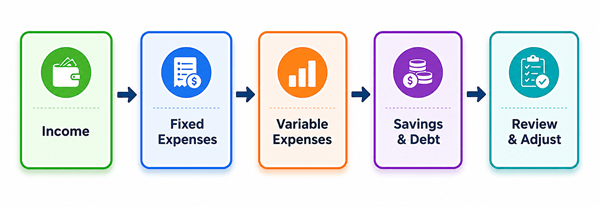
Figure: A simple monthly budget planning flow. Start with income, subtract essential costs, plan flexible spending, assign savings and debt payments, then review and adjust.
4. Step-by-Step Monthly Budget Planning Guide
Step 1: Calculate Your Monthly Income
Start with the money you realistically expect to receive during the month. Use take-home income, not gross income. Take-home income is the money you actually receive after taxes, payroll deductions, retirement contributions, or other automatic deductions.
Common income sources include:
- Salary or wages
- Business or freelance income
- Side hustle income
- Rental income
- Pension, benefits, or support payments
- Regular family support or other recurring income
If your income changes from month to month, budget with a conservative estimate. For example, if you usually earn between $2,000 and $2,700, build your budget around $2,000 or an average of your lowest recent months. Any extra income can go toward savings, debt, or future bills.
Step 2: List Fixed Expenses
Fixed expenses are costs that usually stay the same each month. They are easier to plan because the amount and due date are predictable.
| Fixed Expense | Example |
|---|---|
| Rent or mortgage | $900 due on the 1st |
| Car payment | $250 due on the 10th |
| Insurance | $120 due monthly |
| Internet or phone plan | $80 due monthly |
| Loan payment | $180 due monthly |
| Subscriptions | $30 total monthly |
When listing fixed expenses, include the due date as well as the amount. This helps you avoid late fees and plan around cash flow, especially if you are paid weekly or twice a month.
For better accuracy, check bank statements, card statements, receipts, and automatic payments so small recurring charges are not missed.
Step 3: Estimate Variable Expenses
Variable expenses change from month to month. These are often the categories where people overspend because the amounts are less obvious.
Common variable expenses include groceries, fuel, transport, electricity, gas, dining out, personal care, clothing, household items, entertainment, and school costs. To estimate these, look at your last one to three months of spending. If you do not have records, start with a reasonable estimate and improve it as you track your spending.
| Variable Category | Planning Tip |
|---|---|
| Groceries | Use your recent average, then adjust for family size and meal planning. |
| Utilities | Use the highest recent month if bills change by season. |
| Fuel or transport | Consider work, school, errands, and expected trips. |
| Dining out | Set a limit before the month begins. |
| Entertainment | Plan a realistic amount instead of pretending it will be zero. |
| Personal spending | Give yourself a small flexible allowance to reduce budget fatigue. |
Step 4: Plan Savings Before Spending the Rest
Savings should not be treated only as whatever is left at the end of the month. If possible, include savings as a planned category near the beginning of your budget. This is often called paying yourself first.
Important savings categories include:
- Emergency fund
- Medical costs
- Car repairs
- Home repairs
- Education costs
- Annual bills
- Travel or family events
- Retirement or long-term investing
For beginners, the first savings goal is usually a starter emergency fund. Even a small emergency fund can reduce dependence on credit cards or loans when an unexpected expense appears.
After a starter emergency fund is in place, many households gradually work toward one month of essential expenses and then a larger emergency fund as income allows.
Step 5: Include Debt Payments
If you have debt, list each required minimum payment in your budget. Then decide whether you can add extra money to one debt at a time. Two common strategies are the debt snowball and debt avalanche methods.
| Debt Strategy | How It Works | Best For |
|---|---|---|
| Debt snowball | Pay extra toward the smallest balance first while making minimum payments on the rest. | People who need motivation from quick wins. |
| Debt avalanche | Pay extra toward the highest-interest debt first while making minimum payments on the rest. | People who want to reduce total interest cost. |
Both methods can work. The most important rule is to avoid adding new debt while paying down old debt, unless there is a true emergency and no safer option.
If debt feels unmanageable, consider speaking with a qualified nonprofit credit counselor or a trusted financial professional before choosing a repayment plan.
Step 6: Prepare for Irregular and Annual Expenses
One common budgeting mistake is forgetting expenses that do not happen every month. These costs can make a budget feel like it failed, even though the real issue was incomplete planning.
Examples include annual insurance, school fees, car registration, property taxes, holiday gifts, family events, medical checkups, clothing seasons, and appliance repairs. The simple solution is to divide the expected cost by the number of months available.
Example: If your annual car insurance is $600, save $50 per month. When the bill arrives, the money is already planned.
This same sinking-fund method can be used for school costs, annual subscriptions, tax bills, home maintenance, family events, and seasonal clothing.
Step 7: Choose a Budgeting Method
Different budgeting methods suit different personalities and income situations. You do not need to follow one method perfectly. You can start with a simple version and adjust it.
The best budgeting method is not always the most detailed one. It is the method you can repeat consistently without feeling overwhelmed.
| Budgeting Method | How It Works | Good For | Possible Limitation |
|---|---|---|---|
| Zero-based budget | Every dollar is assigned to a category, including savings and debt. | People who want detailed control. | Requires more tracking. |
| 50/30/20 budget | Needs get 50%, wants 30%, savings/debt 20%. | Beginners who want a simple structure. | May not fit high-rent or low-income situations. |
| Envelope system | Money is divided into spending categories, often using cash or digital envelopes. | People who overspend in flexible categories. | Can feel restrictive if too many envelopes are used. |
| Pay-yourself-first budget | Savings are automated first; remaining money covers expenses. | People focused on building savings. | Still needs expense control. |
| Bare-bones budget | Only essential expenses are funded temporarily. | Debt payoff, emergencies, or income loss. | Not ideal as a long-term lifestyle. |
Step 8: Build Your Monthly Budget
Now combine everything into one plan. A basic monthly budget should show expected income, planned expenses, savings, debt payments, and the remaining balance.
| Category | Planned Amount |
|---|---|
| Monthly take-home income | $3,000 |
| Rent | $900 |
| Utilities | $220 |
| Groceries | $450 |
| Transport | $250 |
| Insurance | $150 |
| Debt minimum payments | $250 |
| Emergency fund savings | $200 |
| Annual bills sinking fund | $100 |
| Dining out and entertainment | $180 |
| Personal and household spending | $200 |
| Remaining cushion | $100 |
In this example, the person has a small cushion of $100. A cushion is helpful because real life rarely matches a budget perfectly. If there is no cushion, the person may need to reduce flexible spending, increase income, or adjust savings temporarily.
Step 9: Track Spending During the Month
A budget is not complete when you write it down. You also need to track what actually happens. Tracking shows whether your plan is realistic.
You can track spending with a notebook, spreadsheet, bank app, budgeting app, or a simple notes app on your phone. The best method is the one you will actually use. Update your budget at least once a week. If you wait until the end of the month, small problems can become bigger.
Step 10: Review and Adjust at Month-End
At the end of the month, compare planned spending with actual spending. Do not use this review to blame yourself. Use it to improve next month’s budget.
Ask these questions:
- Which categories were accurate?
- Where did I overspend?
- Was my income estimate realistic?
- Did any irregular expenses appear?
- Can I reduce one category next month?
- Can I increase savings or debt payments next month?
5. Monthly Budget Example for a Beginner
Here is a practical example of how a beginner might plan income and expenses for one month.
| Budget Line | Amount | Notes |
|---|---|---|
| Net income | $2,500 | After taxes and deductions |
| Rent | $800 | Fixed expense |
| Utilities | $180 | Estimated from recent bills |
| Groceries | $350 | Based on weekly meal plan |
| Transport | $200 | Fuel, public transport, parking |
| Phone and internet | $90 | Fixed monthly bills |
| Debt payments | $250 | Minimums plus a small extra payment |
| Emergency savings | $150 | Automatic transfer after payday |
| Medical and annual bills fund | $100 | Saved for future irregular costs |
| Dining out | $100 | Flexible spending limit |
| Personal spending | $150 | Clothing, gifts, small purchases |
| Cushion | $180 | Left for surprises or extra savings |
This budget is not perfect for everyone, but it shows the basic structure. The person plans essentials first, adds savings and debt payments, allows some personal spending, and keeps a cushion.
5. Needs, Wants, Savings, and Debt: How to Prioritize Expenses
A helpful way to organize your budget is to separate expenses into needs, wants, savings, and debt. This makes it easier to decide what to cut when money is tight.
| Priority Type | Meaning | Examples |
|---|---|---|
| Needs | Expenses required for basic living and work. | Housing, food, utilities, transport, medicine, basic insurance |
| Wants | Expenses that improve comfort or enjoyment but can be adjusted. | Dining out, streaming, hobbies, upgrades, entertainment |
| Savings | Money set aside for future needs and goals. | Emergency fund, sinking funds, retirement, education |
| Debt | Money used to repay borrowed funds. | Credit cards, personal loans, student loans, car loans |
When your budget is tight, protect needs first. Then make minimum debt payments to avoid penalties. After that, keep at least some savings if possible, even if the amount is small. Wants can be reduced temporarily when necessary.
This order helps readers make practical decisions without removing every enjoyable expense at once.
6. How Much Should You Spend in Each Category?
There is no single perfect percentage for every household. A person living in a high-cost city may spend more on housing than someone living in a lower-cost area. A family with children may spend more on food, healthcare, and school costs than a single person.
Still, beginner benchmarks can help you notice whether a category needs attention.
| Category | Common Beginner Guideline | Important Note |
|---|---|---|
| Housing | Around 25% to 35% of take-home income | May be higher in expensive areas. |
| Food | Around 10% to 15% | Depends on family size and food prices. |
| Transport | Around 10% to 15% | Car loans, fuel, and insurance can raise this. |
| Savings and debt payoff | Aim for 10% to 20% if possible | Start smaller if money is tight. |
| Personal and entertainment | Around 5% to 10% | Flexible category; reduce if needed. |
Use these numbers as signals, not strict rules. If one category is high, look for ways to adjust over time. Some changes, such as moving home or changing transport, may take months or years.
Budget percentages should support your real life, not create guilt. Local prices, family size, health needs, and income level can all change what is realistic.
7. How to Budget When Income Is Irregular
Irregular income is common for freelancers, business owners, commission workers, seasonal workers, and people with side hustles. Budgeting is still possible, but you need a more conservative system.
- Find your lowest realistic monthly income from the last six to twelve months.
- Build a basic budget using that lower income number.
- Create a priority list: essentials first, then minimum debt payments, then savings, then wants.
- During higher-income months, save extra money in an income buffer account.
- Use the buffer to support lower-income months instead of increasing lifestyle spending immediately.
The key is to avoid building your normal lifestyle around your best months. Budget from your reliable income and treat extra income as a tool for stability, savings, and debt reduction.
A separate income buffer can make irregular income feel more like a steady paycheck because stronger months help cover slower months.
8. How to Budget When Expenses Are Higher Than Income
If your expenses are higher than your income, your budget is showing an important warning. This does not mean you failed. It means your current money situation needs a decision.
Start by separating expenses into three groups: essential, adjustable, and optional.
- Essential: rent, basic food, utilities, transport to work, medicine, minimum debt payments.
- Adjustable: groceries, phone plan, insurance plan, fuel use, utility use.
- Optional: subscriptions, dining out, entertainment, upgrades, impulse purchases.
Then look for immediate and longer-term solutions. Immediate solutions may include pausing optional spending, negotiating bills, using a cheaper phone plan, reducing dining out, or selling unused items. Longer-term solutions may include increasing income, changing housing, refinancing expensive debt carefully, or getting help from a nonprofit credit counselor if debt is unmanageable.
9. Common Monthly Budget Planning Mistakes
| Mistake | Why It Hurts | Better Approach |
|---|---|---|
| Using gross income instead of take-home income | The budget looks bigger than the money available. | Use net income actually received. |
| Forgetting irregular expenses | Annual or seasonal bills create surprises. | Create monthly sinking funds. |
| Being too strict | The budget becomes hard to follow. | Allow realistic personal spending. |
| Not tracking spending | You cannot compare plan versus reality. | Update spending weekly. |
| Ignoring small purchases | Small purchases can quietly drain cash. | Track frequent categories like snacks, apps, and delivery. |
| Giving up after one bad month | Budgeting is a skill that improves with practice. | Adjust next month's plan instead of quitting. |
10. Best Practices for Monthly Budget Planning
- Create the budget before the month begins or right before your pay period starts.
- Use realistic numbers based on past spending, not ideal guesses.
- Automate savings and important bill payments when possible.
- Keep a small cushion for unexpected costs.
- Review subscriptions and recurring payments every few months.
- Use separate savings buckets for annual bills and emergencies.
- Talk openly with family members if the budget affects shared spending.
- Adjust your budget when income, rent, debt, or family needs change.
11. Simple Monthly Budget Template
You can copy this structure into a notebook, spreadsheet, or budgeting app.
For best results, keep the template simple at first. Too many categories can make a beginner budget harder to maintain.
| Section | Line Items to Include |
|---|---|
| Income | Salary, business income, side income, benefits, support payments |
| Fixed expenses | Rent, loan payments, insurance, phone, internet, subscriptions |
| Variable expenses | Groceries, utilities, transport, personal care, household items |
| Savings | Emergency fund, annual bills, future goals, retirement |
| Debt | Minimum payments and extra payoff amount |
| Flexible spending | Dining out, entertainment, hobbies, personal money |
| Review | Actual spending, difference from plan, notes for next month |
12. Mini Checklist: Before You Finalize Your Monthly Budget
- Did you use take-home income?
- Did you include every bill due this month?
- Did you estimate groceries, utilities, and transport realistically?
- Did you include at least a small savings category?
- Did you include minimum debt payments?
- Did you plan for irregular or annual expenses?
- Did you leave a small cushion if possible?
- Did you choose a weekly time to review spending?
13. Pros and Cons of Monthly Budget Planning
| Pros | Cons or Challenges |
|---|---|
| Gives clear control over income and expenses. | Takes time to set up and maintain. |
| Reduces financial stress by making bills predictable. | First few months may feel inaccurate. |
| Helps build savings and pay down debt. | Requires honest tracking of spending. |
| Makes financial goals easier to plan. | Can feel restrictive if the plan has no flexibility. |
| Improves communication in households that share money. | Unexpected expenses still require adjustments. |
14. Important Misconceptions About Monthly Budgets
Misconception 1: A budget means you cannot spend on fun.
A good budget includes enjoyable spending when possible. The difference is that you plan it instead of letting it happen accidentally.
Misconception 2: Budgeting is only for people with money problems.
Budgeting is useful at every income level. Higher income does not automatically create savings if spending rises just as quickly.
Misconception 3: A budget must be perfect.
No monthly budget is perfect at first. The purpose is to improve your decisions over time, not predict every expense exactly.
Misconception 4: Small amounts do not matter.
Small expenses matter when they happen often. A daily habit that costs $5 becomes about $150 in a 30-day month.
15. When Should You Update Your Monthly Budget?
Update your budget whenever your financial life changes. Common reasons include a raise, job loss, new debt, paid-off debt, rent increase, new baby, school expenses, medical costs, moving, marriage, divorce, or a major savings goal.
Even when nothing major changes, review your budget every month. A budget is a living plan, not a one-time document.
■ FAQs About Monthly Budget Planning
1. What is the easiest way to start a monthly budget?
The easiest way is to write down your take-home income, list your bills, estimate groceries and transport, add savings and debt payments, and then compare the total with your income. Start simple and improve your categories over time.
2. How often should I check my budget?
Check your budget at least once a week. Weekly reviews help you catch overspending early and make small adjustments before the month ends.
3. What if I do not earn the same amount every month?
Use a conservative income estimate based on your lower-income months. In better months, save the extra money in a buffer account so you can cover slower months.
4. Should I use a budgeting app or spreadsheet?
Use whichever tool you will actually maintain. Apps can automate tracking, spreadsheets offer flexibility, and paper works well for people who prefer a simple hands-on system.
5. How much should I save each month?
Save what is realistic. A common goal is 10% to 20% of income, but beginners can start with a smaller amount. Consistency matters more than a perfect percentage at the beginning.
6. What should I cut first when my budget is too tight?
Start with optional and flexible expenses such as unused subscriptions, dining out, entertainment, impulse purchases, and nonessential upgrades. Protect housing, food, utilities, transport to work, medicine, and minimum debt payments first.
7. Is monthly budgeting the same as tracking expenses?
No. Budgeting is planning where your money should go. Tracking is recording where your money actually went. You need both for the best results.
8. Why does my budget fail every month?
Most budgets fail because the numbers are unrealistic, irregular expenses are missing, spending is not tracked, or the plan is too strict. Review the gap between planned and actual spending and adjust one category at a time.
9. Is the 50/30/20 budget rule required?
No. The 50/30/20 rule is a helpful starting point, but it is not required. If housing, food, healthcare, family responsibilities, or debt payments are high, adjust the percentages to fit your real situation.■ Final Thoughts: Make Your Monthly Budget Practical, Not Perfect
Monthly budget planning is one of the most useful personal finance habits because it turns income and expenses into a clear plan. You do not need advanced financial knowledge to start. You only need honest numbers, realistic categories, and a willingness to review your progress.
Begin with your take-home income, list your fixed and variable expenses, plan savings and debt payments, include irregular costs, and review your spending weekly. Over time, your monthly budget will become more accurate and easier to follow. The real benefit is not just saving money. It is gaining confidence, reducing financial stress, and making your money support the life you are trying to build.
Reader Advice: This article is for educational and information purposes only and should not be taken as personal financial, legal, tax, or professional advice. Please check the latest information from official sources or qualified professionals, as rules, policies, and financial guidance can change over time.