50/30/20 Budget Rule: How It Works, Examples & When to Use It
1. What Is the 50/30/20 Budget Rule?
The 50/30/20 budget rule is a simple personal budgeting method that divides your monthly after-tax income into three broad categories: 50% for needs, 30% for wants, and 20% for savings and extra debt repayment. It is not a strict law. It is a flexible starting point that helps beginners understand where their money is going and how to create balance between current expenses and future goals.
| Budget Category | Recommended Share | What It Usually Includes |
|---|---|---|
| Needs | 50% | Rent or mortgage, utilities, groceries, transport, insurance, minimum debt payments, basic childcare, necessary medical costs |
| Wants | 30% | Dining out, entertainment, streaming, travel, hobbies, upgrades, non-essential shopping, lifestyle extras |
| Savings and Extra Debt Repayment | 20% | Emergency fund, retirement investing, sinking funds, extra credit card payments, extra loan payments, long-term goals |
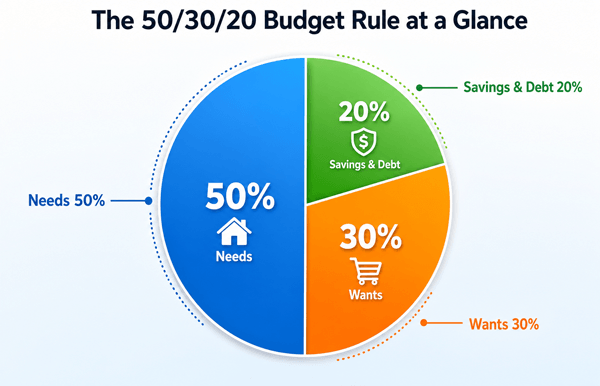
Chart: A simple visual breakdown of the 50/30/20 budget rule.
2. How the 50/30/20 Budget Rule Works
The rule starts with your take-home income, not your gross salary. Take-home income is the money that actually reaches your bank account after income tax, payroll deductions, and required deductions. Once you know that number, you divide it into three spending and saving buckets.
Simple formula:
Needs = take-home income x 0.50; Wants = take-home income x 0.30; Savings and extra debt repayment = take-home income x 0.20. This gives readers a quick 50/30/20 budget calculator they can use without a spreadsheet.
For example, if your monthly take-home income is $3,000, the 50/30/20 budget gives you $1,500 for needs, $900 for wants, and $600 for savings and extra debt repayment. The goal is not to make every month perfect. The goal is to create a realistic framework that shows whether your spending is balanced.
| Monthly Take-Home Income | Needs 50% | Wants 30% | Savings/Debt 20% |
|---|---|---|---|
| $1,500 | $750 | $450 | $300 |
| $2,500 | $1,250 | $750 | $500 |
| $3,000 | $1,500 | $900 | $600 |
| $4,000 | $2,000 | $1,200 | $800 |
| $5,000 | $2,500 | $1,500 | $1,000 |
| $7,000 | $3,500 | $2,100 | $1,400 |
Why After-Tax Income Matters
A common beginner mistake is applying the formula to gross income. Gross income can make the budget look easier than it really is because it includes money you never actually receive. Use net income, take-home pay, or income after taxes and payroll deductions. If retirement contributions or health insurance premiums are deducted before your paycheck arrives, decide whether you want to count them as part of the 20% savings bucket. The important point is to avoid double counting.
3. What Counts as Needs?
Needs are expenses you must pay to maintain basic living, safety, health, work, and legal obligations. They are not always enjoyable, but they are necessary. The 50% category should include the minimum cost of living, not the most expensive version of every essential.
- Housing: rent, mortgage payment, property taxes, required maintenance, basic renters or homeowners insurance.
- Utilities: electricity, water, gas, phone service needed for work or safety, internet if required for work, school, or basic household needs.
- Food: groceries and basic household supplies, not frequent restaurant meals.
- Transportation: fuel, public transport, required car payment, basic maintenance, registration, and insurance.
- Insurance and health: health insurance, necessary prescriptions, medical appointments, disability insurance when needed.
- Minimum debt payments: required payments on credit cards, student loans, auto loans, personal loans, or other debt.
- Childcare or dependent care: necessary care that allows you to work, study, or meet family obligations.
Needs vs. Wants: A Practical Test
Some expenses can be partly a need and partly a want. A phone plan may be a need, but the most expensive unlimited plan may be a want. Food is a need, but restaurant delivery is usually a want. Transportation is a need, but a luxury car payment may be partly a want. The test is simple: ask what the minimum reasonable version of the expense would cost. Anything above that may belong in wants.
| Expense | Need Portion | Want Portion |
|---|---|---|
| Housing | A safe, affordable place to live | Extra space, luxury location, premium finishes beyond your budget |
| Food | Groceries and basic meals | Frequent dining out, delivery, premium convenience foods |
| Phone | A reliable basic plan | Latest device upgrade, expensive add-ons |
| Transport | Basic commuting cost | Luxury vehicle, unnecessary upgrades, frequent rideshares for convenience |
| Clothing | Work, school, and weather-appropriate clothing | Fashion shopping, designer brands, impulse purchases |
4. What Counts as Wants?
Wants are non-essential expenses that improve comfort, enjoyment, convenience, or lifestyle. Wants are not bad. A healthy budget should leave room for fun and personal choice. The problem begins when wants silently take money away from bills, emergency savings, or debt repayment.
- Restaurants, coffee shops, takeout, and food delivery.
- Streaming services, entertainment, games, hobbies, concerts, and events.
- Vacations, weekend trips, and non-essential travel.
- Shopping for non-essential clothes, gadgets, home decor, and upgrades.
- Gym memberships or subscriptions you do not use regularly.
- Convenience spending, such as frequent paid delivery or rideshares when cheaper options are practical.
5. What Counts as Savings and Extra Debt Repayment?
The 20% category is for improving your future financial position. It includes money you save, invest, or use to reduce debt faster than required. Minimum debt payments usually belong in needs because missing them can lead to fees, credit damage, or legal consequences. Extra payments above the minimum belong in the 20% category because they help you become financially stronger.
A practical order for many beginners is to build a starter emergency fund, pay down high-interest debt, then increase long-term savings and investing. The right order can vary, so the rule should support your goals rather than replace personal financial planning.
- Emergency fund contributions.
- Retirement contributions if they are not already deducted before take-home pay.
- Investing for long-term goals.
- Saving for a home down payment, education, car replacement, or other planned goals.
- Sinking funds for irregular expenses such as annual insurance, school fees, holidays, repairs, or medical deductibles.
- Extra payments on credit cards, personal loans, student loans, car loans, or other debt.
■ Step-by-Step: How to Create a 50/30/20 Budget
- Calculate your monthly take-home income. Use your actual deposit amount if your income is regular. If your income changes, use a conservative average based on the last three to six months.
- List all current expenses. Review bank statements, card statements, payment apps, and cash spending. Do not rely on memory.
- Sort each expense into needs, wants, or savings/debt. Be honest about mixed expenses and split them when necessary.
- Compare your actual spending with the 50/30/20 targets. Look for the category that is most out of balance.
- Adjust gradually. Start with the easiest changes, such as unused subscriptions, expensive dining habits, or automatic transfers to savings.
- Automate the 20% category where possible. Move savings or extra debt payments shortly after payday so the money is not accidentally spent.
- Review monthly. The first month is for learning. The second and third months are for improving.
■ Detailed Example: A 50/30/20 Budget for a Beginner
Assume someone earns $3,200 per month after taxes. Their target budget would be $1,600 for needs, $960 for wants, and $640 for savings and extra debt repayment.
| Category | Target Amount | Example Expenses |
|---|---|---|
| Needs - 50% | $1,600 | Rent $950; utilities $160; groceries $300; transport $120; insurance $70 |
| Wants - 30% | $960 | Restaurants $250; entertainment $150; shopping $200; hobbies $100; travel fund $180; miscellaneous $80 |
| Savings/Debt - 20% | $640 | Emergency fund $250; retirement $200; extra credit card payment $150; annual expenses fund $40 |
In real life, the exact line items will differ. The important lesson is that every dollar is assigned to a broad purpose. This makes the budget easier to manage than a long list of tiny categories.
6. When the 50/30/20 Rule Works Best
The 50/30/20 rule works best when your income is reasonably stable, your essential expenses are not extremely high, and you want a simple budgeting system that does not require tracking dozens of categories. It is especially useful for beginners who need structure but do not want a complicated spreadsheet.
- You are new to budgeting and want a simple starting point.
- You earn enough to cover basic needs within about half of take-home pay.
- You want permission to spend on wants without guilt, while still saving.
- You have moderate debt and can make extra payments after covering essentials.
- You want a quick way to check whether your lifestyle is affordable.
7. When You Should Adjust the 50/30/20 Rule
The 50/30/20 rule is useful, but it does not fit every situation. Housing costs, family size, debt level, income volatility, local cost of living, and financial goals can all make a different split more realistic. Adjusting the rule is not failure. A budget is successful when it helps you make better decisions and stay consistent.
| Situation | Why 50/30/20 May Not Fit | Possible Adjustment |
|---|---|---|
| High housing or living costs | Needs may exceed 50% even with careful spending. | Try 60/20/20, 60/30/10 temporarily, or reduce fixed costs over time. |
| Very low income | Essentials may consume most income. | Focus first on stability, benefits, income growth, and small emergency savings. |
| Heavy high-interest debt | 20% may be too slow for debt payoff. | Reduce wants and direct more money to debt until balances are controlled. |
| Aggressive savings goal | 20% may be too low for early retirement, home purchase, or business goals. | Use 50/20/30 or 40/20/40 if realistic. |
| Irregular income | Monthly percentages may swing too much. | Use an average income, a baseline budget, and a buffer account. |
| Single-income household with dependents | Needs may naturally be higher. | Use the rule as a benchmark, not a strict scorecard. |
How to Use the Rule If Your Needs Are More Than 50%
Many people discover that rent, utilities, groceries, transportation, insurance, and minimum debt payments already exceed 50% of take-home pay. This does not mean budgeting is pointless. It means your fixed costs are putting pressure on the rest of your plan.
- Separate true needs from upgraded needs. Look for cheaper plans, lower-cost transport, meal planning, or insurance comparisons.
- Protect at least a small savings habit. Even 2% to 5% is better than waiting for a perfect month.
- Reduce wants temporarily, but do not remove all enjoyment. An overly harsh budget often fails.
- Work on structural changes. Consider income growth, refinancing, debt payoff, housing changes, or shared costs where realistic.
- Revisit the split every three months. The goal is progress, not instant perfection.
8. Pros and Cons of the 50/30/20 Budget Rule
| Pros | Cons |
|---|---|
| Simple to understand and easy to remember. | Too broad for people who need detailed category control. |
| Balances bills, lifestyle, and future goals. | Can feel unrealistic in high-cost areas. |
| Allows guilt-free spending on wants within limits. | Does not automatically solve overspending in fixed expenses. |
| Useful for beginners and quick financial checkups. | May not be aggressive enough for major debt payoff or early retirement. |
| Flexible enough to adapt to many lifestyles. | Requires honest classification of needs vs. wants. |
50/30/20 Rule vs. Other Budgeting Methods
The 50/30/20 budget is one of several popular budgeting methods. The best method is the one you can actually use consistently.
| Method | How It Works | Best For | Main Limitation |
|---|---|---|---|
| 50/30/20 budget | Splits take-home income into needs, wants, and savings/debt | Beginners who want a simple framework | May be too broad or unrealistic in expensive situations |
| Zero-based budget | Assigns every dollar a job until income minus planned expenses equals zero | People who want detailed control or need to stop overspending | Takes more time and regular tracking |
| Envelope system | Divides money into spending envelopes or digital categories | People who overspend in specific categories | Can feel restrictive and needs discipline |
| Pay-yourself-first budget | Savings and investing happen before spending decisions | People focused on building wealth automatically | Can ignore detailed spending problems if bills are not tracked |
| 80/20 budget | Save 20%, spend the remaining 80% as needed | People who want extreme simplicity | Does not distinguish needs from wants |
9. Common Mistakes to Avoid
- Using gross income instead of take-home income. This makes the budget look better than reality.
- Treating every preferred expense as a need. A need is not the same as a habit, comfort, or upgrade.
- Forgetting irregular expenses. Annual insurance, repairs, holidays, school costs, and medical bills should be planned through sinking funds.
- Counting minimum debt payments as savings. Minimum payments are obligations; extra payments create progress.
- Making the budget too perfect. A budget with no flexibility is easy to abandon.
- Ignoring small leaks. Subscriptions, convenience fees, delivery charges, and impulse purchases can quietly consume the wants category.
- Comparing your percentages to someone else without context. Income, city, family size, and debt level matter.
Best Practices for Making the 50/30/20 Rule Work
- Start with one month of real spending data before making major cuts.
- Automate savings or extra debt payments on payday.
- Use separate accounts or sub-accounts for bills, spending, emergency savings, and annual expenses.
- Review fixed expenses first because rent, car payments, insurance, and subscriptions shape the entire budget.
- Use a small miscellaneous category so normal life does not break the plan.
- Track only what matters. If detailed tracking overwhelms you, review category totals once a week.
- Adjust the percentages during major life changes such as marriage, a new child, moving, job loss, debt payoff, or retirement.
A Simple 50/30/20 Monthly Budget Worksheet
Use this worksheet as a quick starting point. Replace the example numbers with your own amounts.
| Step | Formula or Action | Your Amount |
|---|---|---|
| 1. Monthly take-home income | Total monthly income after taxes and required deductions | $________ |
| 2. Needs target | Take-home income × 0.50 | $________ |
| 3. Wants target | Take-home income × 0.30 | $________ |
| 4. Savings/debt target | Take-home income × 0.20 | $________ |
| 5. Actual needs | Add rent, bills, groceries, transport, insurance, minimum debt payments | $________ |
| 6. Actual wants | Add dining, entertainment, shopping, travel, subscriptions, hobbies | $________ |
| 7. Actual savings/debt | Add savings, investing, sinking funds, extra debt payments | $________ |
| 8. Adjustment needed | Compare actual spending with target amounts | $________ |
10. Practical Scenario: What If the Budget Does Not Balance?
Imagine your take-home income is $3,500. The target is $1,750 needs, $1,050 wants, and $700 savings/debt. But your actual spending is $2,100 needs, $1,100 wants, and $300 savings. Your needs are $350 over target and your savings are $400 under target.
The first response should not be panic. Instead, look for the highest-impact changes. Maybe rent is fixed for now, but you can reduce food waste, compare insurance, cancel unused subscriptions, pause non-essential shopping, and move $100 automatically to savings each payday. If housing or debt is the main issue, the long-term solution may require a bigger decision, such as refinancing, increasing income, moving when the lease ends, or choosing a cheaper car.
11. Is the 50/30/20 Rule Realistic Today?
It can be realistic for some households and unrealistic for others. The rule was designed as a guideline, not a guarantee. In high-cost cities or during periods of rising living costs, many households may spend more than 50% on needs. In that case, the rule still has value as a diagnostic tool. It tells you where the pressure is and helps you decide whether the problem is spending habits, fixed costs, debt, income, or a combination of these.
A realistic budget should reflect your actual life while still moving you toward better financial health. If you cannot reach 20% savings immediately, start with what you can sustain and increase the percentage over time.
12. Who Should Not Use the 50/30/20 Rule as Their Main Budget?
- People with urgent debt problems who need a more aggressive payoff plan.
- People with irregular income who need a cash-flow buffer and baseline expense plan.
- People living on very low income where basic needs take nearly all income.
- People with complex business, tax, or investment situations who need more detailed planning.
- People who enjoy detailed tracking and prefer a zero-based budget.
13. How to Customize the Rule Without Losing Its Purpose
The purpose of the 50/30/20 rule is balance: cover essentials, enjoy life responsibly, and build future security. You can change the percentages while keeping that purpose intact.
| Modified Rule | Needs | Wants | Savings/Debt | When It May Help |
|---|---|---|---|---|
| 60/20/20 | 60% | 20% | 20% | High-cost living while still protecting savings |
| 60/30/10 | 60% | 30% | 10% | Temporary pressure where saving 20% is not yet realistic |
| 50/20/30 | 50% | 20% | 30% | Stronger savings, debt payoff, or investing goals |
| 40/20/40 | 40% | 20% | 40% | High income, low fixed costs, aggressive wealth building |
| 70/20/10 | 70% | 20% | 10% | Short-term survival budget during low income or transition |
■ Frequently Asked Questions
These answers target the most common beginner questions about using the 50/30/20 rule with net income, rent, credit cards, groceries, retirement contributions and debt payoff.
1. Is the 50/30/20 rule good for beginners?
Yes. It is one of the easiest budgeting methods for beginners because it uses only three broad categories. It helps you start without needing a complicated spreadsheet.
2. Should the 50/30/20 rule use gross income or net income?
Use net income or take-home income. The method works best when based on the money you actually receive after taxes and required deductions.
3. Do credit card payments count as needs or savings?
Minimum required payments usually count as needs because they are obligations. Extra payments above the minimum count as savings/debt repayment because they improve your financial position.
4. What if my rent alone is more than 50% of my income?
Use the rule as a warning signal, not a reason to give up. Reduce other needs where possible, protect a small savings habit, lower wants temporarily, and consider longer-term changes such as increasing income, moving, or restructuring debt.
5. Are groceries needs or wants?
Basic groceries are needs. Premium convenience foods, frequent takeout, and restaurant meals are usually wants.
6. Can I include retirement contributions in the 20% category?
Yes, if they are not already deducted before you calculate take-home income. If retirement contributions are already deducted from your paycheck, avoid counting them twice.
7. Is the 50/30/20 rule better than zero-based budgeting?
Neither is always better. The 50/30/20 rule is simpler. Zero-based budgeting gives more control. Choose based on your personality, debt level, and need for detail.
8. Can the 50/30/20 rule help me pay off debt?
Yes, especially if you use the 20% category for extra debt payments. If you have high-interest debt, you may temporarily reduce wants and put more than 20% toward debt.
9. How often should I review my 50/30/20 budget?
Review it monthly at first. Once your system is stable, a short weekly check-in plus a monthly review is often enough.
10. What is the biggest weakness of the 50/30/20 rule?
Its biggest weakness is that it can be too broad. Some people need more detailed categories, and some households cannot fit needs into 50% because of high living costs or low income.
11. What is the best alternative to the 50/30/20 rule?
The best alternative depends on your situation. Zero-based budgeting may work better for detailed control, the envelope system may help with overspending, and a 60/20/20 or 60/30/10 split may fit high-cost periods better.12. Is the 50/30/20 rule realistic if prices are rising?
It can still be useful, but many households may need to adjust it. If essentials are above 50%, use the rule to identify pressure points, protect a small savings habit and revisit the split as income, debt or housing costs change.13. What is a 50/30/20 budget calculator?
A 50/30/20 budget calculator is simply the rule turned into math. Multiply your monthly take-home income by 0.50 for needs, 0.30 for wants and 0.20 for savings or extra debt repayment.■ Final Thoughts: Should You Use the 50/30/20 Budget Rule?
Use the 50/30/20 budget rule if you want a simple, flexible way to organize your money. It is especially helpful when you are new to budgeting, want clear limits, and need a quick way to see whether your spending supports your goals. But do not treat the percentages as moral judgments. A budget should serve your life, not shame you for having real expenses.
Start with the standard 50/30/20 split, compare it with your actual spending, then adjust it honestly. The best budget is not the one that looks perfect on paper. It is the one you can follow consistently while covering your needs, enjoying life within reason, and building a stronger financial future.
Sources and Notes
- Consumer.gov, “Making a Budget” - practical steps for listing expenses and income. https://consumer.gov/your-money/making-budget
- Consumer Financial Protection Bureau, “Your Money, Your Goals” toolkit - resources for spending decisions, income, bills, credit, and debt. https://www.consumerfinance.gov/consumer-tools/educator-tools/your-money-your-goals/toolkit/
- Financial Consumer Agency of Canada, “Making a budget” - explains budgeting as a plan to manage income, spending, and savings. https://www.canada.ca/en/financial-consumer-agency/services/make-budget.html
- Consumer.gov, “Make a Budget” worksheet - downloadable worksheet for tracking income and expenses. https://consumer.gov/sites/default/files/pdf-1020-make-budget-worksheet_form.pdf
- Better Money Habits, “Your guide to creating a budget plan” - guidance on starting with take-home income and organizing expenses. https://bettermoneyhabits.bankofamerica.com/en/saving-budgeting/creating-a-budget
Reader Advice: This article is for educational and informational purposes only and should not be taken as personal financial, legal or tax advice. Please check the latest information from official sources or a qualified professional because rules, information and policies can change over time.