Family Budgeting Guide: Manage Household Expenses & Save Money
A family budget is a simple plan for how the household will use its income. It helps everyone see what money is coming in, what must be paid, what can be reduced, and what should be saved for future needs. A good family budget is not about controlling every small purchase. It is about making sure the most important expenses are covered before money disappears on unplanned spending.
This guide explains family budgeting from the beginning. You will learn how to organize household expenses, choose a budgeting method, involve family members, plan for irregular bills, reduce waste, handle financial disagreements, and review the budget each month. It also includes practical household budgeting examples, a simple template, and a monthly review checklist for beginners.
1. Why family budgeting matters
Money problems in a household often come from unclear expectations. One person may think saving is the top priority, while another person may focus on groceries, children, debt, or helping relatives. A family budget puts these priorities in one place so decisions are easier and less emotional.
- It shows whether the household can afford its current lifestyle.
- It helps prevent missed bills, late fees, and unnecessary borrowing.
- It gives every family member a clearer role in money decisions.
- It makes room for emergencies, school costs, repairs, medical expenses, and seasonal spending.
- It supports long-term goals such as buying a home, building savings, paying off debt, or funding education.
The Federal Trade Commission’s consumer education guidance describes budgeting as a process of listing bills and expenses, writing down monthly income, and subtracting expenses from income to understand what is left. The CFPB also defines emergency savings as money set aside for unexpected expenses such as repairs, medical bills, or loss of income. Sources are listed at the end of this document.
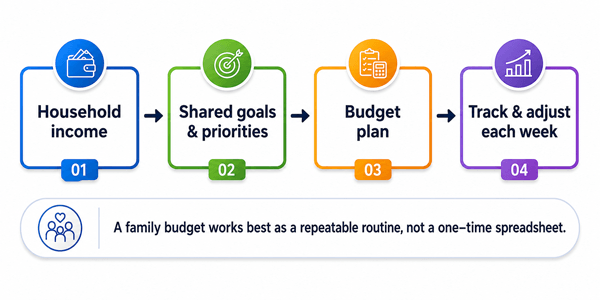
2. Family budget flow diagram
The diagram below shows the basic routine. Start with income, agree on family priorities, build the budget, then track and adjust it regularly.
3. Step-by-step family budgeting guide
Step 1: Calculate total household income
Start with net income, not gross income. Net income is the amount actually available after taxes, payroll deductions, and other automatic deductions. For families with irregular income, use a conservative estimate based on the lower end of recent monthly income.
- Salary or wages after deductions
- Self-employment or freelance income after business costs and taxes
- Child support or family support payments
- Rental income after expenses
- Benefits, pensions, or other regular payments
Example: If one partner earns $2,600 after tax and the other earns $1,400 after tax, the household has $4,000 available for the monthly budget. If one income changes each month, use the lower average and treat extra income as money for savings, debt, or irregular bills.
Step 2: List all household expenses
Write down every regular expense. Use bank statements, receipts, bills, app histories, and memory, but do not rely only on memory. Most families underestimate food, transportation, children’s items, subscriptions, and small cash spending.
| Category | Examples | Budgeting tip |
|---|---|---|
| Housing | Rent/mortgage, property tax, repairs | Keep housing realistic before adding lifestyle spending |
| Utilities | Electricity, water, gas, internet, phone | Track seasonal changes and average them |
| Food | Groceries, school lunches, eating out | Separate groceries from restaurants |
| Transportation | Fuel, public transport, repairs, insurance | Create a repair sinking fund |
| Children and education | Fees, supplies, clothing, activities | Plan before school terms or seasons start |
| Debt payments | Credit cards, loans, installments | Pay at least minimums; prioritize high-interest debt |
| Health | Medicine, appointments, insurance, dental | Keep a medical buffer if possible |
| Savings | Emergency fund, goals, retirement | Treat savings like a bill |
| Giving/family support | Charity, relatives, community support | Set a limit that fits the budget |
| Personal spending | Clothes, hobbies, entertainment | Give adults and older children reasonable limits |
Step 3: Separate needs, wants, and goals
A household budget becomes easier when expenses are sorted into three groups: needs, wants, and goals. This does not mean wants are bad. It simply helps the family decide what must be protected when money is tight.
| Type | Meaning | Examples | Cut first? |
|---|---|---|---|
| Needs | Required for basic living and work | Rent, food, utilities, transport, medicine | Usually no, but compare costs |
| Wants | Improve comfort or enjoyment | Dining out, streaming, upgrades, vacations | Yes, when the budget is tight |
| Goals | Future security or planned priorities | Emergency fund, debt payoff, education, home deposit | Protect as much as possible |
Step 4: Choose a family budgeting method
There is no single best method for every household. Choose the method your family can actually follow.
| Budgeting method | How it works | Best for | Limitations |
|---|---|---|---|
| Zero-based budget | Every dollar is assigned to a job before the month begins | Families that need tight control or debt payoff | Requires more tracking |
| 50/30/20 rule | Income is divided into needs, wants, and savings/debt goals | Beginners who want a simple framework | May not fit high-cost or low-income households |
| Envelope system | Money is divided into spending categories using cash or digital envelopes | Families that overspend in groceries, eating out, or personal spending | Less convenient for online payments |
| Pay-yourself-first | Savings happens before discretionary spending | Families focused on emergency savings or big goals | Can fail if basic bills are underestimated |
| Values-based budget | Spending is aligned with family priorities | Families with conflicting wants or many goals | Still needs numbers and tracking |
Step 5: Build a realistic monthly family budget
Use your income and expense list to create a plan for the next month. A practical family budget usually includes five broad sections: fixed bills, flexible spending, debt, savings, and irregular expenses. If your family is paid weekly or every two weeks, divide bills by payday so the whole month is covered before discretionary spending begins.
| Budget section | Example amount | Notes |
|---|---|---|
| Income after tax | $4,000 | Total household income available |
| Fixed bills | $1,650 | Rent, utilities, insurance, phone, internet |
| Flexible essentials | $950 | Groceries, fuel, basic clothing, school needs |
| Debt payments | $400 | Minimums plus extra if possible |
| Savings and sinking funds | $500 | Emergency fund, annual bills, car repairs, school costs |
| Personal and family wants | $400 | Entertainment, eating out, hobbies, family treats |
| Buffer | $100 | Small surprises so the budget does not break |
In this example, the household does not spend every dollar casually. A small buffer is included because real family life rarely follows a perfect plan.
Step 6: Plan for irregular household expenses
Many family budgets fail because they only include monthly bills. Families also face non-monthly expenses such as school uniforms, birthdays, medical costs, car repairs, annual insurance, holidays, home maintenance, and appliance replacement. These should be handled through sinking funds.
A sinking fund is money saved gradually for a known future expense. For example, if school expenses are expected to cost $600 in six months, save $100 per month. This turns a stressful bill into a planned expense.
| Irregular expense | Expected cost | Due in | Monthly sinking fund |
|---|---|---|---|
| School supplies and uniforms | $600 | 6 months | $100 |
| Car insurance | $720 | 12 months | $60 |
| Holiday spending | $480 | 8 months | $60 |
| Home repairs | $900 | 12 months | $75 |
| Medical/dental buffer | $600 | 12 months | $50 |
Step 7: Track spending without making it complicated
A budget is only useful if you compare it with real spending. Families can track spending with a notebook, spreadsheet, banking app, budgeting app, cash envelopes, or a shared note. The best system is the one the family will consistently use.
- Track daily spending for categories that easily get out of control, such as groceries, snacks, fuel, and eating out.
- Review fixed bills once a month to catch price increases and unused subscriptions.
- Hold a short weekly money check-in instead of waiting until the end of the month.
- Use a shared family budget sheet if more than one adult spends household money.
4. How to involve the whole family in budgeting
Family budgeting works better when it is not treated as one person’s burden. The goal is not to blame anyone. The goal is to agree on priorities and reduce confusion.
For couples or adults sharing expenses
- Agree on what counts as household spending and what counts as personal spending.
- Decide who pays each bill and when it is due.
- Set personal spending amounts for each adult to reduce arguments over small purchases.
- Discuss debt honestly, including minimum payments, interest rates, and payoff goals.
- Use calm monthly meetings instead of only discussing money during a crisis.
For children and teenagers
Children do not need to know every private financial detail, but they can learn healthy money habits. Explain that the family has needs, wants, and goals. Let them help compare prices, plan grocery lists, save for an activity, or choose between two affordable options.
5. Practical ways to reduce household expenses
Reducing expenses does not always mean cutting everything enjoyable. Start with waste, unused costs, and expensive habits that do not match family priorities.
| Area | Practical action | Why it helps |
|---|---|---|
| Groceries | Plan meals, check pantry first, use a list, compare unit prices | Reduces duplicate purchases and food waste |
| Utilities | Use energy-saving habits, repair leaks, review internet/phone plans | Small monthly savings repeat every month |
| Subscriptions | Cancel unused apps, streaming, memberships, and trials | Stops silent budget leaks |
| Transportation | Combine trips, maintain vehicles, compare insurance | Fuel and repair costs add up quickly |
| Debt | Avoid new high-interest debt and pay extra on one target debt | Interest can crowd out savings |
| Children's costs | Buy used where safe, swap items, plan school costs early | Children's needs are predictable but often unplanned |
| Eating out | Set a monthly limit and plan easy backup meals | Prevents convenience spending from becoming routine |
6. How much should a family save?
A common long-term goal is to build an emergency fund that can cover several months of essential expenses. However, beginners should start with a smaller target if money is tight. A first goal might be one week of essential expenses, then one month, then three months. The important point is to start and keep the money separate from everyday spending.
Emergency savings should be easy to access in a real emergency, but not so easy that it gets used for normal shopping. Examples include a separate savings account, a bank sub-account, or another safe account used only for emergencies.
7. What to do when income is low or expenses are higher than income
If expenses are higher than income, the budget is giving useful information, not judging the family. The solution usually requires a mix of cutting costs, increasing income, changing payment plans, and prioritizing essentials.
- Protect essentials first: housing, basic food, utilities, transport to work, medicine, and required child expenses.
- Pause or reduce non-essential spending while the budget is negative.
- Contact lenders or service providers before missing payments when possible.
- Look for benefits, community support, food assistance, fee waivers, or local programs if eligible.
- Consider temporary income options such as overtime, selling unused items, part-time work, freelancing, or renting unused space, where appropriate.
- Avoid using high-interest debt to maintain a lifestyle the income cannot support.
8. Common family budgeting mistakes
| Mistake | Why it causes problems | Better approach |
|---|---|---|
| Budgeting from memory | Small expenses are forgotten | Use statements and receipts |
| Ignoring irregular expenses | Annual bills become emergencies | Use sinking funds |
| Making the budget too strict | Family members give up quickly | Include a realistic buffer and personal money |
| Only one person knows the budget | Creates stress and resentment | Share key numbers and responsibilities |
| Treating savings as optional | Savings disappear when spending rises | Automate or schedule savings like a bill |
| Not reviewing the plan | Prices and needs change | Review weekly and monthly |
| Using debt without a payoff plan | Payments grow over time | Choose a debt strategy and track progress |
9. Sample family budget template
Use this simple template as a starting point. Adjust the categories to match your household.
| Category | Planned | Actual | Difference |
|---|---|---|---|
| Income after tax | |||
| Housing | |||
| Utilities | |||
| Groceries | |||
| Transportation | |||
| Children/education | |||
| Health/medical | |||
| Debt payments | |||
| Emergency fund | |||
| Sinking funds | |||
| Personal spending | |||
| Entertainment/eating out | |||
| Giving/family support | |||
| Buffer | |||
| Total expenses | |||
| Left over or short |
10. Monthly family budget review checklist
- Did all bills get paid on time?
- Which categories went over budget and why?
- Were there any unexpected expenses?
- Did the family add money to emergency savings or sinking funds?
- Are any subscriptions, plans, or services no longer worth the cost?
- Is debt going down, staying the same, or increasing?
- What one change would make next month easier?
11. Family budgeting pros and cons
| Pros | Cons or challenges | How to handle the challenge |
|---|---|---|
| Improves control over household money | Can feel restrictive at first | Include realistic personal spending |
| Reduces financial surprises | Requires tracking and review | Use a simple weekly routine |
| Helps couples and families agree on priorities | Money talks can become emotional | Focus on numbers and shared goals, not blame |
| Supports savings and debt payoff | Irregular income can make planning hard | Use a baseline budget and separate extra income |
| Teaches children healthy money habits | Children may not understand limits immediately | Use age-appropriate examples and choices |
12. Best practices for managing household expenses
- Create the budget before the month begins, not after money is already spent.
- Use net income as the starting point.
- Name every major expense category clearly.
- Give each adult a reasonable personal spending amount if possible.
- Use automatic payments only when the account will have enough money on the due date.
- Build sinking funds for predictable but irregular costs.
- Keep emergency savings separate from normal spending money.
- Review the budget after major life changes such as a new baby, job loss, move, school change, illness, or new debt.
- Make small improvements every month instead of trying to perfect the budget immediately.
■ Frequently asked questions
1. What is the best budget for a family?
The best family budget is the one your household can follow consistently. Many beginners start with a simple monthly budget or the 50/30/20 rule, while families with debt or tight cash flow may prefer a zero-based budget.
2. How do I start a household budget?
Start by writing down monthly take-home income, then list all bills and spending categories. Subtract expenses from income, adjust categories that are too high, and set aside money for savings and irregular expenses.
3. How often should a family review the budget?
A short weekly check-in works well for tracking spending, while a deeper monthly review helps adjust the next month’s plan.
4. Should children be included in family budgeting?
Children can be included in age-appropriate ways. They can help compare prices, understand needs versus wants, and save for goals without seeing private adult financial details.
5. What if my spouse or partner does not want to budget?
Start with shared goals instead of restrictions. Discuss what the family wants money to do: reduce stress, pay bills on time, save for school, travel, debt freedom, or emergency security.
6. How much should a family spend on groceries?
There is no perfect number because costs depend on family size, location, diet, and income. Track your current grocery spending first, then reduce waste through meal planning, pantry checks, and shopping lists.
7. What is a sinking fund in a family budget?
A sinking fund is money saved gradually for a known future expense, such as school fees, car repairs, insurance, holidays, or home maintenance.
8. What should I do if the budget does not balance?
Protect essentials first, reduce non-essential spending, review bills, contact creditors early if needed, and look for safe ways to increase income or access support.
■ Final thoughts
A family budget is not a punishment. It is a household decision-making tool. The first budget may be imperfect, and that is normal. What matters is building a routine: know the income, list the expenses, agree on priorities, track spending, prepare for irregular costs, and adjust each month. Over time, this habit can reduce stress, improve communication, and help the family use money more intentionally.
Reader Advice: This article is for educational and informational purposes only and should not be taken as financial, legal, tax, or professional advice. Please check the latest information from official sources or a qualified professional, because rules, costs, and policies can change over time.
Sources Used:
- Consumer.gov / Federal Trade Commission, “Making a Budget” and “Make a Budget Worksheet.”
- Consumer Financial Protection Bureau, emergency savings and consumer finance education resources.
- FDIC, “Money Smart” financial education resources.
- Financial Consumer Agency of Canada, “Making a budget.”
- Google Search Central, guidance on creating helpful, reliable, people-first content.