Budget Categories Explained: What to Include in Your Personal Budget
Quick answer: The core personal budget categories are income, housing, utilities, food, transportation, insurance, medical costs, debt payments, savings, personal spending, lifestyle, giving, and a small buffer. These categories help beginners plan monthly expenses, track spending, and adjust financial goals without making the budget too complicated.
A personal budget is much easier to manage when your money is organized into clear budget categories. Instead of wondering where your income went, you can see how much was spent on housing, food, transportation, savings, debt, and everyday personal choices. Budget categories turn a messy list of transactions into a simple money map.
This guide explains what budget categories are, which categories belong in a beginner personal budget, how to choose the right categories for your life, and how to avoid making your budget too complicated. The goal is not to create a perfect spreadsheet. The goal is to build a budget you can actually use every month.
1. What Are Budget Categories?
Budget categories are groups that organize your income and expenses. Each category answers one simple question: “What was this money used for?” For example, rent belongs under housing, groceries belong under food, fuel belongs under transportation, and emergency fund contributions belong under savings.
Good budget categories help you plan before spending, track what actually happened, and make better decisions when money feels tight. Without categories, a budget becomes a random list of bills. With categories, you can quickly see which areas are essential, which are flexible, and where changes may be possible.
A strong beginner budget also keeps personal finance advice realistic: it separates general education from personalized financial advice and encourages readers to review current rules, benefits, taxes, and account terms from official sources when needed.
Simple example
Suppose your take-home income is $2,500 per month. If you only write down “expenses,” you may not learn much. But if you divide spending into categories, you might see $900 for housing, $450 for food, $300 for transportation, $250 for debt payments, $200 for savings, and $400 for personal and lifestyle spending. That gives you a clearer picture of your money habits.
2. Why Budget Categories Matter
- They make your budget easier to understand because similar expenses are grouped together.
- They help you spot overspending without judging every individual purchase.
- They make planning easier because you can set limits for each part of your life.
- They help you prepare for irregular expenses such as car repairs, gifts, school costs, and annual subscriptions.
- They make financial goals more realistic because savings and debt payments become planned categories, not leftovers.
The biggest benefit is awareness. Many people do not overspend because they are careless. They overspend because their money is not clearly organized. Budget categories create that organization.
3. The Main Budget Categories to Include in a Personal Budget
Most personal budgets can start with the categories below. You can add or remove categories based on your lifestyle, income, family size, location, and goals. These are the same practical categories people often search for when asking what to include in a personal budget, how to organize monthly expenses, or how to divide needs, wants, savings, and debt.
| Main Category | What It Includes | Beginner Tip |
|---|---|---|
| Income | Salary, wages, freelance income, business income, benefits, side hustle money, investment income, other cash inflows. | Use take-home income, not gross income, for monthly spending plans. |
| Housing | Rent or mortgage, property taxes, home insurance, maintenance, repairs, furniture, household supplies. | Separate rent/mortgage from utilities so you know your true housing cost. |
| Utilities | Electricity, gas, water, trash, internet, phone, heating, cooling, basic service charges. | Use an average amount if bills change by season. |
| Food | Groceries, household food staples, dining out, coffee shops, takeout, school or work lunches. | Split groceries and restaurants if food spending feels high. |
| Transportation | Fuel, public transport, rideshare, car payment, insurance, parking, tolls, repairs, registration. | Car repairs should be planned monthly even when no repair happens. |
| Insurance | Health, auto, life, disability, renter's, homeowner's, travel, and other coverage. | Do not cancel important insurance just to make the budget look better. |
| Medical and Health | Doctor visits, prescriptions, dental care, vision care, therapy, medical devices, copays. | Set aside a small amount monthly if health costs are irregular. |
| Debt Payments | Credit cards, personal loans, student loans, car loans, buy-now-pay-later balances. | Track minimum payments separately from extra debt payoff. |
| Savings and Investments | Emergency fund, retirement, sinking funds, education savings, investing, future goals. | Treat savings like a bill you pay yourself. |
| Personal and Family | Clothing, childcare, education, personal care, gifts, children's needs, pet care. | Create subcategories only when the total is hard to control. |
| Lifestyle and Fun | Entertainment, hobbies, streaming, travel, subscriptions, events, recreation. | This category is not bad; it just needs a clear limit. |
| Giving and Community | Charity, religious giving, family support, community contributions, donations. | Plan generosity so it does not create financial stress. |
| Miscellaneous or Buffer | Small unexpected expenses, price changes, forgotten items, budget rounding errors. | Keep this category small and review it often. |
4. Income: The Starting Point of Every Budget
Income is not an expense category, but it is the first section of a personal budget. Your spending plan depends on how much money is actually available. For most beginners, the safest approach is to budget with net income, also called take-home pay. This is the amount that reaches your bank account after taxes, payroll deductions, and other automatic deductions.
If your income changes from month to month, budget with a conservative estimate. Freelancers, commission workers, students, and business owners may prefer to use the lowest typical monthly income from the past three to six months. When extra income arrives, it can be assigned to savings, debt payoff, annual bills, or other priorities.
Income sources to include
- Main job income
- Part-time or side job income
- Freelance or business income
- Government benefits or support payments
- Rental or investment income
- Scholarships, stipends, or family support if they are regular and reliable
5. Needs, Wants, and Goals: A Simple Way to Group Categories
A helpful beginner framework is to separate budget categories into needs, wants, and financial goals. Needs are required for basic living and work. Wants improve comfort or enjoyment but can usually be adjusted. Financial goals include savings, investing, and paying down debt faster.
| Group | Common Categories | Examples |
|---|---|---|
| Needs | Housing, utilities, groceries, transportation, insurance, basic medical care, minimum debt payments. | Rent, electricity, basic groceries, fuel for work, health insurance, minimum credit card payment. |
| Wants | Dining out, entertainment, hobbies, upgrades, nonessential shopping, travel, premium subscriptions. | Takeout, concerts, new gadgets, vacation spending, extra streaming services. |
| Goals | Emergency savings, sinking funds, retirement contributions, investing, extra debt payments. | Emergency fund transfer, car repair fund, retirement account, extra loan payment. |
This framework is useful because it helps you make decisions. When money is tight, needs usually come first, goals should still receive something if possible, and wants can be reduced temporarily. When income increases, you can increase savings or debt payoff before lifestyle spending grows too quickly. This is also why popular budgeting methods such as the 50/30/20 budget should be treated as flexible guides, not strict rules for every household.
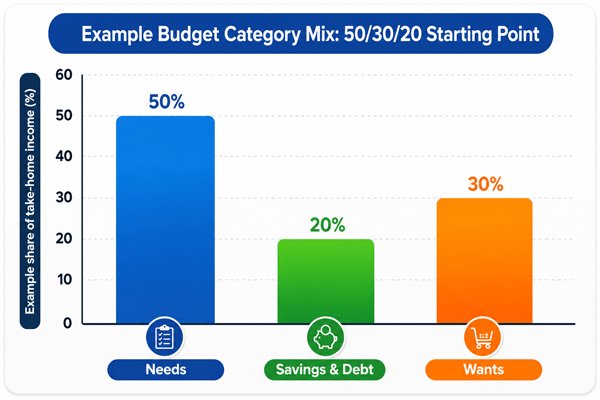
Chart: A 50/30/20 split is only a starting point. Your real budget categories may need different percentages based on income, location, debt, family responsibilities, and financial goals.
■ Essential Budget Categories Explained
1. Housing
Housing is often the largest budget category. It includes rent or mortgage payments, property taxes, renter’s or homeowner’s insurance, repairs, maintenance, furniture, and basic household supplies. If you own a home, repairs should not be ignored just because they do not happen every month. Roof repairs, appliance replacement, plumbing issues, and maintenance costs can be expensive if they are not planned.
Beginner tip: keep your housing category realistic. If housing takes a very large share of your income, the rest of the budget may feel tight even if you manage other categories carefully.
2. Utilities
Utilities include electricity, gas, water, trash, heating, cooling, internet, and phone service. Some people include phone and internet under utilities because they are regular bills. Others separate them if they want to track technology costs more closely. Either method is fine as long as you are consistent.
Beginner tip: if utility bills rise in summer or winter, use a monthly average. Add the past 12 months of bills and divide by 12. This gives you a smoother number to budget each month.
3. Food
Food usually includes groceries, household food staples, takeout, restaurants, coffee, snacks, delivery fees, and work or school lunches. If you are new to budgeting, food is one of the best categories to track because small daily purchases can add up quickly.
A practical setup is to use two subcategories: groceries and dining out. Groceries are usually more essential, while dining out is more flexible. This separation helps you cut spending without making food planning unrealistic.
4. Transportation
Transportation includes any cost that helps you get to work, school, errands, medical appointments, and daily life. Common expenses include fuel, public transportation, rideshare, car payments, auto insurance, parking, tolls, registration, oil changes, tires, and repairs.
Beginner tip: do not only budget for fuel. Cars have hidden costs. Even if you have no repair this month, your car is still wearing down. A small monthly car maintenance fund can prevent future emergencies.
5. Insurance
Insurance is easy to dislike because it feels like paying for something you hope not to use. But it protects your budget from large financial shocks. Depending on your situation, insurance may include health insurance, car insurance, life insurance, disability insurance, renter’s insurance, homeowner’s insurance, or business insurance.
Beginner tip: compare coverage carefully before cutting insurance. A lower premium with poor coverage may cost more later if something goes wrong.
6. Medical and Health
This category covers doctor visits, dental care, vision care, prescriptions, therapy, medical supplies, copays, and out-of-pocket health expenses. Even healthy people can have occasional medical costs, so this category should not be ignored.
You can keep medical spending as a separate category or include it under personal care. Separate tracking is better if your health expenses are regular or significant.
7. Debt Payments
Debt payments include credit cards, student loans, personal loans, car loans, buy-now-pay-later balances, and any money owed to family or friends. In a budget, it helps to separate minimum required payments from extra payments. Minimum payments protect your account from late fees and credit damage. Extra payments help you reduce debt faster.
Beginner tip: if you are paying high-interest debt, avoid treating extra debt payoff as optional forever. Even small extra payments can help reduce interest over time.
8. Savings and Investments
Savings and investments should be planned categories, not whatever is left at the end of the month. This category may include an emergency fund, retirement contributions, education savings, down payment savings, investment accounts, and short-term sinking funds.
A sinking fund is money saved a little at a time for a known future expense. Examples include car repairs, holiday gifts, school fees, insurance premiums, travel, medical costs, or annual subscriptions. Sinking funds make irregular expenses feel predictable.
9. Personal Care and Clothing
Personal care includes haircuts, toiletries, skincare, grooming, laundry, shoes, clothing, and other basic personal items. This category can be essential or flexible depending on the item. Work shoes may be necessary; impulse clothing purchases may be optional.
Beginner tip: if clothing purchases create budget problems, set a monthly or seasonal limit instead of deciding purchase by purchase.
10. Family, Children, and Pets
Families may need categories for childcare, school costs, children’s clothing, activities, allowance, diapers, formula, toys, elder care, family support, and pet expenses. Pet costs may include food, grooming, vet visits, medication, boarding, and emergency care.
Beginner tip: family and pet costs often include irregular expenses. Add sinking funds for school supplies, birthdays, vet care, and seasonal needs.
11. Lifestyle, Entertainment, and Fun
A good budget does not remove all fun. It simply gives fun a limit. Entertainment may include streaming services, hobbies, gaming, sports, concerts, books, travel, eating out, events, and social activities. This is often one of the easiest places to adjust when money is tight.
Beginner tip: cutting every enjoyable expense can make a budget hard to follow. A realistic fun-money category can help you stay consistent.
12. Giving, Gifts, and Community Support
Giving includes charity, religious giving, donations, community support, helping relatives, and gifts for birthdays, weddings, holidays, or other occasions. This category is personal and value-based. The key is to plan it clearly so generosity does not create debt or stress.
13. Miscellaneous and Buffer
A miscellaneous or buffer category covers small surprises and forgotten items. It can protect your budget from falling apart when prices change or a minor unplanned cost appears. However, this category should not become a hiding place for overspending.
A useful rule is to keep a small buffer and review it at the end of the month. If the same expense appears repeatedly, give it its own category.
■ Fixed, Variable, and Irregular Expenses
Budget categories become easier when you understand the type of expense inside each category.
| Expense Type | Meaning | Examples | How to Budget for It |
|---|---|---|---|
| Fixed expenses | Costs that stay mostly the same each month. | Rent, loan payment, insurance premium, subscription. | List the exact amount and due date. |
| Variable expenses | Costs that happen monthly but change in amount. | Groceries, electricity, fuel, dining out. | Set a realistic limit using recent spending history. |
| Irregular expenses | Costs that do not happen every month but are predictable over time. | Car repairs, annual fees, gifts, school costs, travel. | Save monthly in sinking funds before the bill arrives. |
Many beginner budgets fail because they only include fixed monthly bills. A complete personal budget also includes variable and irregular expenses. Irregular expenses are especially important because they often become “emergencies” only because they were not planned.
6. How Much Should You Spend in Each Budget Category?
There is no perfect percentage for every person. A student, a family with children, a freelancer, and a retiree may all need different category limits. However, beginner guidelines can help you start. The safest approach is to compare these ranges with your real take-home income, local cost of living, debt level, and emergency savings needs.
| Category Group | Common Starting Range | Important Notes |
|---|---|---|
| Housing | 25% to 35% of take-home income | May be higher in expensive cities, but high housing costs reduce flexibility elsewhere. |
| Utilities | 5% to 10% | Seasonal bills may require averaging. |
| Food | 10% to 15% | Family size and local prices matter. Separate groceries from dining out. |
| Transportation | 10% to 15% | Can be much lower with public transport or much higher with car payments. |
| Insurance and medical | 5% to 15% | Depends heavily on country, employer benefits, family size, and health needs. |
| Debt payments | 5% to 20% | High-interest debt may need a focused payoff plan. |
| Savings and investments | 10% to 20%+ | Start small if needed, then increase over time. |
| Lifestyle and personal spending | 5% to 15% | Flexible category; reduce when income is tight or goals are urgent. |
| Giving and gifts | 0% to 10% | Personal choice, values, and cultural expectations matter. |
| Buffer or miscellaneous | 2% to 5% | Useful for small surprises, but do not let it become too large. |
These ranges are not strict rules. Use them as a starting point, then adjust based on real life. If your income is low, basic needs may take most of your budget. If you have high debt, debt payments may need more space for a season. If you have an unstable income, savings and buffers become even more important.
■ Step-by-Step: How to Build Your Budget Categories
- List your monthly take-home income. Use conservative income if your earnings change each month.
- Write down your fixed bills. Include rent, loan payments, insurance, subscriptions, and any bill with a due date.
- Review your last one to three months of spending. Group transactions into categories such as food, transportation, personal care, and entertainment.
- Add irregular expenses. Think about annual bills, car repairs, medical costs, holidays, school fees, and gifts.
- Create savings categories. Include emergency savings, sinking funds, retirement, and other goals.
- Set a realistic spending limit for each category. Start with your real spending history, then adjust gradually.
- Track your actual spending during the month. Compare planned amounts with real amounts.
- Review and revise at the end of the month. A budget should improve with use, not be perfect on the first try.
8. Sample Monthly Budget Categories
The example below shows how a person with $3,000 in monthly take-home income might organize a simple budget. The amounts are examples only, not recommendations for every person.
| Budget Category | Planned Amount | Notes |
|---|---|---|
| Income | $3,000 | Monthly take-home pay. |
| Housing | $950 | Rent and renter's insurance. |
| Utilities | $220 | Electricity, water, internet, phone. |
| Food | $450 | Groceries $330, dining out $120. |
| Transportation | $350 | Fuel, insurance, maintenance fund. |
| Medical and health | $100 | Prescriptions, copays, basic health expenses. |
| Debt minimums | $250 | Required loan and credit card payments. |
| Extra debt payoff | $150 | Additional payment toward high-interest debt. |
| Emergency savings | $200 | Automatic transfer after payday. |
| Sinking funds | $150 | Car repairs, gifts, annual fees. |
| Personal and clothing | $150 | Haircuts, toiletries, clothing. |
| Entertainment and fun | $180 | Streaming, hobbies, social activities. |
| Giving and gifts | $100 | Charity, family gifts, community support. |
| Buffer | $100 | Small unexpected costs. |
| Total assigned | $3,000 | Every dollar has a purpose. |
9. How Many Budget Categories Should You Have?
Most beginners do best with 8 to 15 main categories. Too few categories can hide problems. Too many categories can make budgeting feel like homework. The best number is the number that gives you useful information without overwhelming you. If you are just starting, broad categories are usually better; detailed subcategories can be added later for areas such as groceries, restaurants, subscriptions, or car maintenance.
| Budget Style | Best For | Possible Problem |
|---|---|---|
| Simple budget with broad categories | Beginners, busy people, low transaction volume. | May hide overspending inside large categories. |
| Detailed budget with many subcategories | People who enjoy tracking, families, business owners, irregular income earners. | Can become hard to maintain if too detailed. |
| Hybrid budget | Most people. | Requires occasional review to decide which categories deserve detail. |
A good approach is to start broad, then add detail only where needed. For example, start with “Food.” If food spending is too high, split it into “Groceries,” “Restaurants,” “Coffee,” and “Delivery.” Once the problem is controlled, you may simplify again.
10. Budget Categories for Different Life Situations
Students
- Tuition and fees
- Books and supplies
- Transportation
- Food
- Phone and internet
- Personal care
- Emergency savings
- Social activities
Families
- Childcare
- School costs
- Groceries
- Medical care
- Children’s clothing
- Activities
- Gifts and holidays
- Emergency fund
Freelancers and irregular income earners
- Business expenses
- Taxes
- Income buffer
- Health insurance
- Emergency fund
- Professional tools
- Slow-month savings
- Retirement contributions
Homeowners
- Mortgage
- Property taxes
- Home insurance
- Repairs and maintenance
- Appliance replacement
- Utilities
- Home improvement sinking fund
11. Common Budget Category Mistakes
- Forgetting irregular expenses such as annual subscriptions, car maintenance, school fees, or gifts.
- Making too many categories before building the habit of tracking spending.
- Using unrealistic limits that look good on paper but do not match real life.
- Mixing needs and wants in one category when spending is already hard to control.
- Treating savings as optional instead of making it a planned category.
- Leaving out cash spending, small purchases, bank fees, and delivery charges.
- Using a miscellaneous category too often instead of naming repeated expenses clearly.
12. Best Practices for Managing Budget Categories
- Use clear category names that make sense to you.
- Automate savings where possible so goals are funded before money is spent elsewhere.
- Review categories monthly, especially after income changes, moving, marriage, a new child, job loss, or debt changes.
- Create sinking funds for predictable non-monthly expenses.
- Keep a small buffer to reduce stress when small surprises happen.
- Separate groceries from dining out if food costs are hard to manage.
- Track actual spending, not just planned spending.
- Adjust slowly instead of cutting every flexible category at once.
13. Budget Category Checklist
Use this checklist when creating or reviewing your personal budget:
- Income
- Housing
- Utilities
- Food and groceries
- Transportation
- Insurance
- Medical and health
- Debt payments
- Savings and investments
- Emergency fund
- Sinking funds
- Personal care
- Clothing
- Childcare or family expenses
- Pet care
- Education
- Entertainment
- Subscriptions
- Travel
- Giving and gifts
- Miscellaneous or buffer
14. Practical Diagram: Simple Budget Category Flow
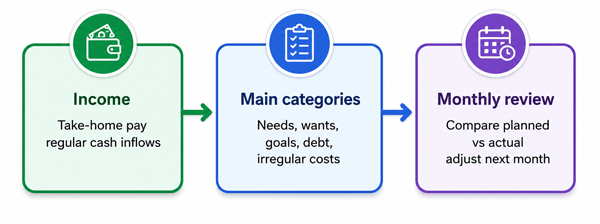
Diagram: A simple personal budget flow from take-home income to main budget categories and monthly review.
| Income | → | Main Categories | → | Monthly Review |
|---|---|---|---|---|
| Salary, business, side income | Needs, wants, savings, debt, irregular expenses | Compare planned vs actual spending | ||
| Use take-home pay | Assign every dollar a purpose | Adjust categories for next month |
■ Frequently Asked Questions
1. What are the basic budget categories everyone should have?
The basic budget categories are income, housing, utilities, food, transportation, insurance, medical costs, debt payments, savings, personal spending, entertainment, giving, and a small miscellaneous or buffer category. Not everyone needs the same subcategories, but most personal budgets should cover these areas.
2. Should savings be a budget category?
Yes. Savings should be a planned budget category. If you only save what is left over, savings may not happen consistently. Include emergency savings, sinking funds, retirement, and other financial goals in your budget.
3. Is debt a need or a financial goal?
Minimum debt payments are usually a need because they are required obligations. Extra debt payments are a financial goal because they help you reduce debt faster and may lower interest costs over time.
4. How do I budget for expenses that do not happen every month?
Use sinking funds. Estimate the yearly cost, divide it by 12, and save that amount each month. For example, if car insurance costs $600 every six months, save $100 per month so the bill is ready when it arrives.
5. What if my budget categories change every month?
Some change is normal. Your core categories may stay the same, while amounts change based on bills, seasons, income, or family needs. Review your budget monthly and adjust before the month begins.
6. Should I use percentages or exact amounts?
Use both if helpful. Percentages are useful for checking balance, but exact amounts are better for daily money management. For example, knowing that food is 15% of income is helpful, but knowing you have $450 for food is more practical.
7. How detailed should my budget categories be?
Start with broad categories and add detail only where it helps. If groceries, restaurants, and coffee are all in one food category and spending is too high, separate them. If a category is easy to control, keep it simple.
8. What is the easiest budget category system for beginners?
The easiest system is to start with broad categories: income, needs, wants, savings, debt, and a small buffer. After one or two months, split only the categories that need more control, such as food, subscriptions, transportation, or personal spending.
■ Final Thoughts
Budget categories are the foundation of a practical personal budget. They help you see where your money goes, prepare for upcoming expenses, control flexible spending, and fund goals on purpose. The best budget categories are not the most complicated ones. They are the categories you understand, review, and use consistently. A simple, accurate category system can also make your budget easier to update, explain, and trust over time.
Start with the main categories in this guide, track your real spending for one month, and then adjust. Over time, your budget will become more accurate, more personal, and more useful. A good budget does not restrict your life; it helps your money support the life you are trying to build.
Reader Advice: This article is for educational and informational purposes only and should not be taken as personalized financial, tax, legal, or investment advice. Please check the latest information from official sources or a qualified professional, because rules, policies, prices, and personal circumstances can change over time.