Bitcoin Fees Explained: Transaction Fees, Mempool and How to Save Money
Key takeaways
- Bitcoin fees are paid to miners, not to Bitcoin itself. The fee helps your transaction compete for limited space in the next blocks.
- Fees are based mostly on transaction size, measured in virtual bytes (vB), not on how much BTC you send.
- The usual pricing unit is sat/vB: satoshis per virtual byte. Total fee = fee rate x transaction size.
- The mempool is the waiting area for unconfirmed transactions. When it is crowded, higher-fee transactions usually confirm faster.
- You can often save money by waiting for quieter periods, using SegWit/Taproot addresses, batching payments, consolidating UTXOs during low-fee periods, and enabling Replace-by-Fee when appropriate.
2. What are Bitcoin transaction fees?
Bitcoin transaction fees are small payments attached to Bitcoin transactions. They are paid to miners as part of the reward for including transactions in a block. A transaction can be valid even with a very low fee, but it may wait longer if many other users are paying more.
Think of Bitcoin block space like seats on a busy train. Every block has limited room. When many people want to use the network at the same time, users compete by attaching higher fees. When demand is low, cheaper transactions can often confirm quickly.
A common beginner mistake is assuming the fee depends on the dollar value of the payment. It does not. Sending $20 of BTC can cost the same as sending $20,000 of BTC if the transaction uses the same number of inputs and outputs. The network cares about data size, not payment value.
3. Why Bitcoin fees exist
Fees serve two important purposes. First, they give miners an incentive to include transactions in blocks. Second, they help prevent spam. If block space were free, attackers could flood the network with low-value transactions at little cost.
Fees also become more important over time because Bitcoin block subsidies are designed to decrease through halvings. Miners currently earn both newly issued bitcoin and transaction fees, but transaction fees are expected to remain an important part of miner incentives in the long run.
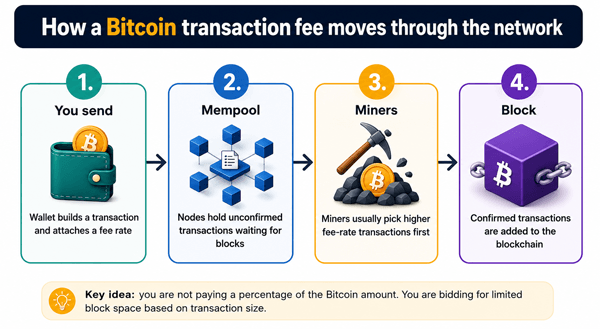
Figure 1: A simple view of how transaction fees help move a Bitcoin transaction from your wallet into a confirmed block.
| Term | Beginner meaning | Why it matters |
|---|---|---|
| Satoshi (sat) | The smallest unit of bitcoin. 1 BTC = 100,000,000 sats. | Fees are usually discussed in sats. |
| vByte (vB) | A measure of a transaction’s effective size after SegWit weighting. | Bigger transactions cost more at the same fee rate. |
| sat/vB | Satoshis paid per virtual byte. | This is the main “bid” miners look at. |
| Mempool | A node’s waiting room for valid but unconfirmed transactions. | A crowded mempool usually means higher fees. |
| Confirmation | A transaction has been included in a block. | More confirmations mean more settlement confidence. |
4. How Bitcoin transaction fees are calculated
4.1 The simple formula
The basic formula is: total fee = transaction size in vB x fee rate in sat/vB. For example, if a transaction is 140 vB and you choose 25 sat/vB, the fee is 3,500 sats. If bitcoin were trading at $60,000, that would be about $2.10. The BTC amount being sent is not part of the formula.
Wallets usually hide the math and show fee choices such as “economy,” “normal,” or “priority.” Still, understanding the formula helps you know when a wallet is overcharging or when a low fee may be too slow.
4.2 Why some transactions are larger than others
A Bitcoin wallet is not like a bank account with one single balance. It is made of spendable pieces called UTXOs, short for unspent transaction outputs. If you have received many small payments, your wallet may need to combine many UTXOs to make one payment. Each input adds data, which increases the transaction size and fee.
Outputs matter too. A normal payment often has two outputs: one to the recipient and one “change” output back to your wallet. More recipients usually mean more outputs. This is why one payment to ten people is larger than one payment to one person, but it can still be cheaper than sending ten separate transactions.
5. What is the Bitcoin mempool?
5.1 The mempool in plain English
The mempool is where unconfirmed Bitcoin transactions wait before they are mined into blocks. Each Bitcoin node has its own mempool, so there is not one single official mempool. However, public mempool explorers provide a useful estimate of current network congestion.
When you broadcast a transaction, it spreads across nodes. Miners then select transactions from their mempools for the next block. They usually choose transactions that pay the highest fee rate because block space is limited and miners are economically motivated.
5.2 Why mempool congestion changes fees
A new Bitcoin block is found roughly every 10 minutes on average, but the exact timing is random. Sometimes blocks arrive quickly; sometimes there is a longer gap. If many transactions arrive during a gap, the mempool can grow and fee rates can rise.
Fees can also spike during market volatility, exchange withdrawals, NFT/inscription activity, large consolidations, or wallet service batching. Because demand changes constantly, there is no fixed “normal” Bitcoin fee.
6. How miners choose transactions
6.1 Fee rate matters more than total fee
Miners usually care about fee rate, not just the absolute fee. A large transaction paying 10,000 sats may be less attractive than a small transaction paying 5,000 sats if the small transaction has a higher sat/vB rate.
This is similar to shipping cargo: a courier cares how much revenue it earns per unit of space. A transaction that pays more per vB makes better use of block space.
6.2 Confirmation targets are estimates, not guarantees
Wallets and fee estimators often say a fee may confirm in “1 block,” “3 blocks,” or “within an hour.” These are estimates, not promises. The next block could arrive in one minute or thirty minutes, and new higher-fee transactions can enter the mempool after yours.
For urgent payments, choose a fee rate with a safety margin and use a wallet that supports fee bumping. For non-urgent payments, it is often reasonable to pay less and wait.
7. Real-world fee examples
7.1 Example 1: A simple wallet payment
Suppose Alice sends bitcoin from a modern SegWit wallet. Her transaction is 140 vB. If she chooses 12 sat/vB, the fee is 1,680 sats. If she chooses 60 sat/vB, the fee is 8,400 sats. The second transaction may confirm faster during congestion, but it costs five times more.
This example shows why small changes in fee rate can matter. The wallet’s recommended option may be convenient, but it may not be the cheapest option if you are not in a hurry.
7.2 Example 2: A wallet with many small UTXOs
Ben has received 50 small payments over time. When he sends a large payment, his wallet may need to spend many inputs. His transaction could be much larger than Alice’s, maybe 1,000 vB or more. At 50 sat/vB, that would cost 50,000 sats. At 5 sat/vB, it would cost 5,000 sats.
This is why UTXO management matters. If Ben consolidates small UTXOs during a low-fee period, future urgent transactions can be smaller and cheaper.
7.3 Example 3: Sending from an exchange
When you withdraw bitcoin from an exchange, the exchange may charge a withdrawal fee that is not the same as the actual on-chain miner fee. Some exchanges charge a flat withdrawal fee to cover operational costs, batching, and network costs. Sometimes the flat fee is higher than the miner fee; sometimes it is lower.
Before moving small amounts from an exchange, check the withdrawal fee. A $20 withdrawal can be uneconomical if the platform charges a high flat fee.
| Fee choice | Best for | Trade-off |
|---|---|---|
| Low / economy | Non-urgent transfers, self-transfers, UTXO consolidation | May take hours or longer during congestion |
| Medium / standard | Normal payments where waiting is acceptable | Costs more than economy but usually reduces delay risk |
| High / priority | Time-sensitive payments, exchange deposits, urgent settlement | Can be wasteful if the mempool clears soon |
| Manual custom fee | Users who check mempool conditions and understand sat/vB | Requires more attention and can cause delays if set too low |
8. How to save money on Bitcoin fees
8.1 Check the mempool before sending
Before sending a non-urgent transaction, look at a mempool explorer or your wallet’s fee estimate. If the mempool is clearing and low-fee transactions are confirming, you may not need to pay a priority fee. If blocks are full of high-fee transactions, paying too little can leave your transaction waiting.
8.2 Use a wallet with custom fees
A good wallet lets you choose a fee target or enter a custom sat/vB rate. Beginner-friendly presets are useful, but manual control helps when you are willing to wait or when the wallet’s estimate looks too high.
8.3 Enable Replace-by-Fee when possible
Replace-by-Fee, or RBF, lets you increase the fee on an unconfirmed transaction by replacing it with a higher-fee version. It is useful when you start with a cheaper fee and only bump it if needed. Some merchants or services may treat unconfirmed RBF transactions as less final, so use it with care for payments that depend on instant trust.
8.4 Use Child-Pays-for-Parent if RBF is not available
Child-Pays-for-Parent, or CPFP, is a method where a new transaction spends the output of a stuck unconfirmed transaction and pays a high enough fee to make miners include both. This is often used when the receiver controls an output from the stuck transaction or when a wallet supports CPFP.
8.5 Prefer SegWit or Taproot addresses
Modern address types generally make transactions more block-space efficient than old legacy addresses. For beginners, this often means using wallets and services that support addresses starting with bc1. Better address support can reduce fees over time.
8.6 Batch payments when you can
If you need to pay several people, one transaction with multiple outputs is usually cheaper than many separate transactions. Businesses, freelancers, miners, and services can save a lot by batching withdrawals or payouts.
8.7 Consolidate UTXOs during low-fee periods
If your wallet has many small UTXOs, future spending may be expensive. During quiet periods, you can send coins to yourself to combine smaller UTXOs into fewer larger ones. Do this only when fees are low and be aware that consolidation can reduce privacy by linking coins together.
8.8 Avoid creating dust
Dust means tiny outputs that may cost more to spend than they are worth. Avoid withdrawing or receiving very small amounts on-chain if fees are high. For small, frequent payments, consider whether Lightning or another payment method is more suitable.
8.9 Do not overpay just because the amount is large
A large-value payment does not automatically need a higher fee. What matters is urgency and transaction size. For a large but non-urgent self-transfer, you can often choose a moderate fee and wait.
8.10 Be careful with “accelerator” services
Some transaction accelerators are legitimate services, but many are unnecessary, expensive, or ineffective. In most cases, RBF, CPFP, or simply waiting is the better first option.
| Method | How it saves money | Main caution |
|---|---|---|
| Waiting for low congestion | Lets low sat/vB transactions confirm when demand drops | Not suitable for urgent payments |
| SegWit/Taproot | Reduces effective transaction size | Both wallet and service support matter |
| Batching | Shares overhead across many payments | Less useful for one-off personal payments |
| UTXO consolidation | Reduces future input count | Can hurt privacy if done carelessly |
| RBF | Start lower and bump only if needed | Not all wallets/services handle it the same way |
| CPFP | Can rescue stuck transactions | Requires wallet support and enough fee on the child transaction |
9. Common beginner mistakes
- Choosing the fastest fee for every transaction Priority fees are useful when time matters, but they can waste money for routine transfers.
- Sending tiny amounts on-chain during high fees Small withdrawals can become uneconomical when miner fees or exchange withdrawal fees are high.
- Ignoring UTXOs Many small inputs can make one transaction surprisingly expensive.
- Turning off RBF without a reason RBF gives you a safety valve if your first fee is too low.
- Trusting one fee estimate blindly Different wallets and explorers can estimate differently. Use judgment, especially for non-urgent transfers.
10. Misconceptions about Bitcoin fees
- “The fee is a percentage of the amount sent.” False. It is mainly based on transaction size and fee rate.
- “A transaction with a low fee is lost forever.” Usually false. It may confirm later, be replaced, be accelerated by CPFP, or eventually be dropped by some mempools and become spendable again in the wallet.
- “One mempool explorer shows the exact truth.” Not exactly. Each node has its own mempool, although good explorers are useful approximations.
- “Miners always choose transactions strictly by fee rate.” Fee rate is the main incentive, but mining policies, package relationships, private deals, and node policies can affect selection.
| Approach | Pros | Cons |
|---|---|---|
| Pay high fee | Fast confirmation probability; less waiting stress | Can be expensive and unnecessary |
| Pay low fee | Saves money when time does not matter | May wait a long time during congestion |
| Use RBF | Flexible; start low and increase later | Needs wallet support; some receivers dislike unconfirmed RBF |
| Use Lightning for small payments | Fast, low-cost payments when supported | Requires channel/liquidity/app support and is different from on-chain settlement |
| Keep coins on exchange to avoid fees | No on-chain fee for internal trades or transfers | Custody risk; withdrawal fees may still apply later |
11. What to do if your Bitcoin transaction is stuck
First, do not panic. A stuck transaction usually means it is waiting with a fee rate that is currently unattractive to miners. Check the transaction ID in a reputable block explorer and look at its fee rate, confirmation status, and whether it signals RBF.
If your wallet supports RBF, use the wallet’s “bump fee,” “increase fee,” or similar option. Choose a fee rate that matches current mempool conditions. If RBF is not available, check whether your wallet supports CPFP. If neither option is available and the payment is not urgent, waiting may be enough.
Avoid entering your seed phrase into any website claiming it can “unstick” your transaction. A real fee-bumping tool does not need your seed phrase. Anyone who asks for it can steal your bitcoin.
12. A simple fee decision checklist
Before pressing send, ask five questions: How urgent is this payment? What fee rate does my wallet suggest? What does the mempool look like? Is RBF enabled? Am I spending many small UTXOs? If the payment is not urgent, consider a lower fee target and be prepared to wait.
For beginners, a safe routine is to use a reputable wallet, keep RBF enabled, choose a lower or medium fee for non-urgent transfers, and check the mempool during unusually high-fee periods.
13. FAQs about Bitcoin fees
13.1 What is a good Bitcoin fee?
A good fee is the lowest fee that meets your timing needs. There is no universal number because mempool demand changes. Check current sat/vB estimates and choose based on urgency.
13.2 Why are Bitcoin fees sometimes so high?
Fees rise when many users compete for limited block space. Congestion can happen during price volatility, exchange activity, inscriptions, wallet consolidations, or long gaps between blocks.
13.3 Can I send Bitcoin with zero fee?
In practice, most modern wallets and nodes will not relay zero-fee transactions. You should expect to attach a fee if you want your transaction to propagate and confirm.
13.4 Who receives Bitcoin transaction fees?
The miner who mines the block containing your transaction receives the transaction fee as part of the block reward.
13.5 Does a higher fee guarantee the next block?
No. It improves probability, but block timing, new transactions, miner policies, and mempool changes can affect confirmation.
13.6 What is sat/vB?
Sat/vB means satoshis per virtual byte. It is the standard way to compare Bitcoin transaction fee rates.
13.7 Why did my wallet fee differ from a block explorer?
Wallets may estimate based on different data, confirmation targets, safety margins, or their own node. Block explorers are useful but not identical to your wallet’s view.
13.8 Is RBF safe?
RBF is safe when used correctly. It lets you increase the fee before confirmation. For merchants accepting unconfirmed payments, RBF increases double-spend risk, so they may wait for confirmations.
13.9 Can a confirmed Bitcoin transaction fee be refunded?
No. Once confirmed, the fee has been paid to the miner and cannot be recovered.
13.10 Is Lightning cheaper than on-chain Bitcoin?
For small, frequent payments, Lightning can be much cheaper and faster when both parties support it. On-chain Bitcoin is still important for final settlement, large transfers, and opening or closing channels.
14. Final thoughts
Bitcoin fees are easiest to understand as a market for block space. You attach a fee rate, your transaction enters the mempool, and miners usually pick the transactions that pay the most per unit of space. When demand is low, fees can be cheap. When demand is high, users compete and fees rise.
The best way to save money is not to guess. Learn the basics of sat/vB, check mempool conditions, use modern address types, keep RBF available, avoid tiny on-chain transactions during congestion, and manage UTXOs if you receive many small payments. With a little patience and the right wallet settings, most users can avoid overpaying while still getting reliable confirmations.
Sources Consulted and Checked
These sources were consulted and checked while preparing this document to support accuracy and clarity.
- Bitcoin Core FAQ: Opt-in Replace-by-Fee
- Bitcoin Core policy documentation: mempool replacements
- Bitcoin Optech topic: Fee estimation
- Bitcoin Optech topic: Replace-by-fee
- mempool.space FAQ and fee/mempool tools
- mempool.space REST API documentation
- Blockchain.com charts: mempool state by fee level
- BitBox blog: UTXO consolidation explanation
Reader Advice
This article is provided for general educational and informational purposes only. It is not personalized legal, financial, investment, tax, security, or technical advice, and it does not recommend any particular transaction, wallet, exchange, service, or fee rate. Bitcoin fees, network conditions, software behavior, service policies, laws, regulations, and statistics can change and may vary by country or region, so verify important details through current official documentation and trusted local sources before acting. Bitcoin transactions may be delayed, may incur unexpected costs, and are generally irreversible once confirmed. Use reputable tools, check addresses and fee settings carefully, never share your seed phrase or private keys, and consider qualified professional guidance where your circumstances or local rules require it.