Bitcoin Security Model Explained: Hashrate, Mining Incentives and Network Attacks
Quick answer
Bitcoin is secured by proof-of-work: miners spend electricity and specialized computing power to compete for the right to add the next valid block. The network follows the valid chain with the most accumulated work. This makes rewriting history expensive because an attacker must redo the work for the block they want to change and then catch up with the honest network.
The security model combines three forces: hashrate, mining incentives, and node validation. Hashrate makes attacks costly. Incentives encourage miners to follow the rules because honest mining earns block rewards and transaction fees. Nodes enforce the rules by rejecting invalid blocks, even if those blocks are produced by powerful miners.
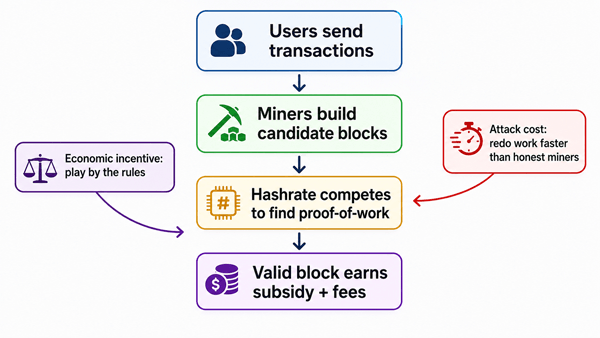
Figure 1: A simplified view of Bitcoin’s security loop.
2. Why Bitcoin needs a security model
Bitcoin is a digital money network with no central bank, payment processor, or administrator deciding which transactions are final. That creates a hard problem: how can thousands of independent computers agree on one shared transaction history when anyone can join the network and some participants may be dishonest?
The classic digital money problem is double spending. If a digital coin is just data, a dishonest person may try to spend the same coin twice: once to a merchant and once back to themselves. Banks solve this with a central ledger. Bitcoin solves it with a public ledger, cryptographic signatures, proof-of-work mining, and economic incentives.
For beginners, the key idea is simple: Bitcoin does not make fraud impossible in a magical way. It makes certain types of fraud extremely expensive, easy for nodes to reject when invalid, and usually less profitable than honest participation.
| Part of the model | What it does | Beginner example |
|---|---|---|
| Digital signatures | Prove that the spender controls the private key for the coins being spent. | Like a tamper-resistant signature that only the owner can produce. |
| Full nodes | Check every block and transaction against Bitcoin’s rules. | Like independent referees that reject invalid plays. |
| Proof-of-work | Makes block production costly and measurable. | Like a lottery where tickets are paid for with real computing work. |
| Hashrate | Represents how much mining computation is securing the chain. | More honest miners mean a higher wall for attackers to climb. |
| Mining rewards | Pay miners to spend resources honestly. | The winning miner receives newly issued bitcoin plus transaction fees. |
3. What is hashrate in Bitcoin?
Hashrate is the total speed at which miners are trying possible answers to Bitcoin’s proof-of-work puzzle. It is usually measured in hashes per second. A hash is the output of a cryptographic function; in Bitcoin mining, miners repeatedly change small pieces of block data and hash the result until they find a hash below the current difficulty target.
You can think of mining as a global guessing contest. Each miner is guessing numbers. Most guesses fail instantly. A valid guess is rare, but easy for everyone else to verify. The more hashrate a miner controls, the more guesses that miner can make per second and the higher the chance they find the next block.
3.1. Why hashrate matters for security
Hashrate matters because changing Bitcoin’s recent history requires competing against the combined work of honest miners. If an attacker wants to reverse a payment that already has confirmations, they must build an alternative chain from an earlier point and make it accumulate more proof-of-work than the honest chain. As more blocks are added after a transaction, the amount of work the attacker must overcome grows.
High hashrate does not mean Bitcoin is invincible. It means a proof-of-work attack becomes more expensive and operationally difficult. The attacker needs hardware, electricity, coordination, timing, and a way to profit from the attack without destroying the value of what they are trying to steal.
3.2. Mining difficulty: how Bitcoin keeps blocks near 10 minutes
Bitcoin automatically adjusts mining difficulty so that blocks are found roughly every 10 minutes on average. If miners add a lot of hashrate, blocks would be found too quickly, so difficulty rises. If miners leave, difficulty eventually falls. This adjustment is important because the network needs predictable block production even as mining hardware and electricity conditions change.
4. How Bitcoin mining works step by step
- Users broadcast signed transactions to the Bitcoin network.
- Nodes check whether the transactions follow the rules, such as not spending coins twice.
- Miners collect valid transactions into a candidate block.
- Miners repeatedly hash the block header while changing a nonce and other data.
- The first miner to find a hash below the target broadcasts the block.
- Nodes verify the block. If it is valid, they accept it and miners begin building on top of it.
The important detail is that miners do not get to change the rules. They propose blocks. Nodes verify them. A miner with huge hashrate can create many blocks, but full nodes will still reject blocks that create too many bitcoins, spend coins without valid signatures, or break other consensus rules.
5. Mining incentives: why miners usually play by the rules
Bitcoin miners are paid through the block reward. The block reward has two parts: the block subsidy, which is newly issued bitcoin, and transaction fees paid by users. After the 2024 halving, the subsidy is 3.125 BTC per block until the next halving period. Fees vary depending on demand for block space.
This reward system is not just a payment mechanism. It is part of Bitcoin’s security design. Miners spend real money on ASIC machines, facilities, cooling, staff, and electricity. Honest mining gives them a predictable way to earn revenue. Attacking the network risks lost rewards, wasted energy, reputational damage, legal exposure, and a possible fall in bitcoin’s price.
| Miner choice | Potential benefit | Major downside |
|---|---|---|
| Mine honestly | Earn block subsidy and transaction fees; keep hardware productive. | Revenue depends on bitcoin price, fees, difficulty, and electricity cost. |
| Attempt a double spend | May reverse the attacker’s own payment if the attack succeeds. | Requires enormous hashrate and timing; may fail; can damage market confidence. |
| Censor transactions | May serve political, competitive, or compliance motives. | Other miners can include the transactions; long-term censorship requires sustained majority control. |
| Mine invalid blocks | No legitimate benefit if nodes enforce rules. | Full nodes reject the block, so the miner wastes the block reward and electricity. |
5.1. What “economic security” really means
Economic security means Bitcoin relies on incentives as well as cryptography. The system assumes that most mining power is controlled by participants who are better off earning rewards than attacking. This is a practical assumption, not a guarantee. It is strongest when mining is decentralized, rewards are meaningful, users run validating nodes, and the market quickly punishes dishonest behavior.
6. Confirmations: how settlement becomes safer over time
A confirmation means a transaction has been included in a block. Each new block added after that is another confirmation. More confirmations make a reversal harder because an attacker must replace more accumulated proof-of-work.
| Situation | Common practical approach | Reason |
|---|---|---|
| Small everyday payment | May accept quickly, sometimes with zero or one confirmation. | The value at risk is low, so waiting may not be worth the delay. |
| Online purchase or exchange deposit | Often waits for multiple confirmations. | The merchant wants more protection against reorgs and double spends. |
| Large transfer | Wait longer and monitor the transaction. | Higher value justifies more caution. |
| Unusual network conditions | Be more conservative. | Fee spikes, congestion, or large reorg concerns can change risk tolerance. |
There is no universal number of confirmations that fits every situation. Six confirmations is a common reference point, but the right number depends on transaction value, business risk, counterparty trust, and current network conditions.
7. Common Bitcoin network attacks explained
Bitcoin’s security model is best understood by looking at what attackers may try to do and where the limits are. Some attacks are serious but expensive. Others sound scary but do less than beginners assume.
| Attack | Plain-English meaning | Main limit or defense |
|---|---|---|
| 51% attack | An attacker controls enough mining power to build a competing chain faster than honest miners. | Can reorganize recent blocks or censor temporarily, but cannot steal coins without private keys or make nodes accept invalid blocks. |
| Double spend | The attacker pays someone, then tries to replace that payment with another transaction paying themselves. | More confirmations make this harder; merchants and exchanges reduce risk by waiting before crediting high-value payments. |
| Censorship attack | A miner or pool refuses to include certain transactions or blocks. | Other miners can still include those transactions unless the censor controls mining power for a sustained period. |
| Selfish mining | A miner withholds blocks to try to gain an advantage over honest miners. | It depends on network conditions and coordination; it does not allow invalid blocks or unlimited control. |
| Eclipse attack | An attacker isolates one node from honest peers and feeds it misleading information. | This targets a victim node or service, not the whole network; good peer diversity and monitoring reduce risk. |
7.1. The 51% attack: the most famous threat
A 51% attack happens when one miner, pool, or coordinated group controls enough hashrate to outpace the rest of the network. The phrase “51%” is a useful shortcut, but the reality is probabilistic. More hashrate gives the attacker a higher chance of success; less hashrate gives them a lower chance, especially as confirmations increase.
A successful majority-hashrate attacker could attempt to reorganize recent blocks and double spend their own coins. They could also censor transactions for as long as they maintain enough control. However, they cannot simply take coins from other wallets, forge digital signatures, or force full nodes to accept invalid blocks.
7.2. Real-world scenario: exchange double spend
Imagine an attacker sends bitcoin to an exchange, waits until the exchange credits the deposit, trades or withdraws another asset, and secretly mines an alternative chain where the original deposit never happened. If the attacker’s private chain becomes longer in accumulated work and is accepted by nodes, the exchange’s deposit transaction can disappear from the main chain. This is why exchanges use confirmation policies and risk controls.
8. Mining pools: useful but a decentralization concern
Most miners do not mine alone because solo mining is extremely unpredictable. Instead, they join mining pools. A pool combines the hashrate of many miners and distributes rewards based on contributed work. This smooths income, especially for smaller miners.
The tradeoff is concentration. If too much hashrate points to a small number of pools, block construction and transaction selection can become more centralized. Pool miners can usually redirect their machines to another pool, so pool control is not the same as owning all the hardware. Still, users should pay attention to mining pool concentration because Bitcoin’s security is healthier when mining power is widely distributed.
| Mining alone | Mining pool |
|---|---|
| Potentially keeps the whole block reward if lucky. | Receives smaller but steadier payouts. |
| Very high variance; small miners may wait years or never find a block. | Lower variance; practical for most miners. |
| More independent block production. | Can contribute to pool concentration if too many miners use the same pool. |
9. Benefits of Bitcoin’s security model
- No central transaction approver is required. Users can verify the ledger with software instead of trusting a bank or payment company.
- The cost of rewriting history rises as more proof-of-work is added after a transaction.
- Invalid blocks are easy for nodes to reject, even if they were expensive for a miner to produce.
- Mining rewards create a business reason to secure the network honestly.
- The rules are transparent: anyone can inspect the software, run a node, and verify the supply and transaction history.
10. Limitations and honest risks
- Proof-of-work uses significant energy because miners compete by performing real computation.
- Security depends partly on continued miner revenue from subsidy and fees. As subsidies decline over time, transaction fees become more important.
- Mining can become geographically, economically, or politically concentrated if energy access, regulation, or hardware supply concentrates.
- A 51% attack is unlikely against Bitcoin compared with small proof-of-work coins, but it is not theoretically impossible.
- Users can still lose money through wallet mistakes, phishing, malware, exchange failures, or sending funds to the wrong address. The network security model does not protect against every user-level risk.
11. Common misconceptions about Bitcoin security
| Misconception | Reality |
|---|---|
| “Miners control Bitcoin.” | Miners propose blocks, but full nodes enforce the rules. Invalid miner blocks are rejected. |
| “A 51% attacker can steal everyone’s bitcoin.” | They cannot spend coins without private keys. The main risk is reorgs, double spends, and censorship. |
| “More confirmations make a payment 100% final.” | They make reversal increasingly impractical, not mathematically impossible. |
| “Hashrate alone is the whole security model.” | Hashrate matters, but incentives, node validation, decentralization, wallet security, and user behavior also matter. |
| “Bitcoin mining is just solving useless math.” | The computation provides a costly signal that helps order transactions without a central authority. Whether the energy cost is worth it is a separate economic and social debate. |
12. Best practices for users, merchants, and beginners
12.1. For ordinary users
- Use a reputable wallet and back up your seed phrase offline.
- Send a small test transaction before moving a large amount for the first time.
- Wait for confirmations when receiving meaningful value from someone you do not fully trust.
- Do not confuse network security with wallet security. Bitcoin can be secure while your phone, exchange account, or seed phrase is not.
12.2. For merchants and exchanges
- Set confirmation requirements based on transaction value and fraud risk.
- Monitor for chain reorganizations and unusual mempool or fee conditions.
- Use dynamic risk policies rather than one fixed confirmation number for every payment.
- Avoid crediting large deposits instantly from unknown counterparties.
- Keep operational security separate from blockchain security: protect hot wallets, withdrawal systems, admin accounts, and private keys.
13. Proof-of-work vs proof-of-stake: quick beginner comparison
| Feature | Bitcoin proof-of-work | Proof-of-stake systems |
|---|---|---|
| Security resource | External cost: specialized hardware and electricity. | Internal capital: staked tokens. |
| Block producers | Miners compete with hashrate. | Validators are selected based on stake and protocol rules. |
| Attack cost | Acquire or rent enough mining power and pay energy costs. | Acquire or control enough stake, depending on the design. |
| Main tradeoff | High energy use but simple external cost model. | Lower energy use but different governance, slashing, and stake-concentration assumptions. |
This comparison is not about declaring one model perfect. It shows that different systems make different security tradeoffs. Bitcoin’s design is built around proof-of-work because it aims to let anyone verify the monetary rules without trusting a central validator set.
14. The future security question: fees after halvings
Bitcoin’s subsidy falls every 210,000 blocks, roughly every four years. Over the long term, miners are expected to rely more on transaction fees. This raises an important open question: will fee revenue be large and stable enough to keep miners highly incentivized as the subsidy becomes smaller?
There is no perfectly certain answer. Higher Bitcoin adoption, more competition for block space, and higher-value settlement use could support fee revenue. On the other hand, if fees are low for long periods, miner revenue could fall, which may reduce hashrate unless offset by higher bitcoin price, more efficient hardware, or cheaper energy. A trustworthy explanation should acknowledge this uncertainty rather than pretend it is solved forever.
15. Summary: how the pieces fit together
Bitcoin security is not one thing. It is a layered model: signatures protect ownership, nodes enforce rules, proof-of-work orders transactions, hashrate makes history costly to rewrite, and mining incentives encourage honest participation. The model works best when hashrate is high, mining is decentralized, users verify with nodes, and recipients use sensible confirmation policies.
For a beginner, the simplest takeaway is this: Bitcoin does not rely on trusting miners to be good. It pays miners to behave honestly and makes dishonest behavior expensive, limited, and visible. That is the heart of the Bitcoin security model.
16. FAQs
16.1. What is the Bitcoin security model in simple words?
It is the combination of cryptography, full-node validation, proof-of-work mining, hashrate, and economic incentives that helps Bitcoin agree on one transaction history without a central authority.
16.2. What does hashrate mean?
Hashrate is the amount of computing power miners use to search for valid blocks. More hashrate means more attempts per second and, generally, a higher cost for attackers trying to rewrite the chain.
16.3. Can Bitcoin be hacked with a 51% attack?
A majority-hashrate attack could reorganize recent blocks, double spend the attacker’s own coins, or censor transactions temporarily. It cannot steal coins without private keys or make nodes accept invalid bitcoins.
16.4. Why do miners receive rewards?
Rewards compensate miners for spending money on hardware and electricity. They also create an incentive to secure the network honestly instead of attacking it.
16.5. Are Bitcoin transactions final?
Bitcoin transactions become harder to reverse as confirmations increase. They are not instantly final in the same way a centralized database entry might appear final, but after enough confirmations reversal becomes increasingly impractical.
16.6. Do miners or nodes control Bitcoin?
Both play different roles. Miners propose blocks and provide proof-of-work. Full nodes independently verify blocks and enforce Bitcoin’s rules.
16.7. Why is proof-of-work energy intensive?
Miners compete by performing real computation, and that computation uses electricity. The energy cost is part of what makes attacks expensive.
16.8. Is high hashrate always good?
High hashrate improves resistance to proof-of-work attacks, but it is not the only factor. Decentralization, node validation, user security, and miner incentives also matter.
Sources Consulted and Checked
These sources were consulted and checked while preparing this document to support accuracy and clarity.
- Satoshi Nakamoto, “Bitcoin: A Peer-to-Peer Electronic Cash System,” bitcoin.org/bitcoin.pdf.
- Bitcoin Developer Documentation, “Block Chain” and “Mining,” developer.bitcoin.org.
- MIT Digital Currency Initiative, “51% Attacks,” dci.mit.edu/projects/51-percent-attacks.
- Cambridge Centre for Alternative Finance, Cambridge Bitcoin Electricity Consumption Index, ccaf.io/cbnsi/cbeci.
- Bitcoin.org reference documentation on block subsidy and halving intervals, developer.bitcoin.org/reference/block_chain.html.
Reader Advice
This article is provided for educational and informational purposes only and is not personalized legal, financial, investment, tax, cybersecurity, or professional advice. Bitcoin transactions, mining, custody, and network activity involve technical, financial, operational, fraud, volatility, and regulatory risks, including the possible loss of funds. Rules, policies, laws, technical conditions, fees, statistics, and industry practices can change over time and may vary by country or region. Before making a decision, verify current information through official and reliable sources, assess your own circumstances and risk tolerance, and seek suitably qualified professional guidance where appropriate.