Bitcoin Mining Explained: How BTC Mining Works and Why It Matters
Bitcoin mining is the process that keeps the Bitcoin network running. It confirms transactions, adds new blocks to the blockchain, protects the system from double spending, and releases new bitcoin into circulation according to a fixed schedule.
The word “mining” can be confusing because no one is digging coins out of the ground. Bitcoin miners use specialized computers to compete in a global guessing game. The winner earns the right to add the next block of transactions and receives bitcoin as a reward. That simple idea is the foundation of Bitcoin’s security model.
This guide explains Bitcoin mining in plain English. You will learn what miners actually do, why mining uses electricity, how rewards work, what mining pools are, whether beginners should mine Bitcoin, and why mining matters even if you never plan to own mining hardware.
- Bitcoin mining is how new blocks are added to the Bitcoin blockchain.
- Miners compete to find a valid SHA-256 hash that meets the network’s current difficulty target.
- The successful miner earns the block subsidy plus transaction fees. After the April 2024 halving, the subsidy is 3.125 BTC per block.
- Difficulty adjusts every 2,016 blocks to keep block production close to one block every 10 minutes on average.
- Modern Bitcoin mining is dominated by ASIC machines and mining pools, not normal laptops or gaming PCs.
- Mining secures Bitcoin, but it also has real costs: electricity demand, hardware expense, heat, noise, regulation, and profitability risk.
2. What Is Bitcoin Mining?
Bitcoin mining is the competitive process of creating valid blocks for the Bitcoin blockchain. A block is a batch of confirmed transactions. When a miner creates a valid block, thousands of Bitcoin nodes around the world check it. If the block follows the rules, nodes add it to their copy of the blockchain.
At a practical level, miners do three jobs: they collect unconfirmed transactions, package those transactions into a candidate block, and repeatedly change a small piece of data called a nonce until the block hash is low enough to satisfy the network target.
Because finding a valid block requires expensive computation, miners cannot cheaply rewrite history. This is the main reason mining matters: it makes the Bitcoin ledger costly to attack and easy for honest nodes to verify.
2.1 A simple analogy: lottery tickets, not math homework
Bitcoin mining is often described as “solving complex math problems.” That phrase is not completely wrong, but it gives beginners the wrong picture. Miners are not solving equations by thinking through them. They are generating enormous numbers of hash attempts per second, like buying lottery tickets at machine speed.
Each hash attempt is unpredictable. A miner cannot know which nonce will work until it tries. The more computing power a miner controls, the more attempts it can make, and the better its chance of finding the next valid block.
3. Why Bitcoin Needs Mining
Bitcoin does not have a central bank, payment processor, or administrator deciding which transactions are final. Mining helps the network agree on the order of transactions without trusting one company or government.
Mining solves two key problems. First, it helps prevent double spending, where someone tries to spend the same bitcoin twice. Second, it creates a fair, open competition for adding the next block, so no single party is automatically in charge of the ledger.
Full nodes enforce Bitcoin’s rules. Miners propose blocks. This difference is important. Miners do not get unlimited power to change Bitcoin. If a miner creates an invalid block, ordinary nodes reject it.
4. How Bitcoin Mining Works Step by Step
The mining process is technical, but the logic is straightforward when broken into steps.
- A user sends a Bitcoin transaction from a wallet. The transaction is broadcast to the peer-to-peer network.
- Nodes check whether the transaction follows Bitcoin’s rules, such as valid digital signatures and no obvious double spend.
- Valid unconfirmed transactions wait in the mempool, which is like a public waiting room for transactions.
- Miners choose transactions, usually prioritizing those with higher fees per unit of block space.
- The miner builds a candidate block with a block header, a list of transactions, and a special coinbase transaction that pays the miner.
- Mining hardware repeatedly hashes the block header while changing the nonce and other data.
- When a miner finds a hash below the difficulty target, it broadcasts the block.
- Nodes verify the block. If valid, it becomes the newest block in the chain.
The diagram below shows the process in a simplified form.
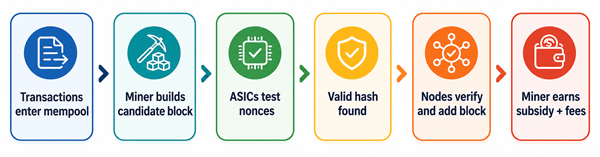
Figure 1: Simplified Bitcoin mining workflow.
5. Proof-of-Work Explained Simply
Proof-of-work is the rule that makes miners prove they spent real computing effort before their block can be accepted. In Bitcoin, this work is based on the SHA-256 hashing algorithm. A hash is a fixed-length digital fingerprint of data. Even a tiny change in the input creates a completely different output.
Bitcoin sets a target. To mine a block, miners need a block hash that is lower than that target. If the target is very low, valid hashes are rare. That means miners need more attempts on average. This is what people mean when they say mining difficulty has increased.
Proof-of-work is hard to produce but easy to verify. A miner may spend huge amounts of electricity searching for a valid hash, but a node can check that hash almost instantly.
5.1 What Is Mining Difficulty?
Mining difficulty measures how hard it is to find a valid block compared with the easiest possible setting. Bitcoin adjusts difficulty every 2,016 blocks, roughly every two weeks, to keep the average block interval close to 10 minutes.
If many miners join and total hash rate rises, blocks may arrive too quickly for a while. The next difficulty adjustment makes mining harder. If miners leave and blocks slow down, the next adjustment makes mining easier. This automatic feedback loop helps Bitcoin keep a predictable issuance schedule.
5.2 What Do Miners Actually Earn?
A successful Bitcoin miner earns two types of revenue: the block subsidy and transaction fees. The subsidy is newly issued bitcoin. Transaction fees are paid by users who want their transactions included in a block.
After the fourth Bitcoin halving in April 2024, the block subsidy became 3.125 BTC. This subsidy is cut in half every 210,000 blocks, approximately every four years. Over time, fees are expected to become a more important part of miner revenue as the subsidy keeps shrinking.
| Revenue source | What it means | Beginner note |
|---|---|---|
| Block subsidy | New bitcoin issued to the miner who creates a valid block. | 3.125 BTC per block after the April 2024 halving. |
| Transaction fees | Fees paid by users whose transactions are included in the block. | Fees vary with network demand and block space competition. |
| Pool payout | A share of rewards distributed by a mining pool. | More predictable than solo mining, but includes pool rules and fees. |
5.3 Bitcoin Halving and the 21 Million Supply Cap
Bitcoin’s supply schedule is written into its rules. The subsidy started at 50 BTC per block in 2009. It later fell to 25 BTC, 12.5 BTC, 6.25 BTC, and then 3.125 BTC after the 2024 halving.
This is why Bitcoin is often described as having a fixed supply. New bitcoin issuance slows over time and is expected to approach the 21 million cap around the year 2140. The exact timing depends on block production, but the rule is not controlled by a company or committee.
5.4 Bitcoin Mining Hardware: From CPUs to ASICs
In Bitcoin’s earliest days, people could mine with ordinary computer CPUs. As competition increased, miners moved to GPUs, then FPGAs, and eventually ASICs. An ASIC, or application-specific integrated circuit, is a machine designed for one job: hashing Bitcoin’s SHA-256 algorithm as efficiently as possible.
Today, a normal laptop is not a realistic Bitcoin miner. It may technically be able to run mining software, but it will almost certainly earn less than it costs in electricity and may damage the device through heat.
| Era / hardware | Beginner explanation | Practical status today |
|---|---|---|
| CPU mining | Using a normal computer processor. | Historically important, not competitive for Bitcoin today. |
| GPU mining | Using graphics cards to calculate hashes. | Useful for some other coins historically, not realistic for Bitcoin. |
| FPGA mining | Programmable hardware between GPUs and ASICs. | Mostly replaced by ASICs. |
| ASIC mining | Specialized machines built for Bitcoin SHA-256 hashing. | Industry standard for serious Bitcoin mining. |
5.5 What Is a Bitcoin Mining Pool?
A mining pool is a group of miners who combine their hash power and share rewards. Because the chance of one small miner finding a block alone is extremely low, pools make income more predictable.
For example, imagine a miner has a tiny fraction of the global hash rate. Solo mining might mean waiting years without a block. In a pool, that miner receives small regular payouts based on contributed work, minus the pool fee. The tradeoff is that the miner relies on the pool operator for payout accounting and block construction policies.
6. Bitcoin Mining Profitability: What Beginners Must Consider
Bitcoin mining is a business calculation, not a guaranteed income stream. Profit depends on bitcoin price, mining difficulty, electricity cost, hardware efficiency, pool fees, cooling, taxes, downtime, and regulatory conditions.
A simple rule: if your electricity is expensive, Bitcoin mining is usually not profitable. Many professional miners operate where power is cheap, infrastructure is strong, and cooling is manageable.
| Factor | Why it matters | Question to ask |
|---|---|---|
| Electricity cost | Usually the largest operating expense. | What is my true all-in rate per kWh? |
| ASIC efficiency | Efficient machines produce more hashes per watt. | How many joules per terahash does it use? |
| Bitcoin price | Revenue is usually valued in fiat currency. | Can I survive a major price drop? |
| Difficulty | Higher difficulty lowers expected BTC earned per unit of hash power. | What happens if difficulty rises? |
| Cooling and noise | ASICs produce heat and can be very loud. | Can my location handle this safely? |
| Regulation and taxes | Rules vary by country, state, and utility. | Is mining allowed and how is it taxed? |
6.1 Real-World Example: Home Miner vs Industrial Miner
A home miner might buy one ASIC, plug it into a garage, and join a pool. The machine may be loud, hot, and power-hungry. Even if it earns bitcoin, the electricity bill may exceed the value of the mining rewards.
An industrial miner may run thousands of ASICs in a purpose-built facility with negotiated power rates, ventilation, maintenance staff, firmware management, and uptime monitoring. This scale can improve economics, but it also increases exposure to debt, regulation, energy prices, and market cycles.
6.2 Why Bitcoin Mining Uses So Much Electricity
Mining uses electricity because proof-of-work deliberately requires real-world cost. Miners spend power to compete for block rewards. The security idea is that attacking Bitcoin would require controlling enough hash power and energy resources to outcompete honest miners.
This design creates a serious debate. Supporters argue that mining turns energy into a neutral, decentralized settlement system. Critics argue that the energy use, emissions, noise, water use, and electronic waste can be harmful, especially when mining relies on fossil fuels or strains local grids. Both points matter. A trustworthy view should acknowledge that mining provides network security but has environmental and community costs that depend heavily on energy source, location, regulation, and equipment lifecycle.
7. Benefits of Bitcoin Mining
Bitcoin mining helps secure the network, process transactions, and issue new bitcoin without a central authority. It also creates a market-based incentive for participants to follow the rules because invalid blocks waste money.
In some locations, miners can act as flexible electricity buyers, shutting down during grid stress or using power that might otherwise be wasted. However, these benefits are situation-specific and should not be treated as automatic proof that all mining is beneficial.
| Potential benefit | What it means | Important limitation |
|---|---|---|
| Network security | Hash power makes rewriting the chain expensive. | Security depends on broad, competitive mining participation. |
| Decentralized issuance | New bitcoin enters circulation by protocol rules. | Large pools can still create centralization concerns. |
| Transaction settlement | Miners include transactions in blocks. | Fees rise when block space demand is high. |
| Flexible energy demand | Some miners can reduce load during grid stress. | Only true where contracts and operations allow it. |
8. Risks and Limitations of Bitcoin Mining
Mining has important risks. Hardware can become obsolete. Difficulty can rise. Bitcoin price can fall. Electricity rates can change. Regulations can tighten. A pool can have payout issues. Noise and heat can create problems for neighbors or landlords.
There is also opportunity cost. A beginner who spends thousands of dollars on an ASIC may have been better off simply buying bitcoin, learning about self-custody, or avoiding crypto exposure altogether depending on their financial situation and risk tolerance.
| Risk | What can go wrong | Practical mitigation |
|---|---|---|
| Financial loss | Revenue may not cover hardware and electricity. | Stress test assumptions before buying. |
| Hardware failure | ASICs can break, overheat, or become obsolete. | Budget for maintenance and resale risk. |
| Noise and heat | Home setups can disturb people and damage spaces. | Measure noise, ventilation, and electrical capacity first. |
| Regulatory risk | Some locations restrict mining or energy usage. | Check current local rules before operating. |
| Scams | Cloud mining and “guaranteed ROI” offers can be fraudulent. | Avoid unrealistic returns and verify providers carefully. |
9. Common Bitcoin Mining Mistakes
Beginners often underestimate total costs. The machine price is only one part. You also need to consider power supply, electrical wiring, cooling, ventilation, repair, import duties, pool fees, internet reliability, taxes, and the resale value of hardware.
Another mistake is using online calculators without stress testing assumptions. Profitability calculators are useful, but they are snapshots. Run scenarios with lower bitcoin price, higher difficulty, higher electricity cost, and hardware downtime before making a purchase.
10. Common Misconceptions About Bitcoin Mining
Misconception 1: miners create bitcoin from nothing. More accurately, miners receive newly issued bitcoin only when they follow the network rules and produce a valid block.
Misconception 2: miners control Bitcoin. Miners are powerful service providers, but full nodes enforce the rules. If miners produce invalid blocks, nodes reject them.
Misconception 3: mining is easy passive income. In reality, mining is competitive, operationally demanding, and often unprofitable for small users with normal electricity rates.
Misconception 4: Bitcoin mining and crypto staking are the same. Mining uses proof-of-work hardware and electricity. Staking belongs to proof-of-stake systems, where validators lock coins instead of performing hash work.
11. Should a Beginner Mine Bitcoin?
For most beginners, directly mining Bitcoin at home is not the best first step. It is usually better to learn how Bitcoin works, understand wallets and private keys, study fees and confirmations, and compare the cost of mining with simply buying bitcoin or not investing at all.
Home mining may make sense for hobbyists who want hands-on experience, have very cheap electricity, can handle heat and noise, and accept that the project may lose money. It is rarely a good idea to borrow money to buy mining equipment or to trust a “guaranteed return” cloud mining offer.
12. Best Practices Before You Start Mining
Before buying any mining equipment, calculate your all-in electricity cost per kilowatt-hour, check local rules, understand your machine’s power draw and noise level, verify the seller, compare pool fees, and plan for cooling. Also decide how you will store any bitcoin you earn. Mining rewards should eventually be moved to a wallet you control if you are comfortable managing private keys.
Keep records for taxes. In many countries, mined bitcoin may create taxable income when received and capital gains or losses when sold. Rules vary by location, so consult a qualified tax professional if real money is involved.
13. Bitcoin Mining vs Buying Bitcoin
Many beginners ask whether it is better to mine bitcoin or simply buy it. The answer depends on costs, skills, and goals.
| Option | Best for | Main advantage | Main downside |
|---|---|---|---|
| Mining bitcoin | Technically minded users with cheap power and suitable space. | Earn BTC through operations and learn the network hands-on. | High complexity, hardware risk, noise, heat, and uncertain profitability. |
| Buying bitcoin | Users who want exposure without running machines. | Simple compared with mining. | Market risk remains and custody must be handled carefully. |
| Doing neither | People who do not understand the risks or cannot afford losses. | Avoids financial and operational risk. | No direct exposure to Bitcoin upside. |
14. Bitcoin Mining vs Proof-of-Stake
| Feature | Bitcoin proof-of-work mining | Proof-of-stake systems |
|---|---|---|
| Main resource | Specialized hardware and electricity. | Locked coins or validator stake. |
| Security cost | External energy and hardware cost. | Economic penalty risk for bad validators. |
| Who participates? | Miners with hash power. | Validators with stake and infrastructure. |
| Bitcoin uses it? | Yes. | No. Bitcoin does not use staking. |
15. Quick Answer: How Does Bitcoin Mining Work?
Bitcoin mining works by having specialized computers repeatedly hash candidate blocks until one miner finds a hash that meets Bitcoin’s difficulty target. That miner broadcasts the block, nodes verify it, and the valid block is added to the blockchain. The miner receives the block subsidy and transaction fees. This proof-of-work process helps secure Bitcoin and keeps new bitcoin issuance predictable.
16. FAQs About Bitcoin Mining
16.1 Is Bitcoin mining legal?
It depends on your country, region, utility rules, and property situation. Some places allow it, some restrict it, and some may regulate industrial-scale energy use. Always check current local rules before buying equipment.
16.2 Can I mine Bitcoin on my phone or laptop?
Technically, some software may allow hash calculations, but it is not practical for Bitcoin. Modern Bitcoin mining requires ASIC hardware. Phones and laptops cannot compete and may be damaged by heat.
16.3 How long does it take to mine one Bitcoin?
Miners do not usually mine “one Bitcoin” at a predictable personal rate. The network mines blocks about every 10 minutes on average, and each successful block currently includes a 3.125 BTC subsidy plus fees. Individual miners typically join pools and earn small proportional payouts.
16.4 Why are Bitcoin blocks about 10 minutes apart?
Bitcoin targets an average block interval of about 10 minutes. Difficulty adjusts every 2,016 blocks to help maintain that average as total hash power changes.
16.5 What happens when all 21 million bitcoin are mined?
The block subsidy will eventually approach zero, and miners will rely on transaction fees. This process is expected to take until around 2140. Bitcoin’s security budget may depend increasingly on fee demand over time.
16.6 Do miners choose which transactions get confirmed?
Miners choose which valid transactions to include in their candidate blocks, usually based on fee rate. But nodes still verify whether those transactions and blocks follow Bitcoin rules.
16.7 Is Bitcoin mining bad for the environment?
Mining consumes significant electricity and can have environmental impacts depending on energy source, location, grid conditions, cooling, e-waste, and regulation. It is more accurate to evaluate specific mining operations than to assume every operation has the same impact.
16.8 What is cloud mining?
Cloud mining means paying someone else to mine on your behalf. It is risky because many offers are unprofitable, opaque, or fraudulent. Be especially cautious of guaranteed returns.
16.9 What is hash rate?
Hash rate is the number of hash attempts per second. A higher hash rate means more chances to find a valid block, but also usually means more electricity use.
16.10 Can miners change Bitcoin’s 21 million supply limit?
Miners alone cannot change Bitcoin’s rules. A change to the supply limit would require broad agreement from the ecosystem and, most importantly, acceptance by nodes. Invalid blocks are rejected by nodes.
17. Beginner Checklist Before Mining Bitcoin
- Calculate your all-in electricity cost per kWh, including taxes and fees.
- Check whether your electrical circuit can safely support the ASIC load.
- Measure expected noise and heat before placing a miner at home.
- Compare mining revenue estimates across pessimistic and optimistic scenarios.
- Avoid any offer promising guaranteed mining profits.
- Understand pool fees, payout thresholds, and payout methods.
- Plan secure bitcoin storage and tax recordkeeping before your first payout.
- Start as a learning project, not as a guaranteed income plan.
18. Conclusion: Why Bitcoin Mining Matters
Bitcoin mining matters because it is the mechanism that connects Bitcoin’s digital ledger to real-world economic cost. Miners compete to add blocks, nodes verify those blocks, and proof-of-work makes attacks expensive. This system allows Bitcoin to operate without a central settlement authority.
For beginners, the most important lesson is balance. Mining is not magic money, and it is not only a technical curiosity. It is a competitive industry with real infrastructure, real costs, and real tradeoffs. Understanding mining helps you understand why Bitcoin works, why fees and confirmations matter, why energy debates exist, and why decentralization depends on more than software alone.
Sources Consulted and Checked
These sources were consulted and checked while preparing this article and reviewing its accuracy.
- Bitcoin Developer Documentation — “Developer Guides” and proof-of-work/mining references
- Bitcoin.org — “How does Bitcoin work?” and related educational resources
- Cambridge Centre for Alternative Finance — Cambridge Bitcoin Electricity Consumption Index methodology
- Cambridge Centre for Alternative Finance — Cambridge Bitcoin Electricity Consumption Index dashboard
- U.S. Energy Information Administration — “Tracking electricity consumption from U.S. cryptocurrency mining operations”
- Investopedia — “Bitcoin Halving”
Reader Advice
This article is provided for educational and informational purposes only. It is not personalized legal, tax, financial, investment, electrical-safety, or regulatory advice, and it does not recommend that any reader buy Bitcoin, mining equipment, or a mining service. Bitcoin mining can involve substantial financial loss, price volatility, equipment failure, high electricity costs, heat, noise, fire or wiring hazards, scams, tax obligations, and changing legal or utility restrictions. Rules, policies, laws, technical conditions, market data, and statistics can change over time and vary by country, region, utility, and property. Before making a decision or spending money, verify current information through official sources, assess whether you can afford the risks, and seek advice from appropriately qualified professionals where necessary.