What Is Bitcoin? Beginner Guide to BTC, Digital Gold and Decentralized Money
1. Quick Answer: What Is Bitcoin?
Bitcoin is a decentralized digital currency and payment network. It lets people send value online without relying on a bank, card company, or payment app to approve the transaction. The currency unit is bitcoin, often shortened to BTC. Transactions are recorded on a public ledger called the blockchain, and the network is maintained by thousands of independent computers called nodes.
Bitcoin is often called “digital gold” because its supply is limited, it is not issued by a government, and many people use it as a long-term store of value. But Bitcoin is also different from gold: it can move across the internet, can be divided into tiny units, and can be held directly in a digital wallet.
| Beginner Question | Simple Answer |
|---|---|
| Who created Bitcoin? | Bitcoin was introduced in 2008 by the pseudonymous creator Satoshi Nakamoto and launched in 2009. |
| What does BTC mean? | BTC is the common ticker symbol for bitcoin, similar to how USD represents U.S. dollars. |
| Is Bitcoin physical? | No. Bitcoin exists as entries on a distributed digital ledger, not as coins or notes. |
| Who controls Bitcoin? | No single company, government, or person controls the network. Rules are enforced by software run by users and nodes. |
| How many bitcoins can exist? | The protocol is designed for a maximum supply of 21 million BTC. |
| Can Bitcoin be divided? | Yes. One bitcoin can be divided into 100,000,000 satoshis, often called sats. |
| Is Bitcoin risk-free? | No. Bitcoin is volatile, technical mistakes can be costly, scams are common, and rules vary by country. |
2. What Problem Was Bitcoin Designed to Solve?
Before Bitcoin, online payments normally required a trusted middleman. A bank, payment processor, or platform had to confirm that the sender had money, move the funds, and prevent the same money from being spent twice. This works well for many everyday payments, but it also creates dependence on intermediaries.
Bitcoin was designed as peer-to-peer electronic money. “Peer-to-peer” means one person can send value directly to another over the internet, while the Bitcoin network checks the rules instead of a central authority. The original idea was not simply to create another investment asset. It was to create money that could be transferred digitally without needing permission from a financial institution.
A simple way to think about it: email lets you send messages without asking the post office to deliver each one. Bitcoin tries to do something similar for value, using cryptography, a public ledger, and economic incentives.
3. Bitcoin vs bitcoin: Network and Asset
People use the word Bitcoin in two ways:
- Bitcoin with a capital B usually means the network, protocol, software, and overall system.
- bitcoin with a lowercase b usually means the currency unit that people buy, sell, send, receive, or hold.
BTC is the market ticker. If someone says “I bought BTC,” they mean they bought units of bitcoin, not shares in a company. Bitcoin does not have revenue, employees, a CEO, or quarterly earnings. Its value depends on market demand, network security, perceived scarcity, liquidity, regulation, and user confidence.
4. How Bitcoin Works in Plain English
Bitcoin works by combining several ideas: a public ledger, digital signatures, decentralized validation, mining, and fixed monetary rules. You do not need to become a programmer to understand the basics.
4.1 The Blockchain Is Bitcoin’s Public Ledger
The Bitcoin blockchain is a chronological record of transactions. Instead of one bank keeping the ledger, many computers around the world keep copies. New transactions are grouped into blocks. Each block links to the previous block, creating a chain of records that becomes increasingly difficult to alter.
The blockchain does not store coins inside a wallet like files in a folder. It records which addresses have the right to spend certain amounts. Your wallet helps you prove you control those funds.
4.2 Wallets Hold Keys, Not Coins
A Bitcoin wallet is software or hardware that manages cryptographic keys. The most important idea for beginners is this: your wallet does not literally store bitcoin. It stores private keys that allow you to sign transactions and spend bitcoin recorded on the blockchain.
| Term | Meaning | Beginner Example |
|---|---|---|
| Public address | A shareable destination for receiving bitcoin. | Like an email address for payments. |
| Private key | A secret that proves you can spend bitcoin from an address. | Like the master password to your funds. |
| Seed phrase | A backup phrase that can restore your wallet. | Usually 12 or 24 words. Keep it offline and private. |
| Transaction fee | A fee paid to miners to include your transaction in a block. | Higher fees may confirm faster when the network is busy. |
4.3 Transactions Are Signed and Broadcast
When you send bitcoin, your wallet creates a transaction and signs it with your private key. This signature proves that you have the right to spend the funds without revealing the private key itself. The transaction is then broadcast to the Bitcoin network, where nodes check whether it follows the rules.
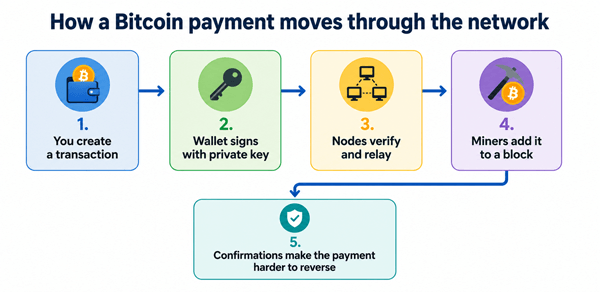
Diagram: A simplified view of how a Bitcoin transaction moves from wallet to network confirmation.
4.4 Nodes Verify the Rules
A full node is software that independently checks Bitcoin transactions and blocks. Nodes verify that coins are not being spent twice, block rules are followed, and invalid transactions are rejected. This is one reason Bitcoin is decentralized: users do not have to trust a single server to tell them what is valid.
4.5 Miners Secure the Network
Bitcoin uses proof of work mining. Miners use specialized computers to compete for the right to add the next block of transactions. The winning miner receives newly issued bitcoin plus transaction fees, but only if the block follows Bitcoin’s rules. If a miner tries to cheat, nodes can reject the block.
Mining is energy-intensive by design because it makes rewriting the blockchain expensive. This is also one of Bitcoin’s most debated limitations, especially when people compare Bitcoin with traditional payment systems or proof-of-stake cryptocurrencies.
4.6 Confirmations Reduce Reversal Risk
A Bitcoin transaction is often described as “confirmed” once it is included in a block. Each new block after that adds another confirmation. For small payments, one confirmation may be enough. For large transfers, exchanges and businesses often wait for more confirmations because each additional block makes reversal harder.
5. Why Is Bitcoin Called Digital Gold?
Bitcoin is called digital gold because many people see it as a scarce, non-sovereign asset. Gold is valuable partly because it is hard to produce, widely recognized, and not controlled by one issuer. Bitcoin shares some of those ideas in digital form.
| Feature | Gold | Bitcoin |
|---|---|---|
| Supply | Naturally scarce, but total above-ground and future supply are estimates. | Programmed maximum supply of 21 million BTC. |
| Portability | Physical transport can be expensive and difficult. | Can be sent globally over the internet. |
| Divisibility | Can be divided, but not conveniently for small online payments. | Divisible into 100 million satoshis per BTC. |
| Verification | Requires testing, trusted sellers, or professional custody. | Can be verified by software and public blockchain data. |
| History | Thousands of years of monetary and cultural history. | Launched in 2009, so it has a much shorter track record. |
| Custody risk | Can be stolen, counterfeited, or held by custodians. | Can be self-custodied, but lost keys can mean permanent loss. |
The comparison is useful, but it is not perfect. Bitcoin is far more volatile than gold, depends on internet-connected infrastructure, and has a shorter history. “Digital gold” should be understood as an analogy, not a guarantee of safety or price performance.
6. Bitcoin’s Supply: Why 21 Million Matters
Bitcoin’s monetary policy is built into its protocol. New bitcoins are issued to miners through block rewards, and those rewards are cut in half roughly every 210,000 blocks. This event is called the halving. The April 2024 halving reduced the block subsidy from 6.25 BTC to 3.125 BTC per block.
The fixed supply is one reason some investors view Bitcoin as a hedge against currency debasement. But scarcity alone does not guarantee value. A scarce asset still needs demand, liquidity, security, and trust in the rules.
| Concept | Beginner Explanation |
|---|---|
| Maximum supply | Bitcoin is designed so no more than 21 million BTC can be created. |
| Halving | The new BTC issued per block is periodically cut in half. |
| Satoshis | Tiny units of bitcoin. 1 BTC = 100,000,000 sats. |
| Lost coins | Some BTC may be permanently inaccessible if private keys or seed phrases are lost. |
7. How Do People Use Bitcoin in Real Life?
Bitcoin can be used in several ways. Different users value different features.
| Use Case | How It Works | Practical Example |
|---|---|---|
| Long-term holding | A person buys BTC and stores it for years. | Someone allocates a small portion of savings to BTC as a high-risk store-of-value asset. |
| International transfer | Bitcoin can be sent across borders without bank rails. | A freelancer receives BTC from a client in another country. |
| Self-custody | Users hold their own private keys instead of relying on a bank. | A hardware wallet stores keys offline. |
| Payments | BTC can be spent where merchants accept it. | A customer pays an online service in BTC or via Lightning where available. |
| Portfolio exposure | Investors may buy BTC directly or through regulated products where available. | Some U.S. investors use spot Bitcoin ETPs approved for exchange trading. |
8. Bitcoin vs Traditional Money
| Question | Traditional Bank Money | Bitcoin |
|---|---|---|
| Who issues it? | Usually central banks and commercial banks. | Issued by protocol rules through mining. |
| Who approves payments? | Banks, payment networks, and processors. | Network nodes and miners according to protocol rules. |
| Can accounts be frozen? | Yes, depending on bank policy, law, or court order. | Bitcoin addresses cannot be frozen by the protocol, but custodial accounts can be restricted. |
| Are payments reversible? | Card and bank payments can often be reversed or disputed. | Confirmed Bitcoin transactions are generally irreversible. |
| Is value stable? | Major fiat currencies are usually less volatile day to day. | BTC price can move sharply. |
| Who handles mistakes? | Banks may help with fraud or mistaken transfers. | Users are usually responsible for their own transactions and keys. |
9. Bitcoin vs Other Crypto Assets
Bitcoin was the first successful decentralized cryptocurrency, but it is not the only crypto asset. Many other tokens have different goals, trade-offs, and risks.
| Asset Type | Main Idea | Key Difference from Bitcoin |
|---|---|---|
| Bitcoin (BTC) | Scarce decentralized money and settlement network. | Focuses on security, decentralization, and fixed supply. |
| Ethereum (ETH) | Programmable blockchain for smart contracts and apps. | More flexible app platform; different monetary and technical design. |
| Stablecoins | Tokens designed to track fiat currencies like the U.S. dollar. | Usually depend on issuers, reserves, or collateral mechanisms. |
| Meme coins | Community-driven speculative tokens. | Often have weaker fundamentals and higher speculation risk. |
A beginner mistake is assuming all crypto assets are basically the same. They are not. Bitcoin’s investment case, technical design, liquidity, regulatory treatment, and risk profile differ from many other tokens.
10. Main Benefits of Bitcoin
- Decentralization: No single company or government operates the entire network.
- Fixed supply: The maximum supply is designed to be 21 million BTC.
- Global access: Anyone with an internet connection and compatible wallet can use the network, subject to local laws and exchange access.
- Self-custody: Users can hold their own private keys instead of relying on a custodian.
- Transparency: Transactions are recorded on a public blockchain that anyone can inspect.
- Portability: Large amounts of value can be moved digitally without physically transporting an asset.
11. Main Risks and Limitations of Bitcoin
- Price volatility: BTC can rise or fall sharply over short periods.
- Permanent mistakes: Sending to the wrong address or losing a seed phrase can be irreversible.
- Scams and fraud: Fake investment platforms, impersonation scams, phishing, and romance scams are common.
- Custodial risk: Keeping BTC on an exchange means trusting that company’s security, solvency, and compliance.
- Regulatory uncertainty: Rules for taxes, trading, payments, and custody vary by country and can change.
- Technical complexity: Beginners may struggle with fees, addresses, backups, confirmations, and wallet security.
- Energy debate: Proof-of-work mining uses significant electricity, which remains a major criticism and policy issue.
12. How to Buy Bitcoin Safely as a Beginner
Buying Bitcoin is not difficult, but beginners should move slowly. The goal is not just to buy BTC. The goal is to avoid common errors that can cause permanent loss.
- Learn the basics first. Understand wallets, fees, private keys, and volatility before buying.
- Use a reputable exchange available in your country. Check licensing, security history, fees, withdrawal support, and customer service.
- Start small. Make a small test purchase before committing larger amounts.
- Decide between custodial and self-custody storage. Exchanges are convenient; personal wallets give more control but require more responsibility.
- Make a test withdrawal. If moving BTC to your own wallet, send a small amount first and confirm it arrives.
- Protect accounts with strong passwords and two-factor authentication. Avoid SMS-based 2FA when stronger app or hardware methods are available.
- Keep records. Purchases, sales, swaps, and income may create tax reporting obligations depending on your country.
13. Wallet Types: Which Bitcoin Wallet Should a Beginner Use?
| Wallet Type | Best For | Pros | Cons |
|---|---|---|---|
| Exchange account | New users buying small amounts. | Easy to start; password recovery; integrated buying and selling. | You do not control the private keys; exchange risk. |
| Mobile wallet | Small everyday amounts. | Convenient and quick for payments. | Phone loss, malware, or weak backups can be risky. |
| Desktop wallet | Users who want more control on a computer. | More features and control than many mobile wallets. | Computer security matters; malware risk. |
| Hardware wallet | Long-term storage and larger balances. | Private keys stay offline; strong security when used correctly. | Costs money; seed phrase must be backed up carefully. |
| Multisig wallet | Advanced users, businesses, or larger holdings. | Requires multiple keys, reducing single-point failure. | More complex to set up and recover. |
13.1 Self-Custody Checklist
- Write your seed phrase on paper or metal, not in a cloud note, email, or screenshot.
- Store backups in secure locations protected from theft, fire, water, and accidental discovery.
- Never type your seed phrase into a website or share it with support staff, friends, or strangers.
- Send a small test transaction before transferring a larger amount.
- Understand how to restore your wallet before relying on it for meaningful funds.
14. Bitcoin Transaction Fees Explained
Bitcoin transaction fees are not based simply on the dollar amount sent. They depend mainly on transaction data size and network demand. When many users want block space at the same time, fees rise. When demand is lower, fees can fall.
Practical example: Sending $50 and sending $5,000 may cost a similar network fee if the transaction uses a similar amount of blockchain data. This surprises beginners who expect fees to work like card payment percentages.
- For urgent payments, choose a fee that is likely to confirm soon.
- For non-urgent transfers, you may be able to choose a lower fee and wait longer.
- Some wallets support fee bumping features, but beginners should learn how their wallet handles this before relying on it.
15. Is Bitcoin Anonymous?
Bitcoin is not fully anonymous. It is better described as pseudonymous. Transactions are public, but addresses are not automatically tied to real-world names. However, if an address is connected to your identity through an exchange, merchant, public post, data leak, or analysis company, your activity may become traceable.
For most beginners, the practical lesson is simple: do not assume Bitcoin transactions are private. Use good privacy habits, understand local laws, and avoid posting addresses publicly unless you are comfortable with the transparency.
16. Is Bitcoin Legal?
Bitcoin’s legal status depends on where you live and how you use it. In many countries, owning or trading Bitcoin is legal but regulated. In some places, access may be restricted or rules may be unclear. Taxes also vary. For example, in the United States, the IRS says digital asset transactions may need to be reported, and income from digital assets is taxable.
Beginners should check local rules before buying, selling, mining, or accepting BTC as payment.
17. Common Bitcoin Mistakes Beginners Should Avoid
| Mistake | Why It Hurts | Better Practice |
|---|---|---|
| Buying because of hype | You may buy near a peak without understanding the risk. | Set a plan and only risk money you can afford to lose. |
| Leaving large balances on an exchange | Exchange hacks, freezes, insolvency, or account problems can affect access. | Learn self-custody or use regulated custody appropriate for your needs. |
| Sharing a seed phrase | Anyone with the seed can steal the funds. | Keep it offline, private, and never enter it into unknown websites. |
| Sending to the wrong address | Bitcoin transactions are usually irreversible. | Copy carefully, verify addresses, and test with a small amount. |
| Ignoring taxes | Sales, swaps, income, or payments may be reportable. | Keep clear records from the beginning. |
| Falling for guaranteed returns | No legitimate Bitcoin investment can guarantee profits. | Be skeptical of pressure, secrecy, and promises of easy money. |
18. Bitcoin Scams: Red Flags to Know
Scammers use Bitcoin because payments are difficult to reverse and can move quickly. The FTC and FBI warn that fake investment opportunities, romance scams, impersonation, and pressure tactics are common in crypto fraud.
- Someone promises guaranteed profits or “risk-free” crypto returns.
- A stranger, romantic interest, influencer, or “trader” tells you exactly where to send money.
- You are told to use a Bitcoin ATM urgently to avoid arrest, taxes, account closure, or legal trouble.
- A platform lets you see fake gains but demands more deposits before withdrawals.
- Someone asks for your seed phrase, private key, or wallet recovery words.
- You are pressured to act immediately or keep the opportunity secret.
Best practice: Slow down. Real financial services do not need your seed phrase, and legitimate government agencies do not demand Bitcoin payments through ATMs.
19. Should You Invest in Bitcoin?
Bitcoin may be suitable for some people as a small, high-risk part of a diversified portfolio. It may be unsuitable for people who need stable value, cannot tolerate large losses, or do not want to manage security and tax complexity.
Before investing, ask yourself:
- Do I understand what Bitcoin is and why it is risky?
- Can I handle a large price drop without panic selling?
- Am I using money I can afford to leave invested or lose?
- Do I know how I will store it safely?
- Do I understand the tax rules in my country?
- Am I buying because of a plan rather than social media hype?
A practical beginner approach is to learn first, start small, avoid leverage, and never treat Bitcoin as a guaranteed path to wealth.
20. Bitcoin Myths and Misconceptions
| Myth | Reality |
|---|---|
| Bitcoin is only used by criminals. | Bitcoin is used for many legal purposes, including saving, payments, donations, and investment. Illicit use exists, but public blockchain records can also help investigations. |
| Bitcoin is completely anonymous. | Bitcoin is pseudonymous and often traceable, especially when exchanges or public data connect addresses to identities. |
| You must buy a whole bitcoin. | You can buy a fraction of a bitcoin, such as a few dollars worth, depending on platform minimums. |
| Bitcoin has no fees. | Bitcoin transactions can have network fees, and exchanges may charge trading or withdrawal fees. |
| Bitcoin is guaranteed to go up because supply is limited. | Limited supply does not guarantee demand or price appreciation. |
| If I lose my password, Bitcoin support can recover it. | There is no central Bitcoin support desk. Recovery depends on your wallet setup and backups. |
21. Actionable Beginner Best Practices
- Treat Bitcoin education as part of the investment. Spend time learning before risking meaningful money.
- Use small test transactions when learning wallets and withdrawals.
- Use two-factor authentication and a password manager for exchange accounts.
- Do not use leverage or borrowed money to buy BTC.
- Create a written storage plan: where your wallet is, where backups are, and how trusted heirs could access funds if necessary.
- Review fees before buying, selling, or transferring.
- Track cost basis, dates, and transaction history for tax purposes.
- Be skeptical of urgency, secrecy, guaranteed returns, and anyone requesting your seed phrase.
22. Frequently Asked Questions About Bitcoin
22.1 What is Bitcoin in one sentence?
Bitcoin is decentralized digital money that can be sent over the internet without a bank, using a public blockchain and cryptographic proof.
22.2 What does BTC stand for?
BTC is the common ticker symbol for bitcoin. It is used on exchanges and price charts.
22.3 Who owns Bitcoin?
No one owns the Bitcoin network. Individuals, companies, miners, developers, exchanges, and node operators participate, but no single entity controls it.
22.4 Can Bitcoin be hacked?
The Bitcoin protocol has proven highly resilient, but wallets, exchanges, users, and devices can be hacked or compromised. Most losses happen through scams, bad custody, phishing, malware, or lost keys rather than someone breaking Bitcoin’s core cryptography.
22.5 Can I buy less than one bitcoin?
Yes. Bitcoin is divisible. You can buy a small fraction of one BTC, depending on the exchange minimum.
22.6 What is a satoshi?
A satoshi, or sat, is the smallest standard unit of bitcoin. One BTC equals 100,000,000 satoshis.
22.7 Why does Bitcoin have value?
Bitcoin has value because people are willing to exchange goods, services, or other money for it. Demand is influenced by scarcity, decentralization, security, liquidity, brand recognition, macro conditions, and belief in its long-term usefulness.
22.8 Is Bitcoin money or an investment?
It can be used as both, but its role depends on the user. Some use it for payments or self-custody. Others treat it as a speculative investment or store-of-value asset.
22.9 Is Bitcoin better than gold?
It depends on the purpose. Bitcoin is more portable and digitally native, while gold has a much longer history and usually lower volatility. Many investors compare them but they are not identical.
22.10 What happens when all 21 million bitcoins are mined?
New block subsidies are expected to end far in the future. Miners would then rely on transaction fees. How the fee market evolves is an important long-term question.
22.11 Is Bitcoin environmentally friendly?
Bitcoin mining uses significant electricity. Supporters argue that mining can use stranded or renewable energy in some cases; critics argue the energy use is excessive. Beginners should understand that energy use is a real and ongoing debate.
22.12 Do I need a wallet to buy Bitcoin?
Not always. An exchange can hold BTC for you, but that means the exchange controls the private keys. A personal wallet is needed if you want self-custody.
22.13 Can Bitcoin transactions be reversed?
Generally, no. Once confirmed, Bitcoin transactions are difficult to reverse. This is useful for final settlement but risky if you make a mistake or get scammed.
22.14 Is Bitcoin legal tender?
In most countries, Bitcoin is not legal tender. Some jurisdictions have adopted it in specific ways, but legal status varies and can change.
22.15 What is the safest way to store Bitcoin?
There is no single best method for everyone. Small amounts may be fine in a reputable exchange or mobile wallet. Larger long-term holdings often require a hardware wallet, strong backups, and careful recovery planning.
23. Final Thoughts: Bitcoin Is Simple to Use, But Not Simple to Master
Bitcoin is a new kind of digital money: scarce, decentralized, global, and programmable only within strict rules. For beginners, the most important lesson is balance. Bitcoin can be useful and innovative, but it is also volatile, unforgiving, and surrounded by scams and misinformation.
The best approach is to learn the basics, start small, protect your keys, avoid hype, understand tax and legal obligations, and make decisions based on your own risk tolerance. Bitcoin is worth understanding whether you choose to buy it or not, because it has changed how people think about money, ownership, and financial networks in the digital age.
Sources Consulted and Checked
These sources were consulted and checked while preparing this document to support accuracy and clarity.
- Satoshi Nakamoto, “Bitcoin: A Peer-to-Peer Electronic Cash System.”
- Bitcoin.org, “Running A Full Node,” explaining full-node validation.
- U.S. Securities and Exchange Commission, statement on approval of spot Bitcoin exchange-traded products, January 10, 2024.
- CoinGecko, Bitcoin Halving information: April 20, 2024 halving at block 840,000; reward reduced to 3.125 BTC.
- Cambridge Centre for Alternative Finance, Cambridge Blockchain Network Sustainability Index and Cambridge Digital Mining Industry Report.
- U.S. Internal Revenue Service, “Digital Assets” and virtual currency transaction FAQs.
- U.S. Federal Trade Commission, “What To Know About Cryptocurrency and Scams.”
- Federal Bureau of Investigation and Internet Crime Complaint Center, cryptocurrency investment fraud and complaint resources.
Reader Advice
This article is provided for educational and informational purposes only. It is not personalized financial, investment, tax, or legal advice, and it does not recommend buying, selling, or holding Bitcoin. Bitcoin involves substantial risks, including price volatility, scams, technical mistakes, loss of access, platform or custody failures, and possible tax or regulatory consequences. Laws, policies, platform rules, and statistics can change and may vary by country or region, so readers should verify current information through official sources and consider qualified professional advice before making decisions involving money or digital assets.