Bitcoin Ordinals and BRC-20 Tokens Explained: NFTs and Tokens on Bitcoin
1. Key Takeaways
- Bitcoin Ordinals are a way to number and track individual satoshis, the smallest units of bitcoin.
- Inscriptions attach data such as images, text, audio, code, or JSON instructions to a satoshi, creating Bitcoin-native digital artifacts.
- BRC-20 is an experimental token standard that uses Ordinal inscriptions and JSON text to deploy, mint, and transfer token balances on Bitcoin.
- Ordinals are often called Bitcoin NFTs, but they do not work like Ethereum NFTs because Bitcoin does not use the same smart-contract model.
- The main benefits are Bitcoin-native settlement, on-chain data, open access, and new creative uses. The main risks are high fees, wallet mistakes, scams, low liquidity, indexer differences, and experimental protocol risk.
2. What Are Bitcoin Ordinals?
Bitcoin Ordinals are a method for giving individual satoshis unique identities. A satoshi, often called a “sat,” is the smallest unit of bitcoin. One bitcoin equals 100,000,000 satoshis. Normally, users think of bitcoin as a balance in a wallet. Ordinal theory looks one level deeper and treats each sat as something that can be numbered, tracked, collected, and transferred.
The important idea is simple: if every sat can be identified, then data can be attached to a specific sat. That data attachment is called an inscription. The combined result is what many people casually call a Bitcoin Ordinal or a Bitcoin NFT.
Strictly speaking, an Ordinal and an inscription are not the same thing. An Ordinal is the numbered sat. An inscription is the content attached to it. In everyday conversation, however, people often use “Ordinals” to mean inscribed sats.
3. Why Did Ordinals Become Possible on Bitcoin?
Ordinals did not require Bitcoin to launch a new token, sidechain, or smart-contract platform. They use features already available on Bitcoin, especially the way transaction witness data works after SegWit and the flexibility introduced by Taproot. These upgrades made it more practical to include data in Bitcoin transactions.
The Ordinals protocol was launched in January 2023 by developer Casey Rodarmor. It quickly became one of the most discussed developments in Bitcoin because it expanded Bitcoin’s use beyond simple peer-to-peer payments without changing Bitcoin’s core consensus rules.
This matters because Bitcoin is intentionally conservative. New features that work without changing the base protocol can spread quickly, but they can also create debate about whether they are a good use of block space.
4. Ordinals, Inscriptions, and Bitcoin NFTs: The Simple Difference
A beginner can think of the system in three layers. Bitcoin provides the blockchain and the sats. Ordinal theory gives sats an order and identity. Inscriptions add content to those sats.
When the content is unique, such as a piece of art or a collectible image, people compare the result to an NFT. But Bitcoin Ordinals are not ERC-721 NFTs. They do not rely on Ethereum-style smart contracts, and many inscriptions store the actual content directly in Bitcoin transaction data rather than pointing to external metadata.
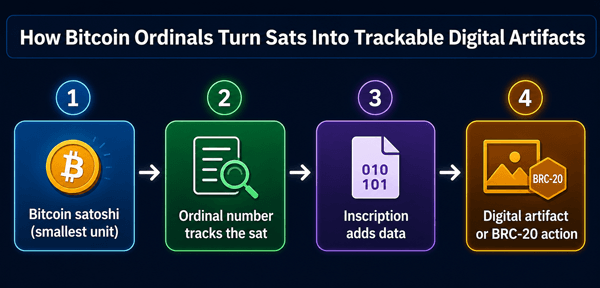
Figure 1: A simplified beginner view of how a satoshi becomes a trackable digital artifact.
| Term | Plain-English meaning | Beginner example |
|---|---|---|
| Satoshi (sat) | The smallest unit of bitcoin. | If 1 BTC is a dollar bill, sats are the tiny cents that make it up. |
| Ordinal | A sat that can be identified and tracked by its order. | Sat number 1,234,567,890 can be followed through transactions. |
| Inscription | Data attached to a sat. | A small image, text note, or JSON file written into Bitcoin transaction data. |
| Bitcoin NFT / digital artifact | A unique inscribed sat that people collect or trade. | A generative art image fully tied to a Bitcoin sat. |
| BRC-20 token | A token balance represented through JSON inscriptions and off-chain indexing. | A meme token minted and transferred through BRC-20 inscriptions. |
5. How Do Bitcoin Ordinals Work?
Bitcoin does not store account balances the same way a bank app does. Instead, it uses unspent transaction outputs, known as UTXOs. Your wallet balance is made up of pieces of bitcoin that can be combined, split, and sent. Ordinal theory follows sats as they move through these outputs.
The technical details can become complex, but the user experience is easier to understand. A wallet that supports Ordinals helps keep track of which UTXO contains the inscribed sat. When you send an Ordinal, you are sending the sat that carries the inscription, not just sending a random amount of bitcoin.
This is why ordinary Bitcoin wallet behavior can be risky for Ordinals. If a wallet does not understand inscriptions, it may accidentally spend the sat that contains your digital artifact as part of a normal Bitcoin transaction.
6. What Can Be Inscribed on Bitcoin?
Inscriptions can contain many types of data, including text, images, audio, video, HTML, code, and JSON. In practice, file size matters because Bitcoin block space is limited and transaction fees can be expensive. Smaller files are usually cheaper to inscribe than large files.
Common examples include pixel art, generative art, profile-picture collections, historical messages, rare-sat collectibles, HTML experiments, and BRC-20 JSON operations.
7. Are Bitcoin Ordinals Really NFTs?
They are NFT-like, but not identical to NFTs on Ethereum, Solana, or other smart-contract chains. A typical Ethereum NFT is usually a token created by a smart contract, with ownership and transfer rules defined in code. The media may be stored on IPFS, Arweave, a server, or sometimes fully on-chain.
A Bitcoin Ordinal inscription is different. It is attached to a satoshi and tracked by Ordinal-aware software. There is no ERC-721-style smart contract controlling it. This gives Ordinals a more Bitcoin-native feel, but it also means users rely on wallets, marketplaces, explorers, and indexers to interpret and display them correctly.
| Feature | Bitcoin Ordinals | Typical Ethereum NFT |
|---|---|---|
| Base system | Bitcoin sats plus inscriptions | Smart contract token standard such as ERC-721 or ERC-1155 |
| Where ownership lives | Ownership follows the Bitcoin UTXO containing the inscribed sat | Ownership is recorded in a smart contract |
| Where content lives | Often directly in Bitcoin transaction data, depending on inscription | Often metadata links to IPFS, Arweave, or external storage |
| Programmability | Limited; Bitcoin does not offer Ethereum-style smart contracts | High; smart contracts can add royalties, traits, access rules, DeFi use, and more |
| Main risk for beginners | Accidentally spending the inscribed sat or using unsupported wallets | Smart-contract bugs, approvals, phishing, metadata issues |
8. What Are BRC-20 Tokens?
BRC-20 tokens are experimental fungible tokens created on Bitcoin using the Ordinals inscription protocol. “Fungible” means each unit is intended to be interchangeable with another unit of the same token, similar to how one dollar is interchangeable with another dollar.
BRC-20 was introduced in March 2023 by the pseudonymous developer Domo as an experiment. It does not work like Ethereum’s ERC-20 standard. ERC-20 tokens are controlled by smart contracts. BRC-20 tokens use simple JSON text inscriptions to define actions such as deploy, mint, and transfer.
Because Bitcoin itself does not run this token logic as smart-contract code, BRC-20 depends heavily on off-chain indexers. Indexers read the Bitcoin blockchain, interpret BRC-20 inscriptions, and calculate token balances according to the standard’s rules. This makes BRC-20 useful and creative, but also more fragile than many beginners expect.
8.1 How BRC-20 Works: Deploy, Mint, Transfer
Most BRC-20 activity falls into three actions. A deploy inscription creates the token rules. A mint inscription creates token units according to those rules. A transfer inscription prepares and moves token balances. These actions are written as JSON data inside inscriptions.
For example, a deploy inscription may define a ticker, maximum supply, and mint limit. A mint inscription may request a certain amount of that ticker. A transfer inscription may move a defined amount from one holder to another, assuming indexers consider it valid.
| BRC-20 action | What it does | Simple example |
|---|---|---|
| Deploy | Creates the token parameters. | Create a token ticker called EXMP with a maximum supply of 21,000,000. |
| Mint | Claims or creates token units under the deploy rules. | Mint 1,000 EXMP if supply remains and the mint follows the limit. |
| Transfer | Moves an amount to another address using a transfer inscription. | Send 250 EXMP to another Ordinals-compatible wallet. |
| BRC-20 | ERC-20 |
|---|---|
| Runs on Bitcoin through Ordinal inscriptions. | Runs on Ethereum or EVM chains through smart contracts. |
| Uses JSON inscriptions and off-chain indexing. | Uses on-chain contract code and contract state. |
| Limited programmability and limited composability. | Strong programmability and broad DeFi integration. |
| Transfers can be clunky and fee-sensitive. | Transfers are usually straightforward through token contracts. |
| Experimental and more dependent on wallet/indexer support. | Mature standard with wide infrastructure support. |
9. Real-World Scenarios
- Digital art collector: A collector buys a Bitcoin-native artwork because they value that the art data is inscribed on Bitcoin itself. They use an Ordinals-compatible wallet and keep the artifact separate from everyday BTC spending.
- Meme token trader: A trader buys a BRC-20 token on a marketplace. They understand that the token is experimental, liquidity can disappear, and fees can make small trades uneconomical.
- Builder or brand: A project uses inscriptions to publish small pieces of content, proof-of-existence records, or community collectibles directly on Bitcoin. The project plans around file size, transaction fees, and long-term indexing.
- Long-term Bitcoiner: A Bitcoin user ignores Ordinals as collectibles but still cares because inscriptions can affect fee markets and block space demand.
10. Benefits of Bitcoin Ordinals and BRC-20 Tokens
- Bitcoin-native settlement: Ordinals and BRC-20 activity settles on Bitcoin’s base layer rather than a separate chain.
- On-chain permanence: Many inscriptions store their content directly in Bitcoin transaction data, which appeals to collectors and archivists.
- New miner fee demand: Inscriptions can increase transaction fee revenue for miners, which some supporters see as helpful for Bitcoin’s long-term security budget.
- Creative experimentation: Artists, developers, and communities can build new cultural and token experiments on Bitcoin.
- Open participation: Anyone with the right wallet and enough BTC for fees can inscribe, mint, or transfer assets.
11. Risks and Limitations
- High transaction fees: When demand for block space rises, minting or transferring inscriptions can become expensive.
- Wallet mistakes: Using a wallet that does not support Ordinals can lead to accidentally spending or losing an inscribed sat.
- Indexer dependence: BRC-20 balances depend on indexers interpreting inscriptions correctly and consistently.
- No smart-contract guarantees: BRC-20 does not have the same programmable safeguards or composability as ERC-20.
- Market volatility: Many Ordinals collections and BRC-20 tokens are speculative, illiquid, and vulnerable to hype cycles.
- Scams and phishing: Fake marketplaces, fake mints, malicious links, and impersonator collections are common in crypto markets.
- Community disagreement: Some Bitcoin users see inscriptions as valid fee-paying transactions; others view them as wasteful use of block space.
12. Common Beginner Mistakes to Avoid
- Sending an Ordinal to a normal Bitcoin wallet that cannot identify or protect inscriptions.
- Keeping valuable Ordinals in the same wallet used for everyday BTC transactions.
- Assuming BRC-20 works exactly like ERC-20 just because the names sound similar.
- Minting tokens without checking fees, supply limits, ticker authenticity, and marketplace support.
- Buying because of social-media hype without checking liquidity, holder distribution, and project history.
- Ignoring UTXO management and accidentally mixing inscribed sats with ordinary BTC.
13. Best Practices Before You Buy, Mint, or Transfer
- Use an Ordinals-compatible wallet and learn how it separates inscriptions from normal BTC.
- Start with a small test transaction before moving anything valuable.
- Keep collectibles in a dedicated wallet, not your main Bitcoin savings wallet.
- Check the exact collection, inscription number, ticker, and marketplace URL before buying.
- Compare transaction fees with the value of the asset. Small mints can become irrational when fees spike.
- Understand that BRC-20 is experimental and depends on indexers. Do not treat balances as risk-free.
- Back up your seed phrase securely and never enter it on a website or share it with support accounts.
- Research the community, trading volume, and history. A low floor price does not mean a good deal if no one wants to buy later.
14. Misconceptions About Ordinals and BRC-20
| Misconception | Reality |
|---|---|
| “Ordinals changed Bitcoin’s consensus rules.” | Ordinals use existing Bitcoin transaction rules. They did not require a hard fork or new Bitcoin token. |
| “Every Ordinal is an NFT in the Ethereum sense.” | Ordinals are NFT-like digital artifacts, but they do not use the same smart-contract model. |
| “BRC-20 tokens are just like ERC-20 tokens.” | They are much more limited and rely on inscriptions plus indexers rather than smart contracts. |
| “On-chain means risk-free.” | On-chain data can still be linked to scams, copied art, bad markets, and user custody mistakes. |
| “Cheap token price means upside.” | Many BRC-20 tokens have weak liquidity, unclear utility, and high risk of collapse. |
15. Where Do Bitcoin Runes Fit In?
Runes are another Bitcoin token protocol introduced after the first wave of BRC-20 activity. They are often discussed alongside Ordinals because they also relate to Bitcoin-native assets, but they are not the same thing. BRC-20 uses inscriptions and JSON. Runes were designed as a more UTXO-native approach to fungible tokens on Bitcoin.
For beginners, the practical takeaway is this: Ordinals are mainly about identifying sats and attaching data; BRC-20 is an inscription-based token experiment; Runes are a newer alternative for fungible tokens. Do not assume wallets or marketplaces support all of them equally.
16. Quick Answer
Bitcoin Ordinals are a way to number individual satoshis and attach data to them through inscriptions, creating Bitcoin-native digital artifacts often compared to NFTs. BRC-20 tokens are experimental fungible tokens on Bitcoin that use Ordinal inscriptions and JSON data to deploy, mint, and transfer token balances. Ordinals are useful for collectibles and on-chain media, while BRC-20 is used for token experiments, but both carry risks such as high fees, wallet mistakes, scams, and limited programmability.
17. FAQs About Bitcoin Ordinals and BRC-20 Tokens
17.1 What is the easiest way to explain Bitcoin Ordinals?
Bitcoin Ordinals give individual satoshis unique identities so they can be tracked. When data is attached to one of those sats, it becomes an inscription or digital artifact.
17.2 Are Ordinals the same as inscriptions?
No. Ordinals are numbered sats. Inscriptions are the data attached to sats. People often use “Ordinals” casually to mean inscribed sats.
17.3 Are Bitcoin Ordinals NFTs?
They are NFT-like because they can be unique digital collectibles. However, they work differently from Ethereum NFTs because they do not rely on ERC-721 smart contracts.
17.4 What is a BRC-20 token?
A BRC-20 token is an experimental fungible token on Bitcoin created through Ordinal inscriptions. It uses JSON text instructions for deploy, mint, and transfer actions.
17.5 Do BRC-20 tokens use smart contracts?
No. BRC-20 does not use Ethereum-style smart contracts. Token balances are interpreted by off-chain indexers that read inscriptions on Bitcoin.
17.6 Can I lose an Ordinal by sending bitcoin normally?
Yes, if you use a wallet that does not protect inscriptions. The inscribed sat can be accidentally spent as ordinary bitcoin.
17.7 Why do Ordinals increase Bitcoin fees?
They compete for the same limited block space as regular Bitcoin transactions. When many users inscribe, mint, or transfer at once, fees can rise.
17.8 Are Ordinals good or bad for Bitcoin?
There is no universal agreement. Supporters like the new fee demand and creative uses. Critics argue that inscriptions consume block space and distract from Bitcoin’s payment and savings role.
17.9 Should beginners buy BRC-20 tokens?
Only after understanding the risks. BRC-20 tokens are experimental, speculative, and often illiquid. Beginners should avoid investing money they cannot afford to lose.
17.10 What should I check before buying an Ordinal or BRC-20 token?
Check wallet support, marketplace authenticity, fees, collection or ticker legitimacy, liquidity, holder distribution, and whether you understand how transfers work.
Sources Consulted and Checked
These sources were consulted and checked while preparing this article to support clarity and accuracy.
- Ordinal Theory Handbook, “Introduction” and “FAQ”
- Ordinal Theory Handbook, “Inscriptions”
- BRC-20 Experiment by Domo
- Chainlink Education Hub, “What Is a BRC-20 Token?”
- Binance Academy, “What Are BRC-20 Tokens?” updated 19 May 2026
- BitMEX Research, “Bitcoin Ordinals Analysis: BRC-20 vs Images Impact,” 8 Sept 2025
- Alexander Wiedenmann, “Bitcoin Ordinals and Inscriptions: An Analysis of Bitcoin’s Evolving Network Dynamics,” Journal of The British Blockchain Association, 2025.
Reader Advice
This article is provided for educational and informational purposes only. It is not personalized financial, investment, tax, legal, or professional advice, and it is not a recommendation to buy, sell, mint, trade, or hold Bitcoin Ordinals, BRC-20 tokens, or any related asset. These technologies and markets are experimental and may involve volatility, loss of funds, scams, wallet or transaction errors, high fees, limited liquidity, indexer differences, and changing platform support. Rules, policies, laws, tax treatment, technical standards, and statistics can change over time and may vary by country or region, so please verify important details through current official sources and consider qualified professional advice before making a decision. Use only funds you can afford to lose and protect your wallet credentials and seed phrase carefully.