Bitcoin ETFs and Institutional Adoption: How Spot BTC ETFs Affect the Crypto Market
1. Quick Answer
Spot Bitcoin ETFs are exchange-traded products that let investors get exposure to bitcoin through a regular brokerage account instead of buying and storing bitcoin directly. They matter because they make bitcoin easier for financial advisors, hedge funds, pension-related investors, family offices and ordinary brokerage users to access inside familiar systems. That can increase demand, liquidity and legitimacy for bitcoin, but it does not remove bitcoin’s core risks: volatility, regulation, custody dependence, fee drag, tracking differences and the possibility of large losses.
2. What Is a Spot Bitcoin ETF?
A spot Bitcoin ETF, often called a spot BTC ETF, is an exchange-traded product designed to track the price of bitcoin by holding bitcoin as its underlying asset. Investors buy and sell shares of the ETF on a stock exchange, much like they would buy shares of a stock or a traditional ETF.
The word “spot” matters. It means the fund is tied to actual bitcoin prices in the spot market, rather than to bitcoin futures contracts. A futures-based bitcoin fund gets exposure through derivatives that expire and roll over. A spot Bitcoin ETF is intended to give more direct exposure to bitcoin’s market price.
In the United States, spot bitcoin exchange-traded product shares were approved for listing and trading by the SEC on January 10, 2024. The approval opened a new route for investors who wanted bitcoin exposure through regulated brokerage and exchange infrastructure. However, the SEC also made clear that approval of the products was not an endorsement of bitcoin itself.
2.1 Simple Analogy
Imagine you want exposure to gold. You could buy physical gold bars and store them yourself, or you could buy a gold ETF in your brokerage account. A spot Bitcoin ETF is similar in spirit: you get price exposure without personally managing the asset. The difference is that bitcoin is digital, trades 24/7 globally, and has unique technology, custody and regulatory risks.
3. Bitcoin ETF vs. Direct Bitcoin: Beginner Comparison
| Feature | Spot Bitcoin ETF | Direct Bitcoin Ownership | Why it matters |
|---|---|---|---|
| Access | Bought in a brokerage account during market hours. | Bought on a crypto exchange or peer-to-peer, often 24/7. | ETFs fit traditional investing workflows. |
| Custody | Fund custodian stores bitcoin for the product. | You manage exchange custody or a private wallet. | ETF reduces self-custody complexity but adds reliance on third parties. |
| Use in crypto apps | Cannot be used on-chain, in DeFi, or for payments. | Can be sent, stored, spent or used on-chain. | ETF shares are investment exposure, not usable bitcoin. |
| Fees | Expense ratio and possible bid-ask spread. | Exchange fees, spreads, withdrawal fees and wallet costs. | Costs differ depending on behavior and holding period. |
| Tax/reporting convenience | Usually integrated into brokerage tax reporting. | May require more detailed crypto tax tracking. | Convenience is a major institutional advantage. |
| Main risk | Bitcoin price risk plus product, custody and market-structure risks. | Bitcoin price risk plus wallet, exchange and key-management risks. | Neither option makes bitcoin “safe.” |
4. Why Spot Bitcoin ETFs Changed Institutional Adoption
Institutional adoption means participation from professional and large-scale investors such as asset managers, hedge funds, registered investment advisers, family offices, public companies, pensions, endowments and wealth platforms. Before spot Bitcoin ETFs, many institutions could already buy bitcoin, but the process was often operationally difficult.
A large organization usually cannot make investment decisions the way an individual can. It needs custody policies, audited reporting, risk controls, trading procedures, compliance review, approved counterparties, valuation methods and board or investment-committee approval. A spot Bitcoin ETF solves several of those problems at once because it packages bitcoin exposure inside a familiar exchange-traded wrapper.
4.1 What Institutions Gain From the ETF Wrapper
- Brokerage compatibility: ETF shares can be held in many existing brokerage, retirement and wealth-management accounts.
- Operational simplicity: institutions can avoid setting up wallets, private-key controls and direct crypto exchange relationships.
- Regulated market structure: shares trade on national securities exchanges through traditional market plumbing.
- Cleaner reporting: positions fit into normal portfolio statements, risk systems and custodial reports.
- Easier governance: investment committees can evaluate an ETF using familiar procedures, even if bitcoin remains a high-risk asset.
This does not mean every institution will buy bitcoin. Many still avoid it because of volatility, unclear long-term valuation, reputational concerns, mandate restrictions or regulatory uncertainty. The important point is that spot Bitcoin ETFs lowered the operational barrier to entry.
5. How Spot BTC ETFs Work Step by Step
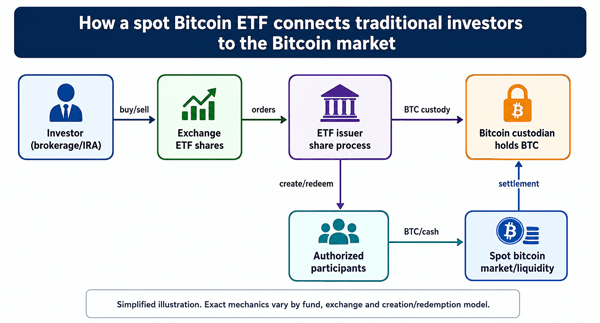
Figure 1. Simplified spot Bitcoin ETF market structure. Exact arrangements differ by fund.
5.1 Investor buys ETF shares
A beginner may log in to a brokerage account, search for a ticker such as IBIT, FBTC, ARKB, BITB or another spot bitcoin product, and place an order. The investor owns ETF shares, not bitcoin in a personal wallet.
5.2 ETF shares trade on an exchange
The shares trade during stock-market hours. Market makers provide bids and offers. The share price should stay close to the value of the bitcoin held by the fund, although small premiums or discounts can occur.
5.3 Authorized participants help keep price in line
Large financial firms called authorized participants can create or redeem large blocks of ETF shares. This process helps keep the ETF share price near its net asset value.
5.4 The issuer and custodian manage the underlying bitcoin
The ETF sponsor runs the product. A custodian stores the bitcoin, usually using institutional custody controls such as cold storage procedures, access controls and audit processes.
5.5 The ETF charges a fee
Most spot Bitcoin ETFs charge an annual sponsor fee or expense ratio. Even a small fee matters over long holding periods because it slowly reduces returns compared with owning bitcoin directly, assuming all else is equal.
6. How Spot Bitcoin ETFs Affect the Crypto Market
Spot Bitcoin ETFs affect the crypto market through several channels. They do not magically determine bitcoin’s price, but they can change who can buy, how easily capital enters or leaves, and how traditional finance interacts with crypto.
6.1 They expand the potential buyer base
Many investors who were uncomfortable with crypto exchanges or private wallets can now get exposure through familiar accounts. This includes retail investors, advisers, hedge funds and institutions with strict operational rules. A larger buyer base can support demand, especially when ETF inflows are strong.
6.2 They can improve market liquidity
ETF trading creates additional activity around bitcoin exposure. Market makers, authorized participants and hedging desks may interact with the underlying bitcoin market. Over time, this can deepen liquidity and tighten spreads, although liquidity can still dry up during stress.
6.3 They make bitcoin easier to include in model portfolios
Financial advisers often build portfolios using ETFs. A spot Bitcoin ETF makes it easier to consider a small bitcoin allocation alongside stocks, bonds, commodities or alternatives. Some advisers may still choose zero allocation, but the ETF makes implementation simpler.
6.4 They may reduce the stigma around crypto
Institutional products from major asset managers can make bitcoin feel more mainstream. This can influence media coverage, boardroom discussions and investor education. However, legitimacy should not be confused with safety.
6.5 They can increase correlation with traditional markets
As more traditional investors hold bitcoin through brokerage accounts, bitcoin may respond more to macro events, liquidity conditions, risk appetite, interest-rate expectations and portfolio rebalancing. Bitcoin can still move for crypto-native reasons, but the ETF channel links it more tightly to traditional finance.
6.6 They can create sharper inflow and outflow cycles
ETFs make it easy to buy, but also easy to sell. Large inflows can support rallies, while large outflows can pressure prices or worsen sentiment. ETF convenience cuts both ways.
6.7 They change crypto business models
Crypto exchanges, custodians, data providers and trading firms may benefit from institutional demand. At the same time, some investors who might have bought bitcoin directly may choose ETFs instead, reducing exchange retail flow or self-custody adoption.
7. Benefits and Risks of Spot Bitcoin ETFs
| Potential benefit | Why it helps | Important limitation |
|---|---|---|
| Easy access | Investors can buy shares through a normal brokerage account. | Market hours, brokerage rules and account restrictions still apply. |
| No private keys | Investors do not need to manage seed phrases or hardware wallets. | They rely on the ETF issuer and custodian instead. |
| Portfolio reporting | ETF holdings appear alongside stocks and bonds. | Tax treatment can still be complex and jurisdiction-dependent. |
| Institutional familiarity | Fits into compliance, custody and risk-management systems. | Investment committees may still reject bitcoin due to risk. |
| Potential liquidity | ETF shares may trade actively with tight spreads. | Spreads can widen during volatile or stressed markets. |
8. Risks, Limitations and Common Misconceptions
8.1 Misconception: “SEC approval means bitcoin is safe.”
False. Approval allowed product shares to list and trade; it did not make bitcoin low-risk or endorsed by the regulator. Bitcoin remains volatile and speculative.
8.2 Misconception: “An ETF share is the same as owning bitcoin.”
Not exactly. ETF investors own shares of a product. They do not control private keys, cannot send bitcoin on-chain, and cannot use the coins in crypto applications.
8.3 Risk: Price volatility
Bitcoin can move sharply in either direction. A spot Bitcoin ETF will generally reflect that volatility. Beginners should be prepared for drawdowns that would feel extreme compared with many traditional funds.
8.4 Risk: Tracking differences
ETF share prices can differ slightly from the value of the underlying bitcoin because of fees, market spreads, premiums, discounts and timing differences.
8.5 Risk: Custody concentration
Spot Bitcoin ETFs depend on professional custodians. Institutional custody can reduce some operational risks, but it can also concentrate risk in a small number of service providers.
8.6 Risk: Regulation can change
Crypto rules continue to evolve. Future tax, accounting, custody, exchange or securities rules could affect ETFs, issuers, advisers or investors.
8.7 Risk: Liquidity shocks
ETF liquidity and bitcoin liquidity are related but not identical. In a market shock, bid-ask spreads can widen, prices can gap, and investors may receive worse execution than expected.
8.8 Risk: Over-allocation
The easiest mistake is buying too much because the ETF feels familiar. A familiar wrapper does not turn bitcoin into a conservative asset.
9. Practical Examples: How Different Investors Might Use Spot Bitcoin ETFs
9.1 Beginner investor
A beginner with a diversified portfolio might use a spot Bitcoin ETF for a very small allocation, such as 1% to 2%, only after building emergency savings and understanding the risk. The goal would be simple exposure, not short-term trading.
9.2 Financial adviser
An adviser may use a spot Bitcoin ETF instead of direct bitcoin because it fits billing, reporting, custody and compliance systems. The adviser still needs to decide whether bitcoin is suitable for each client.
9.3 Hedge fund
A hedge fund may use Bitcoin ETFs for tactical exposure, arbitrage, hedging or relative-value trades. This can add liquidity but may also create fast inflow and outflow cycles.
9.4 Pension or endowment
A pension or endowment may require a long governance process before buying any crypto-linked product. The ETF makes implementation easier, but the investment committee still has to justify risk, sizing, custody and policy fit.
9.5 Crypto-native investor
Someone who already uses bitcoin on-chain may still prefer direct ownership. They may view an ETF as convenient for retirement accounts but not a replacement for self-custody.
10. Best Practices Before Buying a Spot Bitcoin ETF
- Start with education, not price excitement. Understand bitcoin, ETF mechanics, fees and custody before buying.
- Decide the role in your portfolio. Is it a long-term diversifier, a speculative position, or a trade? Your answer changes the risk controls.
- Keep position size modest. Many beginners should think in small percentages, not large bets.
- Compare fees and spreads. A low expense ratio helps, but also check liquidity, bid-ask spread, tracking and issuer reputation.
- Use limit orders during volatile periods. Market orders can execute at unfavorable prices when spreads widen.
- Do not confuse convenience with safety. The ETF wrapper solves access and custody friction, not bitcoin volatility.
- Review tax rules in your country. Crypto-linked ETFs can have different tax implications depending on jurisdiction and account type.
- Rebalance intentionally. If bitcoin rises sharply, it can become a larger portfolio weight than planned. If it falls, decide in advance whether you will rebalance or hold.
11. How to Compare Spot Bitcoin ETFs
| Question to ask | Why it matters |
|---|---|
| What is the annual sponsor fee or expense ratio? | Lower fees can improve long-term tracking, but fee is not the only factor. |
| How liquid is the fund? | Higher trading volume and tighter spreads can reduce trading cost. |
| Who is the issuer? | Issuer experience, operations and reputation matter for trust. |
| Who is the custodian? | Custody is central because the fund’s bitcoin must be stored securely. |
| How close does it trade to net asset value? | Large premiums or discounts can hurt entry and exit prices. |
| Is it available in my account type? | Some brokerage, retirement or advisory platforms restrict access. |
| What does the prospectus say about risks? | The prospectus is the authoritative product document. |
12. What Spot Bitcoin ETFs Could Mean Long Term
The long-term impact of spot Bitcoin ETFs will depend on adoption, regulation, bitcoin’s performance, macroeconomic conditions, and whether investors treat bitcoin as a store-of-value asset, a speculative technology bet, or both.
The most realistic view is balanced: spot Bitcoin ETFs are a major bridge between crypto and traditional finance, but they do not remove the need for risk management. They can support institutional adoption by making bitcoin easier to access, but adoption is likely to be uneven. Some institutions will allocate, some will trade tactically, and many will remain cautious.
13. FAQs About Bitcoin ETFs and Institutional Adoption
13.1 What is the main purpose of a spot Bitcoin ETF?
Its main purpose is to give investors exposure to bitcoin’s price through exchange-traded shares, without requiring them to buy, store or secure bitcoin directly.
13.2 Do spot Bitcoin ETFs buy real bitcoin?
They are designed to hold bitcoin as the underlying asset, although exact creation, redemption and custody details vary by product.
13.3 Are spot Bitcoin ETFs safer than bitcoin?
They may reduce wallet and private-key risks for investors, but they still carry bitcoin price risk. They also add product, custody and market-structure risks.
13.4 Can I use ETF shares to pay with bitcoin?
No. ETF shares are securities-market products. They cannot be sent on the Bitcoin network or used in crypto wallets.
13.5 Why do institutions prefer ETFs?
ETFs fit existing custody, compliance, trading, reporting and governance systems. That makes them easier to approve and manage than direct crypto holdings.
13.6 Do Bitcoin ETFs push bitcoin prices higher?
They can increase demand when inflows are strong, but price depends on many factors: supply, macro conditions, leverage, sentiment, regulation, miner activity and global liquidity.
13.7 What happens if many investors sell Bitcoin ETFs at once?
ETF outflows may require market makers or fund mechanisms to adjust exposure, which can add selling pressure or negative sentiment. The exact impact depends on market depth and redemption activity.
13.8 Is a bitcoin futures ETF the same as a spot Bitcoin ETF?
No. A futures ETF uses bitcoin futures contracts, while a spot Bitcoin ETF aims to track bitcoin more directly through holdings tied to spot bitcoin.
13.9 Should beginners buy a Bitcoin ETF?
Only after understanding the risks, having a diversified plan, and keeping position size appropriate. For many beginners, education and risk control matter more than speed.
13.10 What is the biggest mistake beginners make?
The biggest mistake is treating a familiar ETF wrapper as proof that bitcoin is low-risk. The product is easier to access, not automatically safer.
14. Conclusion: A Bridge, Not a Guarantee
Spot Bitcoin ETFs are one of the most important developments in crypto market structure because they connect bitcoin to the traditional investment system. They make bitcoin easier to access, easier to report, and easier for institutions to consider. That is why they matter for institutional adoption.
But a spot Bitcoin ETF is not a magic shield. It does not remove volatility, regulatory uncertainty, custody dependence, valuation debate or the risk of loss. The best way to think about it is simple: the ETF wrapper makes bitcoin exposure more convenient and institution-friendly, while bitcoin itself remains a high-risk digital asset.
Sources Consulted and Checked
These sources were consulted and checked while preparing this article to support its accuracy and reliability.
- SEC statement on spot bitcoin ETP approval, January 10, 2024
- SEC Investor Bulletin on spot bitcoin and ether ETPs, September 2024
- FINRA overview of crypto-asset risks
- iShares Bitcoin Trust ETF overview and fee information
- Fidelity Wise Origin Bitcoin Fund product and risk information
- CoinShares 13F analysis of professional holdings in U.S. spot Bitcoin ETFs, Q1 2025
- Reuters report on institutional investors and spot Bitcoin ETF holdings, May 2025
Reader Advice
This article is provided for educational and informational purposes only. It is not personalized financial, investment, tax, or legal advice, and it should not be treated as a recommendation to buy, sell, or hold any asset or product. Bitcoin and Bitcoin ETFs can be highly volatile and may result in substantial or total loss. Rules, policies, laws, tax treatment, product terms, fees, and market statistics can change over time and may vary by country or region. Before making a decision, verify current information through official sources, review the relevant fund prospectus, consider your circumstances and risk tolerance, and seek guidance from a qualified professional where appropriate.