Bitcoin Halving Explained: Dates, Supply, Price Cycles and Miner Rewards
Quick answer
Bitcoin halving is a built-in Bitcoin rule that cuts the new bitcoin paid to miners by 50% every 210,000 blocks, roughly every four years. The latest halving occurred at block 840,000 in April 2024, reducing the block subsidy from 6.25 BTC to 3.125 BTC. The next halving is expected around 2028 at block 1,050,000, when the subsidy should fall to 1.5625 BTC. Halving slows new supply, but it does not guarantee a price increase.
1. What Is Bitcoin Halving?
Bitcoin halving is an automatic event in the Bitcoin network that reduces the amount of newly created bitcoin paid to miners for adding a valid block to the blockchain. In plain English, it is Bitcoin’s scheduled supply cut.
When Bitcoin launched in 2009, the block subsidy was 50 BTC per block. After the first halving in 2012, it became 25 BTC. It later dropped to 12.5 BTC, then 6.25 BTC, and after the 2024 halving it became 3.125 BTC per block.
The halving is not decided by a company, a government, or a group of traders. It is part of Bitcoin’s consensus rules. Nodes enforce those rules by rejecting blocks that try to create more bitcoin than allowed.
1.1 Block reward vs block subsidy: a useful distinction
People often say “block reward” when they mean the new bitcoin created in each block. Strictly speaking, miners can earn two things:
- Block subsidy: newly created bitcoin. This is the part that halves.
- Transaction fees: fees paid by users whose transactions are included in the block. These do not halve on a fixed schedule; they depend on demand for block space.
So after a halving, miners do not necessarily earn exactly half as much total revenue. Their new-coin subsidy is cut in half, but fee income, Bitcoin price, mining difficulty, energy costs, and hardware efficiency also matter.
2. How Bitcoin Halving Works
Bitcoin is designed to produce a new block about every 10 minutes on average. Every 210,000 blocks, the software calculates a new subsidy that is half of the previous subsidy. Because 210,000 blocks at roughly 10 minutes each is close to four years, halvings are usually described as four-year events.
| Concept | Beginner explanation |
|---|---|
| Block | A bundle of Bitcoin transactions added to the blockchain. |
| Miner | A participant using computing power to compete to add the next block. |
| Block subsidy | New bitcoin created in a block and paid to the miner. This is what halves. |
| Transaction fees | Fees paid by users and collected by the miner. These are market-based, not halved by rule. |
| Halving interval | 210,000 blocks. At this point, the subsidy is cut by 50%. |
| Supply cap | Bitcoin is designed to approach a maximum supply of about 21 million BTC. |
2.1 A simple example
Imagine a miner finds a valid block before the 2024 halving. The block subsidy was 6.25 BTC, plus transaction fees. After the 2024 halving, a miner finding a similar block receives 3.125 BTC, plus transaction fees. The miner still performs the same basic job - securing the network and confirming transactions - but the new bitcoin created for that work is lower.
2.2 Why the date is estimated, but the block number is exact
A halving does not happen because a calendar says it is time. It happens when the network reaches the required block height. The fourth halving happened at block 840,000. The next one will happen at block 1,050,000. The calendar date is only an estimate because block times vary around the 10-minute average.
3. Bitcoin Halving Dates and Miner Rewards
The table below shows the main Bitcoin halving events and the block subsidy after each event. Future dates are estimates and can shift as actual block production runs faster or slower than the long-term average.
| Halving | Block height | Approx. date | Subsidy before | Subsidy after |
|---|---|---|---|---|
| Launch | 0 | Jan. 2009 | - | 50 BTC |
| 1st halving | 210,000 | Nov. 2012 | 50 BTC | 25 BTC |
| 2nd halving | 420,000 | July 2016 | 25 BTC | 12.5 BTC |
| 3rd halving | 630,000 | May 2020 | 12.5 BTC | 6.25 BTC |
| 4th halving | 840,000 | April 2024 | 6.25 BTC | 3.125 BTC |
| 5th halving | 1,050,000 | Expected around 2028 | 3.125 BTC | 1.5625 BTC |
The 2024 halving was important because it moved Bitcoin into a new issuance era: only 3.125 BTC are now created per block, before fees. At roughly 144 blocks per day, that means about 450 BTC of new subsidy issuance per day, compared with about 900 BTC per day before the 2024 halving. Actual daily totals vary because blocks are not perfectly timed.
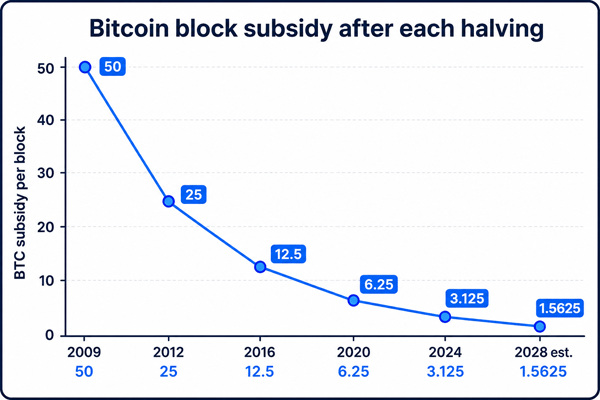
Chart: Bitcoin’s block subsidy has fallen by 50% at each halving, from 50 BTC per block in 2009 to 3.125 BTC after the 2024 halving.
4. Why Bitcoin Halving Exists
Bitcoin’s halving schedule is part of its monetary policy. Traditional currencies can have changing supply policies decided by central banks or governments. Bitcoin works differently: its issuance schedule is programmed and publicly verifiable.
The purpose is to make new supply predictable and increasingly scarce over time. Early in Bitcoin’s life, larger block subsidies helped distribute coins and attract miners. Over time, the subsidy declines, and the network is expected to rely more on transaction fees to reward miners.
4.1 Bitcoin supply in one sentence
Bitcoin does not create coins randomly. New bitcoin enter circulation through mining, the subsidy halves every 210,000 blocks, and total supply approaches about 21 million BTC over time.
5. How Halving Affects Bitcoin Supply
Halving reduces the rate at which new bitcoin are created. It does not reduce the existing supply. If you already own bitcoin, a halving does not split your coins, take coins away, or change your wallet balance.
A useful comparison is gold mining. If gold miners suddenly produced half as much new gold each year, the existing gold would still exist. What changes is the flow of new supply. Bitcoin halving works in a similar way, except the supply schedule is built into the protocol.
| Before vs after a halving | What changes? | What does not change? |
|---|---|---|
| New BTC issuance | The block subsidy drops by 50%. | Existing BTC are not affected. |
| Your wallet balance | Nothing automatic happens to your holdings. | Your amount of BTC stays the same unless you send or receive BTC. |
| Miner revenue | Subsidy income falls immediately. | Fees, BTC price, and costs can change separately. |
| Bitcoin rules | The next subsidy level begins at the halving block. | The 21 million supply cap remains part of the rules. |
6. Does Bitcoin Halving Make the Price Go Up?
This is the question most beginners ask. The honest answer is: halving can affect supply and market psychology, but it does not guarantee a higher price.
Past halvings have often been discussed alongside major Bitcoin bull markets. However, price cycles are influenced by many other factors: global liquidity, interest rates, investor demand, regulation, exchange-traded products, leverage, macroeconomic conditions, miner selling, media attention, and broader risk appetite.
6.1 Why traders watch halvings
- Lower new supply: fewer new BTC are created each block.
- Scarcity narrative: investors often focus on Bitcoin’s fixed supply and declining issuance.
- Miner economics: miners may sell less or more depending on profitability and cash needs.
- Market attention: halvings attract media coverage, which can increase public interest.
6.2 Why price gains are not automatic
- Markets can price in expected events before they happen.
- Demand matters more than supply alone. If demand falls, lower issuance may not support price.
- Short-term volatility can increase around major events.
- Historical patterns are based on a small sample: only four completed halvings so far.
Practical takeaway for investors
Do not buy Bitcoin only because a halving happened. A halving is a supply event, not a guaranteed profit event. Beginners should understand volatility, use position sizing, avoid leverage, and never invest money they may need for rent, debt payments, emergencies, or short-term goals.
7. Bitcoin Price Cycles Around Halvings
Bitcoin has often moved in broad cycles that include accumulation, rapid price increases, sharp corrections, and long periods of consolidation. Halvings are one part of that story, but not the whole story.
A simple way to think about the cycle is: the halving reduces new supply; if demand increases or even stays strong, price pressure can build; if the market becomes overheated, leverage and speculation can create sharp corrections. This is a simplified model, not a prediction tool.
| Cycle stage | What beginners may see | Risk to watch |
|---|---|---|
| Pre-halving attention | More articles, countdowns, and speculation. | Buying because of hype without a plan. |
| Post-halving adjustment | Miners and traders adapt to lower subsidy. | Assuming price must rise immediately. |
| Bullish phase, if demand grows | More retail interest and stronger momentum. | FOMO, leverage, scams, and overconfidence. |
| Correction or bear market | Large drawdowns after strong rallies. | Panic selling or holding more risk than planned. |
8. How Halving Affects Miners
Miners are directly affected because the subsidy portion of their income is cut in half at the halving block. A miner that earned 6.25 BTC subsidy per block before the 2024 halving earned 3.125 BTC subsidy per block after it, plus transaction fees.
This can pressure miners with high electricity costs, older machines, weak balance sheets, or too much debt. More efficient miners may survive better because their cost per unit of hash power is lower.
8.1 What miners can do after a halving
- Upgrade to more efficient mining hardware.
- Move to cheaper or more flexible electricity sources where legal and practical.
- Join mining pools to smooth income instead of relying on rare solo block wins.
- Improve treasury management so they are not forced to sell BTC at bad times.
- Rely more on transaction fees when network demand is high.
8.2 Will miners quit after every halving?
Some inefficient miners may shut down, but Bitcoin has a difficulty adjustment system. Roughly every 2,016 blocks, the network adjusts mining difficulty to target an average 10-minute block time. If many miners leave, blocks may temporarily slow, then difficulty can adjust downward. If more miners join, difficulty can adjust upward.
9. What Happens When All Bitcoin Is Mined?
Bitcoin’s subsidy keeps shrinking until it eventually becomes effectively zero. The commonly cited estimate for the final issuance period is around the year 2140, although exact timing depends on block production over many decades.
When no meaningful new subsidy remains, miners are expected to be paid mainly by transaction fees. This is one of Bitcoin’s long-term open questions: will future fee demand be enough to support a strong mining security budget? Supporters argue that valuable block space can create sufficient fees. Critics argue that relying heavily on fees could create security or usability challenges. The honest answer is that this will depend on future demand, technology, fee markets, and Bitcoin’s role in the global financial system.
10. Benefits of Bitcoin Halving
- Predictable supply: anyone can estimate future issuance from the protocol rules.
- Lower inflation rate: each halving reduces the pace of new BTC creation.
- Scarcity: the supply schedule reinforces Bitcoin’s fixed-supply design.
- Transparency: the rule is public and can be verified by node operators.
- Long-term miner transition: it gradually moves miner income from subsidy toward fees.
11. Risks and Limitations of Bitcoin Halving
- No guaranteed price increase: lower supply issuance does not automatically create higher demand.
- Miner stress: less efficient miners may become unprofitable after subsidy cuts.
- Short-term volatility: major market narratives can attract speculation and leverage.
- Fee uncertainty: future miner incentives may depend more on transaction fees.
- Misleading hype: social media often turns halvings into simple “number go up” stories, which is not how markets reliably work.
12. Common Bitcoin Halving Misconceptions
| Misconception | Reality |
|---|---|
| “My bitcoin balance will be cut in half.” | No. The miner subsidy is cut in half, not user balances. |
| “Bitcoin price must double after a halving.” | No. Price depends on supply, demand, liquidity, sentiment, regulation, and many other factors. |
| “The halving happens on an exact date.” | No. It happens at a specific block height. Dates are estimates until the block is mined. |
| “Miners receive only the subsidy.” | No. Miners can receive both subsidy and transaction fees. |
| “Halving makes Bitcoin risk-free.” | No. Bitcoin remains volatile and speculative. Risk management still matters. |
13. Beginner Best Practices Around a Halving
- Learn the basics before investing. Understand wallets, exchanges, private keys, transaction fees, and volatility.
- Separate the technology from the trade. Halving is real; guaranteed price predictions are not.
- Avoid leverage. Leveraged trades can be liquidated even if your long-term view is correct.
- Use dollar-cost averaging only if it fits your finances. Spreading purchases over time can reduce timing pressure, but it does not remove risk.
- Secure your bitcoin properly. Use reputable wallets, enable two-factor authentication on exchanges, and beware of phishing.
- Plan for taxes and regulation. Rules differ by country and can change.
- Keep an emergency fund in cash or low-risk assets before buying volatile assets.
14. Should You Mine Bitcoin After a Halving?
For most beginners, Bitcoin mining is not a simple side income opportunity. Modern mining is highly competitive and usually requires specialized ASIC hardware, cheap electricity, cooling, technical knowledge, and careful cost calculations.
| Question | Why it matters |
|---|---|
| What is your electricity price? | Power cost is often the biggest ongoing mining expense. |
| What machine will you use? | Older hardware may become unprofitable after a halving. |
| Will you join a pool? | Pools can smooth payouts but charge fees and require trust in pool operations. |
| What is your local law? | Mining rules, taxes, and energy policies vary by location. |
| What happens if BTC price falls? | Revenue can drop while electricity bills remain due. |
A beginner interested in mining should build a spreadsheet before buying equipment. Estimate hardware cost, electricity cost, pool fees, expected hash rate, cooling, downtime, taxes, and possible resale value. If the numbers only work under very optimistic BTC price assumptions, the risk is high.
15. Bitcoin Halving vs Stock Splits, Interest Rate Cuts, and Gold Supply
| Comparison | Similar idea | Key difference |
|---|---|---|
| Stock split | The word “halving” may sound like a split. | A stock split changes share count and price per share; Bitcoin halving changes new miner subsidy, not user balances. |
| Interest rate cut | Both can affect market expectations. | Central banks choose interest rates; Bitcoin halvings are automatic protocol events. |
| Gold mining supply | Both involve costly production and new supply entering circulation. | Bitcoin’s issuance schedule is much more predictable than gold production. |
16. Frequently Asked Questions
16.1 When was the last Bitcoin halving?
The latest Bitcoin halving occurred at block 840,000 in April 2024. It reduced the block subsidy from 6.25 BTC to 3.125 BTC.
16.2 When is the next Bitcoin halving?
The next halving is expected around 2028 at block 1,050,000. The exact calendar date can change because Bitcoin blocks are produced about every 10 minutes on average, not exactly every 10 minutes.
16.3 What is the current Bitcoin block reward?
After the 2024 halving, the subsidy is 3.125 BTC per block. Miners may also receive transaction fees, so total block reward can be higher than the subsidy alone.
16.4 Does halving reduce Bitcoin’s total supply?
No. It reduces the rate of new supply. Existing bitcoin remain unchanged.
16.5 Why does Bitcoin have a 21 million supply cap?
Bitcoin’s issuance rules reduce the subsidy over time so the total supply approaches about 21 million BTC. This fixed-supply design is one reason people compare Bitcoin to scarce commodities, although Bitcoin remains a digital and highly volatile asset.
16.6 Can Bitcoin’s halving rules be changed?
In theory, software can be modified. In practice, changing Bitcoin’s supply rules would require broad agreement across users, node operators, miners, developers, businesses, and the wider ecosystem. Blocks that violate current consensus rules would be rejected by nodes following those rules.
16.7 Will transaction fees replace miner rewards?
Over the long term, transaction fees are expected to become a larger part of miner revenue as the subsidy shrinks. Whether fees will be enough to support future security is debated and depends on future demand for Bitcoin block space.
16.8 Is Bitcoin halving good or bad?
It depends on perspective. It is good for predictable scarcity and lower issuance. It can be difficult for miners with high costs. For investors, it is neither automatically good nor bad; it is one factor among many.
17. Conclusion: What Beginners Should Remember
Bitcoin halving is one of the most important rules in Bitcoin’s design. It cuts the new bitcoin subsidy paid to miners every 210,000 blocks, slows new supply, and helps Bitcoin approach its 21 million supply cap. The latest halving in April 2024 reduced the subsidy to 3.125 BTC per block, and the next halving is expected around 2028.
The key beginner lesson is balance. Halving is important, but it is not magic. It can shape supply, miner economics, and market expectations, but price still depends on demand, liquidity, regulation, competition, and investor behavior. Treat halving as a fundamental concept to understand, not as a guaranteed trading signal.
Sources Consulted and Checked
The following sources were consulted and checked while preparing this article and supporting its accuracy:
- Bitcoin.org, “Bitcoin: A Peer-to-Peer Electronic Cash System” by Satoshi Nakamoto - explains mining incentives and transaction fees.
- Blockchain.com Bitcoin block 840,000 explorer page - documents the fourth halving block.
- CoinGecko Bitcoin Halving page - summarizes recent and expected halving dates and rewards.
- Kraken Learn, “The history of Bitcoin halving” - provides a timeline of halving events.
- Investopedia, Bitcoin halving and mining explainers - beginner-friendly background on halvings, mining, rewards, and difficulty.
- Bitcoin Core source-code discussions and references to GetBlockSubsidy - explain the 210,000-block halving interval in code.
Reader Advice
This article is provided for educational and informational purposes only and is not personalized financial, investment, legal, tax, or mining advice. Bitcoin and mining involve substantial risks, including price volatility, loss of funds, fraud, cybersecurity threats, equipment and electricity costs, regulatory changes, and possible tax obligations. Rules, policies, laws, technical conditions, market data, and statistics may change over time and vary by country or region. Before investing, trading, mining, or making another decision, verify current information through official sources and consider guidance from appropriately qualified professionals based on your circumstances. Never commit money you cannot afford to lose.