Bitcoin Dominance Explained: How BTC Dominance Affects Crypto Market Cycles
Key takeaways
- Bitcoin dominance is Bitcoin’s market capitalization as a percentage of the total cryptocurrency market capitalization.
- A rising BTC dominance usually means Bitcoin is outperforming the rest of crypto or falling less during a market decline.
- A falling BTC dominance often means altcoins are gaining market share, but it does not automatically mean every altcoin is rising.
- BTC dominance is most useful when combined with Bitcoin price action, total crypto market cap, Ethereum performance, stablecoin dominance, and market liquidity.
- It is a market structure indicator, not a guaranteed buy or sell signal.
1. What Is Bitcoin Dominance?
Bitcoin dominance, often written as BTC dominance or BTC.D, measures Bitcoin’s share of the total crypto market. In simple terms, it answers this question: “Out of all the money currently valued in crypto assets, what percentage belongs to Bitcoin?”
The basic formula is:
Bitcoin dominance = Bitcoin market cap ÷ Total crypto market cap × 100
For example, if Bitcoin’s market cap is $1.2 trillion and the total crypto market cap is $2.4 trillion, Bitcoin dominance is 50%. That means Bitcoin represents half of the total market value of crypto assets included by that data provider.
Major market-data sites describe the metric in this way: TradingView defines dominance as a coin’s market cap relative to the total crypto market, expressed as a percentage; CoinGecko describes BTC dominance as the ratio of Bitcoin’s market cap to the global market cap of all cryptocurrencies; and CoinMarketCap describes it as Bitcoin’s relative market share in the cryptocurrency sector. As of June 23, 2026, CoinGecko’s global chart showed Bitcoin dominance around the mid-50% range, but live values change constantly because crypto prices move 24/7.
| Term | Beginner meaning | Why it matters |
|---|---|---|
| Bitcoin market cap | Bitcoin price multiplied by circulating BTC supply. | Shows the total market value of Bitcoin. |
| Total crypto market cap | The combined market value of cryptocurrencies tracked by a data provider. | The denominator used to calculate dominance. |
| BTC dominance | Bitcoin’s percentage share of total crypto market cap. | Shows whether Bitcoin or the rest of crypto is gaining relative share. |
| Altcoin dominance | The market share held by non-Bitcoin crypto assets. | Helps investors understand rotation into Ethereum, large-cap alts, or smaller tokens. |
2. Why Bitcoin Dominance Matters
Bitcoin is the oldest, largest, and most widely recognized crypto asset. Because of that, many traders and investors use Bitcoin dominance as a quick way to understand the market’s risk appetite. When investors want relative safety inside crypto, they often prefer Bitcoin over smaller tokens. When risk appetite increases, money may rotate from Bitcoin into Ethereum, large-cap altcoins, and eventually smaller speculative coins.
This does not mean Bitcoin dominance predicts the future with certainty. It means the metric can help you see where market value is concentrating. Used carefully, it can provide context for crypto market cycles.
- It helps separate “Bitcoin is strong” from “the whole crypto market is strong.”
- It can highlight early signs of capital rotation from Bitcoin into altcoins.
- It can warn beginners not to assume all crypto assets move together.
- It provides a simple framework for understanding bull markets, bear markets, and altcoin seasons.
3. How BTC Dominance Works in Practice
BTC dominance can rise or fall for several different reasons. The most important point for beginners is that dominance is a relative measure. It compares Bitcoin to the rest of the crypto market. Bitcoin can go up while dominance falls, and Bitcoin can go down while dominance rises.
| Bitcoin price | Altcoin market | Likely BTC dominance move | What it may suggest |
|---|---|---|---|
| Rising | Rising faster than Bitcoin | Falls | Risk appetite is increasing; altcoins are outperforming. |
| Rising | Flat or rising slower | Rises | Bitcoin is leading the market. |
| Falling | Falling faster than Bitcoin | Rises | Investors are reducing altcoin exposure or seeking relative safety. |
| Falling | Holding up better than Bitcoin | Falls | Unusual rotation; some alt sectors may be resilient. |
| Flat | Rising | Falls | Capital is moving into altcoins while Bitcoin pauses. |
3.1 A Simple Example: Bitcoin Dominance Rising
Imagine the total crypto market is worth $2 trillion. Bitcoin is worth $1 trillion, so BTC dominance is 50%. A month later, Bitcoin rises to $1.2 trillion while the rest of crypto stays at $1 trillion. The total market is now $2.2 trillion, and Bitcoin dominance becomes about 54.5%. Bitcoin gained share because it grew faster than the rest of crypto.
3.2 A Simple Example: Bitcoin Dominance Falling
Now imagine Bitcoin stays at $1 trillion, while altcoins rise from $1 trillion to $1.5 trillion. The total crypto market becomes $2.5 trillion, and BTC dominance falls to 40%. Bitcoin did not crash; it simply became a smaller share of a larger crypto market because altcoins grew faster.
4. Bitcoin Dominance and Crypto Market Cycles
Crypto market cycles are not perfectly identical, but they often follow a broad rhythm. Bitcoin tends to attract attention first because it is the most established asset in the sector. If confidence improves, capital may move further out on the risk curve into Ethereum, major altcoins, mid-cap tokens, and smaller speculative projects. When fear returns, that process often reverses.
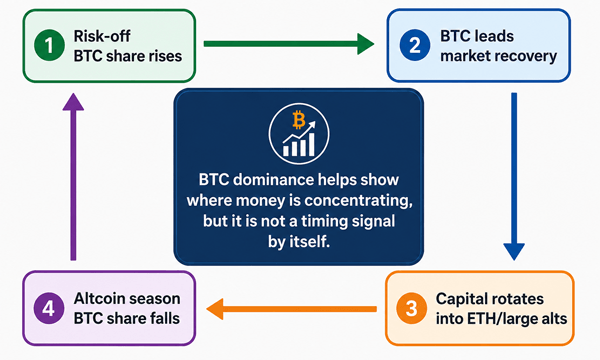
Figure: A simplified capital-rotation cycle. Real markets are messier, but this framework helps beginners understand why BTC dominance often rises and falls across crypto cycles.
4.1 Stage 1: Risk-Off or Bear Market - BTC Dominance Often Rises
During market stress, investors usually become more selective. Smaller tokens can lose liquidity quickly, narratives fade, and leveraged traders may be forced to sell. In this environment, Bitcoin dominance may rise even if Bitcoin’s price is falling, because altcoins are often falling faster.
4.2 Stage 2: Bitcoin-Led Recovery - BTC Dominance Can Stay High or Rise
In many recoveries, Bitcoin moves first. Large investors, institutions, and cautious crypto participants may prefer Bitcoin before they take risk in smaller assets. In this stage, BTC dominance can remain elevated while Bitcoin’s price climbs.
4.3 Stage 3: Rotation Into Ethereum and Large Altcoins - BTC Dominance Often Falls
If confidence improves, investors may start looking for higher potential returns outside Bitcoin. Ethereum often becomes the first major alternative watched by traders, followed by established large-cap sectors such as smart-contract platforms, infrastructure, or exchange tokens. When these assets outperform Bitcoin, BTC dominance usually falls.
4.4 Stage 4: Altcoin Season - BTC Dominance Falls Sharply
Altcoin season is a period when many altcoins outperform Bitcoin over a meaningful timeframe. BTC dominance often falls during this period because smaller assets are gaining market share. However, altcoin seasons can be risky. Prices can move quickly in both directions, liquidity can disappear, and weak projects may rise only because speculation is high.
5. How to Read Bitcoin Dominance Without Getting Misled
The biggest beginner mistake is reading BTC dominance in isolation. The same dominance move can mean different things depending on Bitcoin’s price, total market cap, liquidity, and macro conditions. A better approach is to combine BTC dominance with a few simple market checks.
| Indicator to compare | What to ask | Why it helps |
|---|---|---|
| Bitcoin price | Is BTC rising, falling, or moving sideways? | Shows whether dominance is rising from strength or from defensive selling. |
| Total crypto market cap | Is the whole market expanding or shrinking? | Confirms whether money is entering or leaving crypto overall. |
| ETH/BTC ratio | Is Ethereum outperforming Bitcoin? | Often helps identify early altcoin rotation. |
| Stablecoin dominance | Are stablecoins taking a bigger market share? | May show risk-off behavior or sidelined capital. |
| Trading volume and liquidity | Are moves supported by real activity? | Thin markets can create misleading signals. |
5.1 Four Common BTC Dominance Scenarios
| Scenario | Possible interpretation | Beginner action |
|---|---|---|
| BTC price up + dominance up | Bitcoin is leading; altcoins may lag. | Avoid assuming every altcoin will follow immediately. |
| BTC price up + dominance down | Altcoins are outperforming during a broad rally. | Study whether the move is broad and sustainable. |
| BTC price down + dominance up | Market is defensive; altcoins may be under heavy pressure. | Protect capital; avoid chasing weak altcoin bounces. |
| BTC price down + dominance down | Bitcoin is weak, but some altcoins may be holding up or speculation is fragmented. | Be careful; this can be unstable and hard to trade. |
6. What Is an Altcoin Season?
An altcoin season is a period when altcoins, as a group, outperform Bitcoin. It is not just one token pumping for a few days. A healthier altcoin season usually includes broader participation across multiple sectors, stronger liquidity, rising total crypto market cap excluding Bitcoin, and sustained relative strength against BTC.
Beginners should understand that “altcoin season” is a market nickname, not a precise scientific category. Different websites and analysts use different definitions. Some compare the performance of top altcoins against Bitcoin over 30, 60, or 90 days. Others focus on BTC dominance breaking down from an important range. The exact definition matters less than the habit of looking for confirmation.
6.1 Signs That Altcoin Rotation May Be Strengthening
- BTC dominance falls while total crypto market cap rises.
- ETH/BTC trends upward for several weeks, not just one day.
- Large-cap altcoins start outperforming before smaller speculative tokens.
- Trading volume increases across multiple sectors, not only one meme or hype category.
- Market pullbacks are bought without immediately breaking the trend.
6.2 Signs That Altcoin Risk May Be Too High
- BTC dominance falls while total crypto market cap also falls.
- Only illiquid or highly speculative tokens are moving.
- Social media becomes extremely euphoric and dismisses risk.
- Projects with weak fundamentals rise only because of leverage or hype.
- Bitcoin breaks down sharply and liquidity drains from the broader market.
7. Benefits of Tracking Bitcoin Dominance
- It gives a fast snapshot of whether Bitcoin or altcoins are gaining market share.
- It helps beginners understand why their altcoin portfolio may underperform even when Bitcoin is rising.
- It can support portfolio allocation decisions, such as when to be more BTC-heavy or more diversified.
- It encourages relative thinking: what is outperforming, what is lagging, and why?
- It can reduce emotional decisions by giving you a simple market context tool.
8. Limitations and Risks of Bitcoin Dominance
Bitcoin dominance is useful, but it has important limitations. Treating it as a complete trading system is a mistake.
| Limitation | Why it matters | Better practice |
|---|---|---|
| Different data providers calculate totals differently | One site may include more coins, stablecoins, or wrapped assets than another. | Use the same data source consistently when comparing history. |
| Stablecoins can distort the picture | A rise in stablecoin market cap can change dominance even if investors are not buying altcoins. | Check stablecoin dominance separately. |
| Market cap is not the same as liquidity | A token can have a large market cap but thin real trading depth. | Use volume, order-book depth, and slippage awareness. |
| It does not measure project quality | Weak altcoins can rise during speculative periods. | Research fundamentals, tokenomics, security, and use case. |
| It is not a timing tool by itself | Dominance can trend for months and produce false signals. | Combine it with trend, risk management, and portfolio rules. |
9. Common Misconceptions About BTC Dominance
9.1 Misconception 1: “High BTC dominance means Bitcoin price must go up.”
Not necessarily. Bitcoin dominance can rise while Bitcoin’s price falls if altcoins fall even more. Dominance measures relative share, not direction.
9.2 Misconception 2: “Falling dominance means all altcoins will pump.”
No. Falling dominance only means Bitcoin’s share of the total market is declining. Some altcoins may rise, some may stay flat, and many may still lose value. Rotation is rarely equal across every token.
9.3 Misconception 3: “BTC dominance predicts the exact start of altcoin season.”
BTC dominance can help identify conditions that are more favorable for altcoins, but it does not provide an exact start date. False starts are common.
9.4 Misconception 4: “Bitcoin dominance is the same on every chart.”
Different platforms may use different lists of coins, market-cap methods, and inclusion rules. That is why BTC.D on TradingView may not exactly match a value shown on CoinGecko or CoinMarketCap at the same moment.
10. How Beginners Can Use BTC Dominance Practically
A beginner does not need a complicated trading system to use Bitcoin dominance. The goal is to improve market awareness and avoid obvious mistakes.
10.1 Use BTC Dominance as a Market Context Tool
Before buying an altcoin, ask: Is the market currently rewarding Bitcoin, large altcoins, or smaller speculative assets? If BTC dominance is rising strongly, many altcoins may struggle to outperform. That does not mean you can never buy, but it means your expectations should be realistic.
10.2 Compare BTC Dominance With Bitcoin Price
This is the simplest practical check. A rising Bitcoin price with rising dominance usually means Bitcoin is leading. A rising Bitcoin price with falling dominance can suggest broader risk appetite. A falling Bitcoin price with rising dominance often signals stress in altcoins.
10.3 Watch for Confirmation, Not One-Day Moves
Crypto can move sharply in a single day. One candle or one headline is not enough. Look for multi-week trends, higher trading volume, broader participation, and whether the trend holds after pullbacks.
10.4 Keep Position Size Small When Learning
Beginners often overestimate their ability to rotate perfectly between Bitcoin and altcoins. A safer approach is to start with smaller positions, avoid excessive leverage, and keep enough cash or stablecoins to avoid forced decisions during volatility.
10.5 Use a Written Plan
A basic plan might include: what percentage of your crypto portfolio belongs in Bitcoin, what percentage belongs in altcoins, when you rebalance, what would make you exit, and how much loss you are willing to tolerate. BTC dominance can inform that plan, but it should not replace it.
11. Example Portfolio Approaches Based on Market Context
| Market context | Possible beginner-friendly stance | Reasoning |
|---|---|---|
| BTC dominance rising + BTC price weak | More defensive; avoid aggressive altcoin exposure. | Altcoins may be under pressure and liquidity may be shrinking. |
| BTC dominance rising + BTC price strong | BTC-heavy exposure may fit better than chasing lagging altcoins. | Bitcoin may be leading the recovery. |
| BTC dominance flat + total market rising | Balanced approach; monitor ETH and large-cap altcoins. | Market may be preparing for broader participation. |
| BTC dominance falling + total market rising | Selective altcoin exposure may be considered with strict risk controls. | Risk appetite appears stronger, but not all altcoins are equal. |
| BTC dominance falling + total market falling | Be cautious; do not assume this is healthy altcoin season. | The whole market may be losing value despite BTC losing share. |
12. Bitcoin Dominance vs. Bitcoin Price: What Is the Difference?
Bitcoin price tells you how much one BTC is worth in a currency such as US dollars. Bitcoin dominance tells you how large Bitcoin is relative to the entire crypto market. They answer different questions.
| Metric | What it tells you | What it does not tell you |
|---|---|---|
| Bitcoin price | The current market price of one BTC. | Whether Bitcoin is outperforming the rest of crypto. |
| Bitcoin market cap | The total market value of circulating BTC. | How much market share Bitcoin has compared with all crypto. |
| Bitcoin dominance | Bitcoin’s share of total crypto market cap. | Whether Bitcoin’s price is rising or falling by itself. |
| Total crypto market cap | Whether the whole crypto market is expanding or shrinking. | Which assets are leading or lagging. |
13. Bitcoin Dominance vs. Ethereum Dominance
Ethereum dominance measures Ethereum’s share of the total crypto market. Some investors watch Bitcoin dominance and Ethereum dominance together because Ethereum often acts as a bridge between Bitcoin and the broader altcoin market. If BTC dominance falls while ETH dominance rises, the market may be rotating into Ethereum. If both BTC and ETH dominance fall while smaller sectors rise, speculation may be spreading further into the altcoin market.
14. Where to Check BTC Dominance
Beginners can check Bitcoin dominance on major market-data platforms. The exact number may vary across providers, so consistency matters more than obsessing over small differences.
- TradingView: BTC.D and crypto dominance charts are popular with traders who want charting tools.
- CoinGecko: global crypto charts include Bitcoin dominance, Ethereum dominance, stablecoin share, and total market cap.
- CoinMarketCap: Bitcoin dominance charts show Bitcoin’s relative share of the tracked crypto market.
15. Best Practices for Reading BTC Dominance
- Use one primary chart source so your historical comparisons are consistent.
- Check the trend, not just the current number.
- Compare dominance with Bitcoin price and total crypto market cap.
- Watch stablecoin dominance to understand whether money is moving into risk assets or sitting on the sidelines.
- Avoid making all-or-nothing portfolio changes based on one indicator.
- Remember that market cap does not equal liquidity or safety.
- Do independent research before buying any altcoin, especially small-cap tokens.
16. Beginner Mistakes to Avoid
- Buying altcoins only because BTC dominance dropped for one or two days.
- Assuming a high market cap means a token is easy to sell in size.
- Ignoring Bitcoin’s price trend while looking only at dominance.
- Using screenshots from social media without checking the live chart yourself.
- Chasing late-stage hype after an altcoin has already moved sharply.
- Using leverage without understanding liquidation risk.
- Confusing a temporary bounce with a confirmed market cycle shift.
17. A Practical BTC Dominance Checklist
Use this checklist before making a market-cycle judgment:
- Is BTC dominance trending up, down, or sideways over several weeks?
- Is Bitcoin price rising, falling, or ranging?
- Is total crypto market cap expanding or shrinking?
- Is ETH/BTC showing strength or weakness?
- Are stablecoins gaining or losing market share?
- Are altcoin gains broad-based or limited to one narrative?
- Is volume strong enough to support the move?
- Does your planned trade or investment still make sense if the signal is wrong?
18. FAQs About Bitcoin Dominance
18.1 What is Bitcoin dominance in simple terms?
Bitcoin dominance is Bitcoin’s share of the total crypto market. If BTC dominance is 55%, Bitcoin represents about 55% of the total cryptocurrency market capitalization tracked by that data source.
18.2 Is high Bitcoin dominance good or bad?
It depends. High or rising dominance may show that Bitcoin is stronger than altcoins, but it can happen in both bullish and bearish markets. It is good for Bitcoin relative strength, but not automatically good for the whole crypto market.
18.3 Does falling BTC dominance mean altcoin season?
Not always. Falling dominance can be one sign of altcoin strength, but you should also check total crypto market cap, ETH/BTC, volume, and whether many altcoins are outperforming Bitcoin over a meaningful period.
18.4 Can Bitcoin dominance rise while Bitcoin price falls?
Yes. If Bitcoin falls 5% but many altcoins fall 20%, Bitcoin may become a larger share of the remaining crypto market. In that case, dominance rises even though Bitcoin’s price is down.
18.5 Can Bitcoin dominance fall while Bitcoin price rises?
Yes. If Bitcoin rises but altcoins rise faster, Bitcoin’s share of the total crypto market can fall. This is common during periods of strong altcoin risk appetite.
18.6 What is BTC.D?
BTC.D is the ticker used by TradingView for Bitcoin dominance. It charts Bitcoin’s share of the crypto market as a percentage.
18.7 What is a good Bitcoin dominance level?
There is no universal “good” level. The trend and market context matter more than a single number. A 55% reading can mean different things depending on whether total market cap is rising or falling.
18.8 Should beginners trade based on Bitcoin dominance?
Beginners should use BTC dominance as context, not as a standalone trading signal. It is better used for understanding market cycles, managing expectations, and avoiding overexposure to weak parts of the market.
18.9 Why do different websites show different BTC dominance numbers?
They may track different lists of coins, update at different times, or use different rules for circulating supply, stablecoins, wrapped assets, and inactive tokens. Small differences are normal.
18.10 Does Bitcoin dominance include stablecoins?
Most broad total crypto market cap calculations include stablecoins, but treatment can vary by provider. Because stablecoins can influence dominance readings, it is useful to check stablecoin dominance separately.
19. Conclusion: What BTC Dominance Really Tells You
Bitcoin dominance is one of the simplest ways to understand crypto market structure. It shows whether Bitcoin is gaining or losing market share compared with the rest of crypto. During defensive markets, BTC dominance often rises because altcoins are weaker. During broader risk-on phases, BTC dominance may fall as money rotates into Ethereum and other altcoins.
The key is not to treat BTC dominance as a magic signal. It is most useful when combined with Bitcoin price, total crypto market cap, Ethereum strength, stablecoin dominance, liquidity, and your own risk plan. For beginners, that makes it a valuable educational tool: it helps you understand what kind of market you are in before you decide how much risk to take.
Sources Consulted and Checked
The following sources were consulted and checked while preparing this article to support clarity and accuracy:
- TradingView, Bitcoin Dominance Chart (BTC.D)
- TradingView, Crypto Market Dominance Charts
- CoinGecko, Bitcoin Dominance Chart
- CoinGecko, Global Cryptocurrency Market Cap Charts
- CoinMarketCap, Bitcoin Dominance
Reader Advice
This article is for educational and informational purposes only and is not personalized financial, investment, tax, legal, or professional advice or a recommendation. Crypto assets are highly volatile, liquidity may disappear quickly, and you could lose all invested funds. Market data, statistics, platform methods, laws, regulations, tax rules, and policies change over time and vary by country or region, so verify important details through current official sources and consider a suitably qualified professional before acting. Use independent research, sensible position sizing, and risk controls, and never invest money you cannot afford to lose.