How Bitcoin Works: Mining, Transactions, Nodes and the Bitcoin Blockchain
Quick answer: Bitcoin is a peer-to-peer digital money network. Instead of a bank updating balances, thousands of independent computers called nodes verify rules, miners compete to add new blocks of transactions, and the blockchain records confirmed transactions in chronological order. Mining uses proof of work to make rewriting history expensive, while wallets use private keys to authorize spending.
1. What Is Bitcoin?
Bitcoin is a digital money system that lets people send value over the internet without needing a bank, card network, or payment processor to approve every payment. It was introduced in 2008 in a paper by Satoshi Nakamoto as a peer-to-peer electronic cash system designed to solve the double-spending problem without a trusted middleman.
The important idea is simple: everyone can see the shared record of payments, but no single company owns it. The Bitcoin network follows rules enforced by software. If a transaction or block breaks those rules, honest nodes reject it.
Bitcoin can mean three things at once: the asset, the network, and the protocol. The asset is bitcoin, usually written as BTC. The network is the global group of computers communicating with each other. The protocol is the rulebook that defines valid transactions, valid blocks, issuance, and consensus.
2. Bitcoin at a Glance
| Concept | Beginner explanation |
|---|---|
| BTC | The currency unit of the Bitcoin network. |
| Satoshi | The smallest common unit of bitcoin. 1 BTC = 100,000,000 satoshis. |
| Wallet | Software or hardware that manages keys and creates transactions. It does not literally store coins. |
| Private key / seed phrase | The secret that controls spending. Anyone with it can spend the related bitcoin. |
| Address | A payment destination you can share, similar to an account number but usually used only temporarily. |
| Transaction | A signed instruction that moves bitcoin from old outputs to new outputs. |
| Node | A computer that checks Bitcoin rules and shares valid data with peers. |
| Miner | A participant using specialized hardware to compete for the right to add the next block. |
| Block | A batch of confirmed transactions plus metadata. |
| Blockchain | The ordered chain of blocks that records confirmed Bitcoin transactions. |
3. The Big Picture: How a Bitcoin Payment Works
A Bitcoin payment is not like handing over a digital file. If digital money could be copied like a photo, someone could spend the same coin twice. Bitcoin prevents this with public verification, cryptographic signatures, and a shared transaction history.
Here is the simplified flow when Alice sends bitcoin to Bob:
- Bob gives Alice a Bitcoin address from his wallet.
- Alice’s wallet builds a transaction that spends bitcoin she previously received and creates a new output for Bob.
- Alice’s wallet signs the transaction with her private key. The signature proves authorization without revealing the key.
- The transaction is broadcast to the Bitcoin peer-to-peer network.
- Nodes check that the transaction follows the rules, then relay it to other nodes.
- Miners select valid transactions from the mempool and try to include them in a block.
- When a miner finds a valid proof of work, the block is broadcast.
- Nodes verify the block. If valid, they add it to their copy of the blockchain.
- Bob sees confirmations as more blocks are added after the block containing Alice’s transaction.
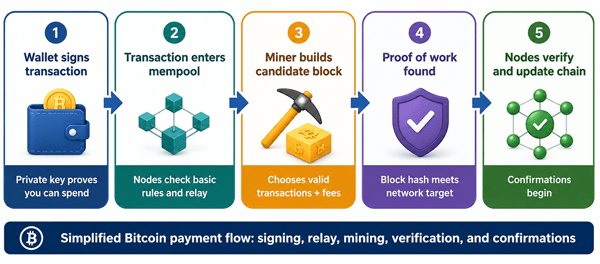
Simplified Bitcoin payment flow: signing, relay, mining, verification, and confirmations
In everyday terms, the wallet creates and signs the payment, nodes check the rules, miners order transactions into blocks, and the blockchain preserves the confirmed history.
4. How Bitcoin Transactions Work
4.1 Bitcoin uses coins as transaction outputs, not account balances
A bank account usually has a single balance that increases or decreases. Bitcoin works differently. It uses unspent transaction outputs, often shortened to UTXOs. A UTXO is like a digital coin or bill that has not yet been spent.
Suppose you have received 0.01 BTC and 0.03 BTC in two separate payments. Your wallet may show a balance of 0.04 BTC, but under the hood it sees two spendable outputs. If you send 0.015 BTC, your wallet might spend the 0.03 BTC output, send 0.015 BTC to the recipient, pay a miner fee, and return the rest to a new change output controlled by you.
4.2 A transaction has inputs, outputs, signatures, and fees
| Part | What it does |
|---|---|
| Inputs | Point to older unspent outputs you are spending. |
| Outputs | Create new spendable amounts for recipients and possibly change back to you. |
| Signature / witness data | Proves the spender has the right private key or satisfies the spending script. |
| Fee | The difference between total inputs and total outputs. Miners collect it if they include the transaction in a block. |
4.3 Why fees change
Bitcoin block space is limited. When many people want transactions confirmed quickly, they compete by offering higher fees. Fees are usually measured in satoshis per virtual byte, not as a fixed percentage of the payment amount. This is why sending a small payment can sometimes cost almost as much as sending a large one.
Practical tip: use a wallet with fee estimation, and avoid overpaying when confirmation speed is not urgent. For non-urgent transfers, you may choose a slower confirmation target and pay less.
4.4 What confirmations mean
A transaction with zero confirmations has been broadcast but is not yet included in a block. Once it is included in a block, it has one confirmation. Each new block added after that increases the confirmation count.
For small, low-risk payments, one confirmation may be enough. For large transfers, exchanges and businesses often wait for several confirmations because each additional block makes reversal less practical. There is no magic number that fits every situation; the right number depends on value, risk, and business policy.
5. What Is the Bitcoin Blockchain?
The Bitcoin blockchain is a public, chronological record of confirmed Bitcoin transactions. It is called a chain because each block contains a cryptographic reference to the previous block. Change an older block, and its hash changes, which breaks the link to every later block.
A block contains a list of transactions and a header. The header includes information such as the previous block hash, a Merkle root summarizing the transactions, a timestamp, the difficulty target, and a nonce that miners change while searching for a valid proof of work.
5.1 Why the blockchain is hard to rewrite
Bitcoin does not make history impossible to change by hiding it. It makes history expensive to change by requiring proof of work. To rewrite an old transaction, an attacker would need to redo the proof of work for that block and catch up with the honest chain. The deeper a transaction is buried under later blocks, the harder that becomes.
5.2 Blockchain vs normal database
| Feature | Traditional payment database | Bitcoin blockchain |
|---|---|---|
| Control | Usually controlled by a bank, company, or government system. | Maintained by independent nodes following open rules. |
| Editing history | Administrators may reverse, correct, or modify records. | Old records are extremely hard to change without massive proof of work. |
| Access | Often private and permissioned. | Public to read and permissionless to verify. |
| Trust model | Users trust the institution. | Users trust open-source rules, cryptography, economic incentives, and their own verification. |
| Speed and cost | Can be very fast and cheap inside one institution. | Base-layer capacity is limited; fees vary with demand. |
6. What Are Bitcoin Nodes?
A Bitcoin node is software connected to the Bitcoin peer-to-peer network. A full node independently validates blocks and transactions against the rules. This matters because nodes decide what they accept as Bitcoin.
A full node checks many things, including whether transactions have valid signatures, whether coins are not spent twice, whether blocks meet proof-of-work requirements, whether the block reward is not too high, and whether scripts and consensus rules are satisfied.
6.1 Types of Bitcoin network participants
| Participant | Main role | Beginner takeaway |
|---|---|---|
| Full node | Validates the full rules and relays valid data. | Best for independent verification and network resilience. |
| Pruned full node | Validates the full history but stores only recent block data after verification. | Useful when disk space is limited. |
| Light wallet / SPV wallet | Uses simplified verification and relies more on other nodes or servers. | Convenient but less independent. |
| Miner | Uses specialized hardware to find proof of work and propose blocks. | Provides ordering and security but does not get to override node rules. |
| Exchange or custodian | Holds bitcoin for users and manages internal accounts. | Convenient, but users rely on the custodian and do not control private keys. |
6.2 Why running a node matters
Running your own node is not required to use Bitcoin, but it improves privacy and independence. Instead of asking someone else whether a payment is valid, your wallet can check against your own node. This reduces reliance on third-party servers and helps keep rule enforcement distributed.
7. What Is Bitcoin Mining?
Bitcoin mining is the process of adding valid blocks to the blockchain through proof of work. Miners gather transactions, build a candidate block, and repeatedly hash the block header while changing data until the result is below the current network target.
This sounds abstract, so think of it like a global lottery where tickets are hashes. Miners cannot predict the winning ticket. They can only try many hashes per second. The more hash power a miner controls, the better their chance of finding the next block, but no miner is guaranteed to win a specific block.
7.1 What miners actually do
- Receive and verify pending transactions from the network.
- Choose transactions, usually prioritizing higher fee rates.
- Create a special coinbase transaction that pays the block subsidy and fees to the miner or mining pool.
- Build a candidate block and compute its Merkle root.
- Search for a block header hash below the difficulty target.
- Broadcast the block when valid proof of work is found.
- Receive the reward only if the network accepts the block as valid and it remains in the main chain.
7.2 Block rewards, halvings, and the 21 million limit
Miners earn two kinds of revenue: the block subsidy, which creates new bitcoin, and transaction fees. The subsidy halves roughly every four years. After the April 2024 halving, the subsidy became 3.125 BTC per block. Over time, the subsidy continues decreasing until new issuance becomes negligible; Bitcoin’s total supply is capped at 21 million BTC by protocol rules.
This fixed issuance schedule is one reason people compare Bitcoin to scarce commodities. However, scarcity alone does not guarantee stable value. Bitcoin’s market price can be highly volatile.
7.3 Difficulty adjustment
Bitcoin aims for an average block interval of about 10 minutes. If miners add a lot of hash power, blocks would come faster unless the system adjusted. About every 2,016 blocks, the difficulty adjusts based on how quickly the previous period was mined. This keeps issuance relatively predictable over time.
7.4 Mining pools
Solo mining is usually unrealistic for ordinary users because the odds of finding a block are tiny without enormous hash power. Mining pools let many miners combine hash power and share rewards in proportion to their contribution. A pool can make income more predictable, but it also introduces pool operator trust and centralization concerns.
8. How Nodes and Miners Work Together
A common misconception is that miners control Bitcoin. Miners are important, but they do not have unlimited power. They propose blocks. Nodes verify those blocks. If a miner creates a block that breaks the rules, full nodes reject it, no matter how much electricity was spent.
| Question | Miners | Full nodes |
|---|---|---|
| Do they create new blocks? | Yes. | No, but they validate blocks. |
| Do they decide which invalid block is accepted? | No. Invalid blocks are rejected by nodes. | Yes, nodes enforce validity rules locally. |
| Do they order transactions? | Yes, miners choose and order transactions in the blocks they find. | Nodes verify that the chosen transactions are valid. |
| Do they receive block rewards? | Yes, if their valid block is accepted. | No. |
| Do everyday users need to run one? | No. | Not required, but useful for privacy and self-verification. |
9. What Keeps Bitcoin Secure?
Bitcoin security comes from several layers working together rather than one magic feature.
- Private keys authorize spending. Without a valid signature, a transaction cannot spend someone else’s bitcoin.
- Full nodes independently enforce the rules. They reject invalid transactions and invalid blocks.
- Proof of work makes block history costly to rewrite.
- Economic incentives reward miners for following rules and producing valid blocks.
- Decentralization reduces dependence on any single company, server, or administrator.
9.1 The double-spending problem
Double spending means trying to spend the same bitcoin twice. Bitcoin reduces this risk by making nodes track which outputs are already spent and by using mining to create a widely accepted order of transactions. If two conflicting transactions appear, only one can become part of the accepted blockchain history.
9.2 51% attacks in plain English
A 51% attack means an entity controls enough mining power to outpace the rest of the network for some period. This could allow transaction reordering or double-spending of the attacker’s own transactions. It would not allow the attacker to create coins from nothing, steal coins without private keys, or change rules that full nodes reject. Still, it is a serious risk in proof-of-work systems and one reason mining decentralization matters.
10. Benefits of Bitcoin
- Open access: anyone with an internet connection can create a wallet and receive bitcoin.
- Self-custody: users can hold their own keys instead of relying on a bank or custodian.
- Transparent supply: issuance rules are public and auditable.
- Censorship resistance: no single payment company controls the whole network.
- Global settlement: payments can be sent across borders without traditional banking rails.
- Programmable ownership: scripts allow conditions such as multisignature spending.
11. Risks, Limitations, and Trade-Offs
Bitcoin also has real drawbacks. A trustworthy explanation should cover them clearly.
| Issue | What it means | Practical advice |
|---|---|---|
| Price volatility | BTC can rise or fall sharply. | Do not treat bitcoin as a guaranteed store of value or risk-free investment. |
| Lost keys | If you lose your private key or seed phrase, there may be no recovery option. | Use a reputable wallet, secure backups, and consider hardware wallets for larger amounts. |
| Scams and phishing | Attackers target seed phrases, fake wallets, and fake investment schemes. | Never share your seed phrase. Verify wallet downloads and website URLs. |
| Fees and congestion | Fees can rise when demand for block space is high. | Use fee estimation and avoid urgent transfers during congestion when possible. |
| Energy use | Proof-of-work mining consumes electricity. | Understand the trade-off: energy use is part of Bitcoin’s security model, but environmental impact depends on energy sources and mining practices. |
| Regulation and taxes | Rules vary by country and may change. | Keep records and seek local tax or legal advice for significant activity. |
| Irreversible payments | Confirmed transactions generally cannot be reversed by a support team. | Double-check addresses, amounts, and networks before sending. |
12. Common Bitcoin Misconceptions
12.1 “Bitcoin is completely anonymous”
Bitcoin is pseudonymous, not fully anonymous. Addresses are not names, but transactions are public. If an address becomes linked to a person, business, exchange account, or IP activity, privacy can be reduced. Good wallet practices matter.
12.2 “Bitcoin wallets store coins”
Wallets store and manage keys. The coins are represented by unspent outputs on the blockchain. Your wallet reads the blockchain and signs transactions that spend outputs controlled by your keys.
12.3 “Miners validate everything and users just trust them”
Miners produce candidate blocks, but full nodes validate them. A miner who includes invalid transactions or creates too much subsidy will have the block rejected by nodes.
12.4 “A transaction is final the second I click send”
Broadcasting is not the same as confirmation. A payment becomes more reliable after it is included in a block and gains additional confirmations.
12.5 “Bitcoin is free to use”
Bitcoin does not require a monthly bank account fee, but on-chain transactions require miner fees. Fees vary based on network demand and transaction size.
13. Practical Best Practices for Beginners
- Start with a small test transaction before sending a large amount.
- Write down your seed phrase offline and keep it private. Do not store it in screenshots, cloud notes, or email.
- Use a hardware wallet for meaningful long-term holdings.
- Verify the receiving address carefully, especially the first and last characters.
- Understand the difference between Bitcoin and other networks. Sending BTC to the wrong type of address or platform can cause loss.
- Use wallets that support modern address types and good fee estimation.
- Consider running your own node if privacy and self-verification matter to you.
- Keep software updated, but download only from official sources.
- Be skeptical of guaranteed returns, mining investment schemes, and anyone asking for your seed phrase.
14. Bitcoin Compared With Banks, PayPal, and Cash
| Feature | Bitcoin | Bank / PayPal style payment | Physical cash |
|---|---|---|---|
| Who approves payments? | Network rules verified by nodes; miners include transactions in blocks. | A company or bank approves and can block or reverse payments. | No network approval needed in person. |
| Reversibility | Generally irreversible after confirmation. | Often reversible or disputable. | Usually irreversible once handed over. |
| Privacy | Public ledger; pseudonymous addresses. | Private to the public, visible to institutions and sometimes governments. | Strong in-person privacy, but limited online use. |
| Custody | Can be self-custodied. | Usually custodial. | Self-custodied physically. |
| Global online use | Designed for internet-native settlement. | Works globally but depends on intermediaries and rules. | Poor for remote digital payments. |
| Main risk | Key loss, volatility, fees, scams. | Account freezes, chargebacks, institution risk. | Theft, loss, physical handling. |
15. When Bitcoin Is Useful and When It May Not Be
15.1 Bitcoin may be useful when
- You need self-custody and direct control over funds.
- You want to receive global payments without relying on one payment company.
- You are making larger settlements where waiting for confirmations is acceptable.
- You value open, transparent monetary rules and independent verification.
15.2 Bitcoin may not be the best tool when
- You need guaranteed price stability.
- You need instant, reversible consumer protection like credit card chargebacks.
- You cannot safely manage private keys.
- The transaction fee is too high relative to the payment amount.
- Local laws or platform policies make use restricted or complicated.
16. Summary: How Bitcoin Works in 6 Steps
- A wallet creates a transaction that spends existing unspent outputs.
- The wallet signs the transaction with a private key.
- The transaction is broadcast to the Bitcoin peer-to-peer network.
- Nodes verify the transaction and relay it if valid.
- Miners compete to place valid transactions into a proof-of-work block.
- Nodes verify the new block and add it to the blockchain, giving the transaction confirmations.
17. Frequently Asked Questions
17.1 Who invented Bitcoin?
Bitcoin was introduced in 2008 by Satoshi Nakamoto, a name used by the person or group that published the Bitcoin white paper. Satoshi’s real-world identity remains unknown.
17.2 Is Bitcoin legal?
Bitcoin’s legal status depends on the country. In many places it is legal to own or trade, but rules for exchanges, taxes, mining, payments, and reporting vary. Check local regulations before significant use.
17.3 Can Bitcoin be hacked?
The Bitcoin protocol has proven resilient, but users, wallets, exchanges, and custodians can be hacked or tricked. Most losses happen through stolen keys, phishing, malware, bad custody, or scams rather than someone breaking Bitcoin’s cryptography.
17.4 Why does Bitcoin mining use electricity?
Proof of work uses electricity because miners perform repeated computations to find a valid block hash. This cost helps secure the chain by making attacks and history rewriting expensive.
17.5 How long does a Bitcoin transaction take?
A transaction can appear in the network within seconds, but confirmation depends on miner selection, fees, and block timing. Blocks are found about every 10 minutes on average, not exactly every 10 minutes.
17.6 What happens if I send bitcoin to the wrong address?
Confirmed Bitcoin transactions usually cannot be reversed. If the address is valid but belongs to someone else, recovery depends on that person or service cooperating. Always verify before sending.
17.7 Do I need to understand mining to use Bitcoin?
No. You can use Bitcoin with a wallet without mining. Understanding mining helps you understand confirmations, security, fees, and why transactions are irreversible.
17.8 Can all 21 million bitcoins already exist?
No. New bitcoin is issued through the block subsidy, which decreases over time through halvings. The supply approaches 21 million BTC but issuance becomes smaller and smaller over many decades.
17.9 What is the mempool?
The mempool is a node’s collection of valid unconfirmed transactions waiting to be mined. Each node has its own mempool, so mempool contents can differ slightly across the network.
17.10 Are Bitcoin and blockchain the same thing?
No. Bitcoin is a specific digital money network. A blockchain is the data structure Bitcoin uses to order confirmed transactions. Many other systems use blockchains, but they may have very different rules and trust models.
18. Conclusion
Bitcoin works by combining cryptography, peer-to-peer networking, proof-of-work mining, and independent node verification. Wallets sign transactions, nodes check the rules, miners compete to add blocks, and the blockchain records the confirmed history.
For beginners, the most important practical lesson is this: Bitcoin removes many middlemen, but it also shifts responsibility to the user. Learn how wallets, private keys, fees, confirmations, and scams work before moving meaningful amounts of money. Used carefully, Bitcoin is a powerful open payment network. Used carelessly, it can be unforgiving.
Sources Consulted and Checked
The following sources were consulted and checked while preparing this document and reviewing its accuracy.
- Satoshi Nakamoto, “Bitcoin: A Peer-to-Peer Electronic Cash System,” bitcoin.org/bitcoin.pdf.
- Bitcoin.org, “How does Bitcoin work?” and “Running A Full Node.”
- Bitcoin.org Developer Guide, sections on the blockchain, transactions, and payment processing.
- Bitcoin Core project information on validation and decentralization.
- Cambridge Centre for Alternative Finance, Cambridge Bitcoin Electricity Consumption Index methodology.
- U.S. Energy Information Administration, preliminary estimates on electricity use from cryptocurrency mining operations in the United States.
- Investopedia coverage of the April 2024 Bitcoin halving and current 3.125 BTC block subsidy.
Reader Advice
This article is provided for educational and informational purposes only. It is not personalized legal, tax, financial, investment, cybersecurity, or regulatory advice, and it does not recommend buying, selling, mining, or holding bitcoin. Bitcoin involves significant risks, including price volatility, scams, loss or theft of private keys, irreversible transactions, changing fees, technical failures, and possible tax or regulatory consequences. Laws, rules, platform policies, network conditions, and statistics can change over time and vary by country or region, so readers should verify important information through current official sources and seek qualified local professional advice before making significant decisions or transferring meaningful amounts.