Stocks vs ETFs: Pros, Cons, and Which Should You Buy?
1. Quick Answer: Most Beginners Should Start With ETFs, Then Add Stocks Slowly
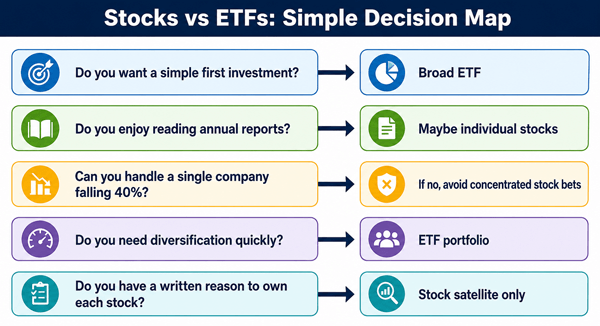
If you are new to investing, ETFs are usually the easier and safer starting point because one ETF can hold dozens, hundreds, or even thousands of investments. That does not make ETFs risk-free, but it does reduce the danger of putting too much money into one company. Individual stocks can produce higher returns, but they also require more research, patience, emotional control, and risk management.
A practical beginner approach is simple: use broad, low-cost ETFs as the core of your portfolio, then add a small number of individual stocks only if you genuinely want to study businesses. In plain English, ETFs are the “easy basket.” Stocks are the “pick one company” choice.
| Best choice when... | ETFs may fit better | Individual stocks may fit better |
|---|---|---|
| You are a beginner | Yes. They are simpler and diversified. | Only with a small amount and strong research. |
| You want broad exposure | Yes. One ETF can cover a whole market or sector. | No. One stock is one company. |
| You want control over exact companies | Limited. The fund decides holdings based on its strategy. | Yes. You choose each company. |
| You want lower research burden | Yes. You mainly research the ETF type, cost, index, and risk. | No. You must research the business, valuation, debt, competition, and management. |
| You want the chance to beat the market | Possible but less direct, especially with index ETFs. | Possible, but difficult and riskier. |
| You dislike big surprises | Usually better, though ETFs can still fall sharply. | Riskier. Bad news in one company can hit hard. |
2. What Is a Stock?
A stock is a small ownership share in a company. When you buy shares of a company, you become a partial owner of that business. If the company grows, earns more money, and investors become willing to pay more for it, your shares may rise in value. If the company struggles, faces lawsuits, loses customers, takes on too much debt, or disappoints the market, your shares may fall.
For example, buying one share of a large technology company does not mean you control the company. It simply means you own a tiny piece of it. You may benefit from price increases and sometimes dividends, but you also accept company-specific risk.
2.1 How Stocks Make or Lose Money
Stocks can make money in two main ways: capital gains and dividends. A capital gain happens when you buy at one price and later sell at a higher price. A dividend is a cash payment some companies send to shareholders. Not all companies pay dividends, and dividends can be reduced or stopped.
Stocks lose money when the price falls below what you paid and you sell, or when the company permanently loses value. Beginners often underestimate how normal volatility is. A good company can still fall 20% or more during a bad market. A weak company can fall much more and may never recover.
Beginner example
A new investor buys one stock at $100. A weak earnings report comes out and the stock drops to $75. The investor is now down 25%. To recover from a 25% loss, the stock must rise about 33%, not 25%. This is why risk control matters.
3. What Is an ETF?
An ETF, or exchange-traded fund, is an investment fund that trades on a stock exchange like a stock. Instead of buying one company, you buy one fund that holds a collection of investments. Depending on the ETF, it may hold U.S. stocks, international stocks, bonds, real estate companies, commodities, dividend stocks, growth stocks, or a specific sector.
A broad stock-market ETF might own hundreds of companies. A bond ETF might own many bonds. A sector ETF, such as a technology ETF, may own many companies in one industry. ETFs can be passive, meaning they track an index, or active, meaning a manager makes investment decisions.
Regulators and investor-education organizations emphasize that ETFs still carry risk. Their value can fall if the securities inside the fund fall. ETFs are not bank deposits and are not guaranteed or FDIC-insured.
3.1 How ETFs Work in Simple Terms
Think of an ETF as a basket. You buy one share of the basket, and inside the basket are many investments. If the basket tracks the S&P 500, it tries to follow the performance of large U.S. companies. If it tracks a total stock market index, it may own large, mid-sized, and smaller companies. If it tracks a bond index, it owns bonds instead of stocks.
You can buy and sell ETFs during the trading day through a brokerage account. The ETF has a market price, an expense ratio, and a list of holdings. The expense ratio is the annual fund cost. A 0.03% expense ratio means the fund costs about 30 cents per year for every $1,000 invested. A 0.75% expense ratio means about $7.50 per year for every $1,000 invested. Small percentages matter over decades.
| Term | Meaning | Why it matters |
|---|---|---|
| Expense ratio | The annual cost of owning the fund. | Lower costs leave more of the return for the investor. |
| Holdings | The investments inside the ETF. | Shows what you actually own. |
| Index | A benchmark the ETF may track. | Explains the ETF’s strategy and exposure. |
| Bid-ask spread | The gap between buying and selling prices. | Wider spreads can quietly increase trading cost. |
| Liquidity | How easily the ETF trades. | More liquid ETFs are usually easier to buy and sell efficiently. |
| Tracking difference | How ETF performance differs from its index. | A large gap may signal costs, structure, or trading issues. |
4. Stocks vs ETFs: Main Differences
| Feature | Individual stocks | ETFs |
|---|---|---|
| What you own | A share of one company. | A fund that owns many securities. |
| Diversification | Low unless you buy many stocks. | Often built in, depending on the ETF. |
| Risk type | Company-specific risk plus market risk. | Market, sector, bond, currency, or strategy risk; usually less single-company risk. |
| Research needed | High. | Moderate for broad ETFs; high for niche, leveraged, or complex ETFs. |
| Fees | No fund expense ratio, but trading costs may apply. | Expense ratio plus possible trading spread. |
| Control | Very high. You pick the company. | Lower. The ETF strategy controls holdings. |
| Upside potential | High if you pick a big winner. | Usually more balanced; less likely to depend on one winner. |
| Downside potential | High if the company performs poorly. | Can still be high, especially in sector, leveraged, or narrow ETFs. |
| Best use | Satellite holdings for informed investors. | Core portfolio building block for many beginners. |
5. Pros of Buying Individual Stocks
The biggest advantage of individual stocks is control. You decide exactly which companies you own, how much you own, and when to sell. If you deeply understand a business and buy it at a reasonable price, a stock can outperform the broader market. Stocks can also be useful for investors who want to build a dividend portfolio, avoid certain industries, or concentrate on companies they know well.
Individual stocks are also transparent. You can read the company’s annual report, financial statements, earnings calls, debt levels, margins, and competitive position. There is no fund manager deciding the basket for you.
| Stock advantage | What it means in real life |
|---|---|
| Higher upside from winners | A single excellent company can multiply in value and lift your portfolio. |
| No ETF expense ratio | You do not pay an annual fund fee for holding the stock. |
| Exact ownership | You choose the company, sector, and position size. |
| Tax control | You decide which shares to sell and when, subject to tax rules. |
| Learning value | Researching stocks can teach you how businesses actually make money. |
6. Cons of Buying Individual Stocks
The main drawback is concentration risk. One company can disappoint investors for reasons you did not expect: product failures, accounting problems, competition, regulation, lawsuits, management mistakes, debt pressure, fraud, or changing consumer behavior. Even well-known companies can fall hard.
Stocks also demand emotional discipline. Many beginners buy after a stock has already gone up because it feels exciting, then sell after it drops because the loss feels painful. That behavior can turn normal volatility into permanent losses.
Another issue is research quality. Reading headlines is not research. A serious stock investor should understand revenue growth, profit margins, cash flow, valuation, debt, competitive advantage, industry trends, and why the market may already know the “good news.”
People-experience insight
Many beginners do not lose money because stocks are impossible. They lose because they overconcentrate, chase popular names, copy social media picks, ignore valuation, and sell emotionally after normal drawdowns.
7. Pros of ETFs
The biggest ETF benefit is diversification. Instead of betting on one company, you can own a broad slice of the market. This reduces the impact of a single company failure. ETFs can also be simple, low-cost, and accessible for small investors. Many brokers allow fractional ETF investing, which means you may not need enough cash to buy a full share.
ETFs are useful for building a portfolio around goals. A beginner might use a broad U.S. stock ETF, an international stock ETF, and a bond ETF. A more advanced investor might add small allocations to dividend ETFs, value ETFs, or sector ETFs. The key is to understand what the ETF owns and why it belongs in the portfolio.
| ETF advantage | What it means in real life |
|---|---|
| Built-in diversification | One purchase can spread money across many securities. |
| Lower research burden | You study the fund strategy instead of every company individually. |
| Low-cost options | Many broad index ETFs have very low expense ratios. |
| Easy portfolio building | ETFs can cover U.S. stocks, global stocks, bonds, and sectors. |
| Trading flexibility | ETFs trade during the day like stocks. |
| Transparency | Most ETFs regularly publish holdings, costs, and performance data. |
8. Cons of ETFs
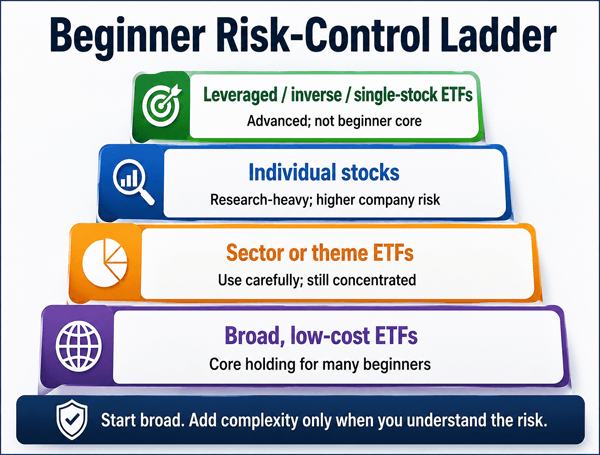
ETFs are not perfect. A broad ETF can still fall during a bear market. A sector ETF can be concentrated in one industry. A thematic ETF can be trendy, expensive, and launched near peak excitement. A high-yield ETF may carry credit risk. A bond ETF can lose value when interest rates rise. A leveraged ETF can behave very differently from what beginners expect.
Another common misunderstanding is that every ETF is “safe.” That is false. Some ETFs are conservative; others are highly speculative. A total market ETF and a leveraged single-stock ETF are not remotely the same product. Beginner investors should be especially cautious with leveraged, inverse, single-stock, commodity, and narrow theme ETFs.
| ETF risk | Plain-English explanation | Beginner check |
|---|---|---|
| Market risk | If the market falls, the ETF can fall too. | Can you hold through a downturn? |
| Concentration risk | Some ETFs hold many names but still depend heavily on a few large companies or one sector. | Check top 10 holdings and sector weights. |
| Fee risk | High expense ratios reduce long-term returns. | Compare expense ratios before buying. |
| Liquidity/spread risk | Thinly traded ETFs may cost more to enter or exit. | Look at trading volume and bid-ask spread. |
| Complex strategy risk | Leveraged or inverse ETFs can be unsuitable for long-term beginners. | Avoid what you cannot explain in one sentence. |
9. Which Is Better for Beginners?
For most beginners, ETFs are better as a first investment because they solve the biggest beginner problem: overdependence on one stock. A beginner who buys one company may think they are “investing in the stock market,” but they are really betting on one business. A beginner who buys a broad ETF is closer to investing in the market as a whole.
That said, “ETF first” does not mean “never buy stocks.” A balanced approach can work well: keep 80% to 95% of your long-term investment money in diversified funds, and use 5% to 20% for individual stocks only if you enjoy research and can accept mistakes. Some beginners should keep the stock-picking portion at 0% until they have more experience.
| Investor type | Possible approach | Why |
|---|---|---|
| Complete beginner | Start with broad, low-cost ETFs. | Simple, diversified, easier to maintain. |
| Busy professional | Mostly ETFs; automate contributions. | Less time needed for company research. |
| Curious learner | Core ETFs plus small stock “learning account.” | Lets you learn without risking the whole portfolio. |
| High-risk stock picker | Set strict position-size rules. | Limits damage from wrong picks. |
| Income-focused investor | Dividend ETFs or carefully researched dividend stocks. | Diversification matters because dividends can be cut. |
10. Practical Portfolio Examples
These examples are educational, not personal recommendations. The right mix depends on age, income stability, debt, emergency savings, time horizon, taxes, and risk tolerance.
| Example | Portfolio idea | Who it may fit | Main risk |
|---|---|---|---|
| Simple beginner core | 70% broad stock ETF + 30% bond ETF | A cautious long-term beginner who wants simplicity. | Stocks and bonds can both fall, especially in unusual markets. |
| Growth-oriented beginner | 90% broad stock ETFs + 10% bond ETF or cash-like allocation | A younger investor with a long time horizon and stable income. | Large market drawdowns may be emotionally hard. |
| ETF core + stock satellite | 85% diversified ETFs + 15% individual stocks | Someone who wants to learn stock analysis without overconcentrating. | Stock picks may underperform or lose money. |
| Dividend-focused | Broad ETF + dividend ETF + limited individual dividend stocks | Someone seeking income style exposure. | High dividends can signal higher risk; dividend cuts happen. |
| Sector tilt | Core ETFs + small allocation to a sector ETF | An investor with a researched view on a sector. | Sector ETFs can be concentrated and volatile. |
Actionable rule
Before buying any investment, write one sentence: “I am buying this because...” If your reason is “everyone is talking about it,” “it already went up,” or “I need quick money,” pause.
11. How to Analyze an ETF Before Buying
A beginner does not need to become a fund analyst, but should know the basics before investing. Start with the ETF’s objective. Is it broad market, sector-specific, dividend-focused, bond-focused, international, leveraged, inverse, or thematic? Then check cost, holdings, diversification, performance history, trading liquidity, and whether the ETF fits your plan.
| ETF checklist question | Why it matters |
|---|---|
| What index or strategy does it follow? | Tells you what you are actually buying. |
| What is the expense ratio? | Costs reduce returns every year. |
| What are the top 10 holdings? | Shows concentration risk. |
| How many holdings does it have? | More holdings can mean broader diversification, but quality still matters. |
| What sectors and countries are included? | Prevents accidental overexposure. |
| Is it leveraged, inverse, or single-stock? | These products can be much riskier than ordinary ETFs. |
| How liquid is it? | Low liquidity can increase trading costs. |
| Does it overlap with funds I already own? | Many ETFs hold the same big companies, creating hidden concentration. |
12. How to Analyze an Individual Stock Before Buying
Stock analysis should begin with the business, not the chart. Ask: What does this company sell? Who are its customers? Why do they choose it? Is revenue growing? Is the company profitable? Does it produce free cash flow? How much debt does it carry? Can competitors copy it? Is the stock price already assuming perfect results?
A beginner-friendly stock checklist should be strict. If you cannot explain the business, skip it. If you cannot handle a large drop, keep the position small. If the stock is being promoted mainly through hype, be skeptical.
| Stock checklist question | Good sign | Warning sign |
|---|---|---|
| Business model | You can explain how the company makes money. | You only know the ticker symbol. |
| Financial health | Consistent cash flow and manageable debt. | Heavy losses, dilution, or debt stress. |
| Competitive advantage | Brand, network effects, cost advantage, switching costs, or strong distribution. | Easy to copy and weak pricing power. |
| Valuation | Price makes sense relative to future earnings/cash flow. | Great company but wildly expensive expectations. |
| Management | Clear communication and shareholder-friendly decisions. | Frequent overpromising or questionable governance. |
| Position size | Small enough that a mistake will not ruin the plan. | Too much money in one stock. |
13. Fees, Taxes, and Hidden Costs
Costs matter because investing is a compounding game. A small fee gap can become meaningful over 10, 20, or 30 years. Stocks do not have an ETF expense ratio, but investors may still face trading costs, spreads, taxes, and mistakes from overtrading. ETFs have expense ratios and spreads, but many broad ETFs are very inexpensive.
Taxes depend on your country and account type. In taxable accounts, selling for a profit can create capital gains. Dividends may be taxable. Tax-loss selling may be affected by wash-sale rules in the United States if a substantially identical investment is bought too soon before or after selling at a loss. Tax rules change and personal situations differ, so readers should verify with a qualified tax professional.
| Cost or tax issue | Stocks | ETFs | Beginner tip |
|---|---|---|---|
| Expense ratio | None. | Yes, varies by fund. | Prefer low-cost broad ETFs for core holdings. |
| Trading spread | Can apply. | Can apply. | Avoid thinly traded securities and market orders in volatile periods. |
| Capital gains | Triggered when sold at a profit in taxable accounts. | Triggered when ETF shares are sold at a profit; fund distributions may also matter. | Use tax-advantaged accounts where appropriate. |
| Dividends | Company dividends may be taxable. | ETF distributions may be taxable. | Do not chase yield without checking risk. |
| Overtrading | Common risk for beginners. | Also possible. | Use a written plan and avoid emotional trading. |
14. Common Beginner Mistakes
| Mistake | Why it hurts | Better habit |
|---|---|---|
| Buying because of hype | Popular trades can already be overpriced. | Understand valuation and risk before buying. |
| Putting too much in one stock | One bad event can damage the portfolio. | Limit position size and diversify. |
| Assuming ETFs are always safe | Niche ETFs can be risky and concentrated. | Read holdings, strategy, and expense ratio. |
| Selling during panic | Turns temporary volatility into permanent loss. | Set a long-term plan before downturns happen. |
| Ignoring emergency savings | You may be forced to sell investments at a bad time. | Build emergency savings before investing aggressively. |
| Chasing dividends | High yield can signal stress. | Look at payout safety and total return. |
| Not rebalancing | A portfolio can become riskier over time. | Review allocations once or twice a year. |
15. When Stocks Make Sense
Individual stocks can make sense when you are willing to do real research, understand the business, have a long time horizon, and keep position sizes reasonable. Stocks can also make sense when you want direct ownership in companies you believe are financially strong and attractively valued.
They make less sense when you are investing rent money, trying to get rich quickly, copying social media, or unable to tolerate volatility. A stock portfolio should be built like a business owner, not like a lottery ticket buyer.
16. When ETFs Make Sense
ETFs make sense when you want a simple, diversified, low-maintenance way to invest. They are especially useful for retirement investing, monthly investing, beginner portfolios, and investors who do not want to spend hours reading financial statements. Broad ETFs can help investors participate in long-term market growth without trying to identify the few winning companies in advance.
ETFs make less sense when the ETF is expensive, poorly understood, too narrow, too leveraged, or bought only because a theme is trending. The word “ETF” does not automatically mean “conservative.”
17. The Best Practical Answer: Core and Satellite
A core-and-satellite strategy is one of the most practical ways to combine ETFs and stocks. The core is the stable foundation, often broad ETFs. The satellites are smaller positions, such as individual stocks or specialized ETFs. This structure gives beginners diversification while still allowing room to learn and express researched views.
For example, an investor might keep 90% in broad ETFs and 10% in individual stocks. If one stock performs badly, it will not destroy the plan. If the investor becomes skilled over time, they can adjust carefully. If they discover stock picking is stressful or unproductive, they can return to a mostly ETF portfolio.
| Portfolio part | Purpose | Example allocation | Rule |
|---|---|---|---|
| Core ETFs | Diversification and long-term growth. | 80% to 100% | Keep costs low and strategy simple. |
| Individual stocks | Learning, targeted ownership, possible outperformance. | 0% to 20% | Only buy what you understand. |
| Cash / emergency fund | Avoid forced selling. | Separate from investment portfolio | Do not invest money needed soon. |
| Bonds / conservative assets | Reduce volatility and match shorter goals. | Varies by age and risk tolerance | Use based on goal, not fear alone. |
18. Step-by-Step: How a Beginner Can Start
- Build emergency savings first. Investing money you may need next month can force you to sell at the worst time.
- Define the goal. Retirement, house deposit, education, or wealth building all have different time horizons.
- Choose account type. A taxable brokerage account, retirement account, or local tax-advantaged account may change the best approach.
- Decide your asset allocation. Choose how much belongs in stocks, bonds, and cash-like assets based on time horizon and risk tolerance.
- Start with broad ETFs if unsure. A broad ETF can help avoid the beginner mistake of betting everything on one company.
- Use automatic contributions. Monthly investing can reduce the pressure of timing the market.
- Add individual stocks only with rules. Set maximum position sizes and write a reason for every stock.
- Review, rebalance, and keep learning. Do not check prices obsessively; review the plan periodically.
19. FAQ: Stocks vs ETFs
19.1 Are ETFs better than stocks?
For many beginners, broad ETFs are better as a starting point because they are diversified and simpler. Stocks may be better for investors who can research companies and manage concentration risk.
19.2 Can you lose money in ETFs?
Yes. ETFs can fall when the investments inside them fall. Some ETFs are very risky, especially leveraged, inverse, single-stock, and narrow thematic ETFs.
19.3 Do ETFs pay dividends?
Many stock and bond ETFs distribute dividends or interest, but amounts vary. Dividend payments are not guaranteed.
19.4 How many ETFs should a beginner own?
Often just a few broad ETFs can be enough. Owning many overlapping ETFs can create complexity without better diversification.
19.5 How many stocks should a beginner own?
If a beginner buys stocks, position sizes should be small. A portfolio of only one to five stocks can be highly concentrated.
19.6 Should I buy stocks or ETFs every month?
Regular contributions to diversified investments can be a practical habit. The exact investment depends on your goals, risk tolerance, and account type.
19.7 Are index ETFs safer than individual stocks?
They usually reduce single-company risk, but they still carry market risk. A stock-market index ETF can lose value in a broad market downturn.
19.8 What is the biggest mistake with ETFs?
Buying an ETF without checking what it owns. The label may sound diversified, but the fund may be concentrated in one sector, country, theme, or a few large holdings.
20. Final Verdict: Which Should You Buy?
If you are starting from zero, buy knowledge first. Learn the difference between owning one company and owning a basket of investments. Then, for most beginners, a broad, low-cost ETF portfolio is the more practical starting point. It is simpler, diversified, and easier to maintain.
Individual stocks can be useful, but they should be treated as concentrated business ownership. Buy stocks only when you understand the company, accept the risk, and have a written plan. A sensible compromise is to keep ETFs as the core and use a small stock allocation as a learning or opportunity bucket.
The best investment is not the one that sounds exciting today. It is the one you can understand, afford, hold through volatility, and fit into a long-term plan without needing hype, guesses, or luck.
One-sentence takeaway
ETFs are usually the better first tool for beginners; individual stocks are optional tools for investors who want more control and can handle more research and risk.
Sources Consulted and Checked
The following sources were consulted and checked while preparing this article to support accuracy, clarity, and responsible presentation of the information.
- SEC Investor.gov - Beginners’ Guide to Asset Allocation, Diversification, and Rebalancing: https://www.investor.gov/additional-resources/general-resources/publications-research/info-sheets/beginners-guide-asset
- SEC Investor.gov - Exchange-Traded Funds: https://www.investor.gov/introduction-investing/investing-basics/investment-products/mutual-funds-and-exchange-traded-2
- FINRA - Exchange-Traded Funds and Products: https://www.finra.org/investors/investing/investment-products/exchange-traded-funds-and-products
- Vanguard - ETFs vs. individual securities: https://investor.vanguard.com/investor-resources-education/understanding-investment-types/choosing-between-funds-individual-securities
- IRS Publication 550 - Investment Income and Expenses: https://www.irs.gov/pub/irs-pdf/p550.pdf
- Fidelity - Wash-sale rules: https://www.fidelity.com/learning-center/personal-finance/wash-sales-rules-tax
Reader Advice
This article is provided solely for educational and informational purposes and does not constitute personalized financial, investment, tax, legal, or other professional advice. Investing involves risk, including the possible loss of principal, and no investment strategy or product is suitable for every person. Before making any financial decision, readers should consider their objectives, financial circumstances, time horizon, risk tolerance, fees, tax position, and applicable local laws, and should seek advice from an appropriately qualified professional when needed. Rules, tax treatment, fund expenses, product features, market conditions, and regulatory requirements may change over time and may differ by country, account type, provider, and individual circumstances. Readers should therefore verify important facts, figures, fees, eligibility requirements, and current rules directly through official regulators, tax authorities, fund documents, brokerage disclosures, and other authoritative sources. Historical performance, examples, and general illustrations are not guarantees of future results.