How to Buy Stocks Online: Everything You Need to Know
1. What does it mean to buy stocks online?
Buying stocks online means using a regulated brokerage account or investment app to purchase shares of public companies through a website or mobile platform. In the past, investors often called a broker to place a trade. Today, a beginner can compare companies, deposit money, enter an order, and track the investment from a phone. The convenience is real, but so is the responsibility: the app makes trading easy, not automatically wise.
A stock is a small ownership interest in a company. If the company grows and the market values it more highly, the share price may rise. Some companies also pay dividends, which are cash payments to shareholders. But share prices move up and down every day, and no online trading platform can remove that risk.
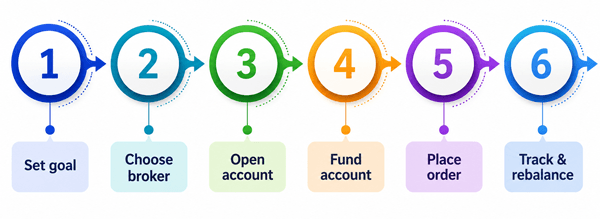
Figure 1: A simple beginner workflow for buying stocks online.
2. How buying stocks online works behind the screen
When you tap Buy, your broker does not simply hand you shares from its own shelf. Your order is routed to a market center, exchange, or other execution venue. The order is matched with a seller, executed at an available price based on the order type, and then the trade moves through clearing and settlement. In the U.S., the standard settlement cycle for many securities moved to T+1 for applicable trades on or after May 28, 2024, meaning settlement generally happens one business day after the trade date. Settlement rules vary by country and security type, so local investors should check their broker and regulator.
| Stage | Plain-English meaning | What a beginner should watch |
|---|---|---|
| Order entry | You enter ticker, buy/sell, quantity or dollar amount, order type, and time-in-force. | Double-check the ticker, amount, and whether you are buying shares or a dollar amount. |
| Execution | The order is filled in the market if the conditions are met. | Market orders prioritize speed; limit orders prioritize price control. |
| Confirmation | The broker shows trade details such as shares, price, fees, and time. | Save confirmations for records and taxes. |
| Settlement | Cash and securities officially exchange hands. | Do not assume every cash balance is immediately withdrawable or reusable in every account type. |
| Ongoing ownership | Your shares may rise, fall, pay dividends, split, or vote on corporate matters. | Track the business, not just the daily price movement. |
3. Who should consider buying stocks online?
Online stock investing can be useful for people who want long-term wealth building, dividend income, ownership in public companies, or low-cost access to broad market funds. It is not ideal for people who need the money soon, cannot handle price swings, or are tempted to trade based on social-media hype.
| Good fit | Be careful if |
|---|---|
| You have an emergency fund and high-interest debt is under control. | You need the money for rent, tuition, medical bills, or a near-term purchase. |
| You can invest for years, not days. | You feel pressure to “get rich fast.” |
| You are willing to learn basic valuation, diversification, and risk. | You plan to borrow money or use margin without experience. |
| You can ignore daily noise and follow a written plan. | You panic sell whenever the market drops. |
4. Before you buy your first stock: the beginner checklist
- Define the goal: Are you investing for retirement, a house down payment, children’s education, passive income, or general wealth building? The right account and investments depend on the goal.
- Decide your time horizon: Money needed in the next one to three years usually does not belong in individual stocks because a bad market can arrive at the wrong time.
- Know your risk tolerance: Risk tolerance is not just what you say during a rising market. It is what you can emotionally and financially survive when your portfolio is down 20% or more.
- Choose a realistic starting amount: Many brokers support fractional shares, so you may be able to start with a small dollar amount. The habit matters more than the headline amount.
- Write simple rules: Example: “I will invest $100 every month into a broad ETF and only buy individual stocks after reading the latest financial statements.”
- Learn the tax basics: Selling at a profit may create a taxable gain. Dividends may also be taxable. Rules vary by country and account type.
5. How to choose the best online broker for beginners
The best broker is not always the app with the prettiest interface. A good online brokerage account should be regulated, transparent about fees, reliable during volatile markets, and suitable for your investing style. In the U.S., investors can use tools such as Investor.gov and FINRA BrokerCheck to research investment professionals and firms. In Pakistan, investors should use SECP/PSX resources and make sure the brokerage account is opened in their own name.
| Feature | Why it matters | Beginner-friendly question to ask |
|---|---|---|
| Regulation and reputation | You want a real, supervised firm with clear account protections and complaint history. | Is the broker registered with the relevant regulator in my country? |
| Account types | A taxable brokerage account, retirement account, cash account, and margin account serve different purposes. | Can I start with a simple cash account? |
| Fees and spreads | Zero commission does not mean zero cost; spreads, currency conversion, platform fees, inactivity fees, and transfer fees can matter. | What will I pay to buy, sell, withdraw, convert currency, or transfer assets? |
| Investment choices | Some platforms offer U.S. stocks, local stocks, ETFs, mutual funds, bonds, options, or crypto-related products. | Does it offer the investments I actually need, not just risky features? |
| Fractional shares | Helpful when high-priced stocks are unaffordable, but fractional shares may have transfer limits. | Can I buy by dollar amount, and can I transfer fractional shares later? |
| Research tools | Good screeners, financial statements, analyst data, and education reduce blind guessing. | Can I understand the company before buying? |
| Security | Two-factor authentication, device alerts, and withdrawal controls help protect your account. | Does the app support strong account protection? |
| Customer support | During account lockouts or market volatility, support quality matters. | Can I reach a human if something goes wrong? |
6. Cash account vs. margin account: start simple
Most beginners should understand the difference before opening an account. A cash account requires you to pay for purchases with available cash. A margin account lets you borrow from the broker against your securities. Margin can increase buying power, but it can also magnify losses and lead to margin calls.
| Account type | How it works | Beginner view |
|---|---|---|
| Cash account | You buy investments with cash you deposit. | Usually the simplest starting point. Easier to understand and less likely to create debt. |
| Margin account | The broker lends money secured by your account. Interest applies, and losses can exceed your original cash in severe cases. | Not recommended for most new investors. Learn first; avoid using borrowed money to chase returns. |
| Retirement or tax-advantaged account | Country-specific accounts may offer tax benefits but have rules. | Useful for long-term goals when available, but withdrawal and contribution rules matter. |
| Robo-advisor account | Automated portfolio management based on your goals and risk profile. | Good for hands-off investors who prefer diversified portfolios over stock picking. |
7. Step-by-step: how to buy stocks online for the first time
- Step 1: Pick your investing approach: Choose between individual stocks, ETFs/index funds, dividend stocks, or a robo-advisor. For most beginners, a broad, low-cost ETF is often easier than trying to pick the next winning company.
- Step 2: Open a regulated brokerage account: Complete identity verification, tax forms, contact details, bank-linking steps, and risk disclosures. Use your own legal name and accurate information.
- Step 3: Fund the account: Transfer only money you can afford to invest. Keep emergency savings separate. Do not fund an account with borrowed money just because the market looks exciting.
- Step 4: Research the investment: For an individual stock, review what the company does, revenue, profit, debt, competitive position, valuation, risks, and recent filings. For an ETF, review its holdings, expense ratio, index, and concentration.
- Step 5: Choose order type: Beginners often use limit orders for price control, especially in volatile or thinly traded stocks. Market orders are simple but the final price is not guaranteed.
- Step 6: Review before submitting: Check ticker symbol, quantity, estimated cost, order type, time-in-force, and account. A wrong ticker is a common beginner mistake.
- Step 7: Save the confirmation: Record the date, price, fees, and reason for buying. This creates discipline and helps with taxes.
- Step 8: Monitor with a plan: Do not stare at minute-by-minute price changes. Review periodically based on the business and your asset allocation.
8. Practical example: buying a first stock or ETF
Imagine Sara is 28, has an emergency fund, and wants to invest $200 per month for long-term wealth building. She opens a cash brokerage account and decides not to use margin or options. She compares two choices: a broad market ETF and one popular technology stock.
| Choice | What Sara is really buying | Main advantage | Main risk |
|---|---|---|---|
| Broad market ETF | A basket of many companies, often tracking an index. | Instant diversification and less dependence on one company. | Still falls when the whole market falls; returns are not guaranteed. |
| One technology stock | Ownership in one company. | Potentially higher return if the company performs very well. | Company-specific risk: earnings misses, competition, regulation, management mistakes. |
| A mix | Mostly ETF plus a small individual-stock allocation. | Balances learning with diversification. | Requires discipline so the stock-picking portion does not become gambling. |
A practical beginner decision could be: invest $180 into a broad ETF and $20 into one researched stock. That lets Sara learn the mechanics of buying stocks online without making her entire plan depend on one company.
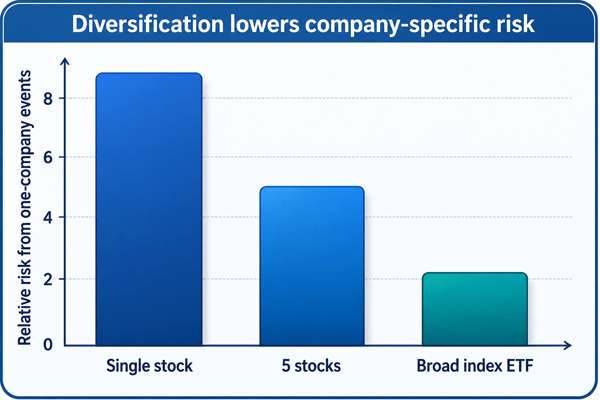
Figure 2: Diversification can reduce the damage from one bad company outcome.
9. Order types explained in plain English
Order type controls how your broker tries to buy or sell. This is one of the most important parts of online stock trading because the wrong order type can create a surprise price.
| Order type | Simple meaning | When beginners might use it | Main caution |
|---|---|---|---|
| Market order | Buy or sell immediately at the best available price. | Large, highly liquid stocks or ETFs during normal market hours. | Execution is likely, but the exact price is not guaranteed. |
| Limit order | Buy only at your limit price or lower; sell only at your limit price or higher. | When you want price control or the stock is moving quickly. | May not fill if the market never reaches your limit. |
| Stop-loss order | Becomes a market order after a stop price is reached. | To reduce downside in some trading plans. | The final sale price can be worse than the stop price in a fast drop. |
| Stop-limit order | Becomes a limit order after a stop price is reached. | For more control than a stop-loss. | May not execute, leaving you still holding the stock. |
| Recurring order | Automatically invests a set amount on a schedule. | Dollar-cost averaging into ETFs or long-term holdings. | Can buy during overvalued periods; still requires periodic review. |
Simple rule of thumb
For a beginner buying during normal market hours, a limit order is often a safer learning tool because it teaches price discipline. Avoid placing market orders before the market opens, after hours, or in thinly traded stocks unless you understand the risk.
10. What should beginners buy: stocks, ETFs, or something else?
There is no single best investment for everyone. But beginners often underestimate how hard individual stock picking is. A strong company can still be a poor investment if bought at an unrealistic price. A cheap-looking stock can stay cheap because the business is deteriorating. ETFs and index funds can be a simpler foundation because they spread money across many companies.
| Investment | Best for | Pros | Cons |
|---|---|---|---|
| Individual stocks | People willing to research businesses and tolerate volatility. | Direct ownership, potential outperformance, dividend potential. | Higher company-specific risk; requires ongoing research. |
| Index ETFs | Beginners seeking diversified market exposure. | Low cost, simple, transparent, diversified. | Will not avoid broad market downturns; can still be concentrated depending on the index. |
| Dividend stocks | Investors seeking income plus possible growth. | Cash flow can encourage patience. | High dividend yield can be a warning sign; dividends can be cut. |
| Robo-advisor | Hands-off investors. | Automated asset allocation and rebalancing. | Advisory fees and less control over exact holdings. |
| Options or leveraged products | Experienced traders with risk controls. | Can hedge or speculate. | Complex and risky; generally unsuitable for beginners. |
11. A beginner-friendly stock research checklist
- Business model: Can you explain how the company makes money in one sentence?
- Revenue growth: Are sales growing because demand is strong, prices rose, or acquisitions were made?
- Profitability: Does the company earn consistent profits, or is it promising profits later?
- Debt: Could debt become a problem if interest rates rise or sales fall?
- Competitive advantage: What stops competitors from taking customers?
- Valuation: Is the price reasonable compared with earnings, sales, cash flow, growth, and peers?
- Management: Does management communicate clearly and allocate capital wisely?
- Risks: What could make the investment thesis wrong?
- Your reason: Would you still want to own it if the price dropped 20% after purchase?
12. Fees and hidden costs: commission-free does not always mean free
Many online brokers advertise commission-free stock trading, but investors should still understand total cost. A broker can earn money through spreads, payment for order flow, margin interest, securities lending, cash sweep arrangements, currency conversion, premium data, inactivity fees, withdrawal fees, or advisory fees. None of these are automatically bad, but they should be transparent.
| Cost | Where it appears | How to reduce it |
|---|---|---|
| Trading commission | Fee per buy or sell order. | Choose low-cost brokers, but do not trade more just because commissions are low. |
| Bid-ask spread | Difference between buying and selling prices. | Use liquid securities and limit orders. |
| Expense ratio | Annual fund cost inside ETFs or mutual funds. | Compare similar funds; lower cost is usually better when exposure is similar. |
| Margin interest | Interest on borrowed broker money. | Avoid margin as a beginner. |
| FX conversion | Currency conversion for international stocks. | Check spread and conversion fee before funding. |
| Transfer or withdrawal fee | Moving cash or assets out. | Read the fee schedule before opening the account. |
| Tax cost | Capital gains, dividends, withholding taxes. | Hold tax records and seek qualified tax help when needed. |
13. Major risks beginners must understand
- Market risk: The whole market can fall due to recession, inflation, rates, war, policy changes, or investor fear.
- Company risk: A single company can disappoint because of weak earnings, fraud, debt, lawsuits, product failure, or bad management.
- Liquidity risk: Some stocks are hard to buy or sell without moving the price.
- Currency risk: International investors may gain on a stock but lose after currency conversion, or vice versa.
- Behavior risk: The biggest risk is often the investor: chasing hype, panic selling, overtrading, or refusing to admit mistakes.
- Platform risk: Apps can go down. Passwords can be stolen. Orders can be misunderstood. Security habits matter.
- Scam risk: Promises of high returns with little or no risk, pressure to act now, FOMO, fake testimonials, and unusual payment methods are classic fraud warnings.
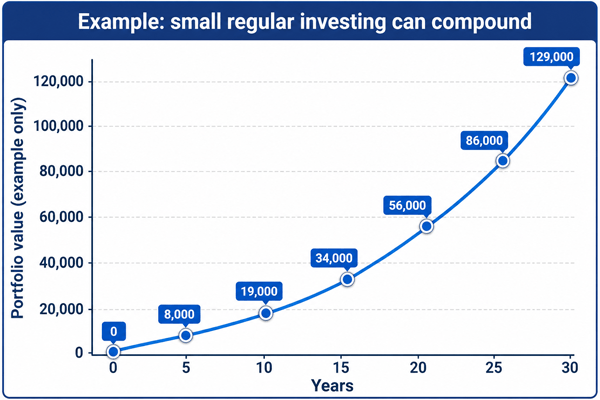
Figure 3: Example only - regular investing can compound over long periods, but returns are never guaranteed.
14. A simple beginner investing strategy
A practical beginner plan should be boring enough to follow. The goal is not to feel smart every day. The goal is to build wealth without making one avoidable mistake that damages years of savings.
| Rule | Example |
|---|---|
| Use a core-satellite approach | 80% broad diversified ETF or fund, 20% researched individual stocks. Beginners can make the satellite even smaller. |
| Dollar-cost average | Invest a fixed amount monthly instead of trying to guess the perfect day. |
| Limit single-stock exposure | Keep any one stock small enough that a big loss would not ruin the plan. |
| Rebalance periodically | Review allocation quarterly or semiannually instead of reacting daily. |
| Document every purchase | Write the reason, risks, expected holding period, and sell rules before buying. |
| Avoid leverage | No margin, no borrowed money, no complex derivatives until you have experience. |
15. Common beginner mistakes when buying stocks online
- Buying because the price “looks cheap”: A $5 stock is not automatically cheaper than a $500 stock. Value depends on the business and shares outstanding.
- Confusing a good company with a good stock: A great company can be overvalued. Price matters.
- Overtrading: Frequent trading can increase taxes, costs, stress, and bad decisions.
- Using margin too early: Borrowed money turns normal volatility into potential forced selling.
- Ignoring diversification: A portfolio of three trendy stocks is not diversified.
- Following influencers blindly: A social-media post is not research. Ask what the promoter gains if you buy.
- Not reading order details: Ticker mistakes, wrong quantities, and market orders in volatile names can be costly.
- Selling only because the price fell: A price drop is a signal to review the thesis, not automatically a reason to panic.
- Never selling a broken thesis: Long-term investing does not mean ignoring new facts.
- Forgetting taxes: A profitable trade can still create a tax bill.
16. 30-day action plan for a complete beginner
| Day range | Action | Outcome |
|---|---|---|
| Days 1-3 | Learn basic terms: stock, ETF, dividend, broker, cash account, market order, limit order, settlement. | You understand the language before risking money. |
| Days 4-7 | Compare regulated brokers using fees, account types, security, support, research tools, and product availability. | You choose a platform for fit, not hype. |
| Days 8-10 | Open a cash account and enable two-factor authentication. | Account is ready and protected. |
| Days 11-15 | Create a written investing policy: goals, monthly amount, max single-stock exposure, review schedule. | You have rules before emotions arrive. |
| Days 16-20 | Research one broad ETF and one individual stock as practice. | You learn the difference between diversified and company-specific exposure. |
| Days 21-25 | Place a small limit order or set up a recurring investment. | You learn the mechanics safely. |
| Days 26-30 | Review confirmation, update your investment journal, and plan the next monthly contribution. | You build a repeatable process. |
17. Online broker vs. investment app vs. robo-advisor
| Platform type | Best use | Strength | Weakness |
|---|---|---|---|
| Full online broker | Investors who want stocks, ETFs, research, and more account options. | More tools, more investment choice, stronger research. | Can feel complex for beginners. |
| Simple investment app | New investors who want an easy interface and fractional shares. | Fast onboarding, simple buying process. | May encourage frequent trading or offer fewer research tools. |
| Robo-advisor | Hands-off long-term investing. | Automated diversification, rebalancing, and risk-based portfolios. | Advisory fee and less control over individual stocks. |
18. Frequently Asked Questions
18.1 How much money do I need to start buying stocks online?
Many brokers allow small starting amounts, especially where fractional shares are available. The better question is how much you can invest without touching emergency savings or near-term cash needs.
18.2 Is buying stocks online safe?
It can be safe when done through a regulated broker with strong security practices, but investing risk remains. Platform safety and investment risk are separate issues.
18.3 Can I lose more than I invest?
In a simple cash account buying stocks without leverage, losses are generally limited to the amount invested in the stock. With margin, options, short selling, or leveraged products, risk can be much higher.
18.4 Should I buy individual stocks or ETFs first?
Many beginners are better served by starting with diversified ETFs and then learning individual stock research gradually.
18.5 What is the best time of day to buy stocks online?
For beginners, normal market hours are usually easier because liquidity is better than pre-market or after-hours trading. Avoid making decisions based only on the minute of the day.
18.6 What is a fractional share?
A fractional share is less than one full share. It helps investors buy expensive stocks with smaller dollar amounts, but transferability and order handling can vary by broker.
18.7 What happens after I buy a stock?
You receive a trade confirmation, the transaction settles according to the applicable settlement cycle, and you own the position in your brokerage account. You may receive dividends if declared and eligible.
18.8 How often should I check my portfolio?
Beginners often benefit from checking less often, such as monthly or quarterly, unless there is a planned contribution or major company news. Constant checking can lead to emotional trading.
18.9 Can I buy international stocks online?
Many brokers offer foreign stocks or ETFs, but currency conversion, withholding taxes, local rules, and liquidity should be reviewed first.
18.10 Do I need a financial advisor?
Not always. Simple long-term investing can be self-directed, but an advisor can help with complex tax, retirement, estate, or large-portfolio decisions.
19. Beginner glossary
| Term | Meaning |
|---|---|
| Broker | A regulated firm that lets you buy and sell investments. |
| Ticker symbol | Short code used to identify a stock or ETF. |
| Share | One unit of ownership in a company. |
| ETF | Exchange-traded fund, usually a basket of securities that trades like a stock. |
| Dividend | Cash payment some companies make to shareholders. |
| Market order | Order to buy or sell immediately, without guaranteed price. |
| Limit order | Order to buy or sell only at a specified price or better. |
| Bid-ask spread | Difference between the price buyers offer and sellers ask. |
| Settlement | Final exchange of money and securities after a trade. |
| Diversification | Spreading money across investments to reduce dependence on one outcome. |
| Margin | Borrowed money from a broker, secured by your account. |
| Expense ratio | Annual cost charged by a fund as a percentage of assets. |
20. Final takeaway
Buying stocks online is simple mechanically but serious financially. The best beginner does not rush to find a hot stock. The best beginner learns the account, controls risk, uses clear order types, starts with small amounts, diversifies, keeps records, and invests according to a plan. The platform is only a tool. The real edge is patience, discipline, and honest decision-making.
Reader Advice
This article is provided solely for educational and general informational purposes. It does not constitute personalized financial, investment, legal, accounting, or tax advice, and it should not be treated as a recommendation to buy, sell, or hold any particular security, fund, or financial product. Stock investing involves risk, including the possible loss of principal. Before making any financial decision, readers should assess their goals, financial circumstances, time horizon, and risk tolerance and, where appropriate, consult a qualified and properly licensed professional.
Brokerage rules, settlement procedures, fees, taxes, product availability, investor protections, and regulatory requirements may differ by country, account type, broker, security, and date, and they may change over time. Readers should therefore verify all material facts, figures, eligibility requirements, costs, and current rules directly with official regulators, exchanges, tax authorities, and the relevant financial institution. Examples in this article are illustrative only and do not promise or guarantee any result or investment performance.
Sources Consulted and Checked
The following authoritative sources were consulted and checked while preparing this article to support accuracy and reliability.
- Investor.gov / SEC - Types of Orders: Market, limit, and stop order definitions; market orders execute immediately but do not guarantee execution price.
- FINRA - Brokerage Accounts: Cash accounts and margin accounts are the two main brokerage account options; margin involves borrowing from the broker.
- SEC / Investor.gov - New T+1 Settlement Cycle: Applicable U.S. securities transactions moved to T+1 for trades on or after May 28, 2024.
- FINRA - Investing in Fractional Shares: Fractional shares can improve access but may have limited transferability and tax considerations.
- Investor.gov - Asset Allocation and Diversification: Asset allocation depends on time horizon and risk tolerance; diversification helps manage risk.
- Investor.gov - Fraud red flags: Warnings include high returns with little or no risk, pressure to act now, FOMO, fake testimonials, promises of great wealth, and suspicious payment methods.
- Pakistan Stock Exchange - Open an Account / Invest: Investors should ensure the brokerage account is opened in their own name and review account-opening terms.