How to Start Investing in Stocks with Little Money
1. Introduction: you do not need to be rich to begin investing
Many beginners think stock investing is only for people who already have a lot of money. That used to feel true because buying full shares, paying trading commissions, and understanding financial terms created a high barrier. Today, many brokerage platforms offer commission-free stock and ETF trades and fractional shares, which can let a person begin with small amounts such as $5, $10, $25, or $100. The bigger challenge is not the starting amount. The bigger challenge is learning how to invest without gambling, panicking, chasing hype, or putting essential money at risk.
This guide explains the stock market from the ground up. It is written for a person who has never bought a stock, does not know what an ETF is, and wants a practical path. You will learn what stocks are, how investing works, how much money you need, what accounts to use, what risks to understand, and how to build a simple first plan.
2. What is stock investing?
A stock is a small ownership share in a company. When you buy a stock, you are buying a tiny piece of that business. If the company grows, earns more money, and investors become more confident about its future, the stock price may rise. Some companies also pay dividends, which are cash payments to shareholders. If the business performs poorly or investors lose confidence, the stock price may fall. There is no guaranteed profit.
Stock investing means buying stocks, stock funds, or stock ETFs with the goal of building wealth over time. It is different from saving. Savings are usually kept in safer places such as bank accounts or money market funds for short-term needs. Investing accepts more risk in exchange for the possibility of higher long-term growth.
| Term | Simple meaning | Beginner example |
|---|---|---|
| Stock | A small ownership piece of one company | Buying a share or fractional share of Apple, Coca-Cola, or another company |
| ETF | A fund that trades like a stock and can hold many investments | An S&P 500 ETF that owns pieces of 500 large U.S. companies |
| Index fund | A fund designed to track a market index | A total stock market index fund |
| Dividend | Cash a company may pay shareholders | A company pays $0.50 per share each quarter |
| Brokerage account | An account used to buy and sell investments | An account at a regulated broker |
| Fractional share | Less than one full share | Buying $10 worth of a $200 stock |
3. How the stock market works in plain English
The stock market is a place where buyers and sellers trade ownership shares. A company may first sell shares to the public through an IPO. After that, investors trade those shares with each other on exchanges. Prices move because millions of buyers and sellers have different opinions about a company’s future earnings, interest rates, inflation, industry trends, news, and overall market confidence.
For beginners, the most important point is this: a stock price is not a scoreboard for today only. It is a constantly changing estimate of future expectations. This is why a company can report good news and still see its stock fall if investors expected even better results. It is also why short-term price moves can feel confusing.
3.1 Real-life example
Imagine a local bakery sells ownership pieces to the public. If people believe the bakery will open more branches and earn more profit, they may be willing to pay more for each ownership piece. If rent rises, sales slow, or management makes poor decisions, people may pay less. Public stocks work in a similar way, but with large companies and thousands or millions of investors.
4. Can you really start investing with little money?
Yes, in many countries and on many platforms, small-dollar investing is now realistic. Fractional shares allow you to invest a fixed dollar amount instead of buying one full share. For example, if one share costs $500 and you invest $25, you may receive 0.05 of a share. This does not remove investment risk, but it removes the old problem of needing hundreds or thousands of dollars to buy certain stocks or ETFs.
Starting small can actually be healthy. A beginner who invests $20 or $50 per month can learn how accounts work, how prices move, how emotions feel during market drops, and how fees affect returns - without risking life-changing money. The goal is not to get rich quickly. The goal is to build a habit and a process.
| Starting amount | What it can do | What it cannot do |
|---|---|---|
| $5-$25 | Help you learn the platform and buy fractional shares | Create instant wealth or meaningful diversification by itself |
| $50-$100/month | Build a consistent investing habit | Protect you from market losses |
| $250-$500/month | Grow faster if maintained for years | Guarantee retirement security |
| Lump sum bonus | Speed up progress when invested wisely | Replace emergency savings or debt planning |
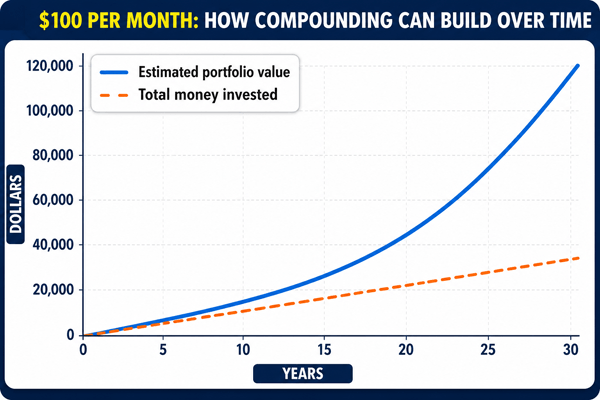
Figure 1: Example only. Investing $100 per month at a hypothetical 7% annual return for 30 years could grow to about $121,997, while total contributions would be $36,000. Actual market returns are not guaranteed.
5. Before you invest: the safety-first checklist
The best beginner investing plan starts before the first stock purchase. Many painful investing stories begin when people invest rent money, borrow money, or put emergency savings into a risky stock because they are afraid of missing out. A safer approach is to create a financial base first.
- Keep money for near-term bills out of stocks. Money needed within the next few months should generally stay in cash or a similarly stable place.
- Build at least a small emergency fund. Even $500 to $1,000 can prevent a beginner from selling investments at a bad time after a surprise expense.
- Pay attention to high-interest debt. If a credit card charges 20% or more, paying it down can be more powerful than hoping an investment beats that cost.
- Only invest money you can leave alone. Stocks can fall sharply over weeks, months, or even years.
- Never invest because of social media pressure, a hot tip, or a promise of guaranteed returns.
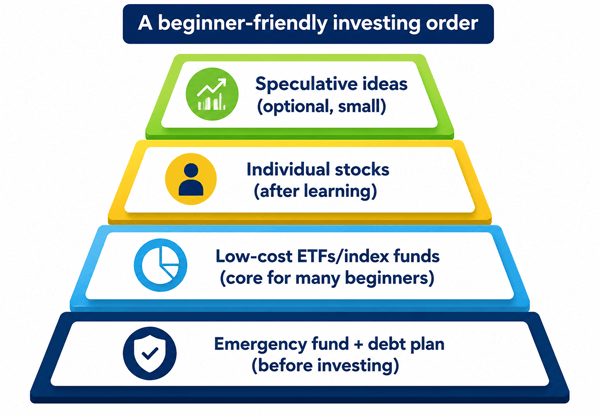
Figure 2: A practical order for beginners. The base comes first; speculative ideas, if used at all, belong at the top and should stay small.
6. The easiest beginner path: invest through diversified funds
A beginner often asks, 'Which stock should I buy first?' A better first question is, 'How can I avoid depending on one company?' One company can disappoint, lose market share, face lawsuits, overpay executives, or become outdated. A diversified fund can hold dozens, hundreds, or thousands of companies, so your result does not depend on one stock.
This is why many long-term beginners start with low-cost ETFs or index funds. They are not exciting, but they are simple, diversified, and easier to manage than a basket of random individual stocks. A broad-market fund will still go down when the market falls, but it reduces the risk that one bad company ruins your plan.
| Choice | Best for | Main benefit | Main risk |
|---|---|---|---|
| Single stock | Learners who want to research individual companies | Potential to outperform if the company does very well | High company-specific risk |
| Sector ETF | People who want exposure to one industry | Diversifies within a sector | Still concentrated in one industry |
| S&P 500 ETF/index fund | Beginners wanting exposure to large U.S. companies | Broad, simple, usually low cost | U.S. large-company concentration |
| Total market ETF/index fund | Beginners wanting wider stock exposure | Very broad diversification | Still exposed to overall stock market drops |
| Target-date fund | Retirement investors wanting an all-in-one fund | Automatically adjusts mix over time | Fees and allocation vary by fund |
6.1 Practical beginner rule
For many new investors, a simple diversified fund is a better first core holding than trying to pick the next winning stock. Individual stocks can be added later, after learning how to read financials, compare valuation, and control risk.
7. Step-by-step: how to start investing in stocks with little money
- Set your purpose. Are you investing for retirement, a future home, education, or general wealth building? The longer your time horizon, the more time you have to ride out market volatility.
- Decide how much you can invest regularly. Start with an amount that will not disturb your bills, food, rent, transportation, insurance, or emergency savings. Consistency matters more than a dramatic first deposit.
- Choose the right account type. A taxable brokerage account is flexible. Retirement accounts such as an IRA or 401(k) may offer tax advantages but have rules and limits. In the U.S., the 2026 IRA contribution limit is $7,500, or $8,600 for age 50 or older, subject to compensation and eligibility rules.
- Select a regulated broker. Look for account minimums, fractional shares, trading costs, ETF availability, research tools, customer support, security features, and whether the broker is properly regulated in your country.
- Fund the account. Link a bank account and transfer a small amount you are comfortable investing.
- Pick a simple first investment. Many beginners use a broad low-cost ETF or index fund as the foundation.
- Use a recurring schedule. Investing a fixed amount every payday or every month can reduce decision fatigue and build discipline.
- Track, but do not obsess. Check your account occasionally, not every hour. A long-term plan should not depend on daily price movements.
- Review once or twice a year. Revisit your contribution amount, asset mix, fees, and goals. Avoid making changes only because the market had a bad week.
8. Dollar-cost averaging: the small-budget investor’s friend
Dollar-cost averaging means investing the same amount at regular intervals, regardless of whether the market is up or down. This can help beginners because it turns investing into a habit and removes the pressure of guessing the perfect day to buy. When prices are lower, the same dollar amount buys more shares. When prices are higher, it buys fewer shares.
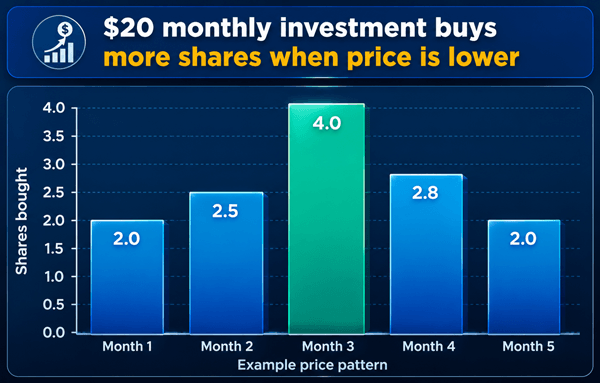
Figure 3: Dollar-cost averaging example. A fixed $20 monthly investment buys more shares when the price is lower and fewer shares when the price is higher.
| Month | Price per share | Amount invested | Shares bought |
|---|---|---|---|
| 1 | $10 | $20 | 2.00 |
| 2 | $8 | $20 | 2.50 |
| 3 | $5 | $20 | 4.00 |
| 4 | $7 | $20 | 2.86 |
| 5 | $10 | $20 | 2.00 |
| Total | Average cost varies | $100 | 13.36 shares |
In this example, the investor buys 13.36 shares with $100. The average purchase cost is about $7.49 per share, even though the price started and ended at $10. This does not guarantee profit, but it shows why steady investing can be useful when prices move around.
9. How much money should a beginner invest?
There is no perfect amount. A good beginner amount is one you can repeat without stress. For one person, that may be $10 per week. For another, it may be $200 per month. The habit is more important than the first deposit. The mistake is investing so much that one normal market drop makes you panic and quit.
| Monthly amount | One-year contribution | Ten-year contribution before growth | Beginner takeaway |
|---|---|---|---|
| $25 | $300 | $3,000 | Good for learning and habit building |
| $50 | $600 | $6,000 | Meaningful start if consistent |
| $100 | $1,200 | $12,000 | Can become powerful over decades |
| $250 | $3,000 | $30,000 | Strong habit if budget allows |
9.1 Helpful mindset
Investing small amounts is not pointless. Small amounts teach behavior. Behavior is what keeps people investing when the market becomes uncomfortable.
10. What beginners must know about risk
Risk is not only the chance of losing money. It is also the chance that you choose the wrong investment, pay too much in fees, sell at the wrong time, fail to diversify, use borrowed money, or misunderstand what you bought. FINRA describes risk tolerance as the amount of investment risk a person is willing and able to accept. Both parts matter: willing and able. You may feel brave emotionally, but if you need the money soon, you may not be able to take much risk.
| Risk | What it means | How beginners can reduce it |
|---|---|---|
| Market risk | The whole market falls | Invest long term, avoid money needed soon |
| Company risk | One company performs badly | Use diversified funds; limit single-stock exposure |
| Behavior risk | You panic sell or chase hype | Use a written plan and recurring contributions |
| Fee risk | Costs quietly reduce returns | Prefer low-cost funds and avoid unnecessary trading |
| Concentration risk | Too much money in one stock or sector | Spread investments across companies and asset classes |
| Margin risk | Borrowed money magnifies losses | Avoid margin as a beginner |
10.1 Honest warning
Do not use margin, loans, credit cards, or emergency money to buy stocks. Margin can increase buying power, but it can also create losses larger than the money you originally invested.
11. Fees: the quiet detail that matters a lot
A fund’s expense ratio is the annual cost of owning the fund, expressed as a percentage. A 0.05% expense ratio costs about $0.50 per year for every $1,000 invested. A 1.00% expense ratio costs about $10 per year for every $1,000 invested. That difference looks small at first, but over many years fees can compound against you.
| Investment | Expense ratio | Approx. yearly cost on $10,000 | Beginner comment |
|---|---|---|---|
| Low-cost index ETF | 0.03% | $3 | Very low ongoing cost |
| Average active fund example | 0.75% | $75 | Needs strong performance to justify cost |
| High-fee product example | 1.50% | $150 | Can heavily reduce long-term returns |
Fees are not always bad. Sometimes advice, planning, or specialized management may be worth paying for. But beginners should understand exactly what they are paying, who receives the fee, and whether the benefit is clear.
12. Beginner portfolio examples with little money
The examples below are educational illustrations. They are not recommendations for every reader. The right choice depends on age, country, tax rules, time horizon, income stability, and comfort with risk.
| Investor type | Monthly amount | Simple example | Why it may fit |
|---|---|---|---|
| Very new learner | $25 | 100% broad stock market ETF | Simple, low maintenance, focused on learning |
| Retirement beginner | $100 | Target-date retirement fund in an IRA | All-in-one fund that adjusts over time |
| Cautious beginner | $100 | 70% broad stock fund / 30% bond or cash-like fund | Less volatile than all stocks, though growth may be lower |
| Curious stock picker | $100 | 80%-90% broad ETF / 10%-20% individual stocks | Keeps speculation small while learning |
12.1 Experience-based tip
Many beginners who quit investing do not quit because the math is difficult. They quit because they bought something they did not understand, watched it fall, and had no plan. Keep the first portfolio boring enough that you can stay with it.
13. How to choose a brokerage account
A broker is the company that lets you buy and sell investments. Beginners should choose a broker based on safety, costs, features, and usability - not social media popularity alone.
| Feature to check | Why it matters |
|---|---|
| Regulation and account protection | Helps reduce fraud and platform risk |
| Fractional shares | Lets small investors buy dollar amounts |
| Commission-free ETFs/stocks | Reduces trading friction, though other costs may still exist |
| Low or no account minimum | Helpful for small starters |
| Automatic recurring investments | Makes consistency easier |
| Fund availability | You need access to low-cost ETFs/index funds |
| Educational resources | Good for beginners who want to learn |
| Security tools | Two-factor authentication and account alerts matter |
14. What should beginners avoid?
- Avoid “guaranteed profit” claims. Real stock investing has risk.
- Avoid investing based only on influencers, chat groups, or viral screenshots.
- Avoid day trading before understanding order types, taxes, spreads, and risk.
- Avoid putting all your money into one company because you like its products.
- Avoid high-fee products you do not understand.
- Avoid panic selling during normal market declines.
- Avoid checking prices constantly if it makes you emotional.
- Avoid copying someone else’s portfolio without knowing their goals and risk tolerance.
15. A practical first 30-day plan
| Day range | Action | Result |
|---|---|---|
| Days 1-3 | Write your goal and list debts, bills, and emergency savings | You know whether you are ready to invest |
| Days 4-7 | Learn basic terms: stock, ETF, index fund, dividend, expense ratio | You understand what you are buying |
| Days 8-12 | Compare regulated brokers and account types | You avoid choosing based only on ads |
| Days 13-15 | Open account and enable security settings | Your account is ready safely |
| Days 16-20 | Transfer a small amount | You begin without stress |
| Days 21-25 | Choose a broad low-cost fund or a learning-size investment | You make your first purchase thoughtfully |
| Days 26-30 | Set a recurring contribution and write review rules | You create a system instead of relying on emotion |
16. Simple example: starting with $50 per month
Suppose Sara has paid her bills, has a small emergency fund, and wants to begin investing with $50 per month. She opens a brokerage or retirement account, chooses one broad low-cost ETF, and sets an automatic $50 investment every month. She does not try to predict the next market move. After one year, she has contributed $600. If the market falls, she continues because her goal is 10-plus years away. After six months, she reads more and decides whether to keep the same plan or slowly add a small individual-stock learning portion.
This example is not dramatic, but it is realistic. Many successful long-term investors build wealth from ordinary income, repeated contributions, low costs, diversification, and patience.
17. Tax basics beginners should understand
Taxes depend on your country and account type. In the U.S., taxable brokerage accounts may create taxes when you sell investments for gains or receive dividends. Retirement accounts such as traditional IRAs, Roth IRAs, and 401(k)s have special rules. For 2026, the IRS lists the IRA contribution limit at $7,500, or $8,600 for people age 50 or older, subject to rules. A 401(k) has a separate higher limit. Beginners should check current rules before contributing because limits and eligibility can change.
17.1 Beginner tax tip
Do not let tax rules stop you from learning, but do not ignore them either. Keep records, understand your account type, and consider professional tax advice when your situation becomes more complex.
18. Frequently asked questions
18.1 Is $10 enough to start investing?
Yes, if your broker supports fractional shares and low minimums. $10 will not make you rich quickly, but it can help you learn and build the habit.
18.2 Should I buy stocks or ETFs first?
Many beginners are better served by a diversified ETF or index fund as a first core investment because it spreads risk across many companies.
18.3 Can I lose all my money?
With one individual stock, a total loss is possible if the company fails. With a diversified broad-market fund, a total loss is much less likely, but large declines can still happen.
18.4 How long should I invest for?
Stocks are generally more suitable for long-term goals, often five years or more. Money needed soon should usually be kept safer.
18.5 Is day trading a good way to grow small money?
For most beginners, day trading is risky and emotionally difficult. Long-term diversified investing is usually more practical.
18.6 What is the best stock for beginners?
There is no single best stock. A better beginner question is which diversified, low-cost investment matches your goal and risk tolerance.
18.7 How often should I check my investments?
Enough to stay informed, but not so often that normal price swings control your emotions. Monthly or quarterly checks are often enough for long-term investors.
18.8 Should I wait for the market to crash before investing?
Trying to perfectly time the market is difficult. A recurring contribution plan can help beginners start gradually without making one big timing decision.
18.9 Are investing apps safe?
Some are reputable and regulated; others may be risky or poorly suited to beginners. Check regulation, fees, security, account protection, and product availability.
18.10 What if I make a mistake?
Start small, learn, avoid leverage, and keep records. Small mistakes are often tuition; large mistakes usually come from borrowing, concentrating, or chasing hype.
19. Final beginner checklist
- I understand that stocks can go down and returns are not guaranteed.
- I have separated emergency money from investing money.
- I know my goal and rough time horizon.
- I understand the difference between a single stock and a diversified fund.
- I have checked fees and expense ratios.
- I am not using borrowed money or credit cards to invest.
- I have a simple contribution plan I can continue even during market drops.
- I know when I will review my plan and when I will leave it alone.
20. Conclusion: start small, but start wisely
Starting to invest in stocks with little money is possible, but the goal is not to turn a tiny deposit into instant wealth. The goal is to create a repeatable system: earn, save, invest, diversify, keep costs low, avoid hype, and give time for compounding to work. A beginner who starts with $25 or $50 per month, learns carefully, and stays consistent may build more financial confidence than someone who waits years for the perfect moment.
The best first investment is not always the one with the most exciting story. Often, it is the one you understand, can afford, and can hold through normal market ups and downs. Start small. Stay honest. Keep learning. Let your investing plan grow as your knowledge grows.
Sources Consulted and Checked
The following sources were consulted and checked while preparing this article to support accuracy and provide reliable background information. Readers should still confirm current rules, limits, and requirements directly with the relevant official authority.
- Investor.gov, Introduction to Investing - Used for basic investing concepts and diversification guidance.
- Investor.gov, Beginners Guide to Asset Allocation, Diversification, and Rebalancing - Used for the explanation of asset allocation, time horizon, and risk tolerance.
- Investor.gov, Dollar-Cost Averaging glossary - Used for the definition and explanation of investing equal portions at regular intervals.
- FINRA, Risk and Know Your Risk Tolerance - Used for risk tolerance and risk-management framing.
- FINRA, Asset Allocation and Diversification - Used for diversification, asset allocation, and rebalancing concepts.
- SEC investor alert on margin accounts and FINRA material on margin/frequent trading - Used for caution against margin and frequent trading risks.
- IRS, Retirement Topics - IRA Contribution Limits; IRS 2026 retirement plan limits announcement - Used for current 2026 IRA contribution limits and reminder that tax rules change.
Reader Advice
This article is provided solely for educational and informational purposes and does not constitute personalized financial, investment, tax, or legal advice. Investing involves risk, including the possible loss of principal, and no return is guaranteed. Before opening an account, contributing money, selecting an investment, or making any other financial decision, consider your personal circumstances, goals, time horizon, debt, emergency savings, tax position, country of residence, and ability to tolerate losses. Rules, contribution limits, fees, product features, tax treatment, regulations, and market conditions may change and may differ by jurisdiction, account type, provider, age, income, and other factors. Verify important facts and figures through current official sources and regulated providers. When appropriate, consult a qualified financial, tax, or legal professional who can assess your individual situation.