How to Start Investing in U.S. Stocks: A Complete Beginner's Guide
1. Introduction: What does it mean to invest in U.S. stocks?
Investing in U.S. stocks means buying small ownership pieces of companies listed on U.S. stock exchanges, such as the New York Stock Exchange or Nasdaq. When you buy a share of stock, you do not just buy a ticker symbol on a screen. You buy a claim on a real business. If the business grows, earns more profit, and investors are willing to pay more for it, your shares may become more valuable. If the business performs poorly or the market becomes fearful, your shares may fall in value.
For a beginner, the most important idea is this: investing is not the same as guessing the next hot stock. Real investing is a long-term habit of putting money into productive assets, managing risk, keeping costs low, and giving time a chance to work. Many beginners lose money not because the stock market is impossible, but because they start without a plan, chase hype, trade too often, use money they need soon, or confuse investing with gambling.
This guide explains U.S. stock investing from zero. You will learn what stocks are, how brokerage accounts work, what ETFs and index funds are, how to place a first order, how taxes and fees can affect returns, and how to avoid the most common beginner mistakes.
2. How U.S. stocks work in simple words
A stock represents ownership in a company. Public companies sell shares so they can raise capital and allow investors to participate in the company’s future. Once shares trade on an exchange, investors buy and sell them with each other through brokerage platforms.
| Term | Plain-English meaning | Beginner example |
|---|---|---|
| Stock | A small ownership share in one company. | Buying Apple stock means you own a tiny piece of Apple. |
| Share price | The current market price for one share. | If a stock trades at $50, one share costs around $50 before any fees or price movement. |
| Ticker symbol | A short code used to identify a stock or ETF. | AAPL is Apple; VOO is a Vanguard S&P 500 ETF. |
| Brokerage account | An investment account used to buy and sell securities. | You open an account with an online broker, deposit money, and place orders. |
| Dividend | A company payment to shareholders, usually from profits. | A company may pay $0.50 per share each quarter, but dividends are not guaranteed. |
| Capital gain | Profit from selling an investment for more than you paid. | You buy at $40 and sell at $55, creating a $15 gain per share before tax. |
Stock prices move because buyers and sellers constantly update their expectations. Earnings, interest rates, inflation, industry trends, company news, competition, management quality, investor emotion, and global events can all affect prices. This is why even strong companies can fall in price and weak companies can rise temporarily.
3. Why people invest in U.S. stocks
People invest in U.S. stocks because stocks have historically been one of the main ways ordinary people build long-term wealth. U.S. companies include many of the world’s largest technology, healthcare, consumer, financial, industrial, and energy businesses. A beginner may invest for retirement, education, future financial independence, inflation protection, or long-term wealth building.
The attraction is simple: if you own a diversified group of productive companies for many years, you may benefit from business growth, reinvested profits, innovation, dividends, and compounding. The risk is also real: the market can fall sharply, individual companies can fail, and short-term results can be disappointing.
| Potential benefit | What it means | Reality check |
|---|---|---|
| Long-term growth | Stocks can increase in value as companies grow. | Growth is not smooth; market declines are normal. |
| Dividend income | Some companies share profits through dividends. | Dividends can be reduced or stopped. |
| Liquidity | Most U.S. stocks and major ETFs can be bought or sold during market hours. | A fast sale does not guarantee a good price in volatile markets. |
| Diversification options | Investors can buy ETFs that hold hundreds of stocks. | Diversification reduces some risk but does not remove market risk. |
| Low starting amount | Many brokers support fractional shares. | Starting small is useful, but small accounts still need discipline. |
4. The beginner mindset: invest before you try to “beat the market”
The best beginner approach is usually not to prove you are smarter than Wall Street. It is to build a system that you can follow through good and bad markets. Beginners often think the hardest part is choosing the perfect stock. In practice, the harder part is staying patient when prices fall, not overtrading when prices rise, and continuing to invest consistently without risking money needed for rent, bills, or emergencies.
A helpful mindset is: “I am buying future cash-producing businesses, not lottery tickets.” This mindset naturally leads to better questions: Is this investment diversified? What fees am I paying? How long can I leave this money invested? What would make me sell? Am I investing because of research or because of fear of missing out?
5. Before investing: build your financial foundation
A beginner should not rush to buy stocks before handling basic financial safety. The stock market can be rewarding over long periods, but it is unpredictable in the short term. Money needed soon should usually not be exposed to stock market volatility.
| Before you invest | Why it matters | Beginner-friendly rule of thumb |
|---|---|---|
| Emergency fund | Prevents you from selling stocks during a market drop to cover urgent bills. | Keep cash for essential expenses before investing aggressively. |
| High-interest debt plan | Credit card interest can be higher than realistic investment returns. | Paying down very high-interest debt may be a stronger “return” than investing. |
| Clear goal | Your goal decides account type, time horizon, and risk level. | Retirement money can usually take more risk than home-down-payment money. |
| Time horizon | Stocks can fall over months or years. | Money needed within a few years should be treated carefully. |
| Basic budget | Investing works best when contributions are repeatable. | Start with an amount you can maintain without stress. |
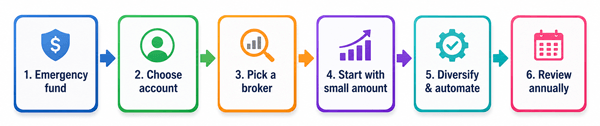
6. Step-by-step: how to start investing in U.S. stocks
6.1 Decide your goal
Do not begin with “Which stock should I buy?” Begin with “What is this money for?” A retirement goal, a five-year savings goal, and a learning account all need different levels of risk. A goal gives your investments a job.
- Retirement investing: usually long-term, often suited to diversified stock and bond funds.
- Learning account: small amount used to understand how markets work without risking serious money.
- Income goal: may include dividend stocks or income funds, but beginners should avoid chasing the highest yield.
- Short-term goal: usually not ideal for heavy stock exposure because prices can fall when you need the money.
6.2 Choose the right type of account
| Account type | Best for | Main advantage | Important caution |
|---|---|---|---|
| Taxable brokerage account | Flexible investing with no retirement withdrawal rules. | Easy access and broad investment choices. | Dividends and realized gains may be taxable. |
| Traditional IRA | Retirement savers who may want current tax benefits. | Potential tax-deferred growth. | Withdrawals are generally taxed, and rules apply. |
| Roth IRA | Retirement savers who qualify and want potential tax-free qualified withdrawals. | After-tax contributions may grow tax-free if rules are met. | Income and contribution limits can apply. |
| 401(k) or workplace plan | Employees with access to a retirement plan. | Employer match may be valuable. | Investment choices may be limited by plan. |
| Custodial account | Investing for a minor. | Can help start early. | Assets legally belong to the child and may affect aid/taxes. |
For beginners searching for the best brokerage account for beginners, the “best” choice is not always the app with the flashiest design. Look for investor protection, low costs, clear statements, strong educational tools, easy tax documents, fractional shares if needed, and a platform that does not push you into risky trading.
6.3 Choose a reputable online stock broker
An online stock broker is the company that holds your brokerage account and routes your buy and sell orders. Many major U.S. brokers offer commission-free trading for U.S. stocks and ETFs, but “commission-free” does not mean every cost disappears. There can still be bid-ask spreads, options fees, margin interest, account fees, fund expense ratios, wire fees, currency conversion costs, or advisory fees.
| Broker feature | Why it matters for beginners | What to check |
|---|---|---|
| SIPC membership | Helps protect eligible securities and cash if a member brokerage fails, within limits. | Confirm membership and understand SIPC does not protect against market losses. |
| Low trading costs | Fees reduce your real return. | Check commissions, account fees, transfer fees, and margin rates. |
| Fractional shares | Lets you start with small amounts. | Check which stocks/ETFs support fractional investing. |
| Education and research | Helps beginners learn before trading. | Look for clear explanations, not hype. |
| Automatic investing | Supports consistency. | Check recurring deposits and recurring purchases. |
| Tax documents | Makes filing easier. | Confirm access to 1099 forms and year-end statements. |
6.4 Fund the account
After opening the account, you normally link a bank account and transfer cash. Avoid depositing money you need for near-term bills. Some brokers make transferred cash available quickly; others wait until funds settle. Beginners should read the broker’s transfer rules before placing orders.
6.5 Pick a simple first investment
For many beginners, a broad, low-cost ETF or index fund is easier and safer to understand than buying one individual stock. An S&P 500 ETF, total U.S. stock market ETF, or global stock ETF can give exposure to many companies in one purchase. This does not eliminate risk, but it reduces the risk that one company’s bad result destroys your whole portfolio.
| Choice | What you own | Pros | Cons | Beginner fit |
|---|---|---|---|---|
| Individual stock | One company. | Potential to outperform if the company does well; easy to understand the business story. | Company-specific risk; requires research and emotional discipline. | Better as a small learning portion, not the whole plan. |
| Stock ETF | A basket of stocks that trades like a stock. | Instant diversification, transparent pricing, often low cost. | Still falls when the market falls; expense ratio applies. | Often beginner-friendly. |
| Index fund | A fund designed to track an index. | Low cost, diversified, simple long-term strategy. | No attempt to avoid downturns; tracks the index down too. | Often beginner-friendly. |
| Actively managed fund | Manager chooses investments. | Potential professional management. | Often higher cost; may underperform. | Compare fees and track record carefully. |
| Options/margin | Leveraged or derivative strategies. | Can be used by advanced investors for specific purposes. | Can magnify losses and create complex risks. | Usually not suitable for true beginners. |
6.6 Place your first order carefully
When you buy a stock or ETF, you place an order. The most common order types are market orders and limit orders. A market order prioritizes getting filled quickly, but the exact execution price is not guaranteed. A limit order sets the maximum price you are willing to pay when buying, or the minimum price you are willing to accept when selling.
| Order type | Simple meaning | When beginners might use it | Main risk |
|---|---|---|---|
| Market order | Buy or sell now at the best available price. | Highly liquid ETFs or stocks during normal market hours. | Final price can differ from the last quote, especially in fast markets. |
| Limit order | Buy only at your limit price or lower; sell only at your limit price or higher. | When price control matters. | Order may not fill. |
| Stop order | Becomes a market order after a stop price is reached. | Risk management for some sell plans. | Execution price after trigger is not guaranteed. |
| Stop-limit order | Becomes a limit order after the stop price. | More price control than a basic stop. | May not fill during a fast drop. |
6.7 Create a repeatable investing habit
Many successful beginners use dollar-cost averaging: investing a fixed amount on a regular schedule, such as every payday or every month. This does not guarantee profit or prevent losses, but it reduces the pressure to perfectly time the market. It also turns investing into a habit instead of an emotional decision.
7. How much money do you need to start?
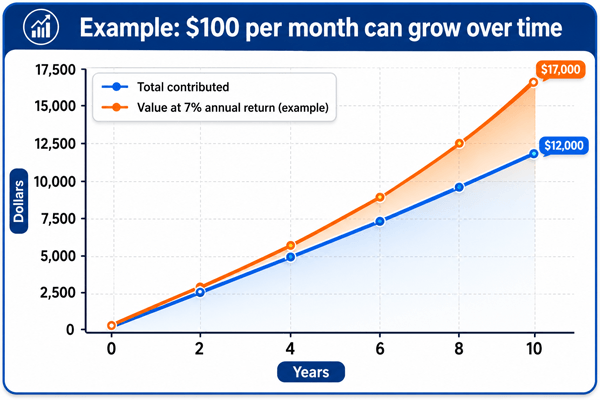
You do not need to be rich to start investing. Many brokers allow small deposits and fractional shares, so a beginner may start with $5, $25, $100, or any amount that fits the budget. The better question is not “What is the minimum?” but “What amount can I invest consistently without needing to pull it out during a bad week?”
Example: If you invest $100 per month, you contribute $1,200 per year. If you keep doing it for 10 years, you contribute $12,000 before growth or losses. The habit is more important than the first amount. A person who invests small amounts consistently may build better long-term behavior than someone who invests a large amount once and then panics during the first market drop.
| Monthly amount | Annual contribution | Good for |
|---|---|---|
| $25 | $300 | Learning the process and building confidence. |
| $100 | $1,200 | A realistic beginner habit for many budgets. |
| $250 | $3,000 | Accelerating long-term investing while staying manageable. |
| $500 | $6,000 | Strong contribution habit if emergency savings and debts are handled. |
8. Stocks vs ETFs: what should a beginner choose?
A beginner can buy individual stocks, ETFs, or both. The safest educational answer is not “never buy individual stocks.” It is: understand the difference before you risk too much. Individual stocks can teach you how businesses work, but ETFs can help you avoid putting your entire future on one company.
A practical beginner structure is a core-and-satellite portfolio. The “core” is a broad diversified ETF or index fund. The “satellite” is a smaller amount used for individual stocks you research deeply. For example, a beginner may keep 80% to 90% in diversified funds and 10% to 20% in individual stocks for learning. The exact mix depends on risk tolerance and goals.
| Question | Individual stock | Broad ETF or index fund |
|---|---|---|
| How many companies do you own? | Usually one per purchase. | Often dozens, hundreds, or thousands. |
| Research needed | High. You must understand the business, valuation, competition, and risks. | Lower, but you still need to understand the fund, index, fees, and holdings. |
| Risk of one company failing | High if concentrated. | Lower because holdings are spread out. |
| Chance to beat the market | Possible, but difficult. | Designed to match a market or index, not beat it. |
| Beginner simplicity | Can be emotionally exciting but risky. | Usually simpler for long-term planning. |
9. Understanding risk: what can go wrong?
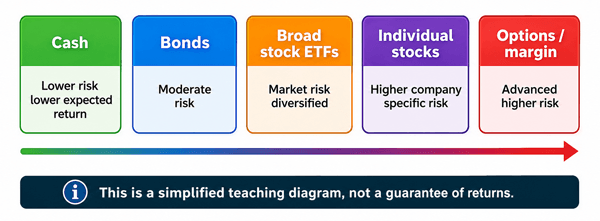
Every investment has risk. The goal is not to remove all risk, because that is impossible. The goal is to take the right amount of risk for your time horizon, goals, and emotional tolerance.
| Risk | What it means | How beginners can reduce it |
|---|---|---|
| Market risk | The whole stock market can fall. | Invest for long periods, diversify, and avoid investing short-term cash. |
| Company risk | A single company can disappoint or fail. | Avoid putting too much money into one stock. |
| Valuation risk | A good company can be a bad investment if bought at an extreme price. | Do not chase hype without understanding expectations. |
| Behavior risk | You panic sell, overtrade, or follow social media tips. | Use rules, automate contributions, and write your plan before buying. |
| Currency risk | Non-U.S. investors may gain or lose from exchange-rate changes. | Understand conversion costs and home-country tax rules. |
| Tax risk | Taxes can reduce after-tax returns. | Use tax-aware accounts and keep records. |
10. Fees and costs beginners often miss
Fees matter because they quietly reduce your return. A 1% annual cost may sound small, but over many years it can consume a meaningful part of your wealth. Beginners should learn the difference between visible trading fees and hidden or indirect costs.
| Cost | Where it appears | Beginner advice |
|---|---|---|
| Commission | Fee to buy or sell a stock or ETF. | Many U.S. brokers offer $0 stock/ETF commissions, but always confirm. |
| Expense ratio | Annual fund cost inside ETFs and mutual funds. | Compare low-cost index funds before buying expensive funds. |
| Bid-ask spread | Difference between the price buyers offer and sellers ask. | Trade liquid securities during normal market hours when possible. |
| Margin interest | Interest charged when borrowing from broker. | Avoid margin as a beginner. |
| Advisory fee | Fee for robo-advisor or human financial advisor. | Can be worth it for planning help, but understand the cost. |
| Currency conversion | Cost for non-U.S. investors converting money. | Check FX spread, transfer fees, and local bank charges. |
11. Taxes: what beginners should know before selling
Taxes are a major part of real investing. In the United States, investors may owe tax on dividends and realized capital gains in taxable accounts. A realized gain generally happens when you sell an investment for more than your cost basis. A loss may occur when you sell for less than your cost basis. Long-term capital gains usually apply to investments held for more than one year, while short-term gains are generally taxed differently. Tax rules change and depend on personal circumstances, so readers should verify current IRS guidance or consult a qualified tax professional.
| Tax topic | Plain-English explanation | Beginner habit |
|---|---|---|
| Dividends | Cash or stock distributions from companies or funds. | Do not ignore small dividends; they may still be reportable. |
| Capital gains | Profit when you sell above your purchase price. | Track cost basis and holding period. |
| Short-term vs long-term | Holding period can affect tax treatment. | Avoid unnecessary trading in taxable accounts. |
| Tax forms | Brokers typically provide tax documents. | Download and save year-end forms. |
| Tax-advantaged accounts | Retirement accounts may defer or reduce taxes if rules are met. | Use them properly and know contribution/withdrawal rules. |
Non-U.S. investors face additional issues, such as local tax rules, U.S. withholding on certain income, estate-tax considerations, currency conversion, and broker availability. This article focuses on U.S. stock market investing generally, but international readers should check rules in their own country before investing.
12. A practical beginner portfolio example
The following examples are educational, not recommendations. They show how a beginner might think about portfolio structure. The right portfolio depends on age, goals, income stability, risk tolerance, country, tax status, and time horizon.
| Investor type | Possible simple structure | Why it may make sense | What to watch |
|---|---|---|---|
| Very cautious beginner | 40% broad stock ETF, 40% bond fund, 20% cash-like holdings. | Lower stock exposure may reduce emotional stress. | May grow slower than a stock-heavy portfolio. |
| Long-term retirement beginner | 80% broad stock ETF, 20% bond fund. | More growth-focused for a long time horizon. | Can fall significantly during bear markets. |
| Learning-focused beginner | 80% broad ETF core, 10% bond/cash, 10% individual stocks. | Allows learning without making stock picking the whole plan. | Individual-stock portion still needs research discipline. |
| Aggressive young investor | 90% broad stock ETFs, 10% bonds/cash. | Higher growth potential if time horizon is long. | Requires ability to sit through large declines. |
A beginner should rebalance occasionally. Rebalancing means bringing the portfolio back to its target mix. For example, if stocks rise and become a much larger share of your account than planned, you may direct new money to bonds or sell some stocks. Rebalancing is not about predicting tomorrow. It is about controlling risk.
13. How to research a stock before buying it
If you want to buy individual stocks, treat it like buying a business, not following a tip. A simple research checklist can prevent impulsive decisions.
| Research question | Why it matters |
|---|---|
| What does the company sell, and how does it make money? | If you cannot explain the business simply, you probably do not understand the risk. |
| Is revenue and profit growing? | Growth can support higher value, but growth expectations can already be priced in. |
| Does the company have debt? | Too much debt can become dangerous in difficult periods. |
| Who are the competitors? | A strong business can lose if competitors offer better products or lower prices. |
| Is the stock expensive compared with earnings, cash flow, or growth? | A great company can be a poor investment at the wrong price. |
| What would make you sell? | A written sell rule reduces emotional decisions. |
| How much of your portfolio will this be? | Position size controls damage if you are wrong. |
Beginner-friendly rule: if you cannot write a five-sentence explanation of why you own a stock, what could go wrong, and when you would sell, you are probably not ready to put meaningful money into it.
14. Common beginner mistakes and how to avoid them
| Mistake | Why it hurts | Better habit |
|---|---|---|
| Investing without an emergency fund | You may be forced to sell during a downturn. | Keep short-term safety cash separate. |
| Chasing “hot” stocks | Hype often arrives after prices already moved. | Use a written research checklist. |
| Putting everything in one stock | One bad company event can damage the whole account. | Use broad diversification. |
| Checking prices all day | Creates anxiety and encourages overtrading. | Review on a schedule, not every hour. |
| Using margin too early | Borrowing magnifies losses and can trigger forced selling. | Avoid margin until you fully understand it. |
| Ignoring taxes | After-tax return matters more than headline return. | Keep records and learn tax basics. |
| Confusing investing with trading | Frequent trading requires skill, time, and emotional control. | Start with long-term investing basics. |
| Selling in panic | Locks in losses after fear peaks. | Write a plan before markets fall. |
15. Beginner investing checklist
- I have an emergency fund or a clear cash safety plan.
- I understand that stocks can lose value, even high-quality companies.
- I know my investing goal and time horizon.
- I selected an account type that fits my goal.
- I compared brokerage fees, account features, and investor protections.
- I know the difference between stocks, ETFs, index funds, and bonds.
- I understand market orders and limit orders before placing a trade.
- I have a simple portfolio plan and will avoid putting everything in one company.
- I know how dividends and realized gains may be taxed in taxable accounts.
- I will not invest based only on social media, hype, or fear of missing out.
16. Practical first-month plan for a complete beginner
| Week | Action | Outcome |
|---|---|---|
| Week 1 | Learn basic terms: stock, ETF, broker, dividend, capital gain, order type. | You can understand what the platform is showing you. |
| Week 2 | Compare account types and brokers; read fee schedules. | You avoid opening the wrong account or paying avoidable costs. |
| Week 3 | Open account, transfer a small test amount, and explore without rushing. | You become comfortable with the process. |
| Week 4 | Buy a small amount of a diversified ETF or create a watchlist and investment plan. | You start carefully or delay until you are ready. |
This slow approach may feel less exciting than buying immediately, but it helps beginners avoid expensive mistakes. The goal of the first month is not to become rich. It is to become competent enough to invest without panic.
17. Frequently asked questions
17.1 Is investing in U.S. stocks safe for beginners?
It can be appropriate for beginners if they use money they can leave invested, diversify, keep costs low, avoid leverage, and understand risk. It is not safe in the sense of guaranteed returns. Stocks can fall sharply.
17.2 Should I buy individual stocks or an S&P 500 ETF first?
Many beginners start with a broad ETF or index fund because it offers instant diversification. Individual stocks require more research and should usually be a smaller part of a beginner portfolio.
17.3 Can I start investing with $100?
Yes, many brokers support small deposits and fractional shares. The key is to start with an amount that will not hurt your budget and to focus on building a repeatable habit.
17.4 What is the best online stock broker for beginners?
The best online stock broker depends on your country, account type, fees, available investments, educational tools, tax documents, and support. A reputable, low-cost, easy-to-use broker is usually better than a flashy app that encourages risky trading.
17.5 Do I pay taxes if I do not sell my stock?
In a taxable account, unrealized price gains are generally not taxed until you sell, but dividends and other distributions may still be taxable. Tax treatment depends on account type and personal situation.
17.6 What is the difference between investing and trading?
Investing usually focuses on long-term ownership and wealth building. Trading focuses on shorter-term price moves. Trading can involve higher costs, taxes, stress, and risk.
17.7 How often should a beginner check their portfolio?
Checking too often can lead to emotional decisions. Many long-term beginners review monthly or quarterly and rebalance annually or when allocations move far from target.
17.8 Can I lose all my money in stocks?
A diversified ETF is unlikely to go to zero, but it can fall significantly. A single company stock can theoretically lose most or all of its value. This is why diversification matters.
17.9 Are dividend stocks good for beginners?
Dividend stocks can be useful, but a high dividend yield is not automatically good. Sometimes a high yield signals risk. Beginners should focus on total return, business quality, diversification, and taxes.
17.10 Should I use a financial advisor?
A qualified financial advisor may help if you have complex taxes, retirement planning needs, large assets, cross-border issues, or emotional difficulty managing money. Understand how the advisor is paid and whether they act in your best interest.
18. Conclusion: the simple path is often the strongest path
Starting with U.S. stocks does not have to be complicated. A beginner needs a clear goal, a suitable account, a reputable broker, a basic understanding of risk, and a simple diversified plan. The most useful early decision is not finding the next big stock. It is building a system you can follow through normal market ups and downs.
If you remember only one thing, remember this: invest with patience, diversify, keep costs low, avoid promises of guaranteed profit, and never risk money you cannot afford to leave invested. Over time, careful habits matter more than exciting predictions.
19. Sources Consulted and Checked
The following authoritative sources were consulted and checked while preparing this article to support accuracy, clarity, and responsible investor education.
| Source | Used for |
|---|---|
| Investor.gov / SEC: Introduction to Investing; Asset Allocation and Diversification; Types of Orders; ETF investor bulletins. | Beginner definitions, diversification, risk tolerance, order types, ETFs, and investor education. |
| FINRA investor education pages. | Brokerage, investing basics, order types, product risks, and investor protection context. |
| IRS Topic No. 404 and Topic No. 409. | General educational explanation of dividends, capital gains, and tax awareness. |
| SIPC: What SIPC Protects and Investor.gov SIPC bulletin. | Brokerage-failure protection limits and clarification that SIPC does not protect against market losses. |
20. Reader Advice
This article is provided solely for educational and general informational purposes. It does not constitute personalized financial, investment, tax, accounting, or legal advice, and it should not be treated as a recommendation to buy, sell, or hold any security or to use any particular broker, account, or strategy. Investing involves risk, including the possible loss of principal, and past performance does not guarantee future results. Before making any financial decision, readers should consider their goals, time horizon, financial circumstances, emergency savings, debt obligations, and tolerance for risk.
Laws, tax rules, contribution limits, brokerage terms, fees, investor-protection arrangements, and market conditions can change and may differ by country, state, account type, and individual circumstances. Readers should verify current facts, figures, eligibility requirements, and rules through relevant official sources and, where appropriate, consult a qualified financial, tax, or legal professional.