How Much Money Do You Need to Start Investing?
1. The Real Starting Line Is Smaller Than Most People Think
Many beginners delay investing because they believe investing is only for people with thousands of dollars, high salaries, or advanced financial knowledge. That belief used to feel more realistic when many brokers had account minimums, commissions, and expensive share prices. Today, the starting line is much lower. Many people can open an online brokerage account with no account minimum, buy fractional shares, and invest small amounts on a schedule.
Still, the answer is not the same for everyone. A person with stable income, no credit card debt, and an emergency fund may be ready to invest $50 or $100 per month. A person living paycheck to paycheck may need to start with $5 or focus first on cash savings and debt. A student may begin with a tiny amount simply to learn. A parent may choose a retirement account or education account. The right starting amount depends on your cash flow, goals, debt, risk tolerance, and time horizon.
Quick answer: You can often start investing with as little as $1 to $25 if your brokerage supports fractional shares or low-minimum funds. But the better question is not “What is the minimum?” It is “What amount can I invest consistently without hurting my bills, emergency savings, or peace of mind?”
This guide explains investing in plain English. It covers how much you need, how investing works, where beginners usually start, what risks to understand, how to avoid costly mistakes, and how to build a simple first plan.
2. So, How Much Money Do You Really Need to Start Investing?
For many beginners, the practical answer is: start with an amount you can repeat. In modern investing, the minimum can be very low, but consistency matters more than a dramatic first deposit. A $25 monthly habit can teach you more and build more discipline than waiting years to make a “perfect” $5,000 investment.
| Starting amount | Can it work? | Best use case | Main limitation |
|---|---|---|---|
| $1-$10 | Yes, if fractional shares are available | Learning how buying, holding, and market movement work | Growth will be small at first; education is the main benefit |
| $25-$50/month | Yes, realistic for many beginners | Building a consistent habit through automatic investing | Needs patience; short-term results may feel slow |
| $100/month | Strong beginner level | Index funds, ETFs, retirement accounts, long-term goals | Still requires emergency savings and debt discipline |
| $500-$1,000 | Helpful but not required | Building a diversified starter portfolio faster | Can be risky if it drains cash reserves |
| $5,000+ | Useful for larger planning | Broader asset allocation, advisory options, larger retirement contributions | Not necessary to begin; may tempt overconfidence |
A useful rule: do not invest money you will probably need in the next few months. Markets can fall at the wrong time. Investing works best when your money has time to recover from downturns and benefit from compounding.
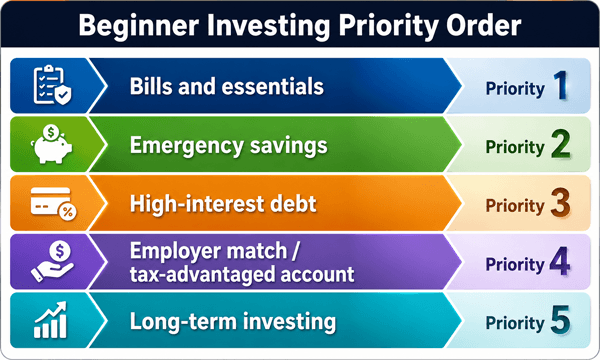
Figure 1. Beginner investing priority order before committing larger amounts.
3. What Is Investing? A Simple Explanation for Complete Beginners
Investing means putting money into an asset with the hope that it grows or produces income over time. Instead of keeping every dollar in cash, you buy something that may become more valuable, pay dividends, or earn interest. Common investments include stocks, bonds, mutual funds, exchange-traded funds (ETFs), real estate investment trusts, and retirement account portfolios.
A stock is a small ownership piece of a company. A bond is more like lending money to a company or government. A fund is a basket that can hold many stocks or bonds. For beginners, broad index funds and ETFs are often easier to understand than picking individual stocks because they spread money across many companies at once.
Investing is different from saving. Saving is for safety and short-term needs. Investing is for growth and long-term goals. Both matter. A beginner should not see investing as a replacement for an emergency fund. Think of savings as your financial seatbelt and investing as your long-distance engine.
| Saving | Investing |
|---|---|
| Best for emergencies, rent, bills, near-term purchases | Best for long-term goals like retirement, wealth building, or education |
| Usually lower risk | Can rise and fall in value |
| Usually lower return potential | Higher return potential over long periods |
| Money should be easy to access | Money should be left alone when possible |
| Examples: bank savings, money market account, cash reserve | Examples: index funds, ETFs, stocks, bonds, retirement account portfolios |
4. Why Small Amounts Can Matter: The Power of Compounding
Compounding is the process where your money earns returns, and then those returns can earn returns too. In simple words, your growth begins to grow. This is why starting early can be more powerful than starting with a large amount later.
For example, imagine someone starts with $25 and invests $50 every month for 10 years. If the portfolio earns an average annual return of 7%, the account could grow to roughly $8,700 before taxes and fees. The exact result will vary because real markets do not move in a straight line, but the lesson is simple: time plus consistency can turn small deposits into meaningful progress.
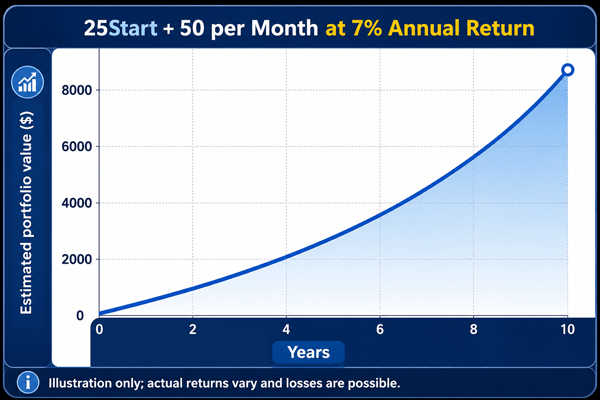
Figure 2. Illustrative growth of a $25 starting balance plus $50 monthly contributions at a steady 7% annual return.
People experience insight: Many beginners say the first benefit of investing small is not the dollar gain. It is confidence. Once they see how an account works, market drops feel less mysterious and automatic contributions feel normal.
5. The Money Checklist Before You Invest
Before asking whether $10, $100, or $1,000 is enough, check whether your financial base is ready. This protects you from selling investments at a bad time because of an avoidable cash emergency.
| Question | Beginner-friendly guideline | Why it matters |
|---|---|---|
| Can I pay my monthly essentials? | Invest only after rent, food, utilities, transport, and insurance are covered. | Investing should not create bill stress. |
| Do I have emergency savings? | Start with at least a small buffer, then build toward 3-6 months of essential expenses over time. | Cash prevents panic selling. |
| Do I have high-interest debt? | Credit card debt and payday loans often deserve urgent attention before aggressive investing. | A 20%+ interest rate can overpower expected investment returns. |
| Do I understand the investment? | If you cannot explain it simply, slow down. | Confusion leads to bad decisions and scams. |
| Can I leave the money invested? | Use investing money for goals at least 3-5 years away, ideally longer. | Short time horizons increase risk. |
6. Where Can Beginners Invest Small Amounts?
The easiest starting place is usually a reputable brokerage, retirement account, employer plan, or robo-advisor. The best choice depends on your country, tax rules, employer benefits, and goals.
| Option | Typical beginner appeal | Good for | Watch out for |
|---|---|---|---|
| Online brokerage account | Flexible, low minimums, ETFs, stocks, fractional shares | Learning and long-term taxable investing | Taxes, temptation to trade too often |
| Employer retirement plan | Payroll deductions and possible employer match | Retirement savings | Limited menu, withdrawal rules |
| IRA or similar retirement account | Tax advantages depending on eligibility | Long-term retirement investing | Contribution limits and withdrawal penalties may apply |
| Robo-advisor | Automated portfolio and rebalancing | Hands-off beginners | Advisory fees and limited control |
| Micro-investing app | Very small contributions and simple interface | Habit building | Fees can be high relative to small balances |
| High-yield savings account | Not investing, but useful before investing | Emergency fund and short-term goals | Growth may not beat inflation long term |
Current market access note: Many major online brokers now advertise $0 commissions for online U.S. stock and ETF trades, no account minimums, or fractional investing features. Always verify current fees, minimums, and rules directly on the provider website before opening an account.
7. A Simple Beginner Plan: Start With the “Comfortable Monthly Amount”
Instead of trying to find the perfect starting amount, use this practical formula:
Starter formula: Monthly amount to invest = money left after essentials, minimum debt payments, emergency savings contribution, and planned short-term needs. Start with 25%-50% of that leftover amount if you are nervous, then increase as confidence grows.
| Monthly leftover after bills and savings | Conservative starter investment | More confident starter investment |
|---|---|---|
| $20 | $5-$10 | $10-$20 |
| $100 | $25 | $50 |
| $250 | $50-$100 | $125-$200 |
| $500 | $100-$200 | $250-$400 |
| $1,000 | $250-$400 | $500-$800 |
This approach is realistic because it respects your life. Investing should be sustainable through normal months, not only perfect months. A small automatic transfer that survives for years is usually better than a large one that gets cancelled after two paychecks.
8. Practical Examples: How Different Beginners Might Start
| Beginner situation | Possible first step | Why this works |
|---|---|---|
| Student with $15/month available | Open a low-cost account, invest $5-$10 monthly in a broad fund or use a practice watchlist first | The goal is education and habit building, not fast wealth. |
| New employee with employer match | Contribute enough to capture the match if affordable | An employer match can be one of the strongest beginner benefits. |
| Parent with credit card debt | Pay down high-interest debt first, invest a tiny amount only for learning if desired | Debt interest can erase investment progress. |
| Freelancer with irregular income | Build a larger cash buffer, then invest a fixed percentage of paid invoices | Protects against income swings. |
| Beginner with $1,000 saved | Keep emergency money separate; invest only the portion not needed soon | Avoids using the market like a checking account. |
9. What Should Beginners Invest In First?
A beginner does not need a complicated portfolio. The first investment should be understandable, diversified, low cost, and aligned with the goal. For many people, that points toward broad-market index funds or ETFs rather than individual stock picking.
| Investment type | Beginner friendliness | What it means | Main risk |
|---|---|---|---|
| Broad stock index fund/ETF | High | Owns many companies in one fund | Can fall sharply during market downturns |
| Bond fund/ETF | Medium to high | Owns many bonds for income and stability | Interest rate and credit risk |
| Target-date fund | High | A diversified retirement fund that adjusts over time | May not match your exact risk preference |
| Individual stocks | Medium to low | Owns shares of one company | Company-specific risk; requires research |
| Crypto/speculative assets | Low for most beginners | Highly volatile digital assets | Large losses, scams, unclear valuation |
| Options or margin trading | Very low | Leveraged or complex strategies | Can create fast and severe losses |
Practical rule: A beginner portfolio should be boring enough that you can keep it during a bad month. If an investment makes you check prices every hour, it may be too risky for your current stage.
10. Dollar-Cost Averaging: A Beginner-Friendly Way to Start
Dollar-cost averaging means investing the same amount at regular intervals, such as $25 every Friday or $100 every month. You buy whether prices are up or down. This does not guarantee profit, but it removes the pressure of guessing the perfect day to invest.
| Market situation | What your fixed $100 buys | Why it helps emotionally |
|---|---|---|
| Price is high | Fewer shares | You avoid putting all money in at once at one price |
| Price is low | More shares | Down markets become part of the plan instead of a surprise |
| Market is confusing | Same scheduled amount | You do not need to predict headlines |
Some research and investment firms note that lump-sum investing can outperform dollar-cost averaging in many rising markets because money gets invested sooner. But for beginners, dollar-cost averaging can be useful because it builds behavior, reduces regret, and makes investing feel manageable.
11. How Much Should You Keep in Cash Before Investing?
Cash is not exciting, but it is powerful. It keeps you from selling investments during emergencies. A common guideline is to build toward 3-6 months of essential expenses in emergency savings. However, beginners do not need to wait until the full emergency fund is complete before learning. A balanced path can work: build a small emergency cushion first, then invest a small amount while continuing to grow cash reserves.
| Stage | Cash focus | Investing focus |
|---|---|---|
| No savings at all | Build a starter emergency fund first | Learn with a watchlist or very tiny amount |
| Small cushion saved | Keep adding cash monthly | Begin small automatic investing if debt is under control |
| 3-6 months saved | Maintain emergency fund | Increase long-term investing if goals allow |
| Unstable income | Keep a larger cash buffer | Invest a smaller percentage until income stabilizes |
12. Fees: The Quiet Reason Starting Small Can Go Wrong
When you invest small amounts, fees matter a lot. A $3 monthly app fee may sound cheap, but if your account balance is only $100, that is effectively 36% per year before investment performance. Beginners should look for low account fees, low fund expense ratios, no unnecessary trading commissions, and transparent costs.
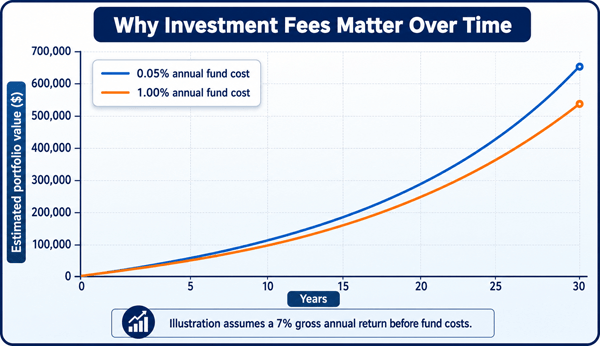
Figure 3. Illustrative long-term effect of lower versus higher annual fund costs.
| Fee type | What it means | Beginner tip |
|---|---|---|
| Account maintenance fee | A fee for keeping the account open | Prefer $0 if available |
| Trading commission | Fee to buy or sell investments | Avoid frequent trading; check commission schedule |
| Expense ratio | Annual cost inside a fund | Lower is generally better for similar index exposure |
| Advisory fee | Fee for robo-advisor or human advisor | Make sure the service is worth the cost |
| Transfer or closure fee | Fee to move or close account | Check before opening |
13. Risk: What Beginners Must Understand Before the First Dollar
The biggest beginner mistake is believing investing is the same as guaranteed growth. Investments can lose money. Even broad stock market funds can fall significantly during recessions, interest-rate shocks, wars, bubbles, or panic. This is normal, but it is not painless.
| Risk | Plain-English meaning | How beginners manage it |
|---|---|---|
| Market risk | Your investment price can fall | Use long time horizons and avoid panic selling |
| Concentration risk | Too much money in one company or sector | Diversify with broad funds |
| Liquidity risk | Hard to sell quickly at a fair price | Avoid complex products you do not understand |
| Inflation risk | Cash loses buying power over time | Invest long-term money for growth |
| Behavior risk | You make emotional decisions | Automate, write a plan, avoid hype |
| Scam risk | Fake opportunities promise easy returns | Verify registration, avoid guaranteed profit claims |
Honest investing practice: No legitimate investment can honestly promise high returns with no risk. Be careful with “double your money,” “secret strategy,” “insider signal,” and pressure-based sales tactics.
14. How to Start Investing Step by Step
Step 1: Define the goal. Decide whether the money is for retirement, a home, education, general wealth building, or learning. The goal affects account type, investment choice, and risk level.
Step 2: Choose the right account. For retirement, look at employer plans or retirement accounts. For flexible long-term investing, consider a taxable brokerage account. Consider tax rules in your country.
Step 3: Pick a simple first investment. For many beginners, a broad-market index fund, ETF, or target-date fund is easier than choosing single stocks.
Step 4: Start with a repeatable amount. Choose a monthly number that does not harm your bills or savings. Even $25 can be useful if it builds the habit.
Step 5: Automate contributions. Automatic investing reduces the temptation to time the market and turns investing into a routine.
Step 6: Review, but not daily. A quarterly or semiannual review is often enough for long-term investors. Daily checking can create anxiety.
Step 7: Increase slowly. Raise contributions after pay increases, debt payoff, or improved savings. Small increases can make a large long-term difference.
15. Beginner Mistakes That Cost Real Money
| Mistake | Why it hurts | Better approach |
|---|---|---|
| Waiting until you feel rich | You lose time and compounding | Start with education and a small habit |
| Investing emergency money | You may sell during a downturn | Separate savings from investing |
| Buying hype stocks only | High risk and emotional decisions | Use diversified core holdings first |
| Ignoring fees | Small fees become big over time | Compare expense ratios and account charges |
| Checking the market daily | Creates fear and overtrading | Use a written plan and scheduled reviews |
| Trying to time the bottom | Often leads to inaction | Use automatic contributions |
| Copying strangers online | Their goals and risk may not match yours | Learn principles, not predictions |
16. Is $100 Enough to Start Investing?
Yes, $100 can be enough to start investing if your account allows it and your finances are ready. With fractional shares or ETFs, $100 can buy pieces of diversified investments. The key is not expecting $100 to become life-changing quickly. The real value of the first $100 is that it starts the process.
A practical $100 beginner approach might look like this: keep emergency savings separate, open a reputable low-cost account, invest in one diversified fund, set a $25-$100 monthly automatic contribution, and review after three months. The goal is to build a repeatable system.
17. Is $1,000 Better Than $100?
$1,000 gives you more flexibility and faster visible progress, but it is not automatically better. If investing $1,000 drains your bank account, it may create stress and force you to sell later. If $1,000 is truly extra long-term money, it can be a strong start.
| Question | If yes | If no |
|---|---|---|
| Do you have emergency cash? | Investing part of $1,000 may be reasonable | Keep more in savings first |
| Is high-interest debt controlled? | Investing can be considered | Paying debt may be more urgent |
| Can you leave it for years? | Long-term investing fits better | Use savings, not investing |
| Do you understand the product? | Proceed carefully | Learn first, invest smaller |
18. What About Retirement Accounts?
For many working adults, retirement accounts are one of the best places to begin because they may offer tax advantages and employer matching. If an employer offers a match, beginners should learn how it works because not using it can mean leaving valuable compensation on the table. However, retirement accounts often have rules about withdrawals, taxes, and contribution limits, so read the plan details carefully.
Beginner-friendly mindset: Retirement investing is not about getting rich next week. It is about buying time. The earlier money enters the account, the longer compounding has to work.
19. How Much Should You Invest Each Month?
There is no perfect percentage for everyone. Some personal finance frameworks mention 10%-20% of income for long-term savings and investing, but beginners should adapt that to reality. If you can invest only 2% now, start there and improve. If you can invest 15% without debt or cash stress, that may be strong. The best amount is the one you can keep doing through ordinary life.
| Income situation | Possible approach |
|---|---|
| Living paycheck to paycheck | Focus on budgeting, small emergency fund, and debt. Invest tiny amounts only for learning. |
| Stable income, little savings | Build emergency cash and start a small monthly investment. |
| Stable income, emergency fund ready | Increase investment percentage toward long-term goals. |
| High income, no plan | Automate investing before lifestyle spending absorbs the surplus. |
| Irregular income | Invest a percentage of each payment after taxes and cash buffer. |
20. A Simple First Portfolio Example
This is not a recommendation for every reader, but an educational example of how a beginner might think. A young long-term investor could use a broad stock index fund as the core. A more cautious investor might mix stocks and bonds. A retirement investor might choose a target-date fund. The goal is to avoid overcomplication.
| Risk comfort | Example beginner structure | Who might consider it |
|---|---|---|
| Higher risk tolerance, long time horizon | Mostly broad stock index fund/ETF | Young investor with decades before needing money |
| Moderate risk tolerance | Mix of stock index fund and bond fund | Investor who wants growth with some stability |
| Hands-off retirement saver | Target-date retirement fund | Beginner who wants automatic allocation changes |
| Very cautious or short-term goal | Mostly cash or savings, not stock investing | Money needed soon or low risk tolerance |
21. How Beginners Can Use This Information Today
- Write down your monthly income, bills, debt payments, and savings contribution.
- Choose a starter amount that feels almost too easy to maintain.
- Decide whether the goal is retirement, long-term wealth, or learning.
- Compare account minimums, fees, fund costs, and fractional investing availability.
- Choose one simple diversified investment before exploring advanced products.
- Set automatic investing if available.
- Create a rule for market drops: do not sell just because prices fall.
- Review fees and contribution amount every 3-6 months.
22. Frequently Asked Questions
22.1 Can I start investing with $5?
Yes, if your platform supports fractional shares or low-minimum investments. With $5, the main benefit is learning and habit-building, not large returns.
22.2 Should I invest if I have credit card debt?
Usually, high-interest credit card debt should be a priority because the interest cost can be higher than realistic investment returns. Some people still invest a tiny amount to learn, but aggressive investing while carrying expensive debt can be risky.
22.3 Do I need a financial advisor to start?
Not always. Many beginners can start with education, a low-cost account, and simple diversified funds. An advisor may be useful for complex tax, retirement, business, inheritance, or family situations.
22.4 What is the safest investment for beginners?
No investment is completely risk-free. For money needed soon, cash savings or government-backed savings products may be more appropriate than stocks. For long-term growth, diversified funds can reduce company-specific risk but still move with markets.
22.5 How long should I keep money invested?
Stock-focused investing is generally better for long time horizons, often 5 years or more. The longer the time horizon, the more time you have to recover from downturns.
22.6 Should I buy individual stocks first?
Most beginners are better served by building a diversified core before buying individual stocks. If you buy single stocks, consider using a small portion of your portfolio and understand the business first.
22.7 What if the market drops right after I start?
That is common and emotionally difficult. If your plan is long term, a drop does not automatically mean you made a mistake. It may be a reason to review your risk level, not panic sell.
22.8 How do I know if an investing app is trustworthy?
Check regulation, fee disclosures, account protections, customer support, investment choices, and whether the app encourages responsible investing or excessive trading.
22.9 23. Final Takeaway: You Do Not Need to Be Rich to Start, But You Do Need a Plan
You may be able to start investing with $1, $10, $25, or $100. The exact minimum depends on the account and investment. But successful investing is not about the smallest possible deposit. It is about starting safely, understanding risk, keeping fees low, investing consistently, and allowing time to do the heavy work.
For a complete beginner, the best first move is often simple: protect your bills, build at least a small emergency fund, avoid high-interest debt, open a reputable low-cost account, choose a diversified investment, and automate an amount you can maintain. The first dollar matters because it changes your identity from someone who is waiting to someone who is learning and building.
Sources Consulted and Checked
The following sources were consulted and checked while preparing this article to support accuracy, clarity, and responsible presentation.
- Investor.gov, Introduction to Investing - regular investing and the effect of compounding.
- Investor.gov, Dollar-Cost Averaging glossary - definition and risk-management concept.
- Investor.gov, Compound Interest Calculator - educational framework for growth illustrations.
- FINRA, Financial Tips for New Investors - small regular investments and automatic contributions.
- FINRA, The Benefits and Limitations of Dollar-Cost Averaging - definition, use, and limitations.
- Fidelity, Fractional Shares page - example of zero account minimums, zero account fees to open a brokerage account, and fractional investing access as advertised by the provider.
- Charles Schwab, Pricing and trading pages - example of $0 online U.S. exchange-listed stock and ETF commission language as advertised by the provider.
- Vanguard, Dollar-cost averaging vs. lump-sum investing education - comparison of investing all at once versus over time.
Reader Advice
This article is provided solely for educational and informational purposes. It does not constitute personalized investment, financial, tax, legal, or accounting advice, and it should not be treated as a recommendation to buy, sell, or hold any security or financial product. Investing involves risk, including the possible loss of principal, and past performance does not guarantee future results. Before making any financial decision, consider your own goals, time horizon, financial circumstances, debt obligations, emergency savings, and risk tolerance. Where appropriate, seek advice from a qualified and properly licensed professional.
Fees, account minimums, tax treatment, contribution limits, withdrawal rules, provider features, regulations, and market conditions can change and may differ by country, state, institution, account type, and personal circumstances. Always verify current facts, figures, eligibility requirements, costs, protections, and rules directly with official regulators, government agencies, plan documents, and the relevant financial provider before acting.