How Do Stock Exchanges Work? Explained Simply
1. What Is a Stock Exchange?
A stock exchange is a regulated marketplace where people and institutions buy and sell ownership pieces of companies. Those ownership pieces are called shares or stocks. When a company is listed on an exchange, its shares can be traded publicly through brokers and trading platforms.
The easiest way to understand it: a stock exchange is not the company, not the broker, and not your trading app. It is the organized marketplace in the middle. It provides rules, technology, price information, trading systems, and oversight so buyers and sellers can meet in a fairer and more transparent way.
Examples include the New York Stock Exchange (NYSE), Nasdaq, London Stock Exchange, Tokyo Stock Exchange, and Pakistan Stock Exchange. Some exchanges have famous buildings and trading floors. Others are almost completely electronic. Today, even exchanges with physical floors rely heavily on technology.
1.1 The simple supermarket example
Imagine a large supermarket where apples from many farms are sold. The supermarket does not grow the apples. It gives sellers a place to display them, buyers a place to compare prices, and everyone a set of rules. A stock exchange works in a similar way, except the “apples” are shares and other securities.
| Supermarket idea | Stock exchange equivalent |
|---|---|
| Farmers bring products | Companies list shares or securities |
| Customers compare prices | Investors compare stock prices |
| Cash register records sale | Exchange systems record trades |
| Store rules protect customers | Exchange and regulator rules protect market integrity |
| Popular items sell quickly | Liquid stocks trade quickly |
2. Why Stock Exchanges Exist
Stock exchanges exist because companies need capital and investors need a trusted way to buy and sell investments. A strong exchange helps money move from savers to businesses that may use it to grow, hire, build products, pay debt, or expand operations.
For investors, the exchange creates liquidity. Liquidity simply means you are more likely to find a buyer when you want to sell, or a seller when you want to buy. Without a stock exchange, selling a small piece of a company would be slow, private, expensive, and difficult.
- They help companies raise money from the public.
- They help investors buy and sell more easily.
- They publish prices so the market can see what buyers and sellers are doing.
- They create rules for listing, trading, reporting, and fair access.
- They support retirement accounts, mutual funds, ETFs, pension funds, and long-term wealth building.
3. How a Stock Exchange Works Step by Step
A beginner usually never talks directly to the exchange. You open a brokerage account, use a stock trading app or online trading platform, choose a stock or ETF, place an order, and the broker routes that order to a market where it can be filled.
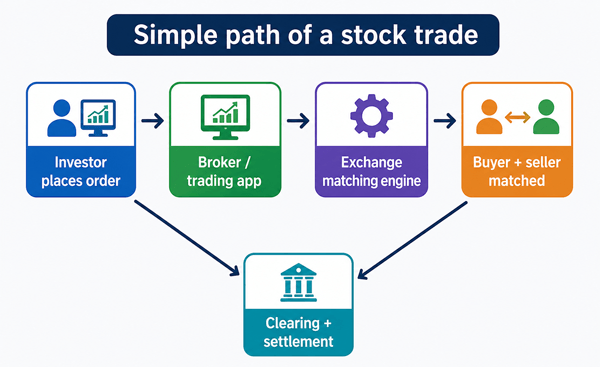
- You decide what you want to buy or sell.
- You place an order through a broker or trading app.
- The broker checks your account, buying power, and order details.
- The order is routed to an exchange, market maker, or another trading venue.
- The market tries to match your order with the best available opposite order.
- If matched, the trade is executed and you receive a confirmation.
- Behind the scenes, clearing and settlement make sure shares and money are properly exchanged.
3.1 What is matching?
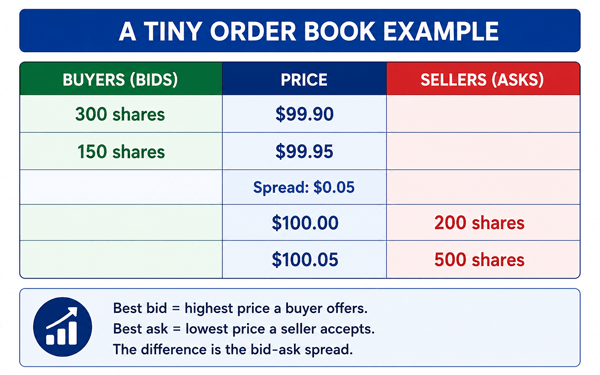
Matching means the market pairs a buyer with a seller. If you want to buy 10 shares and someone else wants to sell 10 shares at a price your order accepts, the trade can happen. Modern exchanges do this electronically in fractions of a second.
4. Key Players in a Stock Exchange
| Player | Simple meaning | What beginners should know |
|---|---|---|
| Company | A business that issues shares | A share represents ownership, but it does not guarantee profit. |
| Investor | A person or institution buying securities | Investors should understand risk before buying. |
| Broker | Licensed firm that connects you to markets | Choose a regulated broker with clear fees and account protections. |
| Exchange | Marketplace and rule system | It organizes trading and listings but does not promise stock gains. |
| Market maker | Firm that may quote buy and sell prices | They can improve liquidity, especially in active securities. |
| Regulator | Government or self-regulatory body | Regulators enforce disclosure, broker rules, and market integrity. |
| Clearing house | Back-office risk and settlement system | It helps complete trades after execution. |
5. Does a Stock Exchange Set Stock Prices?
No. The exchange does not decide that a stock “should” be worth $50 or $100. Prices come from supply and demand. If more buyers urgently want a stock than sellers are willing to sell, the price usually rises. If sellers are more aggressive than buyers, the price usually falls.
A useful beginner rule: a stock price is not a perfect measurement of a company’s true value. It is the price at which real buyers and sellers are currently willing to trade. In the short term, prices can be moved by news, fear, excitement, interest rates, earnings, rumors, liquidity, and large institutional orders. In the long term, business quality, cash flow, profits, debt, growth, and valuation matter more.
| Price driver | Example | Beginner lesson |
|---|---|---|
| Company earnings | A company reports higher profit than expected | Good results can attract buyers, but price may already include expectations. |
| Interest rates | Higher rates make borrowing costlier | Growth stocks can become less attractive when rates rise. |
| News and sentiment | A product launch, lawsuit, or scandal | News can move prices fast; do not react blindly. |
| Liquidity | A small stock has few buyers and sellers | Prices can jump or fall sharply with small orders. |
| Market-wide fear | Recession, war, banking stress, pandemic shock | Diversification matters because even good companies can fall in broad selloffs. |
6. Primary Market vs Secondary Market
The primary market is where securities are created and sold for the first time. An initial public offering, or IPO, is a common example. The company sells shares to raise money.
The secondary market is where investors trade shares with each other after the IPO. Most everyday stock trading happens in the secondary market. When you buy shares of a listed company through your brokerage account, you are usually buying from another investor, market maker, or institution, not directly from the company.
| Feature | Primary market | Secondary market |
|---|---|---|
| Main purpose | Company raises capital | Investors trade existing shares |
| Example | IPO or new share issue | Buying Apple, Microsoft, HBL, or another listed share through a broker |
| Who receives money? | Usually the company selling new shares | Usually the selling investor |
| Beginner focus | Read prospectus and understand IPO risk | Understand price, order type, fees, liquidity, and portfolio fit |
7. NYSE vs Nasdaq vs Local Stock Exchanges
Beginners often think there is only one stock market. In reality, there are many exchanges and trading venues. NYSE is known for its hybrid model and trading floor, while Nasdaq is known as a fully electronic market associated with many technology companies. Local exchanges, such as Pakistan Stock Exchange, serve their own capital markets under local rules and regulators.
| Exchange type | Common example | What makes it different |
|---|---|---|
| Hybrid exchange | NYSE | Combines advanced electronic trading with a physical trading floor for some functions. |
| Electronic exchange | Nasdaq | Trading is electronic and highly technology-driven. |
| Local/national exchange | Pakistan Stock Exchange, London Stock Exchange, Tokyo Stock Exchange | Rules, currencies, settlement, taxes, investor protections, and listed companies differ by country. |
| Alternative venues | Dark pools, electronic communication networks | May serve institutional or specialized trading needs; beginners usually access markets through brokers, not directly. |
8. Important Terms Beginners Must Know
| Term | Plain-English meaning | Why it matters |
|---|---|---|
| Stock / share | A small ownership unit in a company | You participate in gains and losses. |
| Ticker symbol | Short code for a listed security | Helps identify the right company or ETF. |
| Brokerage account | Account used to buy and sell investments | You generally need one to access exchanges. |
| Bid | Highest price buyers are currently offering | Shows demand side of the market. |
| Ask | Lowest price sellers are currently accepting | Shows supply side of the market. |
| Spread | Difference between bid and ask | A hidden cost, especially in less-liquid stocks. |
| Volume | Number of shares traded | Higher volume often means easier entry and exit. |
| Market capitalization | Share price multiplied by shares outstanding | Helps compare company size. |
| Dividend | Cash paid by a company to shareholders | Useful, but not guaranteed. |
| ETF | Fund that trades on an exchange like a stock | Often a practical way to diversify. |
9. Order Types: Market, Limit, Stop, and Stop-Limit
Order type is one of the most practical things a beginner can learn. Many painful beginner experiences happen because someone clicks “buy” or “sell” without understanding how the order will behave.
| Order type | What it means | Main advantage | Main risk |
|---|---|---|---|
| Market order | Buy or sell immediately at the best available price | Fast execution | Price is not guaranteed, especially in volatile or thinly traded stocks. |
| Limit order | Buy at a maximum price or sell at a minimum price | Controls price | May not execute if the market does not reach your price. |
| Stop order | Becomes a market order after a stop price is reached | Can help trigger an exit or entry automatically | Final execution price can be worse than expected. |
| Stop-limit order | Becomes a limit order after stop price is reached | Controls price after trigger | May not execute at all in fast markets. |
9.1 Practical example: market order vs limit order
Suppose a stock last traded at $100. The best ask is $100.10 and only 20 shares are available there. If you place a large market buy order, part of your order may fill at $100.10 and the rest at higher prices. If you place a limit order at $100.10, you control the maximum price, but the full order may not fill.
Practical beginner habit: for less-liquid stocks, volatile markets, pre-market/after-hours sessions, or emotional moments, a limit order is often safer than a market order because it prevents surprise prices. Order availability, trigger rules, and execution practices may differ by broker, exchange, security, and trading session.
10. How Beginners Can Use Stock Exchanges Safely
The goal is not to become a professional trader overnight. The goal is to understand the system well enough to avoid obvious mistakes and make informed, honest decisions.
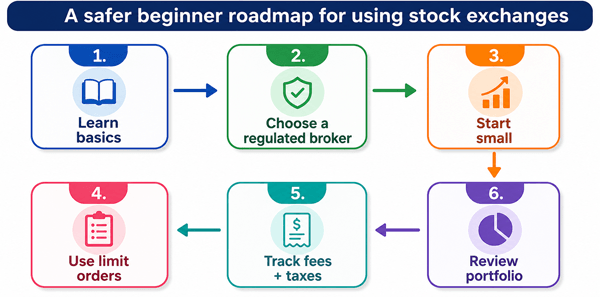
- Learn the difference between investing and trading. Investing is usually long-term ownership. Trading is short-term buying and selling, often with higher risk and emotional pressure.
- Choose a regulated broker. Check licenses, fees, customer support, account protections, order execution practices, and withdrawal process.
- Start small. Use money you can afford to keep invested and do not need for rent, food, emergency savings, or debt payments.
- Understand what you are buying. Read company reports, fund documents, expense ratios, risk disclosures, and basic valuation metrics.
- Prefer diversification. Many beginners are better served by diversified ETFs or mutual funds than by trying to pick one “hot stock.”
- Keep records. Track buy price, reason for buying, fees, dividends, taxes, and exit plan.
- Avoid leverage unless you fully understand it. Margin can increase gains but can also magnify losses and create forced selling.
- Review your portfolio periodically instead of checking prices every few minutes. Over-monitoring often causes emotional mistakes.
11. Beginner Portfolio Example
This is not a recommendation. It is only an educational example showing how a beginner might think about diversification instead of putting all money into one stock.
| Portfolio part | Example idea | Why a beginner might use it | Common risk |
|---|---|---|---|
| Core diversified fund | Broad-market ETF or index fund | Spreads money across many companies | Still falls when the broad market falls. |
| Dividend stock or fund | Dividend-paying companies or dividend ETF | Can provide income focus | High dividend yield can signal business trouble. |
| Individual stock | One company you understand well | Lets you learn business analysis | Single-company risk can be large. |
| Cash reserve | Emergency fund outside trading account | Prevents forced selling in a crisis | Cash may lose purchasing power to inflation. |
12. Fees and Costs Beginners Often Miss
A stock trade may look “free” in an app, but investing still has costs. Some are obvious, such as commissions. Others are less visible, such as bid-ask spreads, fund expense ratios, currency conversion costs, taxes, account inactivity fees, data fees, and margin interest.
| Cost | Where it appears | How to reduce it |
|---|---|---|
| Commission | Broker charges per trade | Compare brokers and avoid unnecessary frequent trading. |
| Bid-ask spread | Difference between buy and sell quotes | Use liquid securities and limit orders. |
| Fund expense ratio | Annual cost inside ETF or mutual fund | Compare low-cost funds with similar exposure. |
| Currency conversion | Buying foreign stocks or funds | Check FX markup before investing internationally. |
| Margin interest | Borrowing from broker | Avoid margin unless experienced and risk-aware. |
| Taxes | Capital gains, dividends, withholding tax | Keep records and consult a qualified tax professional. |
13. Risks: What Can Go Wrong?
The stock exchange makes trading organized; it does not remove risk. Beginners should know what can go wrong before they learn what can go right.
- Market risk: the whole market can fall.
- Business risk: a company can lose customers, face lawsuits, take on too much debt, or fail.
- Liquidity risk: you may not be able to sell quickly at a fair price.
- Execution risk: your order may fill at a different price than expected.
- Currency risk: foreign investments can move because exchange rates change.
- Behavior risk: panic selling, greed buying, revenge trading, and following social media hype.
- Fraud risk: fake gurus, pump-and-dump groups, unrealistic guaranteed-return promises, and unregulated platforms.
13.1 Honest investing practices
A trustworthy article on stock exchanges should not promise quick wealth. Markets reward patience, research, discipline, and risk control, but they can punish overconfidence. No exchange, broker, trading app, financial advisor, or online course can honestly guarantee profits. Be cautious with anyone promising “safe daily returns,” “secret insider methods,” or “risk-free trading.”
14. Stock Exchange vs Stock Market vs Broker
| Term | What it is | Beginner example |
|---|---|---|
| Stock exchange | Specific regulated marketplace | NYSE, Nasdaq, PSX |
| Stock market | Broad network of exchanges and trading venues | The overall system where stocks are issued and traded |
| Broker | Firm that gives you access to markets | Your online trading platform or investment account provider |
| Trading app | Software interface | The app is a tool, not the market itself |
15. Investing vs Trading: Know the Difference
| Feature | Investing | Trading |
|---|---|---|
| Time horizon | Years or decades | Minutes, days, weeks, or months |
| Main focus | Business quality, valuation, diversification, compounding | Price movement, chart patterns, catalysts, risk/reward |
| Typical costs | Lower if turnover is low | Higher due to frequent trades, spreads, taxes |
| Emotional pressure | Lower if plan is clear | Higher because decisions are frequent |
| Best beginner approach | Often more suitable | Requires education, discipline, and strict risk controls |
Many beginners enter the stock market because they see trading profits online. In real life, many new traders lose money because they trade too often, use leverage, chase hype, and ignore risk management. Long-term investing is not easy, but it is usually more forgiving than short-term speculation.
16. How Companies Get Listed
To trade on a major exchange, a company must meet listing standards. These may include minimum size, public float, financial reporting, governance rules, disclosure obligations, and ongoing compliance. Listing standards differ by exchange and country.
For investors, listing does not mean a company is automatically a good investment. It means the company has met certain exchange requirements and can be traded publicly. You still need to analyze the business, valuation, financial statements, risks, and management quality.
17. How Stock Exchanges Protect Investors
Stock exchanges and regulators use rules to make markets more orderly. These rules can include company disclosure requirements, trading halts, surveillance for suspicious activity, broker regulation, circuit breakers during extreme volatility, and penalties for misconduct.
Circuit breakers are an important example. In very volatile conditions, trading may pause to slow panic and allow information to spread. This does not guarantee prices will recover; it simply creates a cooling-off period for market orderliness.
18. A Practical First-Trade Walkthrough
Imagine Sara wants to buy shares of a large, liquid company for long-term learning. Here is a safer thought process.
- Sara first pays off high-interest debt and keeps an emergency fund.
- She chooses a regulated broker and opens a cash brokerage account.
- She reads basic information about the company and compares it with a diversified ETF.
- She decides how much she can risk without stress.
- She checks the bid, ask, spread, daily volume, and recent news.
- Instead of clicking a market order during a volatile moment, she uses a limit order.
- She writes down why she bought it and what would make her sell.
- She reviews monthly or quarterly, not every five minutes.
19. Common Beginner Mistakes
| Mistake | Why it hurts | Better habit |
|---|---|---|
| Buying because social media says it will “moon” | Hype often appears after insiders or early buyers already positioned | Verify information and understand valuation. |
| Putting all money into one stock | One bad event can damage the whole account | Diversify across companies, sectors, and assets. |
| Using market orders in illiquid stocks | Execution price can be poor | Check spread and consider limit orders. |
| Ignoring fees and taxes | Small costs compound over time | Track all costs and use tax-aware planning. |
| Borrowing on margin too early | Losses can exceed comfort level and trigger forced selling | Use cash account until experienced. |
| Confusing price with value | A low-priced stock is not automatically cheap | Look at market cap, earnings, debt, cash flow, and prospects. |
| No exit plan | Emotion decides instead of logic | Set rules before buying. |
20. Helpful Facts and Comparisons
- A stock exchange is a marketplace, not a profit machine.
- Your broker is the doorway; the exchange is the marketplace; the company is the business you may own.
- The last traded price is not always the price you will get from a market order.
- The bid-ask spread is a real cost even when commission is zero.
- ETFs can trade like stocks but may hold dozens, hundreds, or thousands of securities.
- Regulated does not mean risk-free. It means there are rules, reporting requirements, and oversight mechanisms.
- A beginner’s biggest edge is not speed; it is patience, low costs, diversification, and avoiding avoidable mistakes.
21. FAQ: How Do Stock Exchanges Work?
21.1 Can I buy directly from a stock exchange?
Most individual investors cannot trade directly with an exchange. They usually need a regulated broker or online trading platform.
21.2 Is the stock exchange open all the time?
No. Trading hours depend on the exchange and country. Some markets also have pre-market or after-hours sessions, but those sessions can have lower liquidity and wider spreads.
21.3 Is buying stocks safe for beginners?
Stocks carry risk. Beginners can reduce avoidable risk by learning first, diversifying, using regulated brokers, avoiding leverage, and investing money they do not need immediately.
21.4 What is the safest way to start?
There is no risk-free stock strategy. A cautious beginner often starts with education, a small amount, a diversified fund, a cash account, and a long-term plan rather than speculative short-term trades.
21.5 Why do prices move every second?
Prices move because new orders arrive, existing orders are canceled, news changes expectations, and buyers and sellers constantly disagree about fair value.
21.6 What is better: individual stocks or ETFs?
Individual stocks can offer higher company-specific upside but also higher company-specific risk. ETFs can provide diversification in one trade, which is often easier for beginners.
21.7 Do stock exchanges prevent fraud?
They help through rules, surveillance, and disclosure requirements, but fraud can still happen. Investors must still verify brokers, avoid unrealistic promises, and read official documents.
21.8 Should beginners use margin?
Usually not at first. Margin means borrowing money to buy securities. It can increase buying power but also increases losses, interest costs, and the risk of forced selling.
22. Final Takeaway
A stock exchange is simply an organized, regulated marketplace where investors buy and sell pieces of businesses. The concept is simple, but the real-world system includes brokers, order types, spreads, liquidity, settlement, fees, regulators, and human behavior. Beginners do not need to know every advanced trading detail on day one. They do need to understand the basics well enough to avoid hype, scams, poor execution, overtrading, and emotional decisions.
The best beginner approach is honest and practical: learn first, use a regulated broker, start small, diversify, control costs, avoid leverage, keep records, and treat the stock market as a long-term wealth-building tool rather than a quick-money game.
Sources Consulted and Checked
These sources were consulted and checked while preparing this article to support clarity and accuracy. Readers should use the most current official guidance when verifying market rules, trading procedures, or regulatory requirements.
- Investor.gov / SEC - Types of Orders: explains market, limit, stop, and stop-limit order behavior.
- Investor.gov / SEC - Margin Account and Brokerage Account bulletins: explains cash accounts, margin accounts, and borrowing risks.
- Investor.gov / SEC - Circuit Breakers: explains Limit Up-Limit Down and volatility moderators.
- FINRA - Order Types and Brokerage Accounts: investor education on order risks and margin account risks.
- NYSE - Equities and History pages: exchange model, auctions, trading floor, and historical context.
- Vanguard investor education - Stock exchanges: simple explanation of exchanges and electronic vs physical exchanges.
- Pakistan Stock Exchange and SECP investor education pages: useful local-market context for Pakistani readers.
Reader Advice
This article is provided solely for general educational and informational purposes. It does not constitute personal financial, investment, legal, tax, accounting, or brokerage advice, and it is not a recommendation to buy, sell, or hold any security or to use any particular broker, exchange, trading platform, account type, or investment strategy. Investing and trading involve risk, including the possible loss of principal, and past performance does not guarantee future results. Before making a financial decision, consider your objectives, financial circumstances, risk tolerance, time horizon, fees, taxes, and local laws, and seek advice from appropriately qualified and regulated professionals where necessary.
Market rules, trading hours, settlement practices, taxes, fees, product features, listing standards, and investor protections can change and may differ by country, exchange, broker, account, and security. Verify important facts, figures, eligibility requirements, and current procedures directly through official regulators, exchanges, issuers, and licensed service providers before acting. Examples in this article are simplified illustrations and should not be treated as forecasts or guarantees.