What Is the Stock Market? How It Works for Beginners
The stock market is a place where people buy and sell small ownership pieces of public companies. Those pieces are called shares, stocks, or equities. If you buy one share of a company, you do not own its office chair or cash register, but you do own a tiny legal claim on the company. That ownership can become more valuable if the business grows, earns more profit, and investors are willing to pay more for it. It can also lose value if the business disappoints, the economy weakens, or investors simply become less confident.
A simple way to think about it is this: a company needs money to grow, and investors want a chance to grow their money. The stock market connects those two needs. Companies can raise money by selling shares to the public. Investors can buy those shares, hold them, sell them, or collect dividends if the company pays them. The market gives all these buyers and sellers an organized system instead of forcing them to find each other one by one.
For beginners, the most important thing is not learning every technical term. It is understanding the basic machine: companies issue shares, exchanges organize trading, brokers let individuals place orders, and prices move because buyers and sellers disagree about what a share is worth. Once you understand that, the stock market becomes less mysterious and less intimidating.
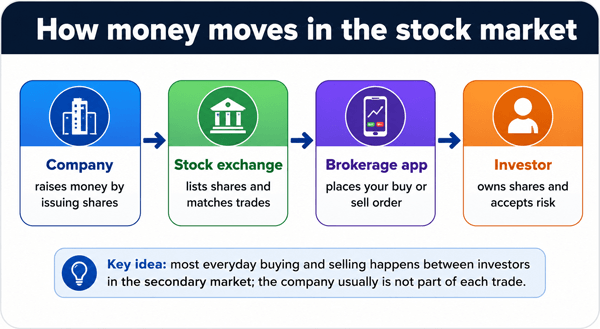
Figure 1: A simple view of how money and orders move through the stock market.
1. What is a stock?
A stock is a security that represents ownership in a company. The U.S. Securities and Exchange Commission explains that stockholders own a share of the company and may benefit from capital appreciation, dividends, and sometimes voting rights. In everyday language, a stock is a small slice of a business.
Suppose a company has 1,000,000 shares outstanding and you own 100 shares. You own 0.01% of that company. That sounds tiny, but the principle matters: your return depends on how the business performs and how much other investors are willing to pay for ownership in it.
Stocks can make money in two main ways. First, the share price may rise. If you buy at $50 and later sell at $70, the $20 difference is your capital gain before fees and taxes. Second, some companies pay dividends, which are cash payments to shareholders. Not every company pays dividends. Fast-growing companies may reinvest profits into expansion instead of paying cash to investors.
| Term | Beginner meaning | Example |
|---|---|---|
| Share / stock | A small ownership piece of a company | One share of Apple, Microsoft, or another listed company |
| Dividend | A cash payment from a company to shareholders | A company pays $1 per share annually |
| Capital gain | Profit when you sell for more than you paid | Buy at $50, sell at $70 |
| Capital loss | Loss when you sell for less than you paid | Buy at $50, sell at $35 |
| Market price | The latest price where buyers and sellers agreed | A stock trades at $120 today |
2. What is the stock market?
The stock market is not one single building or one single website. It is a network of stock exchanges, brokerage firms, market makers, clearing systems, regulators, professional investors, and ordinary investors. When people say “the market is up today,” they often mean major market indexes, such as the S&P 500 or Dow Jones Industrial Average, rose during the trading day.
There are two major parts of the stock market. The primary market is where companies first sell shares to investors, often through an initial public offering, or IPO. The secondary market is where investors trade shares with each other after those shares already exist. Most buying and selling that beginners hear about happens in the secondary market. When you buy 10 shares through an investment app, you are usually buying from another investor, not directly from the company.
A stock exchange, such as the New York Stock Exchange or Nasdaq, provides rules and technology for trading. A brokerage account gives you access to those markets. A clearing system helps settle the trade so the buyer gets the shares and the seller gets the money.
3. How does the stock market work step by step?
- A company decides to sell ownership. It may do this to raise money for expansion, research, debt repayment, acquisitions, or early investors who want to sell part of their stake.
- Shares are listed on an exchange. The company must meet exchange and regulatory requirements. Once listed, the shares can be traded by public investors.
- Investors place orders through brokers. You use a brokerage account, online trading platform, robo-advisor, or financial advisor to place a buy or sell order.
- Buyers and sellers meet through the market. The current price is created by supply and demand. If more investors want to buy than sell at the current price, the price tends to rise. If more want to sell than buy, it tends to fall.
- The trade settles. Behind the scenes, the financial system transfers money and ownership records. You usually see the result instantly in your app, but settlement and recordkeeping continue in the background.
This process can feel instant because modern trading technology is fast. But beginners should not confuse speed with safety. An easy-to-use trading app can make investing feel like shopping. The money is still real, the risks are still real, and the decisions still matter.
4. Why do stock prices go up and down?
Stock prices move because investors constantly update their expectations. A share price is not only about what the company earned last year. It is also about what investors believe the company may earn in the future. That is why a company can report a profit and still see its stock fall if investors expected even better results.
Common reasons stock prices move include earnings reports, interest rates, inflation, economic growth, new products, management changes, lawsuits, industry trends, wars, oil prices, currency movements, analyst ratings, investor emotion, and overall market mood. Sometimes prices move for clear reasons. Sometimes they move first and explanations come later.
| Driver | How it can affect stocks | Beginner lesson |
|---|---|---|
| Earnings growth | Higher profits can increase investor confidence | Quality businesses matter over time |
| Interest rates | Higher rates can make stocks less attractive versus cash or bonds | The economy affects your portfolio |
| News and sentiment | Good or bad headlines can move prices quickly | Do not trade every headline |
| Valuation | An excellent company can still be a poor buy if the price is too high | Price and quality are both important |
| Supply and demand | More buyers than sellers pushes prices up, and the reverse pushes prices down | Market prices are auctions |
5. Stock market vs. stock exchange vs. index
Beginners often mix up these three terms, but they are different. The stock market is the broad system where stocks are bought and sold. A stock exchange is a specific marketplace within that system. An index is a measurement tool that tracks a group of stocks.
| Concept | What it means | Simple comparison |
|---|---|---|
| Stock market | The overall network for buying and selling stocks | The entire shopping system |
| Stock exchange | A specific marketplace such as NYSE or Nasdaq | One large store inside the system |
| Stock index | A basket that tracks selected stocks | A scoreboard showing how a group is doing |
| Brokerage account | Your access point for placing trades | Your personal doorway into the market |
For example, when someone says “the S&P 500 is up,” that does not mean every stock rose. It means the index, which tracks a large group of major U.S. companies, increased overall. Indexes are useful because they help investors see the general direction of a market instead of checking thousands of individual stocks.
6. How beginners can use the stock market
Beginners can use the stock market for long-term wealth building, retirement investing, education savings, income through dividends, or learning about business ownership. The most practical use is not getting rich quickly. It is letting money participate in the growth of productive companies over many years.
A sensible beginner usually starts with four questions: What is my goal? When will I need the money? How much risk can I emotionally and financially handle? What simple investment plan can I follow even when the market falls? The answers matter more than any hot stock tip.
Money needed in the next few months or years usually does not belong in stocks because the market can fall sharply at the wrong time. Money for a long-term goal, such as retirement or a child’s future education, may have more time to recover from downturns. This is why time horizon is one of the most important beginner investing concepts.
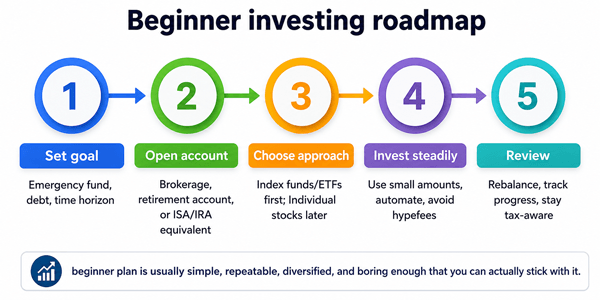
Figure 2: A practical roadmap for beginners who want to start investing responsibly.
7. Best beginner-friendly ways to invest
A beginner does not have to pick individual stocks on day one. In fact, many experienced investors believe most beginners are better served by diversified funds before they try stock picking. A diversified fund owns many investments inside one product, which reduces dependence on any single company.
| Option | What it is | Pros | Watch out for |
|---|---|---|---|
| Index fund | A fund that tries to track a market index | Low cost, diversified, simple | Still falls when the market falls |
| ETF | A fund that trades like a stock | Easy to buy, often low cost, diversified | Bid-ask spreads and trading temptation |
| Individual stock | Ownership in one company | Potentially high upside, educational | Higher company-specific risk |
| Robo-advisor | Automated portfolio management service | Convenient, diversified, beginner-friendly | Advisory fees and limited customization |
| Financial advisor | A professional who helps plan investments | Helpful for complex situations | Fees, conflicts, and credential quality matter |
A practical beginner portfolio may be as simple as a broad stock market index fund plus a bond fund or cash reserve, depending on age, goals, and risk tolerance. Someone young investing for retirement may hold more stocks. Someone close to needing the money may hold less stock exposure. The right mix is personal.
8. A practical example: buying your first investment
Imagine Sarah is 28, has paid off high-interest credit card debt, keeps three months of expenses in an emergency fund, and wants to begin investing for retirement. She opens a low-cost brokerage account or retirement account. Instead of trying to guess which company will be the next big winner, she starts with a diversified total-market ETF.
She invests $200 every month. Some months the market is up, so her $200 buys fewer shares. Some months the market is down, so the same $200 buys more shares. This method is often called dollar-cost averaging. It does not guarantee profit or prevent losses, but it helps beginners avoid the stress of trying to perfectly time the market.
After one year, Sarah has invested $2,400 plus any gains or losses. More important, she has built the habit. After five years, she understands market ups and downs better because she has lived through them with a manageable amount of money. This experience is valuable. Many beginners fail not because they lack intelligence, but because they invest too much too fast, panic during the first drop, and sell at the worst time.
9. What beginners should know before investing
- Risk is normal. Stocks can lose value, sometimes quickly. A falling market is not a system error; it is part of investing.
- Diversification matters. Spreading money across many companies, sectors, and asset types can reduce the damage caused by one bad investment.
- Fees quietly reduce returns. Expense ratios, advisory fees, trading costs, and fund fees all matter, especially over decades.
- Taxes can affect real returns. In the U.S., the IRS generally treats gains on assets held more than one year as long-term and gains on assets held one year or less as short-term. Your country may have different tax rules.
- No one can predict the market perfectly. Even professional investors are often wrong. A plan beats a prediction.
- Scams target beginners. Guaranteed returns, secret signals, pressure to act now, and “risk-free” trading schemes are red flags.
10. Common beginner mistakes and how to avoid them
| Mistake | Why it hurts | Better habit |
|---|---|---|
| Buying because of hype | You may enter after the easy money is gone | Understand the business or use diversified funds |
| Investing emergency money | You may be forced to sell during a downturn | Keep cash reserves separate |
| Checking prices all day | It increases stress and impulsive trades | Review on a schedule |
| Ignoring fees | Small percentages compound into large costs | Compare expense ratios and advisory fees |
| No exit or holding plan | Emotion makes decisions for you | Write down your reason before buying |
| Overconfidence after early gains | Luck can look like skill in a bull market | Increase slowly and stay humble |
The most common real-life beginner experience is emotional surprise. People think they are long-term investors until their portfolio drops 15% or 25%. That is when the plan matters. Before investing, ask yourself: If this account fell by one-fourth, would I sell, hold, or buy more? The honest answer can help you choose a safer allocation.
11. Trading vs. investing
Investing and trading are not the same. Investing usually means buying assets because you believe they can grow in value over years. Trading usually means buying and selling over shorter periods, sometimes days, hours, or minutes. Trading can be exciting, but it is difficult, time-consuming, tax-inefficient, and emotionally demanding.
| Feature | Long-term investing | Short-term trading |
|---|---|---|
| Main goal | Build wealth over years | Profit from short-term price moves |
| Time required | Low to moderate | High |
| Skill needed | Planning, patience, diversification | Speed, discipline, risk controls, market knowledge |
| Typical products | Index funds, ETFs, quality stocks | Stocks, options, futures, leveraged products |
| Beginner suitability | Generally more suitable | Usually risky for beginners |
A beginner can learn about trading, but it is wise to keep any trading experiments small and separate from serious long-term savings. Many people use a “core and explore” approach: most money goes into a diversified long-term portfolio, while a small amount is used for learning or individual stock ideas.
12. How to read a stock in a simple way
You do not need a finance degree to understand the first layer of a stock. Start with the business, not the chart. What does the company sell? Who are its customers? Is revenue growing? Is it profitable? Does it have debt? Who are its competitors? Why might it still be stronger five years from now?
Then look at valuation. A great company can be overpriced, and a cheap stock can be cheap for a reason. Common valuation measures include price-to-earnings ratio, price-to-sales ratio, dividend yield, and free cash flow. These numbers are tools, not magic answers. They should be compared with the company’s history, competitors, growth rate, and risk level.
Finally, think about position size. If you buy one individual stock, do not let it become so large that one bad company event damages your financial life. Diversification is boring until you need it.
13. How much money do beginners need?
You do not need to be rich to begin learning. Many brokerage platforms allow small deposits and fractional shares, meaning you can buy part of a share. The better question is not “What is the minimum?” but “What amount can I invest consistently without hurting my daily life?”
A practical order of operations is: cover basic expenses, build an emergency fund, pay off high-interest debt, capture any employer retirement match if available, then invest regularly according to your goals. Investing while carrying expensive consumer debt can be like filling a bucket with a hole in it.
14. Accounts, brokers, and investment apps
To buy stocks, most people need a brokerage account or a retirement account. A good online brokerage platform should be regulated, transparent about fees, easy to use, and strong on security. It should offer educational resources, account protection information, tax documents, and access to suitable investment products such as ETFs and index funds.
Do not choose a brokerage only because the app looks fun. Look at fees, order types, customer support, account minimums, available funds, research tools, retirement account options, and whether the platform encourages responsible investing or constant trading. Beginner-friendly design is helpful; addictive design is not.
| Broker feature | Why it matters for beginners |
|---|---|
| Low fees and clear expense ratios | Keeps more of your return working for you |
| Fractional shares | Allows small, steady investing |
| Strong security | Protects login and personal information |
| Educational resources | Helps you understand before clicking buy |
| Retirement account access | Supports long-term tax-advantaged investing |
| Good customer service | Important when transfers, tax forms, or account issues arise |
15. Risk management: how to avoid losing money carelessly
No honest investment analyst can promise that you will not lose money in stocks. Risk cannot be removed, but it can be managed. The first rule is never invest money you cannot afford to leave alone. The second is diversify. The third is keep costs low. The fourth is avoid leverage unless you truly understand it. Borrowed money can turn normal market volatility into serious financial damage.
Beginners should also be careful with options, penny stocks, day trading, margin loans, and social-media stock tips. These are often marketed as shortcuts, but they can expose inexperienced investors to risks they do not understand. A boring diversified investment portfolio may not impress people online, but it is often more suitable for real wealth building.
16. Taxes and records
Taxes depend on your country and account type, so beginners should treat this section as a general guide, not personal tax advice. In taxable accounts, selling an investment for a profit may create a capital gain. Selling for a loss may create a capital loss. In the U.S., the IRS generally classifies gains and losses as long-term if the asset was held more than one year and short-term if held one year or less. Retirement accounts may have different tax treatment.
Good recordkeeping helps. Save trade confirmations, tax forms, dividend records, and notes about why you bought an investment. Tax-aware investing does not mean avoiding taxes illegally. It means understanding the rules, using appropriate accounts, and not creating unnecessary taxable trades through impulsive buying and selling.
17. Helpful facts beginners should remember
- A stock price is not the same thing as company quality. A $20 stock is not automatically cheaper than a $200 stock; market value and earnings matter.
- A falling stock is not automatically a bargain. It may be falling because the business has real problems.
- A diversified ETF can own hundreds or thousands of stocks inside one investment.
- Dividends are not free money. When a company pays a dividend, cash leaves the company, and the stock price may adjust.
- Past performance does not guarantee future results.
- The best investment plan is one you understand and can stick with through bad markets.
18. Beginner checklist before you buy
| Question | Why it matters |
|---|---|
| What is my goal for this money? | A retirement plan and a house deposit need different risk levels |
| When will I need the money? | Short timelines usually need less stock risk |
| Do I understand what I am buying? | Confusion leads to panic and bad decisions |
| What are the fees? | Fees reduce returns every year |
| How diversified am I? | One company should not control your future |
| What will I do if the market falls 25%? | A written plan reduces emotional selling |
19. Frequently asked questions
19.1 Is the stock market gambling?
It can become gambling if you buy randomly, chase hype, use leverage, or trade for excitement. But long-term ownership of diversified businesses is different from gambling because it is tied to real companies, earnings, dividends, innovation, and economic growth. The behavior of the investor matters.
19.2 Can beginners make money in stocks?
Yes, beginners can make money, but not reliably through shortcuts. The more realistic path is consistent investing, diversification, low fees, patience, and avoiding major mistakes.
19.3 What is the safest stock?
No stock is completely safe. Even strong companies can fall. Beginners looking for lower company-specific risk often use diversified funds rather than trying to find one “safe” stock.
19.4 Should I buy stocks when the market is down?
A lower market can create opportunity, but only if your finances, time horizon, and risk tolerance support investing. Regular investing can reduce the pressure of deciding whether today is the perfect day.
19.5 Do I need a financial advisor?
Some beginners can start with low-cost diversified funds and education. Others benefit from a qualified financial advisor, especially if they have complex taxes, large assets, business income, inheritance, retirement decisions, or emotional difficulty managing money.
19.6 How often should I check my portfolio?
For long-term investors, monthly or quarterly may be enough. Checking daily can encourage emotional decisions. The best schedule is frequent enough to stay informed but not so frequent that you start reacting to noise.
20. Final thoughts: the simple truth about the stock market
The stock market is not a magic machine, a casino by default, or a secret club reserved for experts. It is a system for buying and selling ownership in public companies. Beginners do not need to predict every market move. They need to understand what they own, why they own it, how much risk they are taking, and what plan they will follow when prices rise or fall.
The most practical beginner strategy is simple: learn the basics, avoid hype, use a regulated brokerage account, consider diversified ETFs or index funds, keep costs low, invest money that has time to grow, and review your plan calmly. Over time, experience becomes your best teacher. Start small enough that mistakes are affordable, but seriously enough that the habit becomes real.
Honest investing is not about pretending risk does not exist. It is about respecting risk, managing it, and using the stock market as one tool in a broader financial life. When approached with patience and discipline, the market can help ordinary people participate in business growth and long-term wealth building.
Reader Advice
This article is provided solely for educational and informational purposes and does not constitute personalized investment, financial, legal, accounting, or tax advice. Investment products, market conditions, laws, tax rules, fees, eligibility requirements, and regulatory standards may change and may differ by country, jurisdiction, account type, and individual circumstances. Before making any financial decision, readers should assess their goals, risk tolerance, time horizon, and ability to bear loss; verify current facts, figures, rules, and product terms through official and regulated sources; and, where appropriate, consult a qualified financial adviser, tax professional, or legal professional. No return is guaranteed, and past performance does not ensure future results.
Sources Consulted and Checked
The following authoritative sources were consulted and checked while preparing this article and reviewing its accuracy:
- U.S. Securities and Exchange Commission, Investor.gov: Introduction to Investing and Stocks FAQs.
- FINRA investor education resources and BrokerCheck investor-protection guidance.
- IRS Topic No. 409: Capital Gains and Losses, updated February 25, 2026.
- NYSE and exchange education resources explaining listed markets, trading, and order matching.
- SIX Swiss Exchange educational guide on supply, demand, price formation, and order types.